
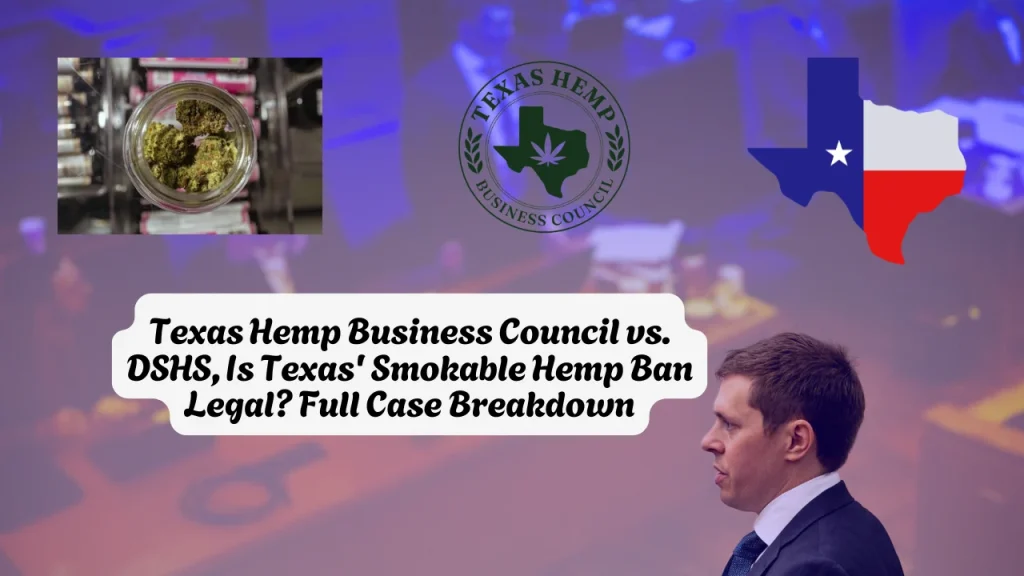
Texas Hemp Business Council vs. DSHS, Is Texas’ Smokable Hemp Ban Legal? Full Case Breakdown
Texas hemp businesses and advocacy groups filed a lawsuit on April 8, 2026, against the Department of State Health Services (DSHS), the Health and Human Services Commission (HHSC), and the Attorney General after DSHS rolled out new rules on March 31 that changed hemp testing procedures — effectively banning smokable hemp — and raised licensing fees for hemp businesses by thousands of dollars. A Travis County judge quickly blocked the ban. A ruling on whether that block holds is expected this week — and it will determine whether THCA flower, pre-rolls, and concentrates stay on Texas shelves or disappear again.
Quick Facts — Texas Smokable Hemp Ban Lawsuit
| Field | Detail |
| Plaintiffs | Texas Hemp Business Council, Hemp Industry & Farmers of America, seven Texas hemp businesses |
| Defendants | Texas Dept. of State Health Services (DSHS), Health and Human Services Commission (HHSC), Texas Attorney General |
| Case Type | Administrative law / separation of powers — regulatory authority challenge |
| Court | Travis County 261st Civil District Court, Austin, Texas |
| Date Filed | April 8, 2026 |
| Legal Claim | DSHS exceeded its rulemaking authority; unconstitutional rewrite of hemp law without legislative approval |
| Current Stage | Three-day temporary injunction hearing — April 29 through May 1, 2026 |
| Presiding Judge | Judge Daniella DeSeta Lyttle |
| Temporary Block | In effect — temporary restraining order (TRO) set to expire May 1, 2026 at 5 p.m. |
| Next Critical Date | Ruling by May 1, 2026 on whether temporary injunction continues the block |
| Last Updated | April 30, 2026 |
What Is the Texas Smokable Hemp Lawsuit About?
This is a separation of powers case — a fight over whether a state health agency can effectively ban an entire product category without a vote from the Texas Legislature. That is the central question Judge Daniella DeSeta Lyttle must answer this week.
Under the new DSHS rules, laboratories now measure the total amount of any THC in a product. If THC levels exceed the 0.3% threshold — even if it is only activated when the product is smoked — the product is noncompliant.
As a result, some of the most popular hemp products, including THCA flower and pre-rolled joints, have been effectively banned. THCA (tetrahydrocannabinolic acid) is non-psychoactive in its raw form but converts to THC when heated — meaning products that are legal under Delta-9 THC standards become illegal under the new “total THC” testing method.
The rules also increase licensing fees for hemp-derived THC manufacturers from $258 to $10,000 per facility, and retail registrations from $155 to $5,000 — increases industry leaders say will force businesses to close even without the ban itself.
Hemp businesses face fines of up to $10,000 per day for selling noncompliant products, plus potential license revocation. For a small Texas smoke shop, a single inspection under the new rules could end the business entirely.
Who Are the Parties in Texas Hemp Business Council vs. DSHS Case?
The plaintiffs are the Texas Hemp Business Council, Hemp Industry & Farmers of America, and seven Texas-based hemp retailers and manufacturers. They represent a sector that, according to DSHS data, includes more than 13,000 stores registered to sell hemp products in Texas and nearly 800 licensed manufacturers. These are not large cannabis corporations — they are small retailers, farmers, and processors who built businesses around products that were legal under Texas and federal law before March 31, 2026.
The defendants are the DSHS and HHSC — the state agencies that issued the new rules — and the Texas Attorney General’s Office, which is defending the regulations in court. The state’s position is that DSHS did not ban hemp but simply clarified how THC should be measured. Zachary Berg, special counsel at the Texas Attorney General’s Office, told the court that regulators were not banning hemp but clarifying how THC should be measured so businesses cannot sell products that become far more mind-altering when smoked, vaped, or heated.
The plaintiffs flatly reject that framing. Attorney Amanda Taylor, one of the plaintiffs’ lawyers, argued the legal dispute is “decidedly a separation of powers case” — the state defendants overreached their delegated rulemaking authority into the territory of the legislature. Texas law gives administrative agencies authority to clarify rules, not rewrite the statutory definitions that the Legislature established.
Related article: $2.67B Blue Cross Blue Shield Antitrust Settlement Started Paying from May, Is Your Payment on the Way?
This distinction — clarification vs. legislation — is exactly what the judge must resolve. For context on how similar product liability and regulatory ban challenges have played out in other states, see our coverage of cannabis and hemp industry lawsuits on AllAboutLawyer.com.
What Is at Stake in Texas Hemp Business Council vs. DSHS Lawsuit?
If you own a hemp shop, manufacture THCA products, or consume smokable hemp in Texas, this ruling directly affects you — possibly by Friday.
A temporary restraining order is currently blocking key parts of the rules, including the new THC threshold that would eliminate smokable products. That order is set to expire May 1, making this hearing critical. If the judge grants a temporary injunction, the rules will remain blocked as the case moves forward. If not, enforcement of the new regulations could begin within days.
Here is what each outcome means in plain English:
- Injunction granted: Smokable hemp stays legal to sell in Texas while the full lawsuit plays out — a process that could take years. THCA flower, pre-rolls, and concentrates remain on shelves.
- Injunction denied: The DSHS rules snap back into effect immediately. Retailers must pull smokable products, face $10,000-per-day fines if they do not, and the licensing fee increases kick in. Industry attorneys have signaled they would appeal immediately.
- Partial ruling: The judge could block some parts of the rules (the smokable ban) while allowing others (higher fees) to take effect — a split outcome that leaves the business landscape uncertain.
The hemp industry is not challenging regulations it agrees with. As attorney David Sergi stated, Texas hemp businesses support age verification and consumer protection rules. What they are fighting are the rules that “would effectively end the in-state production of hemp and the sale of hemp products — items the Legislature chose not to ban during recent legislative and special sessions.” That last point matters legally: the Texas Legislature considered and declined to ban these products. DSHS did it anyway through rulemaking.
Texas Smokable Hemp Lawsuit Timeline
| Milestone | Date |
| DSHS New Rules Take Effect | March 31, 2026 |
| Lawsuit Filed | April 8, 2026 |
| Temporary Restraining Order Granted (Judge Guerra Gamble) | April 8, 2026 |
| Original Injunction Hearing | Postponed from April 23 by agreement |
| Three-Day Injunction Hearing Begins (Judge Lyttle, 261st District Court) | April 29, 2026 |
| TRO Expiration Deadline | May 1, 2026 at 5:00 p.m. |
| Ruling on Temporary Injunction | Expected by May 1, 2026 |
| Texas Supreme Court — Related Delta-8 Case | TBD — expected 2026 |
| Full Lawsuit Resolution | TBD — could take years |
Frequently Asked Questions
Who filed the lawsuit and why?
The Texas Hemp Business Council, Hemp Industry & Farmers of America, and several hemp businesses filed the lawsuit on April 8, 2026, against DSHS, HHSC, and the Attorney General, arguing that the March 31 rules amounted to a legislative rewrite of hemp law — something an administrative agency cannot do without approval from the Texas Legislature.
What court is handling this case?
The case is before Travis County’s 261st Civil District Court in Austin. Judge Daniella DeSeta Lyttle is presiding over the temporary injunction phase. The initial temporary restraining order was granted by a different Travis County judge, Maya Guerra Gamble, on April 8.
What is the current status of the case?
As of April 30, 2026, a three-day hearing is underway and a ruling is expected by May 1 at 5 p.m., when the current temporary restraining order expires. The judge must decide whether to extend the block on the smokable hemp ban through a temporary injunction while the full case continues.
Can Texas hemp shops still sell smokable products right now?
Yes — but only until the judge rules, which could be as soon as May 1. The temporary restraining order blocking the smokable hemp ban is currently in effect. Judge Guerra Gamble blocked the rules prohibiting the sale of smokable hemp but declined to block the higher licensing fees. Retailers should monitor the case closely.
Can I read the court documents?
Yes. The case is filed in Travis County’s 261st Civil District Court. Texas civil court records are publicly accessible through the Travis County District Clerk’s office. Search under plaintiff name “Texas Hemp Business Council” or defendant “Texas Department of State Health Services.”
What is the state’s argument for the ban?
The state cites data from the Texas Poison Center Network showing cannabis-related poisoning calls rose from 923 in 2019 to a 10-year high of 2,592 in 2024, with a further increase to 2,669 in 2025. The majority involve children under five and teenagers. The state says the new testing standard reflects what hemp legally is — not a ban but a measurement correction. Drug policy experts note the data needs additional context before drawing conclusions.
How does the separate delta-8 lawsuit affect this case?
The delta-8 lawsuit — which the Texas Supreme Court is expected to consider in 2026 — will have a direct impact on this case, because both lawsuits challenge the authority of a state health agency to make changes to the hemp market without approval from lawmakers or the public. A Texas Supreme Court ruling on that question would effectively set the legal standard for this case too.
Is there a federal deadline that matters here regardless of what the Texas court decides?
Yes. A separate federal law — H.R. 5371 — is set to impose a nationwide total-THC standard effective November 12, 2026. Even if Texas hemp businesses win in court and keep smokable products legal under state law through 2026, that federal deadline would supersede state law. The Texas court battle determines what happens between now and then.
Sources & References
- Texas Tribune (April 8–21, 2026): Judge Rules to Temporarily Block Texas’ Smokeable Hemp Ban
- KUT News Austin (April 10 and April 29, 2026): Judge Blocks New State Rules That Ban Sale of Smokable Hemp | Texas Court Weighs Whether Smokable Hemp Can Stay on Shelves
- Spectrum News Austin (April 29, 2026): Texas Judge Hears Arguments on State’s Smokable Hemp Ban
- KHOU Houston (April 29, 2026): Texas Hemp Fight Heads to Court as Smokable Product Ban Hangs in Balance
Prepared by the AllAboutLawyer.com Editorial Team and reviewed for factual accuracy against verified reporting citing the Travis County 261st Civil District Court proceedings on April 30, 2026. Last Updated: April 30, 2026
Disclaimer: This article is for informational purposes only and does not constitute legal advice. Information about this ongoing legal case is based on publicly available court records and verified reporting. For advice regarding a particular legal situation, consult a qualified attorney.
About the Author
Israr Ahmad is a legal content researcher with 4+ years of experience covering class action settlements and consumer rights cases. He has researched and published coverage of 2,500+ settlements using verified court records, settlement administrator filings, and government sources. Learn more about Israr.