
Two Sprouts Class Action Lawsuits Claim Chips Aren’t Made With 100% Avocado Oil
Two shoppers have sued Sprouts Farmers Market in federal court in San Diego. They claim Sprouts-brand chips sold as “Made With 100% Avocado Oil” or “Made With Avocado Oil” are not made with avocado oil alone. Both cases are proposed class actions: no judge has certified a class, no court has found that Sprouts mislabeled anything, and the allegations are unproven.
There is no settlement, no claim form, no payment amount and no deadline to file anything.
Quick Facts: Sprouts Avocado Oil Chips Lawsuits
| Item | Mullen case | Hood case |
| Case name | Mullen v. SF Markets LLC, et al. | Hood v. Sprouts Farmers Market Inc. |
| Case number | 3:26-cv-05070-BJC-DEB | 3:26-cv-05362-RSH-DDL |
| Plaintiff | Barbara Mullen | Rhiannon Hood |
| Court | U.S. District Court, Southern District of California | U.S. District Court, Southern District of California |
| Filed | September 8, 2026 | September 17, 2026 |
| Defendant | SF Markets LLC (doing business as Sprouts Farmers Market), et al. | Sprouts Farmers Market Inc. |
| Product named | Organic Sea Salt & A Hint Of Lime Tortilla Chips | Eight products (potato and tortilla chips), not limited to the list |
| Plaintiff’s counsel | Chimicles Schwartz Kriner & Donaldson-Smith LLP; Carey & Danis LLC; Eagan Law Corporation | Siri & Glimstad LLP |
| Proposed class | Reported as a nationwide class and a California subclass (check complaint) | California purchasers only |
| Status | Complaint stage | Complaint stage |
| Settlement website | None. No settlement exists | None. No settlement exists |
| Claim form | None available | None available |
| Claim deadline | None | None |
What Are the Sprouts Avocado Oil Lawsuits About?
Both complaints target the same basic promise on the bag. According to the Hood complaint, the front of each package reads “Made With 100% Avocado Oil” beside a picture of an avocado, and the ingredient list names avocado oil as the only oil. The Sea Salt kettle chips, for example, list potatoes, avocado oil and sea salt.
The plaintiffs argue that avocado oil, if present at all, is not the only oil, and that shoppers paid extra for a premium ingredient they did not fully get. The Hood complaint also points to a Sprouts online collection called “See Ya Later, Seed Oils!” that features the chips, to show the products were marketed to shoppers trying to avoid seed oils.
Sprouts has not been found liable in either case. As far as the sources reviewed show, it has not yet answered either complaint in court.
Mullen v. SF Markets LLC
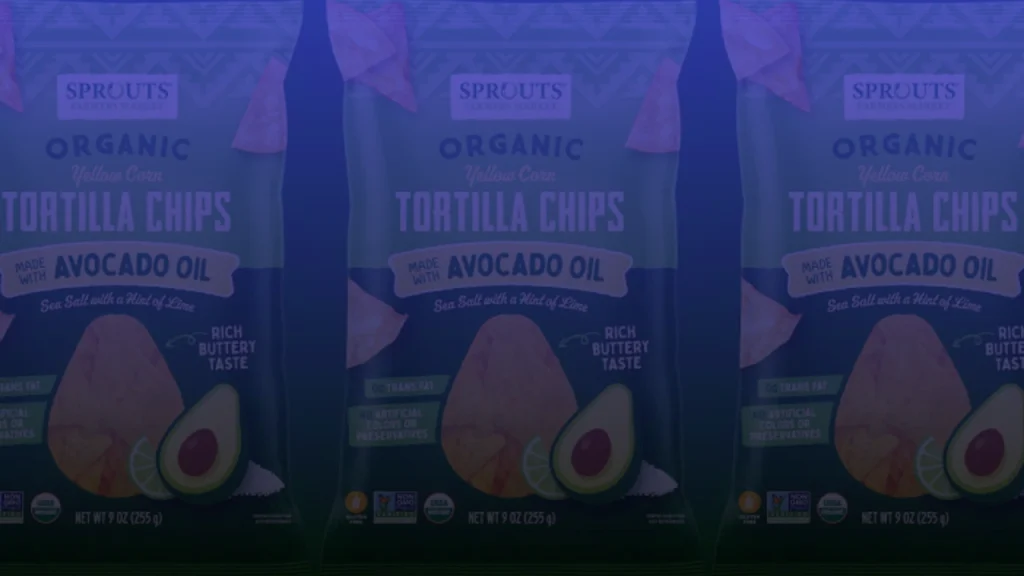
Barbara Mullen filed Mullen v. SF Markets LLC, et al. on September 8, 2026. Her complaint targets Sprouts’ Organic Sea Salt & A Hint Of Lime Tortilla Chips, which allegedly list avocado oil as their only oil ingredient.
She relies on the July 2026 UC Davis study (described below), which reportedly classified two tested Sprouts products as inconsistent with authentic avocado oil. Her claims reportedly include California consumer protection law, breach of express warranty and unjust enrichment. She seeks damages, restitution and court-ordered changes to the challenged practices.
She is represented by Steven A. Schwartz and Beena M. McDonald of Chimicles Schwartz Kriner & Donaldson-Smith LLP, James J. Rosemergy of Carey & Danis LLC, and Todd S. Eagan of Eagan Law Corporation.
The court has not certified her proposed class or ruled that Sprouts violated any law.
Hood v. Sprouts Farmers Market Inc.
Rhiannon Hood, a San Diego shopper, filed her case on September 17, 2026. She is represented by Michael Connett and Catherine Ybarra of Siri & Glimstad LLP.
Chips named in the Hood lawsuit
The complaint lists eight products and says the list is not limited to them:
- Sea Salt Kettle Style Avocado Oil Potato Chips
- Honey BBQ Kettle Style Avocado Oil Potato Chips
- Sour Cream & Onion Kettle Style Avocado Oil Potato Chips
- Sea Salt & Vinegar Kettle Style Avocado Oil Potato Chips
- Dill Pickle Kettle Style Avocado Oil Potato Chips
- Organic Sea Salt & A Hint Of Lime Tortilla Chips Made With Avocado Oil
- Organic Sea Salt Blue Corn Tortilla Chips Made With Avocado Oil
- Organic Unsalted Blue Corn Tortilla Chips Made With Avocado Oil
A product appearing on this list does not mean a court has found it mislabeled.
The plaintiff’s purchases
According to the complaint, Hood bought at least fourteen bags from Sprouts stores in San Diego County starting around August 2025, at roughly $0.60 to $0.67 an ounce. She says she relied on the labels and marketing when buying. The complaint also cites the UC Davis finding that avocado oil chips sold for up to 222% more than chips made with conventional oils.
The testing behind the allegations
The UC Davis study. In July 2026, UC Davis food scientists published a study in Applied Food Research testing 54 processed foods that listed avocado oil as their only oil. The researchers reported that 48 of 54 samples, and 26 of 28 chip samples, did not match the chemical profile of authentic avocado oil. They examined fatty acids and sterols and considered whether processing, such as frying, could explain the differences. According to the complaint, two Sprouts products, the Organic Sea Salt & A Hint Of Lime Tortilla Chips and the Sea Salt Kettle Style chips, were among those classified as inconsistent. The study covers a category of products; it does not by itself prove any specific Sprouts bag is mislabeled. The complaints apply it to Sprouts.
The plaintiff’s own lab tests. In September 2026, Hood sent unopened bags of the Sea Salt, Honey BBQ and Dill Pickle kettle chips to Isotek Laboratories in Oklahoma City. The complaint reports these fatty acid results against the Codex range for avocado oil:
| Fatty acid | Sprouts samples (per complaint) | Codex range for avocado oil |
| Palmitoleic (C16:1) | 0.544%–1.038% | 4.0%–17.1% |
| Stearic (C18:0) | 2.84%–3.33% | 0.1%–1.3% |
| Palmitic (C16:0) | 8.27%–8.80% | 11.0%–26.0% |
These figures come from testing the plaintiff commissioned. They are allegations, not court findings. Sprouts can challenge the sampling, methods and interpretation, and only three bags of one product type were tested.
Claims and relief sought
Hood brings three claims under California law: the Consumers Legal Remedies Act (CLRA), the False Advertising Law (FAL) and the Unfair Competition Law (UCL). She seeks restitution, damages, a court order changing the labeling, and attorneys’ fees. Under the CLRA count, she currently seeks only injunctive and equitable relief.
Who would be covered
As pleaded, the proposed class is all persons in California who purchased Sprouts Avocado Oil chip products within the applicable limitations period, excluding resellers and Sprouts insiders. The chips are sold nationwide, but the claims are California claims, so buyers in other states are not included as the complaint is currently written. A class definition can change if the complaint is amended.
Has Sprouts Responded?
Sprouts has published an avocado oil quality and ingredient verification FAQ on its website, last updated September 2, 2026. In it, the company said it was reviewing the UC Davis study with its suppliers and quality assurance experts, that the study raises questions about ingredient purity rather than food safety, and that it was working with vendors to verify current authenticity-testing methods and results.
That statement addresses the research, not the lawsuits. It is not a court filing and should not be treated as Sprouts’ formal answer to either complaint.
What Laws Are Involved in the Sprouts Lawsuits?
The cases rely mainly on California consumer protection law. Several other laws shape how a food-labeling case like this works.
California Consumers Legal Remedies Act (CLRA), Civil Code § 1750 et seq.
Prohibits specified unfair or deceptive practices in consumer sales, including misrepresenting a product’s characteristics or ingredients. A consumer seeking damages must send the defendant written notice at least 30 days before filing (Civil Code § 1782), and the claim generally has a three-year limitations period (§ 1783). Under § 1780(d), a CLRA plaintiff must also file a venue affidavit with the complaint. A plaintiff who has not yet sent the notice can sue first for injunctive relief and amend later to add damages, which is a common pleading pattern.
California False Advertising Law (FAL), Business & Professions Code § 17500 et seq.
Prohibits untrue or misleading statements made to induce purchases. The limitations period is generally three years.
California Unfair Competition Law (UCL), Business & Professions Code § 17200 et seq.
Prohibits unlawful, unfair or fraudulent business practices. Remedies are generally limited to restitution and injunctive relief, and the limitations period is four years (§ 17208).
Breach of express warranty, California Commercial Code § 2313
A seller’s affirmation of fact or description of goods that becomes part of the basis of the bargain creates an express warranty. Mullen’s complaint reportedly includes this claim.
Unjust enrichment (quasi-contract)
A common-law theory that the defendant kept a benefit, here the premium price, that it should not in fairness retain. Mullen’s complaint reportedly includes it, though California courts disagree on whether it stands as an independent claim.
Federal Food, Drug, and Cosmetic Act (FDCA), 21 U.S.C. § 343(a) and 21 C.F.R. § 101.4
A food is misbranded if its labeling is false or misleading in any particular, and federal rules require ingredients to be listed accurately. Private citizens generally cannot sue directly under the FDCA, so plaintiffs commonly use state laws that parallel it. Federal preemption (21 U.S.C. § 343-1) bars state labeling rules that are not identical to federal requirements, so defendants often argue preemption.
California Sherman Food, Drug, and Cosmetic Law, Health & Safety Code § 109875 et seq.
California’s counterpart to the FDCA, which treats a food as misbranded if its labeling is false or misleading (including § 110660). Plaintiffs often use it as the “unlawful” prong of a UCL claim.
Federal Rule of Civil Procedure 23
Governs class actions. A plaintiff must show numerosity, commonality, typicality and adequacy of representation, plus the requirements of a specific class type. Rule 23(e) requires court approval of any class settlement.
Class Action Fairness Act (CAFA), 28 U.S.C. § 1332(d)
Gives federal courts jurisdiction over many large proposed class actions, which is why these California-law cases are in federal court.
Rules 9(b) and 12(b)(6)
Fraud-based claims must be pleaded with particularity (Rule 9(b)), and defendants commonly move to dismiss for failure to state a claim (Rule 12(b)(6)).
“Reasonable consumer” standard
Courts applying the CLRA, FAL and UCL ask whether a significant portion of reasonable consumers would likely be deceived by the label. Williams v. Gerber Products Co., 552 F.3d 934 (9th Cir. 2008), is a frequently cited Ninth Circuit decision on this standard. Plaintiffs must show the claim would mislead consumers acting reasonably, not only the unwary.
Equitable relief and an adequate legal remedy
Under Sonner v. Premier Nutrition Corp., 971 F.3d 834 (9th Cir. 2020), federal courts generally will not award equitable relief such as restitution if the plaintiff has an adequate remedy at law. That rule is one reason complaints in this area, including Hood’s CLRA count, are often framed carefully about which relief they seek.
A statute named in a complaint is not a finding that it was violated. Sprouts may dispute the allegations, the testing, the class definitions and the legal theories.
The Wider Avocado Oil Litigation
Sprouts is not the first company sued after the UC Davis study. Putative class actions have also been filed over avocado oil chips and other products from Kettle Brand, Siete, Simply Tostitos, Boulder Canyon and Good Health (both Utz brands) and Chosen Foods. As of early October 2026, those cases were still at the complaint stage.
The Sprouts cases stand out because the chips are sold under Sprouts’ own store brand, and the Hood case is limited to California shoppers and California law.
What Happens Next?
- Response from Sprouts. Sprouts will likely answer or move to dismiss. Food-labeling defendants often argue that the label is literally true, that the testing of a few bags cannot prove an entire product line is mislabeled, that the claims are preempted, or that a reasonable consumer would not read the label as plaintiffs do.
- Possible consolidation. The cases sit in the same district and raise overlapping claims, so they could be consolidated or coordinated, though no such order has been reported.
- Discovery. If the cases survive dismissal, the parties will exchange evidence, including supplier records, ingredient formulas and testing data.
- Class certification. Certification is not automatic and is usually more than a year away.
- Possible outcomes. Cases can be narrowed, dismissed, litigated through trial or settled.
If either case settles, a court-approved notice and claim process would follow, and this article will be updated with how to file.
Can Sprouts Shoppers File a Claim or Get Money Now?
No. There is no settlement or claim form for either case. A proposed class is not a certified class, and there is no established payment amount, deadline or guaranteed compensation.
If you bought these chips, you may want to keep receipts, photos of the packaging and any purchase history. This costs nothing, but it does not guarantee you would qualify for any future recovery. If you have questions about your own situation, consult a qualified attorney.
For another example of a food-labeling dispute, see AllAboutLawyer.com’s Target “Yogurt Covered” Snacks False Advertising Class Action Lawsuit, Did You Buy Favorite Day or Good & Gather Yogurt Products? Sierra v. Target Corporation, No. 2:26-cv-02799.
Frequently Asked Questions
Is there a Sprouts avocado oil chips class action lawsuit?
Yes. Two proposed class actions were filed in the Southern District of California in September 2026: Mullen v. SF Markets LLC (September 8) and Hood v. Sprouts Farmers Market Inc. (September 17). The allegations are unproven.
Can I join the lawsuits right now?
There is nothing to join or file. No class has been certified and neither case has a settlement.
Which Sprouts chips are involved?
Hood names eight kettle-style potato chip and organic tortilla chip products, not limited to that list. Mullen names the Organic Sea Salt & A Hint Of Lime Tortilla Chips. Check each complaint for the exact scope.
Do the lawsuits say there is no avocado oil in the chips?
Not exactly. The core claim is that avocado oil, if present, is not the only oil, and that the fatty acid profile looks more like a blend with cheaper oils.
Is there a Sprouts avocado oil chips settlement?
No settlement has been identified, and there is no claim form or payment deadline.
I don’t live in California. Am I covered?
Not by the Hood case as written, which is limited to California purchasers under California law. Mullen reportedly seeks a nationwide class and a California subclass, but the court has not approved any class.
Do the lawsuits prove the chips contain other oils?
No. The plaintiffs cite scientific research and, in Hood’s case, tests they commissioned. The court has not ruled on whether the products were mislabeled.
Are Sprouts avocado oil chips safe to eat?
The lawsuits concern labeling and price, not safety. Neither alleges contamination or illness, and no recall has been reported. Sprouts says its review concerns ingredient purity, not food safety.
Has Sprouts responded?
Sprouts has published a company FAQ about the UC Davis study. It has not been reported to have filed a formal response to the complaints.
Who represents the plaintiffs?
Mullen: Chimicles Schwartz Kriner & Donaldson-Smith LLP, Carey & Danis LLC and Eagan Law Corporation. Hood: Siri & Glimstad LLP.
Should I keep my receipts?
Nothing is required now. If a settlement is reached, its terms will set the claim requirements. Keeping receipts or photos costs nothing.
Editorial Note and Disclaimer
This article is general information about pending litigation and is not legal advice. It does not create an attorney-client relationship. The lawsuits contain allegations that have not been proven in court. Court dockets change quickly, so verify the current status on the public docket and consult a qualified attorney about your own situation. AllAboutLawyer.com corrects errors promptly when they are identified.
Sources and Court Records
- Class action complaint, Hood v. Sprouts Farmers Market, Inc., No. 3:26-cv-05362-RSH-DDL (S.D. Cal., filed Sept. 17, 2026). Docket: https://dockets.justia.com/docket/california/casdce/3%3A2026cv05362/871110
- Docket and complaint, Mullen v. SF Markets LLC, et al., No. 3:26-cv-05070-BJC-DEB (S.D. Cal., filed Sept. 8, 2026). Docket: https://dockets.justia.com/docket/california/casdce/3%3A2026cv05070/869898
- UC Davis, “That Avocado Oil Chip You’re Eating May Not Be Made With Pure Avocado Oil” (July 2026), reporting on the study published in Applied Food Research. https://www.ucdavis.edu/food/news/avocado-oil-chip-youre-eating-may-not-be-made-pure-avocado-oil
- Sprouts Farmers Market, avocado oil quality and ingredient verification FAQ (last updated Sept. 2, 2026). https://www.sprouts.com/about/ingredient-quality/
- Top Class Actions, “Two Sprouts Class Action Lawsuits Claim Chips Aren’t Made With 100% Avocado Oil” (Oct. 11, 2026). https://topclassactions.com/lawsuit-settlements/lawsuit-news/two-sprouts-class-action-lawsuits-claim-chips-not-made-with-100-avocado-oil/
- Open Class Actions, Sprouts avocado oil chips coverage and avocado oil lawsuit tracker (Sept.–Oct. 2026).
- California Civil Code § 1750 et seq. (CLRA); Business & Professions Code §§ 17200 et seq. (UCL) and 17500 et seq. (FAL); Commercial Code § 2313; Health & Safety Code § 109875 et seq. (Sherman Law).
- 21 U.S.C. §§ 343(a) and 343-1; 21 C.F.R. § 101.4; 28 U.S.C. § 1332(d); Fed. R. Civ. P. 9(b), 12(b)(6) and 23.
- Williams v. Gerber Products Co., 552 F.3d 934 (9th Cir. 2008); Sonner v. Premier Nutrition Corp., 971 F.3d 834 (9th Cir. 2020).
Before publishing: Verify against the full complaint PDFs the exact product list, class definitions (especially whether Mullen seeks a nationwide class) and Mullen’s pleaded claims, since these came from secondary summaries. Also check both dockets for any response, motion or consolidation order filed after October 11.
About the Author
Israr Ahmad is a legal content researcher with 4+ years of experience covering class action settlements and consumer rights cases. He has researched and published coverage of 2,500+ settlements using verified court records, settlement administrator filings, and government sources. Learn more about Israr.