
Target “Yogurt Covered” Snacks False Advertising Class Action Lawsuit, Did You Buy Favorite Day or Good & Gather Yogurt Products? Sierra v. Target Corporation, No. 2:26-cv-02799
Target Corporation is facing a class action lawsuit — Sierra v. Target Corporation, Case No. 2:26-cv-02799 — filed May 11, 2026, in the U.S. District Court for the Eastern District of New York, accusing the retail giant of misleading health-conscious shoppers by labeling snacks as “yogurt covered” when the coating allegedly contains no yogurt, yogurt powder, or any yogurt-based ingredient whatsoever.
Plaintiff Victor Sierra claims Target sells products under its Favorite Day and Good & Gather brands that are marketed as “yogurt covered,” even though the coatings allegedly contain no yogurt, yogurt powder, or similar yogurt-based ingredients. If you bought these snacks believing you were getting a product with actual yogurt, this lawsuit may directly affect you.
Target “Yogurt Covered” Snacks False Advertising Lawsuit — Key Facts
| Field | Detail |
| Lawsuit Filed | May 11, 2026 |
| Defendant | Target Corporation |
| Plaintiff | Victor Sierra (New York) |
| Alleged Harm | “Yogurt covered” labeling on snacks that allegedly contain no yogurt or yogurt-based ingredients |
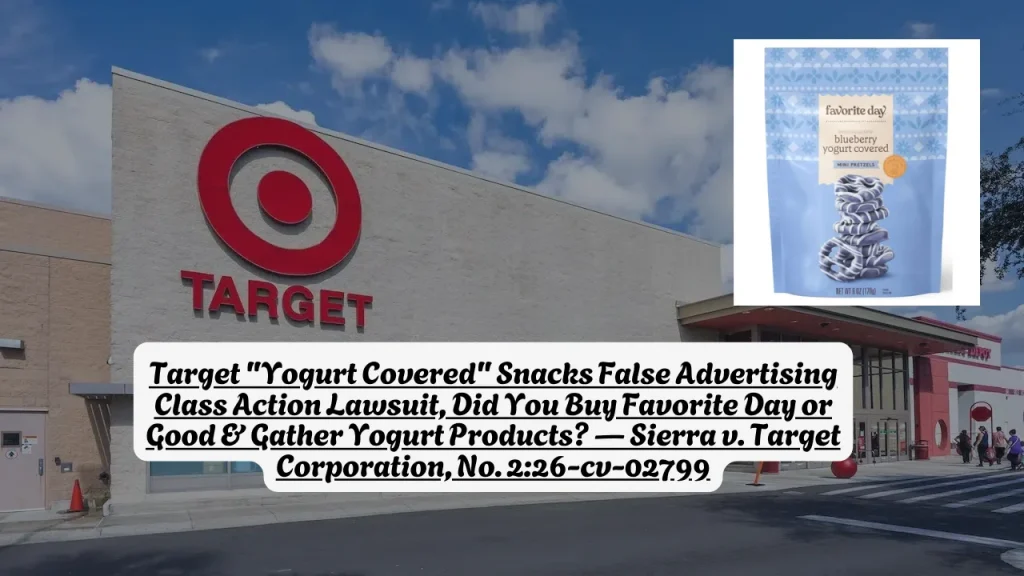
| Products at Issue | Favorite Day Blueberry Yogurt Covered Mini Pretzels; additional Favorite Day and Good & Gather yogurt-covered products |
| Specific Law Alleged | New York General Business Law §§ 349 and 350 (deceptive acts and false advertising) |
| Who Is Affected | New York consumers who purchased the products for personal or household use during the applicable statute of limitations period |
| Court & Case Number | U.S. District Court, Eastern District of New York — No. 2:26-cv-02799 |
| Current Court Stage | Early litigation — complaint filed, no class certified |
| Lead Plaintiff Deadline | TBD — not yet set by court |
| Settlement Status | No settlement — active lawsuit only |
| Law Firm | Arisohn LLC (Joshua D. Arisohn) |
| Target’s Response | No public statement located as of May 28, 2026 |
| Last Updated | May 28, 2026 |
Who Is Target and Why Are They Facing a “Yogurt Covered” Snack Lawsuit?
Target is one of the largest retail chains in the United States, selling its own store-brand grocery products under labels including Favorite Day and Good & Gather. Both lines are positioned as accessible, quality alternatives to national brands — Good & Gather in particular markets itself toward health-conscious consumers. That positioning sits at the heart of this lawsuit. The complaint argues that calling a snack “yogurt covered” sends a clear nutritional message to shoppers who associate yogurt with protein, probiotics, calcium, and digestive health — and that message is allegedly false.
What the Coating on Target’s “Yogurt Covered” Snacks Actually Contains
The class action lawsuit argues consumers associate yogurt with nutritional benefits such as probiotics, calcium, protein, and digestive health support, and are therefore willing to pay more for products marketed as containing real yogurt.
The filing says the products at issue are instead covered in a “confectionary coating” made exclusively from sugar, palm kernel oil, nonfat milk powder, whole milk powder, whey powder, palm oil, soy lecithin, and vanilla.
Read that list again. Sugar is the first ingredient. There is no yogurt. No yogurt powder. No cultures. No probiotics. None of the things a reasonable shopper pictures when they see the words “yogurt covered” on a package.
The false advertising lawsuit emphasizes that the confectionary coating on the Favorite Day and Good & Gather products provides none of the desired benefits of yogurt, given that ingredients like sugar are associated with numerous health problems.
This is the same pattern courts across the country have seen in a growing wave of food labeling litigation — where packaging implies a health-forward ingredient that the actual product simply does not contain. For a look at how similar false advertising cases against food companies have played out in court, including outcomes at different stages of litigation, the Hershey Reese’s false advertising class action and the Kraft Heinz food labeling class action lawsuits offer useful context on how courts weigh the “reasonable consumer” test in packaging disputes like this one.
What Victor Sierra Says Happened When He Bought the Snacks
Sierra, a New York resident, says he purchased a package of Favorite Day Blueberry Yogurt Covered Mini Pretzels from a Target store in East Farmingdale, New York, in March 2025 for about $3. According to the class action lawsuit, Sierra relied on Target’s marketing and labeling when purchasing the product and claims he would not have bought the snacks, or would have paid less for them, had he known the products contained no yogurt.
That is the core economic injury in this type of false advertising case: the consumer paid a premium price driven by a health-oriented label claim that the product could not actually support. The complaint says that Target has “profited enormously” from its misleading representations on the labels of yogurt-covered food products.
Related article: ZWILLING ENFINIGY Electric Kettle Recall, More Than 157,000 Units Recalled Over Burn Hazard — What to Do If You Own One
Are You Part of the Target “Yogurt Covered” Snacks Class Action?
Here is exactly how to know whether this lawsuit includes you.
You may be covered if:
- You purchased Favorite Day Blueberry Yogurt Covered Mini Pretzels or other Favorite Day or Good & Gather “yogurt covered” products from a Target store
- You are a New York resident who bought these products for personal, family, or household use — not for resale
- You paid a higher price for the product specifically because you believed “yogurt covered” meant the coating contained real yogurt or a yogurt-derived ingredient
- You would not have purchased the product, or would have paid less for it, had you known the coating was a confectionary mix of sugar, palm oil, and milk powders with no actual yogurt
You likely do NOT qualify if:
- You purchased these products outside of New York — the current class is limited to New York consumers (this may expand depending on how the court defines the class)
- You purchased the product with full knowledge of the ingredient list and were not relying on the “yogurt covered” label as an indication of actual yogurt content
- You bought these items for commercial resale rather than personal or household consumption
Do Target Shoppers Outside New York Fall Under This Case?
The Target class action lawsuit looks to cover all individuals in New York who, during the maximum period of time permitted by law, purchased the products at issue for personal, family, or household consumption and not for resale. As filed, the class is limited to New York residents. Consumers in other states who purchased the same Favorite Day or Good & Gather yogurt-covered products are not covered by this specific lawsuit at this stage — though separate litigation in other states is always possible. Monitor the case docket for any expansion of the class definition.
If you are unsure whether your purchases qualify for the Target yogurt-covered snacks false advertising lawsuit, a free consultation with a consumer fraud attorney can help you assess your situation.
What Are the Target Plaintiffs Asking the Court to Award in the 2026 Yogurt Snacks Case?
No money is available yet. No claim form exists. Here is what the complaint seeks so you know what could happen next.
The lawsuit asks the court to require Target to change its labeling practices and to provide monetary relief to affected consumers. The complaint argues Target used misleading packaging to boost sales and is demanding the company change its labeling and provide monetary relief to consumers.
The case is brought under New York General Business Law Sections 349 and 350. Section 349 authorizes statutory damages of $50 per violation, while Section 350 authorizes statutory damages of $500 per violation. In a class action with potentially thousands of New York purchasers across multiple products, the aggregate exposure for Target could be significant — though no court has ruled on liability and the case is in its earliest stage.
What Could New York Consumers Who Bought Target’s Yogurt Snacks Receive If the Case Settles?
No settlement exists and no timeline is set. Individual recoveries in food labeling false advertising class actions depend heavily on how many class members file, the number of purchases documented, the strength of evidence, and what the parties ultimately negotiate. Courts have reached very different outcomes in similar packaging cases — some result in settlements worth millions, others are dismissed early. A consumer fraud attorney is the best resource for understanding what your specific purchases might be worth.
Target “Yogurt Covered” Snacks Lawsuit Timeline
| Milestone | Date |
| Victor Sierra purchases Favorite Day Blueberry Yogurt Covered Mini Pretzels at East Farmingdale, NY Target | March 2025 |
| Sierra v. Target Corporation complaint filed, E.D. New York | May 11, 2026 |
| Target’s response deadline | TBD — not yet filed |
| Class certification hearing | TBD — not yet scheduled |
| Expected resolution | TBD — case in earliest stage |
What Should New York Target Shoppers Do Right Now?
You do not need to panic or rush to file anything. In a class action, most eligible consumers are included automatically once a class is certified. Here is what actually matters right now:
- Check your receipts and purchase history. If you bought Favorite Day or Good & Gather yogurt-covered snacks at Target in New York, look for receipts, bank statements, or Target Circle loyalty account history that can confirm what you bought and when.
- Save the packaging if you have it. The “yogurt covered” label language on the front of the package is the central exhibit in this case. Do not throw away packaging from products you still have.
- Note the specific products. The complaint names Favorite Day Blueberry Yogurt Covered Mini Pretzels specifically, and also covers other Favorite Day and Good & Gather yogurt-covered products. Make a list of every yogurt-covered item from these Target brands you have purchased.
- Track the case docket. This case is in the U.S. District Court for the Eastern District of New York under Case No. 2:26-cv-02799. You can monitor it at no cost through CourtListener.com.
- Watch for a lead plaintiff deadline. None has been set yet. If you are a frequent buyer of these products with documented purchase history, a consumer fraud attorney can tell you whether a more active role in the case makes sense for your situation.
- Do nothing if you are outside New York. The class as filed covers only New York consumers. If you live in another state, monitor whether the case expands or whether separate litigation is filed in your jurisdiction.
Target Yogurt-Covered Snacks False Advertising Lawsuit — Frequently Asked Questions, No. 2:26-cv-02799
Is there a class action lawsuit against Target for yogurt-covered snacks right now?
Yes. Sierra v. Target Corporation, Case No. 2:26-cv-02799, was filed May 11, 2026, in the U.S. District Court for the Eastern District of New York. The lawsuit accuses Target of labeling Favorite Day and Good & Gather snacks as “yogurt covered” when the coating allegedly contains no yogurt or yogurt-based ingredients of any kind.
Do I need to do anything right now to be included in the Target yogurt snacks class action?
No immediate action is required. If the court certifies a class of New York consumers, eligible purchasers would typically be included automatically. Save your receipts and any product packaging — that documentation will matter if a claims process opens later.
When will the Target yogurt-covered snacks case settle?
There is no settlement and no timeline. The complaint was filed May 11, 2026. Class certification, discovery, and any settlement negotiations all follow from that — a process that typically takes at least one to several years in federal court.
I live outside New York. Can I still be part of this lawsuit?
As filed, the proposed class covers only New York residents who purchased these products. Consumers in other states are not currently included. Watch for future developments — the class definition can change, and separate lawsuits can be filed in other jurisdictions.
What specific laws does Target allegedly violate in this case?
The Target class action lawsuit alleges violations of New York General Business Law Sections 349 and 350, which prohibit deceptive business practices and false advertising. Section 349 covers deceptive acts and practices broadly; Section 350 focuses specifically on false advertising.
What is actually in the coating on Cento Target’s yogurt-covered snacks?
According to the complaint, the coating contains sugar, palm kernel oil, nonfat milk powder, whole milk powder, whey powder, palm oil, soy lecithin, and vanilla. There is no yogurt, no yogurt powder, and no cultured dairy ingredient anywhere in that list.
Can I file my own separate lawsuit against Target for buying these snacks?
Potentially, yes. New York General Business Law Sections 349 and 350 both provide private rights of action for individual consumers. Whether a separate individual claim makes more sense than waiting for the class action depends on your specific losses and situation. A consumer fraud attorney can advise you.
How much could New York consumers who bought Target’s yogurt snacks receive if the case settles?
No money is available yet and no claim form exists. Under the applicable New York statutes, statutory damages are $50 per violation under Section 349 and $500 per violation under Section 350. Actual class payouts in similar food labeling cases have varied enormously. A consumer fraud attorney is the most reliable resource for a realistic assessment.
Sources Used in This Target Yogurt-Covered Snacks False Advertising Article
- New York General Business Law §§ 349 and 350 — statutory damages framework, Holland & Knight analysis (August 2024): https://www.hklaw.com/en/insights/publications/2024/08/new-york-consumer-protection-laws-gives-rise-to-per-violation
Prepared by the AllAboutLawyer.com Editorial Team and reviewed for factual accuracy against the court complaint and verified legal news sources on May 28, 2026. Last Updated: May 28, 2026.
This article is for informational purposes only and does not constitute legal advice. Consult a qualified attorney for advice about your specific situation.
About the Author
Israr Ahmad is a legal content researcher with 4+ years of experience covering class action settlements and consumer rights cases. He has researched and published coverage of 2,500+ settlements using verified court records, settlement administrator filings, and government sources. Learn more about Israr.