
South Carolina Receives $63,095,224 in 2026 Tobacco Settlement Here Is What That Money Pays For
Prepared by the AllAboutLawyer.com Editorial Team and reviewed for factual accuracy against the South Carolina Attorney General’s official announcement and the Tobacco Master Settlement Agreement public record on April 25, 2026. Last Updated: April 25, 2026
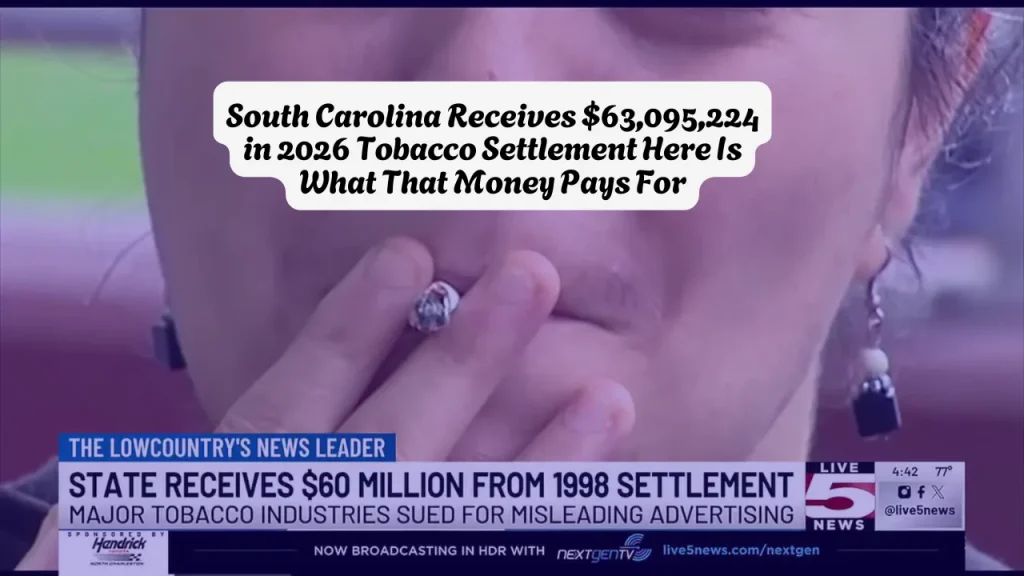
South Carolina Attorney General Alan Wilson announced on April 24, 2026, that the state secured $63,095,224.77 as its share of the annual tobacco Master Settlement Agreement payment. This is not a consumer class action settlement — no individual claim form exists, and residents cannot apply for a personal payout. This is a government-level payment made by tobacco companies to South Carolina every single year, and it has real consequences for the healthcare programs that residents depend on.
Quick Facts: South Carolina 2026 Tobacco MSA Payment
| Field | Detail |
| Payment Amount | $63,095,224.77 |
| Payment Announced | April 24, 2026 |
| Announcing Authority | South Carolina Attorney General Alan Wilson |
| Source of Payment | Tobacco Master Settlement Agreement (MSA), originally signed November 1998 |
| Who Pays | Major U.S. cigarette manufacturers and approximately 50 additional tobacco companies |
| Where the Money Goes | South Carolina Healthcare Tobacco Settlement Trust Fund |
| Total SC Has Received Since 1998 | $2,114,490,113.12 |
| Can Residents File a Claim? | No — this is a state government payment, not a consumer settlement |
| Payments Continue | In perpetuity — annually, with no end date |
| Enforcing Authority | SC Attorney General’s Office, working with other state AGs nationally |
| Last Updated | April 25, 2026 |
What Is the Tobacco Master Settlement Agreement? State of South Carolina v. Philip Morris et al. (MSA, November 1998)
In 1998, the South Carolina Attorney General’s Office joined 45 other states, the District of Columbia, and five U.S. territories in settling claims with the then-four major U.S. cigarette manufacturers. Those four companies — Philip Morris, R.J. Reynolds, Brown & Williamson, and Lorillard — had spent decades marketing cigarettes to the public while concealing the full extent of the health risks. States sued to recover the enormous Medicaid and public healthcare costs they had absorbed treating tobacco-related illnesses.
The agreement is considered the largest financial recovery in legal history, and about 50 additional tobacco companies have since signed on and are bound by its terms. The MSA did not just extract a one-time payment. It permanently restructured how tobacco companies can advertise and market their products, and it locked them into making annual payments to states — payments that continue with no scheduled end date.
The settlement restricts tobacco advertising and marketing and provides annual payments in perpetuity to help states offset healthcare costs and other harms linked to tobacco use. For South Carolina residents, that means this $63 million payment is not a one-time windfall — it is a recurring stream of funding that flows back into the state’s healthcare system every year because of the damage tobacco companies caused. If you are interested in how large-scale legal settlements involving consumer fraud and corporate misconduct are structured, our full explainer on what a RICO lawsuit is and how damages can be tripled breaks down how courts approach these multi-party recovery cases.
Where Does South Carolina’s $63 Million Tobacco Payment Actually Go?
South Carolina’s payment primarily goes to the Healthcare Tobacco Settlement Trust Fund for healthcare programs. This is not a discretionary fund that legislators can redirect freely — it is structured to support healthcare spending tied to tobacco-related illness and public health programs across the state.
This matters to everyday South Carolinians in concrete ways. Medicaid coverage for smoking-related conditions, tobacco cessation programs, and public health initiatives all draw from the resources this annual payment supports. The money flows back into the communities that bore the real cost of tobacco use for decades — not as a personal check, but as sustained investment in the healthcare infrastructure the state relies on.
Since the settlement was signed in November 1998, South Carolina has received a total of $2,114,490,113.12 in MSA payments. That is more than $2.1 billion directed into the state’s healthcare system over 27 years — and the payments keep coming. South Carolina is one of 14 states where tobacco was also grown and processed, which gives the MSA a particular economic and public health dimension beyond the consumer harm angle that drove the original litigation.
Are You Part of the South Carolina Tobacco Settlement Class Action?
This is the most important thing to understand: you cannot file a claim for this payment. The Tobacco Master Settlement Agreement is a legal agreement between state governments and tobacco companies. It is not a class action settlement fund for individual consumers.
Here is what that means in plain terms:
- You are NOT eligible to file a claim for a personal payment from the 2026 MSA distribution
- There is no claim form, no claim deadline, and no settlement administrator for consumers
- The $63,095,224.77 belongs to the State of South Carolina and is directed to state healthcare programs
- You do NOT need to do anything — no action is required
You would be a potential individual plaintiff only if you pursued a separate personal injury lawsuit against a tobacco company for specific documented harm, which is an entirely different legal process requiring a private attorney and individual litigation. A class action lawsuit attorney can evaluate whether a personal injury tobacco claim makes sense for your situation — but this MSA payment is not connected to that path.
For context on how government-level settlements differ from consumer class action settlements where individuals receive personal payments, see our breakdown of the Disney Streaming $2.75 million privacy settlement — another government enforcement action where the money went to the state, not individual consumers.
Related article: CIBC and Renaissance Mutual Funds $26 Million Settlement for Canadians, Do You Qualify for a Payment?
What South Carolina Plaintiffs Sought — and What the MSA Delivered
The original MSA litigation was about one specific legal theory: states had spent billions covering the healthcare costs of tobacco-related diseases through Medicaid and public health programs, and tobacco companies had caused those costs through decades of deceptive marketing. The states sued to get that money back.
What they got was far more than a single reimbursement. The MSA delivered ongoing annual payments — structured to continue indefinitely — along with permanent advertising and marketing restrictions. Tobacco companies cannot use cartoon characters to market cigarettes. They cannot sponsor most sporting events or concerts. They cannot distribute free samples to minors. These restrictions came directly from the 1998 settlement and remain binding today.
Attorney General Wilson’s office is responsible for enforcing tobacco statutes enacted under the agreement and works with attorneys general across the country to ensure compliance with MSA provisions. That enforcement work happens continuously — it is not a passive collection of funds. When tobacco companies try to find workarounds, the attorneys general push back through coordinated legal action.
South Carolina Tobacco MSA Payment Timeline
| Milestone | Detail |
| MSA Signed | November 1998 |
| South Carolina Joined | November 1998 — one of the original 46 settling jurisdictions |
| Additional Companies Added | Approximately 50 more tobacco companies have since signed on |
| 2020 SC Payment | $75,250,164.97 |
| 2024 SC Payment | $70,453,028.48 |
| 2026 SC Payment | $63,095,224.77 (announced April 24, 2026) |
| Total Received Since 1998 | $2,114,490,113.12 |
| Next Payment Expected | TBD — annual payments continue in perpetuity under MSA terms |
| Payment End Date | None — payments are permanent |
Frequently Asked Questions
Is there a class action lawsuit against tobacco companies I can join in South Carolina?
The Tobacco Master Settlement Agreement is a government-level settlement, not a consumer class action. South Carolina residents cannot file personal claims for a share of this annual payment. If you want to pursue compensation for tobacco-related personal injuries, that requires a separate individual lawsuit — consult a consumer rights lawyer about your specific situation.
Can I file a claim for the $63 million South Carolina tobacco payment?
No. South Carolina’s payment goes to the Healthcare Tobacco Settlement Trust Fund for healthcare programs. There is no claim form, no claim portal, and no deadline for individual consumers. The money is a state government recovery — not a personal settlement fund.
How much has South Carolina received in total from the tobacco settlement?
Since the agreement was signed in November 1998, South Carolina has received a total of $2,114,490,113.12 as its share of tobacco Master Settlement Agreement payments.
Why did South Carolina receive less in 2026 than in prior years?
The annual MSA payment each state receives fluctuates based on the volume of cigarettes sold by participating manufacturers each year. As tobacco sales decline nationally, the payments adjust accordingly. This is built into the MSA’s formula — the 2026 payment of $63,095,224.77 reflects current tobacco sales data, compared to $70,453,028.48 in 2024 and $75,250,164.97 in 2020.
Will these payments continue indefinitely?
The settlement provides annual payments in perpetuity to help states offset healthcare costs and other harms linked to tobacco use. There is no scheduled end date. As long as tobacco companies sell cigarettes and remain bound by the MSA, payments continue.
Does the tobacco settlement money go directly into healthcare programs?
Officials say South Carolina’s share is primarily directed to the state’s Healthcare Tobacco Settlement Trust Fund to support health programs. The specific allocation of funds within that trust is determined by the South Carolina legislature.
Can a tobacco company stop making these payments?
Participating manufacturers cannot unilaterally exit the MSA. About 50 additional tobacco companies have since signed on and are bound by its terms alongside the original four manufacturers. Any company that wants to sell cigarettes in the U.S. market has strong incentive to participate — non-participating manufacturers face significant competitive disadvantages under MSA-related state laws.
Sources & References
- South Carolina Attorney General Official Announcement (April 24, 2026): https://www.scag.gov/about-the-office/news/attorney-general-alan-wilson-announces-state-receives-more-than-63-million-in-tobacco-settlement-funds/
Disclaimer: This article is for informational purposes only and does not constitute legal advice. Legal claims and outcomes depend on specific facts and applicable law. For advice regarding a particular situation, consult a qualified attorney.
About the Author
Israr Ahmad is a legal content researcher with 4+ years of experience covering class action settlements and consumer rights cases. He has researched and published coverage of 2,500+ settlements using verified court records, settlement administrator filings, and government sources. Learn more about Israr.