
Trump Administration Sues Catholic Diocese to Seize Sacred Land for Border Wall Here’s the Legal Fight
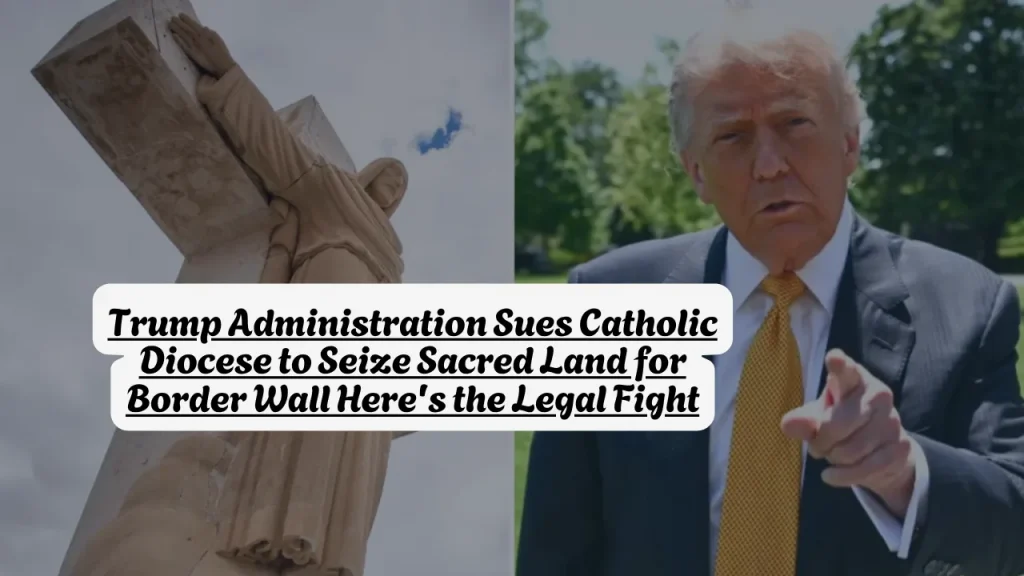
The Trump administration is seeking to seize 14 acres of land at the base of Mount Cristo Rey — a 720-foot mountain near El Paso topped by a 29-foot statue of Jesus Christ — owned by the Catholic Diocese of Las Cruces, New Mexico, to install border barriers and surveillance technology along the U.S.-Mexico border. The diocese is fighting back, and the legal clash involves some of the strongest religious freedom protections in federal law.
What the Government Wants and Why
The federal civil action, filed in U.S. District Court in New Mexico, names the Catholic Diocese of Las Cruces and the treasurer of Doña Ana County as defendants. The government is requesting the land under eminent domain — the legal power that allows the government to take private property for public use — at the request of the Department of Homeland Security.
According to the government’s filing, the land would be used to construct, install, operate, and maintain roads, fencing, vehicle barriers, security lighting, cameras, sensors, and related structures designed to help secure the border within New Mexico.
The Trump administration has said the area is a high-traffic route for human smuggling and wants to close the gap to stop illegal crossings.
The administration has offered the church $183,000 for the 14-acre tract. Construction of a separate 1.32-mile stretch of 30-foot steel border barrier south of the mountain, awarded to a Galveston-based company under a $95 million contract, has already begun.
Why This Site Matters
Mount Cristo Rey is not an ordinary parcel of land. The limestone statue of Jesus Christ at its peak dates back to 1940 and has served as a place of prayer for close to a century.
Each fall on the feast of Christ the King, up to 40,000 people climb the mountain and participate in Mass. Pilgrims have been known to complete the five-mile journey barefoot or on their knees, going to pay their “mandas” — fulfilling a personal pledge made in prayer.
Mount Cristo Rey is the only significant gap without a border fence in the El Paso metropolitan area. That geographic reality is precisely why the government wants it — and why the community does not want to give it up.
How the Diocese Is Fighting Back
The Diocese of Las Cruces is not simply objecting. It is invoking two of the most powerful legal tools available to a religious institution facing government action.
In its May 8 court filing, prepared by attorneys at Georgetown University’s Institute for Constitutional Advocacy and Protection, the diocese argued that the government’s proposed seizure would substantially burden the free exercise of religion by the diocese, its parishioners, and all faithful who seek to commune with God on Mount Cristo Rey. The diocese invoked both the First Amendment’s Free Exercise Clause and the Religious Freedom Restoration Act.
The Religious Freedom Restoration Act — known as RFRA — is a federal law that prohibits the government from placing a substantial burden on a person’s religious exercise unless it can prove a compelling government interest pursued through the least restrictive means. The burden that standard places on the government is significant.
The diocese further argued that RFRA modifies the reach of the Declaration of Taking Act — the law that allows the government to accelerate property seizures by filing a declaration and depositing compensation with the court — and asked a judge to deny that accelerated process until the religious freedom questions are fully argued in court.
The diocese’s message is clear: the government cannot skip past the First Amendment by moving fast.
Related article: LinkedIn Is Silently Scanning 6,000+ Your Chrome Extensions Without Telling You And Ties Results to Your Professional Identity
A Precedent That Favors the Church
Courts have a long track record of siding with religious institutions when the government attempts eminent domain over houses of worship or sacred sites. In October 2018, just outside Mission, Texas, the federal government initiated an eminent domain action against La Lomita Chapel and its surroundings to construct portions of the border wall during the first Trump administration. That case also drew First Amendment challenges. Legal scholars have noted that courts almost always side with faith communities in these disputes, often blocking the taking outright rather than simply ordering compensation.
Legal experts have said that if the Mount Cristo Rey case reaches higher courts, it could have broader implications for religious groups along the border and for others facing eminent domain actions on religious grounds.
The Broader Pattern of Border Construction
This case does not exist in isolation. Construction crews building border barriers have also continued to damage other sensitive sites. In Arizona, crews destroyed a rare Native American archaeological site believed to be at least 1,000 years old.
Conservationists have also raised environmental concerns, noting that Mount Cristo Rey serves as a wildlife corridor for animals moving between La Sierra de Juárez in Mexico and El Paso’s Franklin Mountains.
The case is part of a wider pattern of the federal government using legal force to acquire property for immigration enforcement. For more on how courts have responded when individuals push back against federal immigration enforcement actions, see our coverage of the Minnesota ICE racial profiling lawsuit and our guide on whether suing ICE and winning is possible.
Frequently Asked Questions
What is eminent domain?
Eminent domain is the government’s legal power to take private property for public use. The Fifth Amendment to the U.S. Constitution requires the government to pay “just compensation” to the property owner. The government determines the amount, though owners can challenge it in court.
Can the government seize church property through eminent domain?
Technically yes — no property is entirely exempt. But when the property is a religious site, courts apply heightened scrutiny under the First Amendment and the Religious Freedom Restoration Act. Historically, courts have blocked these takings far more often than they have allowed them.
What is the Religious Freedom Restoration Act and how does it apply here?
RFRA is a federal law that prohibits the government from substantially burdening religious exercise without proving a compelling interest pursued through the least restrictive means. The diocese is arguing that seizing a pilgrimage mountain with 40,000 annual worshippers is a substantial burden — and that the government has not shown it has no less restrictive alternative.
Is $183,000 a fair price for the land?
That is a central question in eminent domain disputes. The government sets an initial estimate, but property owners can contest the valuation in court. Whether $183,000 reflects the true market value — or accounts for the cultural and religious significance of a site with nearly a century of pilgrimage history — is something the court may be asked to evaluate.
What law governs eminent domain in the U.S.?
Federal eminent domain authority is grounded in the Fifth Amendment (U.S. Constitution) and exercised through the Declaration of Taking Act (40 U.S.C. § 3114). RFRA (42 U.S.C. § 2000bb) and the First Amendment provide the primary grounds for religious challenges to government takings.
Sources
- Texas Tribune / AP — Trump administration sues Catholic diocese to seize land on religious site near El Paso for border barrier (May 15, 2026)
- Source New Mexico — Las Cruces Diocese fights federal effort to seize Mount Cristo Rey property for border wall (May 2026)
- Religion News Service — Catholic diocese fights Trump administration plan to seize pilgrimage site for border wall (May 2026)
- OSV News — New Mexico diocese fights Trump push to seize pilgrimage site for border wall (May 2026)
- Yale Law Journal — Condemning Worship: Religious Liberty Protections and Church Takings
- Cornell Law LII — Fifth Amendment: law.cornell.edu/constitution/fifth_amendment
- Cornell Law LII — RFRA, 42 U.S.C. § 2000bb: law.cornell.edu/uscode/text/42/2000bb
Prepared by the AllAboutLawyer.com Editorial Team and reviewed for factual accuracy against official legal sources on May 16, 2026. Last Updated: May 16, 2026.
Disclaimer: This article is for general informational and educational purposes only and does not constitute legal advice. Laws vary by state and jurisdiction. For advice about your specific situation, consult a qualified attorney.
About the Author
Israr Ahmad is a legal content researcher with 4+ years of experience covering class action settlements and consumer rights cases. He has researched and published coverage of 2,500+ settlements using verified court records, settlement administrator filings, and government sources. Learn more about Israr.