
SDNY Judge Signals She Won’t Ignore Trump’s “Political Retribution” Comments in Hudson Tunnel Funding Fight
U.S. District Judge Jeannette Vargas has signaled that she may look beyond official government documents to determine if the Trump administration’s freeze on $16 billion in Hudson Tunnel funding was motivated by political spite. During a high-stakes hearing in Manhattan, the judge pushed back against Department of Justice (DOJ) attorneys who argued the court should ignore President Trump’s public claims that he was “killing” the project to punish political rivals.
The legal battle centers on whether the U.S. Department of Transportation (DOT) used a “pretext”—a fake reason—to stop the flow of contractually obligated federal funds. While the DOT claims it is merely reviewing diversity and equity (DEI) contracting rules, Judge Vargas noted the stark contrast between those technical justifications and the President’s own social media boasts, telling government lawyers, “You’re telling me not to look behind the curtain.”
Quick Case Snapshot
- Plaintiffs: The States of New Jersey and New York.
- Defendant: U.S. Department of Transportation (DOT); Pete Hegseth (Secretary of Transportation, if applicable in 2026) / Trump Administration.
- Court: U.S. District Court for the Southern District of New York (SDNY).
- Case Number: 1:26-cv-00939.
- Filing Date: February 3, 2026.
- Judge: U.S. District Judge Jeannette Vargas.
- Claims Alleged: Violations of the Administrative Procedure Act (APA); Breach of Contract; Political Retribution; Violation of the Separation of Powers.
- Damages Sought: Immediate restoration of $205 million in withheld disbursements and a permanent injunction protecting the $16 billion project.
- Current Status: Preliminary injunction granted (Feb 6, 2026); Hearing on motion to dismiss held April 16, 2026.
Why the “Curtain” Comment Matters for the Gateway Project
The “curtain” referred to by Judge Vargas is the official administrative record—the pile of paperwork the government uses to justify its decisions. Under standard legal rules, judges usually only look at these official documents when deciding if a government action is legal.
However, the states of New York and New Jersey argue that this case is an exception. They claim the official “DEI review” is a smoke-screen for what President Trump called “cutting a project Schumer fought 15 years for.” By refusing to ignore these outside statements, Judge Vargas is opening the door to a ruling that the funding freeze was “arbitrary, capricious,” and legally invalid.
The $200 Million Funding Freeze and Its Impact
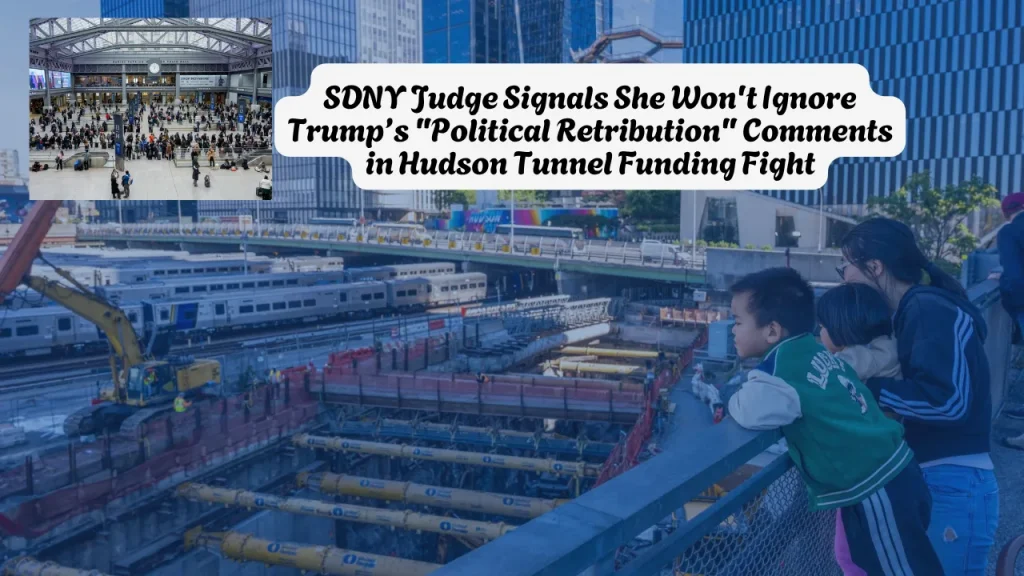
In late 2025, the Trump administration unceremoniously halted payments to the Gateway Development Commission (GDC), the body responsible for building the new rail tunnel under the Hudson River. This project is considered the most critical infrastructure endeavor in the United States, serving over 200,000 daily commuters and supporting 10% of the U.S. economy.
The consequences of a permanent freeze would be catastrophic:
- Job Loss: Nearly 1,000 construction jobs were at immediate risk in February 2026.
- Cost Overruns: A temporary construction pause is estimated to add $2 billion to the project’s total cost.
- Safety Risks: The existing 116-year-old North River Tunnel was severely damaged during Superstorm Sandy and continues to decay.
Related article: $1.4M Hoban & Associates Settlement Ends Class Action Lawsuit Over Allegedly Unlawful Tenant Screenings
The DOJ’s Defense: “Not a Final Action”
Assistant U.S. Attorney Chibogu Nzekwu argued on behalf of the DOJ that the court shouldn’t even be hearing the case yet. The government’s primary defenses are:
- Lack of Standing: The DOJ claims the states of NY and NJ can’t sue because the federal contract is with the Gateway Commission, not the state governments directly.
- No Final Decision: The government argues the funding was “suspended,” not “terminated,” meaning it isn’t a “final agency action” that a judge can review under the Administrative Procedure Act.
Judge Vargas appeared skeptical of these arguments, noting that “the funding stopped” and that “the suspension has consequences.” She previously ruled on February 6 that the public interest would be irreparably harmed by a delay, ordering the money to keep flowing while the case proceeds.
Legal Context: The “Pretext” Standard
This case mirrors the 2019 Supreme Court battle over the census citizenship question (Department of Commerce v. New York). In that case, the court ruled that while agencies have broad power, they cannot provide a “contrived” reason for their actions.
If Judge Vargas finds that the DOT’s “regulatory review” was a pretext for political retribution, it would represent a significant check on executive power. It would affirm that even the President’s social media posts can be used as evidence of illegal intent if they contradict the official justifications provided by government agencies.
What Happens Next for Commuters and Contractors?
While the April 16 hearing did not result in an immediate ruling, the preliminary injunction remains in place. This means federal funds must continue to be disbursed for now, allowing tunnel-boring machines to remain active and workers to stay on the job.
Key Upcoming Milestones:
- Decision on Motion to Dismiss: Expected in the coming weeks. If Judge Vargas denies the government’s motion, the case will move into “discovery,” where the states may get access to internal DOT emails.
- GDC Breach of Contract Suit: A separate lawsuit is moving through the U.S. Court of Federal Claims, which could result in the government paying massive “delay damages” if the freeze is found to be a breach of contract.
FAQs
Is the Hudson Tunnel construction currently stopped?
No. Thanks to the court order issued by Judge Vargas in February 2026, the funding was restored just hours before work was scheduled to halt. Construction is currently ongoing.
How much money is at stake?
The total project is valued at $16 billion. The current legal fight involves a specific freeze on over $200 million in immediate payments and the administration’s broader attempt to reconsider the entire $12 billion federal grant portion.
Why does the judge care about Trump’s social media posts?
Because they provide evidence of motive. If the President says he is “killing” a project for political reasons while his agency says they are “reviewing DEI rules,” the judge must determine which version is the truth.
What does this mean for other federal projects?
A win for the states could set a precedent that protects large-scale infrastructure projects from being used as “political footballs” during changes in presidential administrations.
Last Updated: April 17, 2026
This article is for informational purposes only and does not constitute legal advice. Allegations in a complaint are not findings of fact. All parties are presumed innocent unless and until proven otherwise in court.
About the Author
Israr Ahmad is a legal content researcher with 4+ years of experience covering class action settlements and consumer rights cases. He has researched and published coverage of 2,500+ settlements using verified court records, settlement administrator filings, and government sources. Learn more about Israr.