
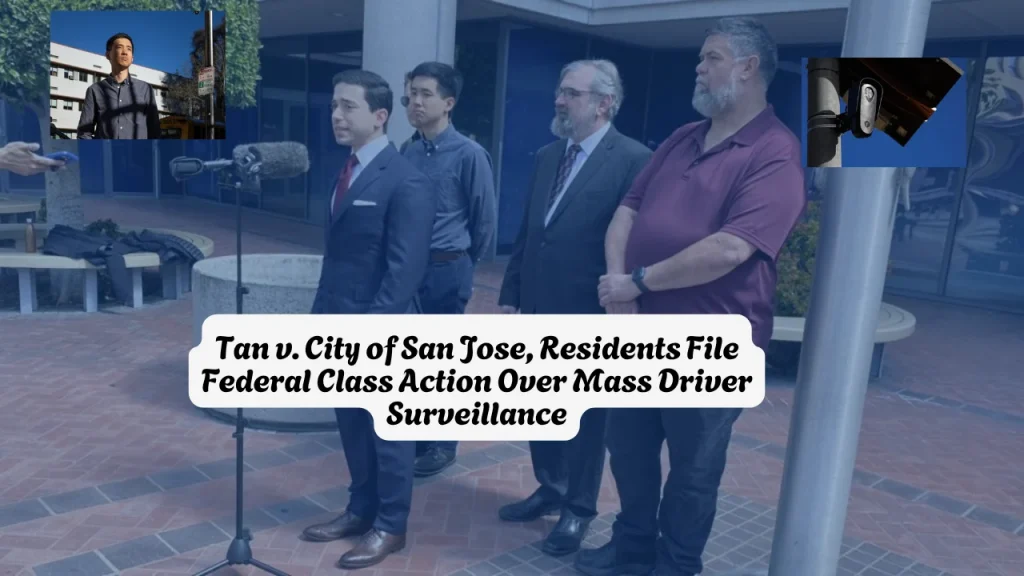
Tan v. City of San Jose, Residents File Federal Class Action Over Mass Driver Surveillance
On April 15, 2026, three San Jose residents filed a federal class action lawsuit against the City of San Jose, alleging that the city’s massive network of nearly 500 Automated License Plate Readers (ALPR) constitutes an unconstitutional mass surveillance program. The plaintiffs, represented by the Institute for Justice (IJ), claim that the warrantless collection and retention of location data for millions of drivers violate the Fourth Amendment’s protection against unreasonable searches and seizures.
The lawsuit seeks to halt the city’s current practice of storing driver movement data for up to 30 days and demands that all license plate data be deleted within 24 hours of collection unless a judicial warrant is obtained. While the city maintains the technology is a vital tool for public safety, the legal challenge argues that the “unblinking eye” of 474 Flock Safety cameras has turned the city into a surveillance “fishbowl” for law-abiding citizens.
Quick Case Snapshot
| Feature | Details |
| Plaintiffs | Tony Tan, Scott West, and Colin Wolfson |
| Defendant | City of San Jose, California |
| Court | U.S. District Court for the Northern District of California |
| Case Number | [Pending Official Assignment] |
| Filing Date | April 15, 2026 |
| Judge | TBD |
| Claims Alleged | Fourth Amendment Violations; Unconstitutional Mass Surveillance |
| Damages Sought | Injunctive Relief (Policy Change) and Attorney Fees |
| Current Status | Newly Filed |
Who Is Affected by San Jose’s Surveillance Network?
If you drive a vehicle within the city limits of San Jose, your location has likely been logged. The city’s ALPR system, provided by Flock Safety, captures the license plate, make, model, and even distinctive features (like bumper stickers or roof racks) of every vehicle that passes its sensors.
According to the complaint, the system currently:
- Captures Millions of Images: The network gathers millions of records every month.
- Allows Warrantless Access: Thousands of government employees across California can reportedly search the database without a warrant or probable cause.
- Tracks Routine Activity: The cameras are positioned to monitor daily commutes, trips to places of worship, and medical appointments, creating a “digital breadcrumb trail” of private lives.
What the Lawsuit Alleges: A “Digital Fishbowl”
The core of the plaintiffs’ argument rests on the Fourth Amendment, which protects citizens from warrantless searches when they have a reasonable expectation of privacy. Lead plaintiff Tony Tan, a privacy engineer who grew up in China, expressed concern that the infrastructure of a “surveillance state” is being built under the guise of local law enforcement.
The lawsuit highlights the rapid expansion of the program, which began as a small pilot in 2021 with just four cameras. By 2026, that number has surged to 474 active cameras. The plaintiffs argue that this scale effectively allows the government to reconstruct the movements of any resident over time—a power that historically required a high bar of suspicion and a specific warrant.
Related article: Roblox Nevada Youth Safety & Protection Settlement, Are You Eligible for Payouts?
Key Allegations in the Complaint:
- Indiscriminate Data Collection: The city collects data on everyone, not just those suspected of crimes.
- Lack of Oversight: The lawsuit alleges that there is almost no oversight regarding who searches the data or why.
- Retention Policy: While the city recently reduced its data retention from 365 days to 30 days, plaintiffs argue that even 30 days is too long to hold location data of innocent people.
Discovery Insights: What We Expect to Learn
As this case enters the discovery phase, legal experts anticipate the release of internal city communications and police department logs. Crucial “Discovery Insights” will likely focus on:
- Search Frequency: Exactly how many times a day are officers searching the ALPR database without a warrant?
- Data Sharing Agreements: Which out-of-state agencies or federal entities (such as ICE) have been granted access to the San Jose driver database?
- Audit Effectiveness: The city claims to have robust audit trails; discovery will reveal if these audits have ever flagged or disciplined an officer for misuse of the surveillance tech.
Bellwether Context: The National Fight Against ALPRs
This case is part of a broader “Bellwether” trend across the United States. The Institute for Justice is currently spearheading similar litigation in other jurisdictions, most notably in Norfolk, Virginia.
San Jose’s outcome will serve as a high-stakes precedent for Silicon Valley and the rest of the country. If the court rules in favor of the residents, it could force hundreds of other municipalities using Flock Safety technology to dismantle their retention databases or seek warrants for every search, fundamentally altering the landscape of modern policing.
Objector Status: Who Opposes This Lawsuit?
While privacy advocates cheer the filing, several “Objector” groups are expected to voice support for the city’s program:
- San Jose Police Officers’ Association: Law enforcement argues that ALPRs are essential for solving hit-and-runs, finding missing persons (Amber Alerts), and tracking stolen vehicles.
- Crime Victim Advocacy Groups: Some groups argue that removing these cameras or limiting their data would hinder the pursuit of violent criminals.
- Flock Safety: As the technology provider, the company maintains that its systems are designed with “privacy-first” features and that the data belongs solely to the city.
What Happens Next?
The City of San Jose has yet to file a formal response in federal court, though the City Attorney has publicly defended the program as transparent and lawful. The next major steps include:
- Motion to Dismiss: The city will likely argue that the plaintiffs lack “standing” or that there is no expectation of privacy on public roads.
- Class Certification: The court must decide if these three residents can officially represent all San Jose drivers.
- Preliminary Injunction Hearing: The plaintiffs may ask the judge to stop data retention immediately while the case proceeds.
Frequently Asked Questions
Q: Do I need to sign up to join this lawsuit?
At this stage, no action is required. If the case is certified as a class action, eligible residents will be notified. You can stay updated through the Institute for Justice website.
Q: Will the city stop using cameras immediately?
No. The cameras will remain operational unless a judge issues a preliminary injunction or a final ruling against the city.
Q: Does this lawsuit affect private cameras (like Ring doorbells)?
No. This case specifically targets the city-owned and operated ALPR network used by law enforcement.
Q: What is the main goal of the plaintiffs?
The primary goal is a court order requiring the city to delete plate data within 24 hours and requiring a warrant for any data searches.
Last Updated: April 17, 2026
This article is for informational purposes only and does not constitute legal advice. Allegations in a complaint are not findings of fact. All parties are presumed innocent unless and until proven otherwise in court.
About the Author
Israr Ahmad is a legal content researcher with 4+ years of experience covering class action settlements and consumer rights cases. He has researched and published coverage of 2,500+ settlements using verified court records, settlement administrator filings, and government sources. Learn more about Israr.