
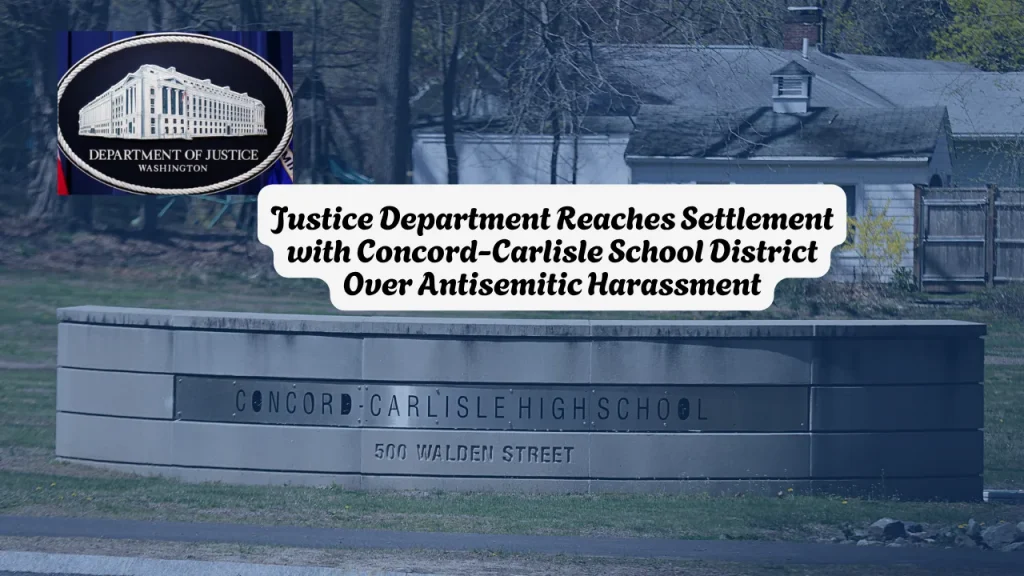
Justice Department Reaches Settlement with Concord-Carlisle School District Over Antisemitic Harassment
The U.S. Department of Justice (DOJ) has officially entered into a voluntary settlement agreement with the Concord-Carlisle Regional School District in Massachusetts to resolve a federal civil rights investigation into rampant antisemitic harassment. The settlement follows a DOJ probe that uncovered a series of disturbing incidents between 2023 and 2025, including the repeated drawing of swastikas and the targeted use of ethnic slurs against Jewish students.
Under the terms of the agreement announced on April 16, 2026, the district must overhaul its anti-discrimination policies, appoint a dedicated compliance officer, and implement mandatory training for both staff and students. While the district does not admit to legal liability, the settlement mandates federal monitoring to ensure the schools provide a safe, non-hostile environment for Jewish and Israeli students.
Quick Case Snapshot
- Plaintiff: United States Department of Justice (Civil Rights Division)
- Defendant: Concord-Carlisle Regional School District, Massachusetts
- Legal Basis: Title IV of the Civil Rights Act of 1964
- Case Status: Settled (Voluntary Agreement)
- Filing Date: Investigation opened March 2025; Settlement finalized April 16, 2026
- Core Allegations: Peer-on-peer antisemitic harassment, including swastikas and derogatory slurs
- Damages/Payout: Not a monetary settlement for individuals; focused on systemic reform and compliance
- Monitoring Period: DOJ will monitor the district’s compliance through at least the 2027-2028 school year
What the Investigation Uncovered
The Department of Justice’s Civil Rights Division launched its investigation in early 2025 following a surge of complaints from parents and community members. The probe focused on whether the district failed to “promptly and effectively” respond to harassment based on religion, race, and national origin.
According to the settlement documents, the DOJ identified a pattern of hostile behavior occurring at both the middle and high school levels. Key allegations included:
- Hate Symbols: The repeated discovery of swastikas in school hallways and common areas.
- Verbal Abuse: Students frequently used the word “Jew” as a derogatory ethnic slur directed at their peers.
- Systemic Failure: Evidence suggested that the district’s existing policies were insufficient to identify, report, or remediate the harassment, leading to a “hostile environment” that interfered with students’ ability to learn.
The Terms of the Settlement
Rather than a monetary payout to victims, this settlement focuses on institutional change. The Concord-Carlisle Regional School District has committed to the following:
- Policy Overhaul: The district must review and revise its harassment and discrimination policies to explicitly prohibit all forms of antisemitic harassment.
- Compliance Officer: A new position will be established to monitor responses to harassment reports across all schools in the district.
- Mandatory Training: Comprehensive training programs on identifying and responding to antisemitism must be provided for all staff members and the student body.
- Enhanced Reporting: The district is required to establish clearer, faster protocols for investigating complaints and protecting whistleblowers from retaliation.
- Federal Oversight: The DOJ will receive regular progress reports and has the authority to intervene if the district fails to meet the milestones outlined in the agreement.
Related article: SDNY Judge Signals She Won’t Ignore Trump’s “Political Retribution” Comments in Hudson Tunnel Funding Fight
Legal Context: Title IV and Educational Obligations
This case was brought under Title IV of the Civil Rights Act of 1964, which authorizes the Attorney General to address complaints of discrimination in public schools. Unlike Title VI (which relates to recipients of federal funding), Title IV gives the DOJ direct authority to ensure that public school districts are not depriving students of equal protection under the law.
Assistant Attorney General Harmeet K. Dhillon of the Civil Rights Division stated that the Department will not tolerate harassment “at any level of education.” The settlement aligns with a broader federal trend of increasing scrutiny on how K-12 districts and universities handle ethnic and religious tensions, particularly following the global rise in antisemitic incidents since late 2023.
Impact on the Community
For residents of Concord and Carlisle, the settlement means immediate changes to the school climate. Parents of students who have experienced harassment now have a federally mandated pathway for reporting incidents with guaranteed protections against retaliation.
While the district has already begun some reforms—including initial staff workshops—the DOJ’s involvement adds a layer of accountability. If the district fails to uphold its end of the bargain, the DOJ could pursue further litigation to compel compliance.
FAQs
Is there a payout for students who were harassed?
No. This is a systemic settlement aimed at changing district-wide policies and safety protocols. It does not provide individual financial compensation. Families seeking damages would likely need to file separate private civil lawsuits.
What should I do if my child experiences harassment in this district?
Under the new agreement, you should contact the district’s designated Compliance Officer. The settlement guarantees a “prompt and effective” investigation and protects your child from any retaliation for making a report.
How long will the DOJ be involved?
The DOJ will monitor the district until they are satisfied that the new policies are fully implemented and effective. Typically, these monitoring periods last between two to three years.
Does this settlement apply to other districts in Massachusetts?
Specifically, no. This agreement is legally binding only for the Concord-Carlisle Regional School District. However, it serves as a “warning shot” and a template for how the DOJ expects other districts to handle similar issues.
Last Updated: April 17, 2026
This article is for informational purposes only and does not constitute legal advice. Allegations in a complaint are not findings of fact. All parties are presumed innocent unless and until proven otherwise in court.
About the Author
Israr Ahmad is a legal content researcher with 4+ years of experience covering class action settlements and consumer rights cases. He has researched and published coverage of 2,500+ settlements using verified court records, settlement administrator filings, and government sources. Learn more about Israr.