
BioLab Warehouse Fire Class Action, Georgia Supreme Court to Rule on Medical Monitoring for Residents
On April 21, 2026, the Supreme Court of Georgia will hear pivotal oral arguments that could determine whether thousands of residents exposed to the 2024 BioLab warehouse fire are entitled to long-term, company-funded medical monitoring. The high court is addressing a “certified question” from a federal judge: Can individuals who were exposed to toxic chlorine gas, but have not yet developed physical symptoms, sue for the costs of lifelong health surveillance?
The outcome of this hearing will dictate the potential payout and scope of the ongoing federal class action lawsuit against BioLab, Inc. and its parent company, KIK Consumer Products. While BioLab previously offered a limited reimbursement program for immediate out-of-pocket evacuation costs, this legal battle focuses on the long-term health risks associated with the massive chemical plume that forced over 90,000 people to shelter in place or evacuate.
Quick Case Snapshot
| Feature | Details |
| Plaintiffs | Residents and Business Owners of Rockdale County (Class Representatives) |
| Defendant | BioLab, Inc. and KIK Consumer Products |
| Court | Supreme Court of Georgia (on certification from U.S. District Court, Northern District of Georgia) |
| Case Number | S24Q1151 (Related to Case No. 1:24-cv-04353-SCG) |
| Argument Date | April 21, 2026 |
| Legal Issue | Availability of Medical Monitoring for asymptomatic plaintiffs under Georgia law |
| Damages Sought | Medical monitoring trust fund, property damage, and business loss compensation |
| Current Status | Oral arguments scheduled; federal class action stayed pending state court ruling |
What Happened: The 2024 Conyers Chemical Disaster
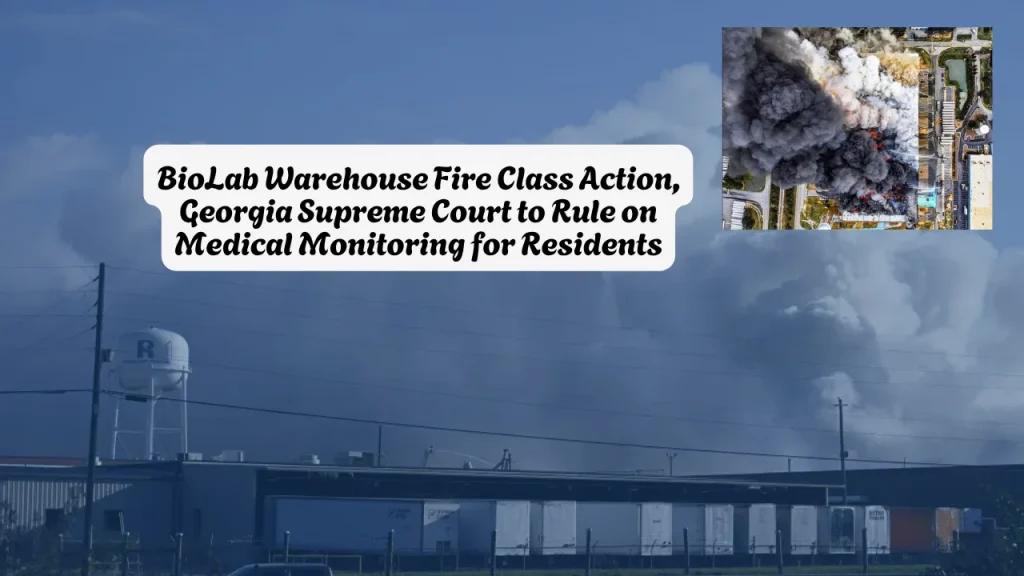
On the morning of September 29, 2024, a malfunction at the BioLab facility in Conyers, Georgia, triggered a catastrophic chemical reaction. According to federal investigators, a sprinkler system malfunctioned, allowing water to mix with trichloroisocyanuric acid (TCCA). This reaction ignited a massive fire and released a dense, toxic plume of chlorine gas and hydrochloric acid into the atmosphere.
The resulting environmental crisis lasted for weeks:
- Evacuations: Approximately 17,000 residents in the immediate vicinity were ordered to leave their homes.
- Shelter-in-Place: Over 70,000 residents across Rockdale County and parts of metro Atlanta were advised to stay indoors with windows and ventilation systems sealed.
- Economic Impact: Local businesses were forced to shutter, and schools remained closed as the plume shifted daily based on wind patterns.
Who Is Affected and Eligible for the Lawsuit?
Eligibility for the class action lawsuit is currently broad, covering several groups impacted by the fire. You may be considered a part of the potential class if you fall into these categories:
- Residents: Anyone living within the evacuation or shelter-in-place zones in Rockdale County or surrounding counties during the plume event (September 29 – mid-October 2024).
- Property Owners: Individuals whose homes or land were contaminated by chemical residue or smoke damage.
- Business Owners: Companies that lost revenue due to mandatory closures or reduced traffic during the environmental emergency.
- First Responders: Firefighters and police officers who were directly exposed to high concentrations of chlorine gas while managing the site.
Related article: Tan v. City of San Jose, Residents File Federal Class Action Over Mass Driver Surveillance
“Discovery” Insights: Internal Failures and OSHA Fines
As the litigation progresses, “Discovery” has revealed troubling details regarding BioLab’s safety protocols. In 2025, the Occupational Safety and Health Administration (OSHA) fined BioLab $61,473 for six violations—four of which were classified as “serious.”
Plaintiffs’ attorneys are using these findings to argue that the fire was not an “act of God” but a preventable result of negligence. Internal records suggest that the facility had a history of chemical incidents, yet the company allegedly failed to modernize the specific TCCA storage safety measures that led to the 2024 disaster. This evidence is crucial for proving the “gross negligence” required to seek punitive damages and a court-supervised medical monitoring fund.
“Bellwether” Context: A Precedent for Georgia Environmental Law
This case serves as a critical Bellwether for environmental litigation in Georgia. Historically, Georgia courts have been hesitant to award damages to people who haven’t shown “physical impact” or illness yet—a standard known as the Impact Rule.
If the Georgia Supreme Court rules in favor of the residents, it will set a new legal standard allowing “asymptomatic” plaintiffs to recover medical monitoring costs. This would fundamentally change how toxic tort cases are handled in the state, potentially opening the door for future lawsuits involving PFAS (“forever chemicals”), coal ash, and other industrial pollutants.
“Objector” Status: The Corporate Pushback
The U.S. Chamber of Commerce has filed an “Amicus Brief” (friend of the court) in support of BioLab, acting as a primary “Objector” to the expansion of medical monitoring.
The Chamber argues that allowing residents to sue without a current injury would “invite judicial morass” and “deplete judicial resources” with premature claims. BioLab’s defense team maintains that the 30-day reimbursement program offered in 2024 was sufficient to cover legitimate losses and that the long-term health risks of the plume have been exaggerated by plaintiffs’ counsel.
FAQs: What Readers Need to Know
Q: I didn’t get sick at the time of the fire. Can I still be part of the lawsuit?
A: Yes. That is exactly what the Georgia Supreme Court is currently deciding. If they rule that “exposure” is enough to justify medical monitoring, you can participate even without current symptoms.
Q: Is there a deadline to join the BioLab class action?
A: There is no specific deadline to join the class action yet, as the class has not been officially “certified” by the judge. However, the deadline to file individual out-of-pocket reimbursement claims directly with BioLab passed on December 31, 2024.
Q: How much money could I receive?
A: At this stage, payouts are not determined. The plaintiffs are primarily seeking a “Medical Monitoring Fund” that would pay for your doctor visits and tests for years to come, rather than a single lump-sum check for everyone.
Q: Does this affect the Rockdale County Commission’s lawsuit?
A: The County Commission has filed its own separate lawsuit in federal court seeking to recover the millions of dollars spent on emergency response. While related, that is a separate legal track from the resident class action.
Last Updated: April 17, 2026
This article is for informational purposes only and does not constitute legal advice. Allegations in a complaint are not findings of fact. All parties are presumed innocent unless and until proven otherwise in court.
About the Author
Israr Ahmad is a legal content researcher with 4+ years of experience covering class action settlements and consumer rights cases. He has researched and published coverage of 2,500+ settlements using verified court records, settlement administrator filings, and government sources. Learn more about Israr.