
San Diego Childcare System Is Caught Between a Federal Funding Freeze, a California Budget Squeeze, and a Lawsuit That Bought Some Time
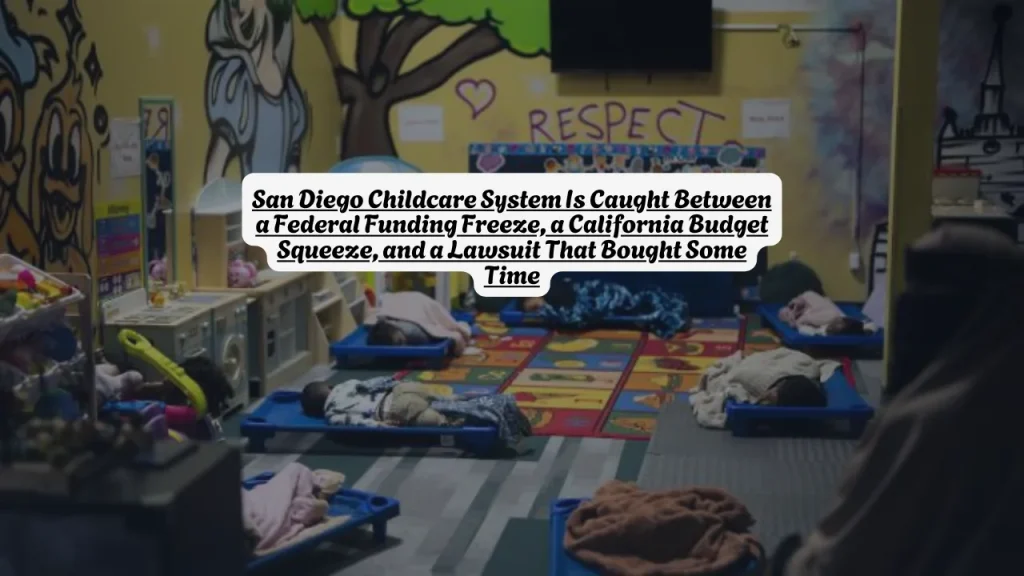
San Diego parents counting on subsidized childcare have spent 2026 navigating real uncertainty. Three separate forces — a federal funding freeze, a tightening California state budget, and active litigation — are pressing on the same sector at the same time. For families already stretched thin, the question is not abstract. It is whether their child’s program will still be open next week.
Here is what happened, where things stand right now, and what San Diego families and providers should know.
Quick Facts
| Detail | Status |
| Federal funding threatened | $10 billion frozen by HHS across 5 states, including California |
| California’s share at risk | Approximately $5 billion, including $1.4 billion for childcare programs |
| Programs affected | Child Care and Development Fund (CCDF), TANF, Social Services Block Grant |
| Lawsuit filed | January 8, 2026 — U.S. District Court, Southern District of New York |
| Court ruling | Temporary restraining order issued January 9; preliminary injunction extended February 7 |
| Court | U.S. District Court for the Southern District of New York |
| California budget for childcare | $7.5 billion total ($5.1 billion General Fund) for 2026–27 |
| San Diego provider at risk | Neighborhood House Association — approximately $3.3 million in state-run programs |
| Head Start status | Protected — not affected by the HHS freeze |
| Last Updated | May 14, 2026 |
The Federal Funding Freeze That Started It All
On January 6, 2026, the U.S. Department of Health and Human Services froze access to federal childcare and family assistance funds for California, Colorado, Illinois, Minnesota, and New York. HHS cited “serious concerns about widespread fraud and misuse of taxpayer dollars” in those states’ welfare programs. The freeze applied to three programs: the Child Care and Development Fund (CCDF), the Temporary Assistance for Needy Families program (TANF), and the Social Services Block Grant.
Of the $10 billion frozen across all five states, approximately $5 billion in funds were frozen in California alone — including $1.4 billion specifically for childcare programs.
The reaction in San Diego was immediate. Charlotte Ochiqui Hans, Deputy General Manager of the Neighborhood House Association — one of San Diego’s largest nonprofit social services agencies — said the freeze would put roughly $3.3 million in state-run childcare funding at risk. She said staff hours and reduced days of service could follow. “Without that funding, we would have to reduce hours of operation and also reduce days served,” she said. She was clear that Early Head Start and Head Start are federally funded through a separate channel and would not be affected — but state-run childcare development programs are a different story.
The Trump administration’s justification pointed in part to fraud cases in Minnesota involving Somali-run childcare centers. But a search of federal prosecutor press releases in California going back more than a decade found only one criminal case referencing childcare benefits fraud in the state — a 2023 case in which four men stole $3.7 million through fraudulent requests to a San Diego organization distributing the funds. All four pleaded guilty. That figure represents roughly one one-hundredth of 1% of all childcare funding California received over the period covered by the search.
California’s Department of Social Services pushed back directly: “These funds are not optional — they are critical lifelines for working families across California. Using unsupported allegations to withhold child care funding only from states that didn’t vote for the President doesn’t stop fraud — it harms struggling moms and dads President Trump claims to be fighting for.”
Related article: NCAA $303 Million Volunteer Coach Settlement Gets Final Approval You Have Until June 2 to Claim Your Share
The Lawsuit That Blocked the Freeze
On January 8, 2026, the attorneys general of California, New York, Colorado, Illinois, and Minnesota filed a joint lawsuit in the U.S. District Court for the Southern District of New York, challenging the funding freeze. The lawsuit argued the freeze violates the Administrative Procedure Act, the Separation of Powers, and the U.S. Constitution’s Appropriations Clause and Spending Clause — asserting that Congress, not the executive branch, holds the authority to attach conditions to already-appropriated federal funds.
Less than 24 hours later, U.S. District Judge Arun Subramanian issued a temporary restraining order blocking the freeze, ruling that the five states had met the legal threshold to protect the status quo while arguments were made in court.
The court’s protection held. On February 7, 2026, California Attorney General Rob Bonta secured a continued court order extending the block on the freeze while litigation proceeds. Bonta said: “The Trump Administration’s actions are not only unlawful — they are cruel, targeting the most vulnerable among us. My fellow attorneys general and I will not relent in this case, and we are confident that we will ultimately prevail in permanently blocking the unlawful funding freeze.”
For San Diego families, the court orders mean the funding currently continues to flow. But the underlying lawsuit remains active, and no permanent resolution has been reached. For more on how federal courts have stepped in to reverse Trump administration funding cuts in other areas, see our coverage of the IMLS library funding lawsuit and settlement, in which a court similarly halted an executive branch attempt to defund a congressionally authorized agency.
What San Diego Families Receive Through These Programs
In California, approximately 286,000 children receive subsidized childcare. A portion of those children receive funds from the TANF program. San Diego County is one of the most expensive counties in the country for housing and childcare combined.
The programs at risk serve working parents in specific income brackets — people who cannot afford private daycare but whose income exceeds the threshold for free programs. These are the families most exposed when funding pauses even briefly, because childcare providers operating on thin margins cannot carry unpaid slots for long.
Providers like San Diego’s family childcare operators work on razor-thin margins. Even a temporary or intermittent pause in funding is tremendously challenging for this sector to endure. For family childcare providers, a temporary freeze could become permanent — if they close, they do not reopen.
The State Budget Picture Is Not Adding Up Either
Even if the federal lawsuit resolves in California’s favor, San Diego providers face a separate pressure from the state level.
Governor Newsom’s January 2026 budget proposed $7.5 billion total for childcare — a slight increase of $200 million over the prior year. However, it does not include funding for the remaining 200,000 new childcare spaces promised in 2021, and it does not propose any new childcare services outside CalWORKS caseload adjustments.
The 2025–26 California State Budget suspended the statutory cost-of-living adjustment for childcare and development programs, while repurposing $70 million for a rate increase to subsidized providers. That trade-off — a one-time rate bump in place of an ongoing COLA — leaves providers uncertain about whether increases will continue.
The Governor’s budget also projects that changes to federal Health and Human Services policy will cost California $1.4 billion in additional General Fund spending in 2026–27 — $1.1 billion attributable to Medi-Cal and $300 million to CalFresh. That pressure on the General Fund makes future childcare expansion harder to fund even if federal courts block the freeze permanently.
For context on how the same administration’s broader push to defund federal programs is affecting working families in other areas, see our earlier coverage of the Trump IRS lawsuit and Department of Justice settlement discussions.
Who Is Protected and Who Is Still at Risk
If you are a San Diego parent or provider trying to make sense of this, here is where things actually stand:
Head Start and Early Head Start are protected. These programs receive federal funding through a separate channel — direct grants from the federal government — and are not part of the HHS freeze on state-administered funds.
State-administered childcare programs are the ones in question. These include programs funded through the Child Care and Development Fund and TANF. The court’s injunction currently keeps that money flowing, but the litigation is ongoing.
Subsidized childcare slots for working families are the most vulnerable. If the court’s protection were to lapse or be overturned, providers would face near-immediate decisions about hours, enrollment, and whether to stay open.
California’s budget limits the state’s ability to backfill federal cuts. Even if the state wanted to replace lost federal dollars, its own budget projections show rising costs from federal policy changes — leaving little room to absorb a $1.4 billion childcare funding loss.
What San Diego Families and Providers Should Do Right Now
If your child is enrolled in a subsidized childcare program: Your spot is currently secure while the court order is in place. Continue attending and keep any paperwork from your provider confirming enrollment and subsidy approval. If hours change or you receive notice of reduced service, document it.
If you are on a waitlist for subsidized childcare: The waitlist situation has not improved under current budget proposals. California did not fund the additional 200,000 spaces promised in 2021. Contact your county’s childcare resource and referral agency — in San Diego County, that is 2-1-1 San Diego — for current availability.
If you are a childcare provider receiving state funds: Monitor your contract agency’s communications closely. The court injunction is currently in force, but until a permanent ruling is reached, planning for multiple scenarios is appropriate. Document your attendance records carefully — HHS demanded states provide attendance data as a condition of releasing frozen funds, and organized records reduce your exposure.
If you believe a program is at risk of closing: Contact the California Department of Social Services at 1-800-952-5253 or visit cdss.ca.gov for information on program continuity.
Frequently Asked Questions
Is there a class action lawsuit about the San Diego childcare funding freeze?
No. The current legal action is a state lawsuit filed by five attorneys general — including California’s Rob Bonta — against the federal government. Individual families and providers are not parties to the case. There is no claim form and no individual compensation available.
Is the federal childcare funding freeze still in effect in California?
No — not currently. A federal court issued a temporary restraining order on January 9, 2026, and extended that protection on February 7, 2026, while the lawsuit continues. Funding is currently flowing. The case is still active and no permanent ruling has been issued.
Is Head Start affected by the HHS childcare funding freeze?
No. Head Start and Early Head Start receive direct federal grants through a separate process and are not part of the state-administered funds that were frozen. San Diego’s Head Start programs continue to operate normally.
What laws are at the center of the California childcare lawsuit?
The five-state lawsuit argues the HHS funding freeze violates the Administrative Procedure Act, the Separation of Powers doctrine, and the U.S. Constitution’s Appropriations Clause and Spending Clause. The core argument is that Congress — not the executive branch — has the authority to impose new conditions on already-appropriated funds.
Will California receive the 200,000 new childcare slots promised in 2021?
Not in the current budget cycle. Governor Newsom’s 2026–27 budget maintains commitments to 146,000 new slots from prior budgets but does not propose any new childcare service expansion beyond CalWORKS caseload adjustments.
Where can San Diego families find subsidized childcare right now?
San Diego’s childcare resource and referral network operates through 2-1-1 San Diego (call or text 211). The California Department of Social Services at cdss.ca.gov maintains information on CalWORKS Stage 1, Stage 2, and General Child Care programs. Income eligibility requirements and availability vary by zip code.
Sources & References
- HHS.gov — HHS Freezes Child Care and Family Assistance Grants in Five States, January 6, 2026: hhs.gov
- California Office of the Attorney General — Attorney General Bonta Sues Trump Administration, January 9, 2026: oag.ca.gov
- California Office of the Attorney General — Bonta Defeats Trump Administration in Court Again, February 7, 2026: oag.ca.gov
Disclaimer: This article is for informational purposes only and does not constitute legal advice. Laws vary by state and jurisdiction. For advice about your specific situation, consult a qualified attorney.
Prepared by the AllAboutLawyer.com Editorial Team and reviewed for factual accuracy against official government sources and court records. Last Updated: May 14, 2026.
About the Author
Israr Ahmad is a legal content researcher with 4+ years of experience covering class action settlements and consumer rights cases. He has researched and published coverage of 2,500+ settlements using verified court records, settlement administrator filings, and government sources. Learn more about Israr.