
Trump Sued the IRS for $10 Billion Now His Own Justice Department May Pay Him Using Taxpayer Money Trump’s $10B IRS Tax Leak Lawsuit
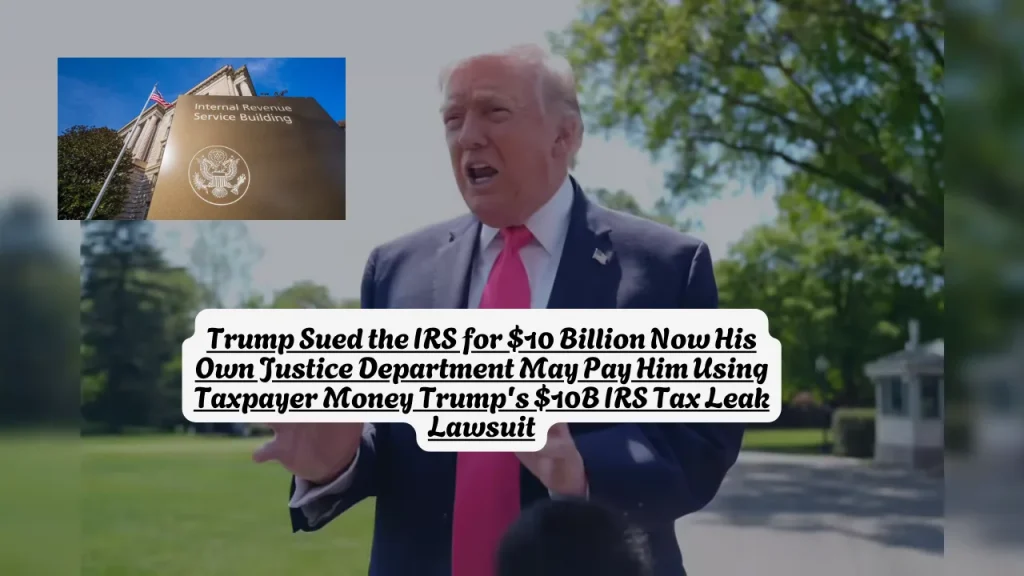
President Donald Trump sued the IRS and Treasury Department in January 2026 for at least $10 billion, claiming the agency failed to stop the unauthorized leak of his tax returns during his first administration. Now, the department that is supposed to defend the IRS in court is considering settling the case — and the money would come from American taxpayers.
The Leak That Started It All
The lawsuit centers on Charles Littlejohn, a former IRS contractor who worked for Booz Allen Hamilton. Littlejohn illegally obtained and disclosed Trump’s tax returns to outlets including the New York Times and ProPublica.
Littlejohn was sentenced in 2024 to five years in prison after pleading guilty to the leak. His criminal conviction is not in dispute. What is in dispute is whether the IRS bears legal responsibility — and how much that responsibility is worth.
The legal basis for Trump’s claim is Section 7431 of the Internal Revenue Code, which allows any taxpayer whose returns are unlawfully disclosed to sue the federal government for civil damages. That statute exists to protect every American taxpayer, not just presidents.
The Conflict That Makes This Case Unusual
This is not a typical lawsuit between two parties with opposing interests. Trump, as president, effectively controls both sides of it.
Trump is suing an IRS that he effectively controls, which is being represented by a DOJ he also effectively controls. For a case to be valid, the parties must demonstrate they are actually on opposite sides — otherwise the case can be thrown out of court.
Trump himself acknowledged the dynamic on a trip aboard Air Force One in January, telling reporters it was “very interesting” to be on both sides of a lawsuit. He added that he was thinking of donating any money he might win to charity: “We could make it a substantial amount — nobody would care because it’s going to go to numerous very good charities.”
Legal experts have not found that reassuring. CNN Senior Legal Analyst Elie Honig, a former federal prosecutor, said the case involves “the obvious irregularity of having essentially the same person in interest” on both sides. He noted that while Trump’s tax returns clearly should not have been disclosed, “Trump is essentially suing the executive branch that he now leads — and so the conflicts of interest here jump off the page.”
What the Judge Said
U.S. District Judge Kathleen Williams ordered the Justice Department to explain in writing by May 20 how she can oversee the case when the Constitution requires legitimate adversarial disputes for courts to have jurisdiction.
Williams wrote: “Although President Trump avers that he is bringing this lawsuit in his personal capacity, he is the sitting president and his named adversaries are entities whose decisions are subject to his direction.”
Williams also appointed a group of six well-respected lawyers not otherwise involved in the case to provide their views on whether Trump’s lawsuit is legitimate. She has set a hearing on the matter for May 27.
A group of former IRS officials and tax experts filed a brief in the case calling it “collusive litigation” that threatens the integrity of the judicial process. They urged the judge to put the case on hold until Trump leaves office.
Related article: Tiffany McElroy Gave Birth on a Jail Floor as Guards Watched But Other Inmates Saved Her Baby
What a Settlement Could Look Like
Among the options being discussed internally is whether a settlement would include a provision requiring the IRS to drop audits of Trump, his family members, and their businesses. One person familiar with the discussions said that no firm decisions have been made, and that it remains unclear whether a monetary payment is being considered.
IRS procedures call for the mandatory audit of the president and vice president’s annual tax returns. Federal law also prohibits the president from ordering the start or conclusion of an IRS audit of a specific taxpayer. In 2024, the Times reported that a loss in an IRS audit could cost Trump more than $100 million.
Some estimates suggest a full $10 billion settlement would cost each American taxpayer roughly $100. Democratic lawmakers have introduced a bill that would bar presidents, vice presidents, and their families from collecting lawsuit settlement payments from the federal government while in office, but it has gained little traction in the Republican-controlled Congress.
This Is Not the First Settlement of Its Kind
The DOJ’s settlement discussions come as it has already resolved other lawsuits brought by Trump allies. In April, it settled a lawsuit by former Trump campaign adviser Carter Page over government surveillance. In March, it paid former national security adviser Michael Flynn over a million dollars following what Flynn described as a wrongful prosecution — a case where Flynn had originally sued for $50 million.
Can the Judge Stop a Settlement?
If a settlement is reached before Williams rules on whether the underlying lawsuit is valid, legal experts say her authority would be limited. She would not likely be able to prevent Trump from simply withdrawing the suit and coming to a private agreement with the federal government.
Legal consensus holds that even if a judge were to find the settlement collusive or reached in bad faith, she would likely be unable to stop money or other benefits from changing hands.
If Your Tax Records Were Also Leaked
You may not realize it, but the IRS confirmed it notified 405,427 taxpayers whose information was inappropriately disclosed by Littlejohn — with 89% of those being business entities. The IRS sent Letter 6613 to affected taxpayers. If you received one, your records were part of the breach, and the same statute Trump is using — 26 U.S.C. § 7431 — is available to any taxpayer whose returns were unlawfully disclosed.
For more background on how this case developed before settlement talks began, read our earlier coverage: Trump’s $10B IRS Tax Return Leak Lawsuit — and Why a Judge Questions If It Can Proceed.
If you received a settlement from a government agency and are wondering whether it counts as taxable income, see: Are Lawsuit Settlements Taxable?
Frequently Asked Questions
Why is Trump suing the IRS if he controls it?
Trump filed the suit in his personal capacity, not as president. His legal team argues the IRS is responsible for Littlejohn’s actions because it failed to correct longstanding security vulnerabilities. The suit seeks compensation under a federal statute that applies to any taxpayer whose records were unlawfully disclosed.
Is the IRS required to audit the president?
Yes. IRS procedures require the mandatory audit of the sitting president’s annual tax returns. Dropping those audits as part of a settlement would be an extraordinary and legally contested outcome.
What law governs this kind of tax record leak claim?
26 U.S.C. § 7431 of the Internal Revenue Code governs civil damages for unauthorized disclosure of tax return information. Any taxpayer — not just Trump — can file a claim under this statute.
What happens if the case settles before the judge rules?
Legal experts say the judge would have limited power to stop it. Trump could withdraw the lawsuit and reach a private agreement with the government, bypassing the court’s concerns about the conflict of interest entirely.
Disclaimer: This article is for general informational and educational purposes only and does not constitute legal advice. Laws vary by state and jurisdiction. For advice about your specific situation, consult a qualified attorney.
Prepared by the AllAboutLawyer.com Editorial Team and reviewed for factual accuracy against official legal sources. Last Updated: May 14, 2026.
About the Author
Israr Ahmad is a legal content researcher with 4+ years of experience covering class action settlements and consumer rights cases. He has researched and published coverage of 2,500+ settlements using verified court records, settlement administrator filings, and government sources. Learn more about Israr.