
Raw Farm Cheese Recalled Over E. Coli Outbreak 2026, Check Your Fridge Now
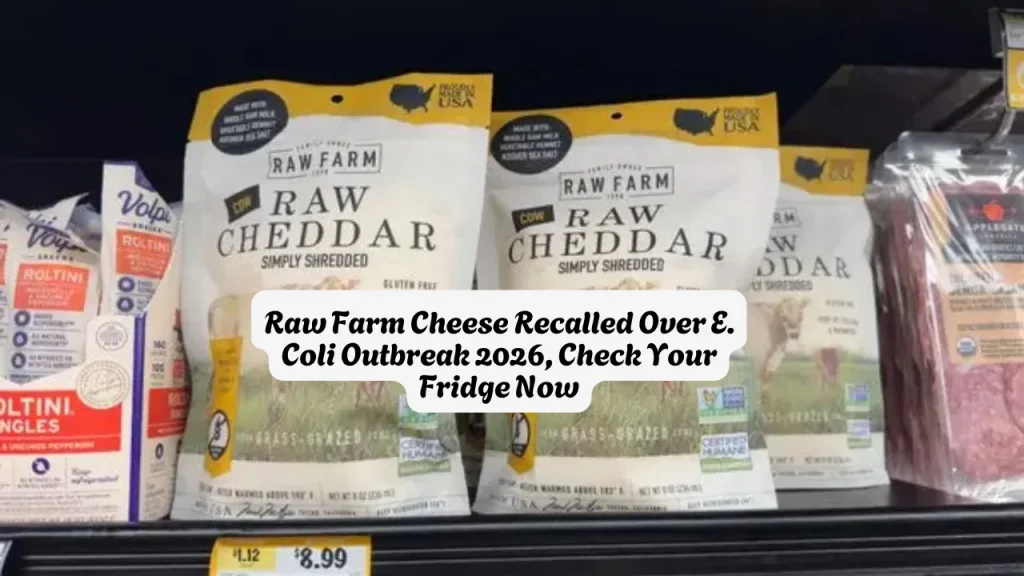
If you have Raw Farm-brand raw cheddar cheese in your refrigerator, stop eating it. On April 2, 2026, RAW FARM, LLC initiated a voluntary recall of certain RAW FARM-brand cheeses after the FDA and CDC linked the product to a multistate E. coli outbreak. A total of 9 people infected with the outbreak strain of E. coli have been reported from 3 states, with illnesses starting from September 1, 2025 to February 20, 2026. Three people have been hospitalized and one person developed hemolytic uremic syndrome, a serious condition that can cause kidney failure. No deaths have been reported. The investigation is ongoing.
Quick Facts
| Field | Detail |
| Recalled Brand | RAW FARM (Raw Farm, LLC — Fresno, California) |
| Product Type | Raw cheddar cheese — block and shredded varieties |
| Recall Date | April 2, 2026 |
| Recall Type | Voluntary (issued “under protest”) |
| Pathogen | E. coli O157:H7 |
| Total Illnesses | 9 confirmed, across California, Florida, and Texas |
| Hospitalizations | 3 |
| Serious Complications | 1 case of HUS (kidney failure risk) |
| Deaths | 0 |
| Most at Risk | Children under 5, elderly, immunocompromised individuals |
| Retailers Reported | Sprouts Farmers Market, H-E-B, Whole Foods Market |
| Distribution | Nationwide |
| What to Do | Do not eat, sell, or serve. Return for a full refund. |
Which Products Are Recalled — Check These Exactly
The recalled items, which also include any batches produced prior to these dates, are: 8 oz Lightly Salted Cheddar Block, Batch 20251027-2, Expiration 8/23/2026; 80 oz Lightly Salted Cheddar Block, Batch 20251015-4, Expiration 8/11/2026; 16 oz Lightly Salted Cheddar Block, Batch 20251027-4, Expiration 8/23/2026; 80 oz Bag of Original Cheddar Shred, Batch 20260205, Expiration 5/6/2026; 16 oz Jalapeño Cheddar Block, Batch 20251128-1J, Expiration 9/24/2026; 8 oz Lightly Salted Cheddar Shred, Batch 20260212, Expiration 5/13/2026; and 8 oz Jalapeño Cheddar Block, Batch 20251128-2J, Expiration 9/24/2026.
The recall also includes bulk products: 80 oz original raw cheddar cheese blocks with expiration dates on or before 8/11/2026 and 80 oz original shredded raw cheddar cheese with expiration dates on or before 5/6/2026.
Any batches produced prior to the dates listed above are also subject to the recall. Check your package’s batch number and expiration date against this list. Product photos are available on the FDA’s official outbreak investigation page.
What to Do If You Have This Cheese
The FDA, CDC, and Raw Farm all say the same thing: do not eat the recalled product.
Step 1 — Check your refrigerator (and freezer, in case you froze any) for Raw Farm-brand raw cheddar cheese. Look for the brand name, batch numbers, and expiration dates listed above.
Step 2 — If you have any of the recalled products, do not eat them — even if they look and smell fine. E. coli contamination is invisible.
Step 3 — Return the product to the store where you purchased it for a full refund. Raw Farm advises consumers to return packages to the store where they were purchased for a full refund. Sprouts Farmers Market customers can contact Sprouts Customer Relations at [email protected] or visit a local store with a receipt.
Step 4 — If you already ate the recalled cheese and feel unwell, contact a healthcare provider immediately. Tell them what you ate and when.
Step 5 — If you have questions, contact Raw Farm directly at rawfarmusa.com/contact.
Estimated time to check your fridge and confirm: approximately 2 minutes.
Related article: $7.1M Wheeler REIT Stock Dilution Settlement, Were You Eligible to Claim?
What Is E. Coli O157:H7 and Why Is It Dangerous?
E. coli O157:H7 is a particularly serious strain of the bacteria. Unlike milder forms of E. coli, this strain can cause life-threatening illness even in previously healthy people.
Symptoms begin anywhere from a few days after consuming contaminated food or up to nine days later. Symptoms include severe stomach cramps, diarrhea, fever, nausea, and/or vomiting. Some infections can cause severe bloody diarrhea and lead to life-threatening conditions, such as a type of kidney failure called hemolytic uremic syndrome (HUS), or the development of high blood pressure, chronic kidney disease, and neurologic problems.
HUS is the most dangerous complication. Symptoms of HUS include fever, abdominal pain, feeling very tired, decreased frequency of urination, small unexplained bruises or bleeding, and pallor. Many people with HUS recover within a few weeks, but some suffer permanent injuries or death. This condition can occur among people of any age but is most common in children younger than five years old because of their immature immune systems, older adults because of deteriorating immune systems, and people with compromised immune systems such as cancer patients.
If you or a family member develop these symptoms after eating Raw Farm cheese, seek emergency medical care immediately — do not wait.
Who Is Most at Risk in This Outbreak?
Over half of the illnesses are in children under five years old. This is the population most vulnerable to developing HUS from E. coli O157:H7. If a young child in your household ate any Raw Farm raw cheddar cheese, monitor them closely for symptoms and contact a pediatrician right away if anything seems wrong.
Other high-risk groups include elderly individuals and people with weakened immune systems, including those undergoing cancer treatment, taking immunosuppressant medications, or living with chronic illnesses.
How the FDA Connected This Cheese to the Outbreak
The FDA and CDC did not find E. coli in product samples — but their investigation still linked the cheese to the outbreak through a different method: genetic fingerprinting of the bacteria in sick patients.
Genetic sequencing of E. coli strains from sick people showed that they are all closely related, indicating people in the outbreak share a common source of infection. State and local public health officials were able to interview eight patients or their caregivers. All said they had consumed raw dairy products before falling ill. Two whose illness started in late 2025 said they drank Raw Farm’s raw milk, and five who fell sick in 2026 had eaten the company’s raw cheddar.
This pattern — all sick patients genetically linked to the same E. coli strain, nearly all reporting the same brand — is how public health agencies identify a common source even when product tests come back negative. Retail samples may not represent the exact batches consumed weeks or months earlier by people who are now sick.
Raw Farm’s Position: “Under Protest”
This recall is unusual because the company that issued it says it should not have had to.
Raw Farm stated: “No pathogens have been found in RAW FARM-brand cheese products. No pathogens have been found in FDA samples collected directly or samples collected by state Health Department officials. RAW FARM continues to contest the epidemiological links provided by the FDA. This voluntary recall is being performed under protest. This voluntary recall is performed as a path forward.”
Aaron McAfee, the president of Raw Farm, said: “It was a standoff between us and them.” He said he decided to comply with the FDA after speaking to the company’s lawyers and to prevent further damage to the business. He estimated that the recall included 170,000 pounds of cheese, valued at approximately $1.5 million.
Raw Farm’s position — that no pathogen has been found in its products — is factually accurate as of the date of this article. The FDA’s position is that epidemiological evidence is sufficient to establish the product as the likely source of the outbreak, even without a confirmed positive product test.
This Is Not the First Time
This recall does not happen in isolation. Raw Farm has been linked to previous E. coli outbreaks, including one in 2024 also for raw cheddar cheese that resulted in five people being hospitalized.
During that 2024 outbreak, Raw Farm initiated a recall on February 16, 2024 — but then withdrew it just ten days later, despite federal agencies identifying its cheese as the confirmed source of the outbreak.
Raw Farm’s products alone have been associated with at least 239 reported cases of food poisoning since 2006, according to food safety lawyer Bill Marler of MarlerClark, including a Salmonella outbreak in October 2024 that sickened 171 people.
Why Raw Milk Cheese Carries Extra Risk
Understanding why this keeps happening requires understanding what makes raw milk cheese fundamentally different from pasteurized dairy.
Raw milk has not been pasteurized, which kills germs like E. coli, Salmonella, Listeria, and Campylobacter. Pasteurization is a heating process that eliminates pathogens while leaving the nutritional profile of milk largely intact. Raw milk and cheeses made from it skip this step entirely, which means any bacteria present in the milk can survive into the finished product.
Interest in and sales of raw milk have been rising in recent years, fueled by social media and growing support from Health Secretary Robert F. Kennedy Jr.’s Make America Healthy Again movement. The federal government does not allow the sale of unpasteurized milk across state lines for human consumption, though state regulations on raw dairy vary widely.
Important Dates
| Milestone | Date |
| Earliest Reported Illness | September 1, 2025 |
| Most Recent Reported Illness | February 20, 2026 |
| FDA/CDC Investigation Announced | March 2026 |
| First Recall Request Issued by FDA | March 2026 |
| Raw Farm Refused Recall | Multiple weeks |
| FDA Conducted Facility Inspection | Late March 2026 |
| Raw Farm Issued Voluntary Recall | April 2, 2026 |
| Investigation Status | Ongoing |
Frequently Asked Questions
I ate Raw Farm cheese. What should I watch for?
Symptoms can begin anywhere from a few days after consuming contaminated food or up to nine days later and include severe stomach cramps, diarrhea, fever, nausea, and/or vomiting. If you develop any of these symptoms — especially bloody diarrhea — contact a healthcare provider immediately and tell them what you ate and when. Do not take anti-diarrheal medication without a doctor’s guidance, as this can worsen some E. coli infections.
My child ate this cheese. Should I go to the ER?
If your child shows any symptoms of E. coli infection — particularly reduced urination, unusual bruising, or extreme fatigue, which are signs of HUS — seek emergency care right away. For children who ate the cheese but feel fine, contact your pediatrician to discuss monitoring. The CDC notes that most healthy people recover completely within a week, but children under 5 are in the highest-risk group for serious complications.
The package has an expiration date after the recall dates. Is it still safe?
No. The recall covers specific batches and all batches produced prior to the dates listed. An expiration date in the future does not mean the product is safe. Check the batch number, not just the expiration date. If the batch number matches or predates the recall, do not eat it.
Can I get a refund?
Yes. Customers with questions may contact Sprouts Customer Relations at [email protected] or request a refund at your local Sprouts store with a receipt. For purchases at other retailers, return the product to the store where you bought it.
Is all Raw Farm cheese recalled?
No. The recall is limited to Raw Farm-brand cheddar cheese, and no other Raw Farm products are being voluntarily recalled. However, the FDA has previously issued advisories covering other Raw Farm raw dairy products tied to earlier illnesses in the same investigation period.
Why did Raw Farm wait so long to recall?
The dairy waited 21 days to initiate the recall after the FDA first requested it. Raw Farm disputes the FDA’s evidence linking its cheese to the outbreak and conducted the recall “under protest” after ultimately deciding it was the right path forward for the business.
Is this still under investigation?
Yes. FDA’s investigation is ongoing. At this time, FDA is not aware of any positive samples, and sample analysis is ongoing. The CDC notes the true number of sick people is likely higher than reported because many people recover without seeking medical care or being tested.
Should I avoid all raw dairy products?
The CDC’s standing recommendation is that pasteurized dairy is the safest choice. The CDC advises: choosing pasteurized milk and dairy products is the best way to safely enjoy the nutritional benefits of milk. If you currently have raw dairy products at home from any brand, check the FDA’s website for current advisories.
Sources & References
- FDA Official Outbreak Investigation Page — E. coli O157:H7, Raw Cheddar Cheese (March 2026)
- CDC Outbreak Investigation Update — March 2026
- Raw Farm Voluntary Recall Notice — FDA.gov
For related food safety coverage, see our article on the FDA recall affecting nearly 2,000 products including Tylenol and Advil from a contaminated warehouse and our coverage of food labeling and safety lawsuits involving dairy products.
Last Updated: April 5, 2026
Disclaimer: This article is for informational purposes only and does not constitute medical or legal advice. If you believe you have consumed contaminated food and are experiencing symptoms, contact a healthcare provider immediately. For the most current recall and outbreak information, visit the FDA’s official website at fda.gov and the CDC at cdc.gov.
About the Author

Sarah Klein, JD, is a licensed attorney and legal content strategist with over 12 years of experience across civil, criminal, family, and regulatory law. At All About Lawyer, she covers a wide range of legal topics — from high-profile lawsuits and courtroom stories to state traffic laws and everyday legal questions — all with a focus on accuracy, clarity, and public understanding.
Her writing blends real legal insight with plain-English explanations, helping readers stay informed and legally aware.
Read more about Sarah