
Kat Von D Tattoo Lawsuit, What Happened, What the Courts Said, and What Comes Next
Photographer Jeffrey Sedlik sued celebrity tattoo artist Kat Von D in 2021, claiming she infringed his copyright when she tattooed his iconic photo of Miles Davis onto a friend’s arm. A jury cleared her in January 2024. The Ninth Circuit Court of Appeals backed that verdict on January 2, 2026. But as of April 2026, the case is not completely over — the photographer has asked a larger panel of judges to reconsider the ruling, and the court has ordered Kat Von D’s team to respond.
Quick Facts
| Field | Detail |
| Case Name | Sedlik v. Von Drachenberg, et al., No. 24-3367 |
| Court | U.S. Court of Appeals for the Ninth Circuit |
| Who Sued Whom | Photographer Jeffrey Sedlik sued Kat Von D (Katherine Von Drachenberg), Kat Von D Inc., and High Voltage Tattoo Inc. |
| What Was Alleged | Copyright infringement — Kat Von D used Sedlik’s 1989 Miles Davis photograph as reference for a tattoo |
| Jury Verdict | Kat Von D won — January 2024 |
| Ninth Circuit Ruling | Affirmed jury verdict — January 2, 2026 |
| Damages Sought | Up to $150,000 |
| En Banc Petition Filed | February 17, 2026 (Sedlik asking full court to reconsider) |
| Response Filed | March 10, 2026 (Kat Von D’s team) |
| Current Status | Pending — en banc petition under review |
| Case Filed | February 2021 |
Where Things Stand Right Now
- The U.S. Court of Appeals for the Ninth Circuit affirmed the jury’s verdict in a January 2, 2026, precedential opinion, finding that the allegedly infringing works were fair use and not substantially similar to Sedlik’s photograph.
- Sedlik filed a Petition for Rehearing En Banc on February 17, 2026, asking the full Ninth Circuit — not just the three-judge panel — to reconsider the ruling. The court ordered Kat Von D’s team to file a response, which they did on March 10, 2026.
- Two judges on the original panel filed concurring opinions sharply criticizing the Ninth Circuit’s legal test for copyright infringement — and suggested that a full court en banc panel or future case should reform or scrap it entirely. That internal friction is exactly what Sedlik is betting on with his petition.
How This All Started
In 2017, Kat Von D gave her friend Blake Farmer a gift: a free tattoo of jazz legend Miles Davis. Farmer, a lighting technician who had worked with Von D on film projects, played trumpet himself and had a deep connection to Miles Davis. After learning how important Davis was to him, she offered to create a tattoo of the musician.
She used photographer Jeffrey Sedlik’s iconic 1989 photograph of Davis — showing him with his finger to his lips in a “shushing” gesture — as reference material for the tattoo design. Sedlik owns a registered copyright for the photograph, which was named one of Life Magazine’s “Pictures of the Year” and appeared on the cover of JAZZIZ Magazine.
Related article: $7.15M Joybird False Discount Settlement, Did You Buy Furniture at a Fake Sale Price?
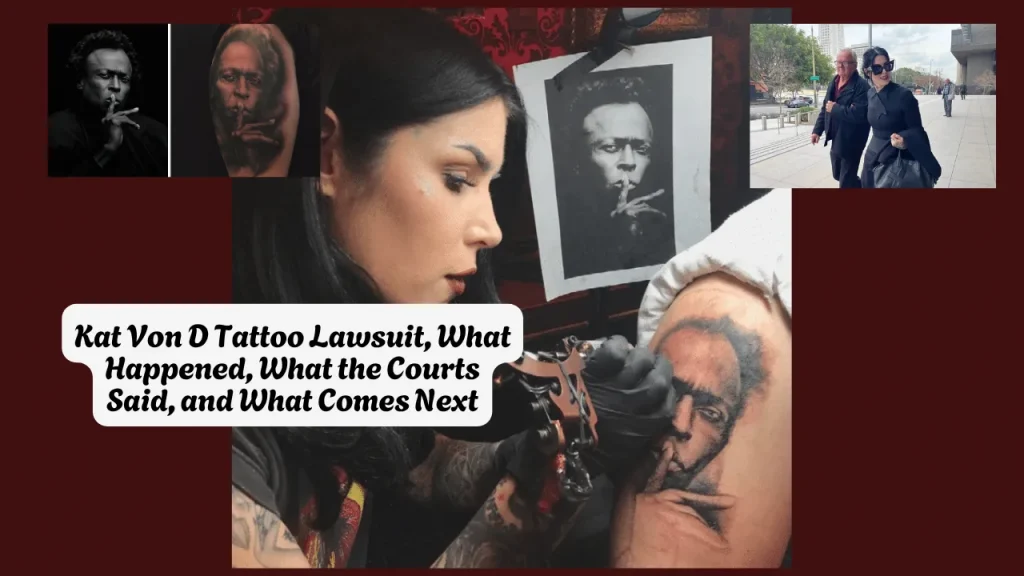
The lawsuit contends that despite tattooing the design for free, Kat Von D received indirect economic benefit in the form of advertising, promotion, and goodwill after sharing photos of the tattoo on social media. Sedlik filed suit in February 2021, seeking up to $150,000 in damages.
This was genuinely uncharted legal territory. As far as anyone knew, this was the first time a tattoo artist had been sued for using a copyrighted photograph as reference for a tattoo — and the first such lawsuit to go to trial.
What Kat Von D Was Actually Accused Of
Sedlik’s case was not just about the tattoo itself. It covered several different works Kat Von D created and posted:
The jury examined ten allegedly infringing works in total — the tattoo, a preparatory sketch, and several social media posts. The jury found that six of those works, including the tattoo and the sketch, were not substantially similar to Sedlik’s photograph. Von Drachenberg acknowledged that four additional social media posts, called “Process Images,” did contain a direct reproduction of Sedlik’s photograph while she was inking the tattoo. However, the jury still ruled those posts were protected by fair use.
The central legal dispute came down to one question: did Kat Von D copy enough of Sedlik’s protected creative expression — not just the general likeness of Miles Davis — to cross the line into infringement?
There was no real dispute that Kat Von D copied from Sedlik’s photograph. She traced it on a light box, transferred a stencil to her friend’s arm, and inked the image with the photograph beside her as reference — a process her shop described on social media as producing a result “100% exactly the same.” The real fight was over whether that copying crossed the line into unlawful infringement.
What the Jury Decided — and Why It Mattered
In January 2024, the Los Angeles jury took only a few hours to reject Sedlik’s claims. Jurors concluded that the tattoo was not substantially similar to the original photograph and that any social media posts showing Sedlik’s photo in the background were fair use.
Kat Von D’s reaction after the verdict captured how much the case had cost her personally. She said she may never create another tattoo again because her heart had been crushed by the ordeal, adding that she might make an exception for Farmer since the lawsuit had tainted his Miles Davis tattoo for him. “I’m excited to be done,” she said. “If we didn’t fight this, it would have done so much harm to an industry that’s already struggling.”
The lawsuit took a visible physical toll. Kat Von D said she lost weight, lost hair, and lost many nights of sleep over it. At times she wanted to settle just to make it stop — even though she believed the photographer did not deserve a penny.
The Ninth Circuit’s 2026 Ruling — and the Controversy Inside It
The Ninth Circuit’s January 2, 2026, ruling confirmed Kat Von D’s win. But the opinion became notable for something unexpected: two of the three judges openly questioned whether the legal test used to reach that outcome was actually a good one.
Although the panel’s decision was unanimous in favor of Kat Von D, two judges filed concurring opinions stating their belief that the Ninth Circuit should discard the “intrinsic test” applied by the jury — because it allows jurors to make their own subjective determinations based on “total concept and feel” and is therefore essentially unreviewable on appeal.
What is the intrinsic test? In copyright cases in the Ninth Circuit, juries apply a two-part check. The extrinsic test looks at specific objective similarities between works. The intrinsic test then asks whether an ordinary observer would feel the works are substantially similar overall. The problem the judges identified: once a jury says “no” on the intrinsic test, an appeals court has almost no power to overturn it — even if the judges themselves would have found infringement.
Judge Wardlaw characterized the intrinsic test as “fundamentally flawed,” arguing its focus on “total concept and feel” may conflict with copyright law’s core principle that ideas and concepts are not protected — only creative expression is. Judge Johnstone added that the test has drifted from its origins and now invites juries to reach copyright verdicts unconstrained by actual copyright law.
The concurring opinions suggested that reconsideration by an en banc panel — the full Ninth Circuit — would be the appropriate way to reform or replace the intrinsic test. That is precisely the door Sedlik walked through when he filed his en banc petition in February 2026.
The En Banc Petition: Is the Case Really Over?
Not yet. Sedlik filed a Petition for Rehearing En Banc on February 17, 2026. The Ninth Circuit ordered Kat Von D’s team to respond, which they did on March 10, 2026. As of early April 2026, the petition remains pending before the court.
An en banc hearing means the full Ninth Circuit — typically eleven judges — would rehear the case instead of the original three-judge panel. The court grants en banc review rarely, reserving it for cases involving exceptional legal importance or conflicting precedent. The two concurring opinions essentially wrote Sedlik’s argument for him: the judges themselves admitted the current test may produce unjust outcomes that courts cannot correct.
If the full court agrees to rehear the case, everything could change. If it declines, Kat Von D’s win becomes final — and the precedent stands as it is.
What This Means for Tattoo Artists
This case caught the tattoo industry’s attention for a reason: millions of tattoos incorporate copyrighted images, and almost none of them involve licensing agreements.
Legal experts noted that more tattoo artists could be emboldened to use iconic photographs for their artwork and associated social media posts in the wake of the ruling — at least in states covered by the Ninth Circuit.
But the two concurring opinions throw cold water on any sense of permanent security. The reliance on a jury’s subjective sense of “total concept and feel” means outcomes in copyright cases remain unpredictable, and verdicts may be difficult to appeal regardless of how strong a copyright claim appears on paper.
The safest path for tattoo artists has not changed: when using someone else’s photograph as direct reference material — especially in a way you plan to post publicly — consulting an intellectual property attorney remains the responsible move.
Full Timeline
| Date | What Happened |
| 1989 | Jeffrey Sedlik photographs Miles Davis; registers copyright in 1994 |
| 2017 | Kat Von D tattoos Miles Davis image on friend Blake Farmer’s arm; posts process photos on social media |
| February 2021 | Sedlik files copyright infringement lawsuit in Central District of California |
| January 27, 2024 | Jury finds Kat Von D did not infringe; rules social media posts were fair use |
| May 3, 2024 | District court denies Sedlik’s motion for judgment as a matter of law and new trial |
| January 2, 2026 | Ninth Circuit affirms jury verdict; two judges issue concurrences criticizing the intrinsic test |
| February 17, 2026 | Sedlik files Petition for Rehearing En Banc |
| March 10, 2026 | Kat Von D’s legal team files response to en banc petition |
| April 2026 | En banc petition pending — no decision yet |
Frequently Asked Questions
Did Kat Von D win the lawsuit?
Yes, so far. A jury cleared her in January 2024, and the Ninth Circuit Court of Appeals upheld that verdict on January 2, 2026. However, the photographer has filed a petition asking the full Ninth Circuit to reconsider the case, and that petition is still pending as of April 2026.
What was the lawsuit actually about?
Photographer Jeffrey Sedlik claimed Kat Von D infringed his copyright when she used his 1989 photograph of jazz musician Miles Davis as reference for a free tattoo she gave a friend in 2017. This was the first copyright infringement case involving a tattoo artist’s use of a copyrighted reference image to go to trial.
Did Kat Von D stop tattooing because of this case?
After the verdict, Kat Von D said she may never create another tattoo professionally again because the lawsuit crushed her heart. She testified she has not charged anyone for a tattoo in over a decade and only does work for friends for free.
What is an en banc petition and why does it matter?
An en banc petition asks the full Ninth Circuit — typically eleven judges instead of three — to rehear a case. Courts grant this rarely, usually when a case raises an important legal question the court needs to settle definitively. Given that two judges on the original panel openly criticized the legal test used in this case, Sedlik’s petition has an unusual basis for consideration.
Do I need a lawyer to participate in this case?
This is not a class action. It is a private copyright dispute between specific parties. Members of the public cannot join it or claim any settlement money. If you are a tattoo artist concerned about your own use of copyrighted reference images, consult an intellectual property attorney about your specific situation.
When will I receive my payment?
There is no settlement fund or payment for the public in this case. This question does not apply here.
What if I missed the claim deadline?
There is no claim process in this lawsuit. It is not a consumer class action.
What does this case mean for copyright law going forward?
Two Ninth Circuit judges have now publicly stated that the court’s fifty-year-old “total concept and feel” test is broken — and that the people in a position to fix it seem to agree for the first time. Whether the full court acts on those concurrences, either in this case or a future one, could reshape how copyright infringement is decided across entertainment, art, and the tattoo industry for years to come.
Sources & References
- Ninth Circuit Opinion — Sedlik v. Von Drachenberg, No. 24-3367, January 2, 2026 (Justia)
- CourtListener — Full Docket, Sedlik v. Von Drachenberg, Including En Banc Petition, April 2026
Last Updated: April 5, 2026
Disclaimer: This article is for informational purposes only and does not constitute legal advice. Legal claims and outcomes depend on specific facts and applicable law. For advice regarding a particular situation, consult a qualified attorney.
About the Author
Israr Ahmad is a legal content researcher with 4+ years of experience covering class action settlements and consumer rights cases. He has researched and published coverage of 2,500+ settlements using verified court records, settlement administrator filings, and government sources. Learn more about Israr.