
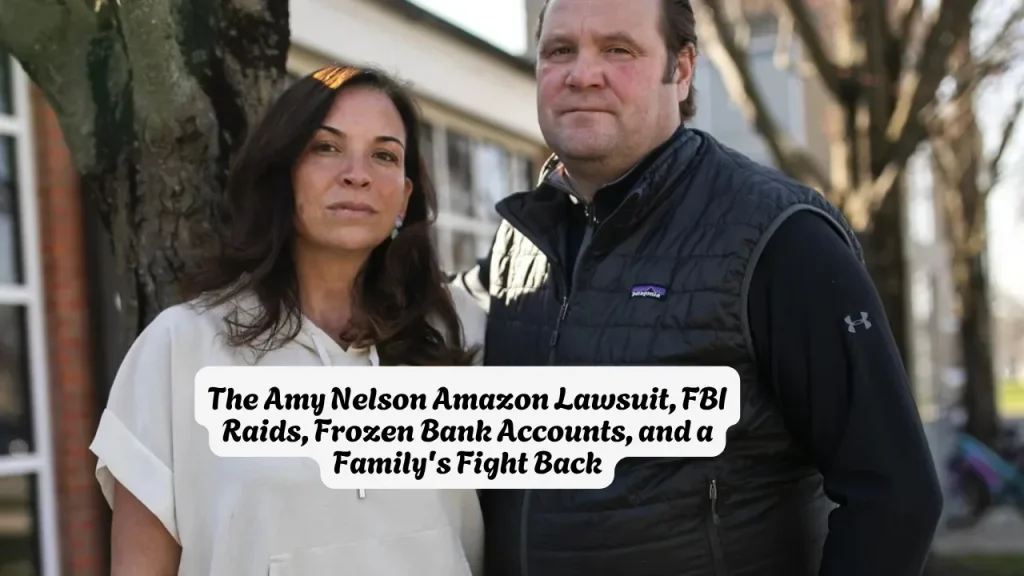
The Amy Nelson Amazon Lawsuit, FBI Raids, Frozen Bank Accounts, and a Family’s Fight Back
If you found Amy Nelson through TikTok or Instagram, you already know the short version: Amazon accused her husband of a crime, the FBI showed up at their door, the government froze nearly $900,000 of their money — and Carl Nelson was never charged. Here is the full story from beginning to present, told plainly so you can understand exactly what happened, what the courts decided, and where things stand today.
Quick Facts
| Field | Detail |
| Who Filed the Lawsuit | Amazon.com, Inc. (civil lawsuit against Carl Nelson and others) |
| Who Is Amy Nelson | Lawyer, entrepreneur, founder of The Riveter — Carl’s wife |
| What Amazon Alleged | Kickback scheme involving AWS real estate data center deals in Virginia |
| Criminal Charges Filed Against Carl Nelson | None — never charged with a crime |
| DOJ Investigation Outcome | Closed; prosecutors vacated related guilty pleas in January 2024 |
| Civil Lawsuit Outcome | Federal judge dismissed 7 of 8 Amazon claims in April 2023 |
| Money Seized by Government | Approximately $900,000 via civil asset forfeiture |
| Money Returned | Yes — Nelsons recovered 85% under a civil forfeiture settlement |
| Amazon Appeal | Amazon appealed the April 2023 ruling to the 4th Circuit |
| Case Status | Ongoing civil litigation; one remaining claim (civil conspiracy) |
| Case Name | Amazon.com Inc. et al. v. WDC Holdings LLC et al. |
| Court | U.S. District Court, Eastern District of Virginia |
Where Things Stand Right Now
- In April 2023, a federal judge dismissed seven of the eight claims Amazon brought against Carl Nelson, finding Amazon failed to prove it suffered any financial damage and that the activities Amazon complained about appeared to be authorized by Carl’s employment contract.
- By early 2025, the criminal side collapsed further. The DOJ had previously secured guilty pleas from two other individuals involved in the real estate deals. In a rare move, federal prosecutors asked to vacate those pleas — with the U.S. Attorney stating that continuing the prosecution was “not in the best interests of justice.”
- Amazon appealed the April 2023 dismissal ruling to the U.S. Court of Appeals for the 4th Circuit, arguing it did suffer significant monetary harm. Carl Nelson and his attorneys continue to fight back, and the couple has used public appearances to advocate for civil asset forfeiture reform.
How This All Started
In 2020, Amazon accused Carl Nelson of lining his own pockets as he steered real estate deals for Amazon data centers in Northern Virginia. Carl Nelson and a colleague, Casey Kirschner, worked on acquiring land for Amazon Web Services — the company’s cloud computing division.
Amazon alleged that Nelson, Kirschner, and real estate developer Brian Watson engaged in an elaborate scheme to defraud Amazon and co-opt its business for their own personal gain. In one deal, two Northstar employees purchased land for roughly $98.7 million and sold it to Amazon the same day for over $116 million. Amazon alleged that insiders received kickbacks for steering the deal.
Related article: Kat Von D Tattoo Lawsuit, What Happened, What the Courts Said, and What Comes Next
Carl’s defense was straightforward: he argued his 2012 employment contract explicitly allowed for outside business activities. He maintained the deals were vetted and that Amazon actually saved money on the transactions. Carl and his co-defendants denied any wrongdoing from the start.
The FBI Raid and the Frozen Bank Accounts
This is the part that went viral — and it is every bit as alarming as it sounds.
On April 2, 2020, the FBI arrived at the Nelsons’ West Seattle home. While Carl was never arrested, the government “arrested” their money. Nearly $900,000 of Carl and Amy’s funds were seized — even though Amy was never the subject of the investigation — because of the commingling of their joint accounts.
The legal mechanism behind this is called civil asset forfeiture — a process that allows the government to seize property suspected of being connected to a crime, even before any charges are filed or any conviction is obtained.
For nearly two years, the Nelsons were not even permitted to see Amazon’s allegations, which remained under seal. For 22 months, they were denied the ability to contest the seizures in any judicial proceeding. With their accounts frozen and credit cards cut off, the family could not pay their mortgage and ultimately sold their Seattle home.
The Nelsons asked the court to return their money, but prosecutors approached them with a settlement offer. They agreed to recover 85% of the seized money in exchange for a promise not to sue under civil forfeiture.
What the Courts Actually Decided
The federal judge’s April 2023 ruling was a significant moment in this case.
A Virginia federal judge ruled in favor of Carl Nelson and summarily dismissed all of the federal claims made by Amazon, ruling that Nelson had not breached his employment contract and that Amazon failed to show any damages, despite alleging millions of dollars in losses.
Out of eight claims in Amazon’s lawsuit, the judge allowed only one — civil conspiracy — to proceed to trial against Nelson, Kirschner, and developer Brian Watson. A second claim for tortious interference proceeded only against Watson and related entities.
Amazon appealed the ruling in December 2023, arguing in court documents that it did suffer significant monetary harm. That appeal is still working through the 4th Circuit Court of Appeals. The remaining civil conspiracy claim still has no final resolution.
What Is Civil Asset Forfeiture — and Why Does It Matter?
Most people assume the government needs a conviction — or at least a charge — before it can take your bank account. The Nelson case is a real-world demonstration that this assumption is wrong.
Civil asset forfeiture is a legal process that allows law enforcement to seize property from people suspected of involvement in crime or illegal activity, even if they have not been charged or convicted.
Amy Nelson argues her family’s story reveals a specific abuse of that system: former FBI and Department of Justice employees who now work for Amazon leveraged existing government relationships to push federal authorities to pursue criminal charges and a civil forfeiture case. Amazon has disputed these characterizations.
According to Amy Nelson, the government collaborated with Amazon attorneys to seize millions in assets from at least 53 companies, investors, law firms, and individuals. Multiple small businesses shut down, more than 50 people lost their jobs, and 12 children lost their family homes — either seized by federal authorities or sold to cover attorney’s fees.
Amy Nelson’s Role: Going Public to Fight Back
Amy Nelson is a lawyer and the founder of The Riveter, a co-working network built to support women at work. When Amazon’s accusations upended her family’s life, she made a decision that proved consequential: she went public.
Amy Nelson’s decision to post on TikTok and Instagram arguably changed the trajectory of the case. By bringing public attention to the situation, she made it much harder for the legal machinery to operate without scrutiny.
Over the years, the family had to fundraise to make ends meet and pay substantial legal bills. Amy has become one of the most outspoken critics of Amazon and the DOJ, which she accuses of doing Amazon’s dirty work.
On May 8, 2025, Amy Nelson posted an allegation on Instagram that Amazon CEO Jeff Bezos leveraged his political influence to pursue federal criminal charges against her husband. She stated that charges were never filed and that the federal judge dropped all charges. Amazon has denied these characterizations throughout the case.
What Amazon Says
Amazon has maintained throughout this case that its former employees participated in a legitimate fraud investigation and that it reported the alleged scheme to law enforcement only after conducting its own internal review.
An Amazon spokesperson said the defendants “orchestrated a sophisticated scheme to obtain millions of dollars in kickbacks” and that given the facts uncovered, the company had “no choice but to act to protect our interests.”
Amazon said customers — and in this context, shareholders — are not without recourse when fraud is suspected, and that the company always seeks to protect its interests when employees violate trust. Amazon has not admitted any wrongdoing in how it handled the investigation.
Timeline of Key Events
| Date | What Happened |
| December 2019 | Anonymous email sent to Jeff Bezos alleging kickback scheme involving Carl Nelson |
| January 2020 | Amazon lawyers contact federal prosecutors |
| April 2, 2020 | FBI arrives at Nelsons’ Seattle home; ~$900,000 in family funds seized |
| 2020 | Amazon files civil lawsuit in Virginia federal court |
| 2021–2022 | Nelsons sell their home; Carl never charged with a crime |
| Early 2022 | Government returns seized money; Nelsons recover 85% via settlement |
| April 6, 2023 | Federal judge dismisses 7 of 8 Amazon civil claims against Carl Nelson |
| December 2023 | Amazon appeals the dismissal ruling to the 4th Circuit |
| January 2024 | DOJ moves to vacate guilty pleas of two co-defendants |
| May 2025 | Amy Nelson publicly alleges Bezos used political influence against her family |
| Ongoing | Amazon appeal pending; one civil conspiracy claim unresolved |
Frequently Asked Questions
Was Carl Nelson ever charged with a crime?
No. Despite a years-long DOJ investigation triggered by Amazon’s allegations, Carl Nelson was never publicly charged with a crime. In early 2025, federal prosecutors took the rare step of vacating guilty pleas from two other individuals connected to the case, effectively closing the criminal investigation.
What did Amy Nelson’s husband actually do at Amazon?
Carl Nelson and colleague Casey Kirschner worked on real estate deals to acquire data centers for Amazon Web Services. The two represented Amazon in at least 10 land deals with developer Brian Watson and his company, Northstar Commercial Partners. Carl argued his contract permitted outside business activity and that he did nothing wrong.
What is civil asset forfeiture, and how did it affect the Nelsons?
Civil asset forfeiture allows the government to seize property connected to a suspected crime — before any charge or conviction. Nearly $900,000 of the Nelsons’ money was seized even though Amy was never a subject of the investigation, because of the commingling of their joint accounts. They ultimately settled to recover 85% of it, giving up the right to sue over the seizure.
Did the judge rule in Carl Nelson’s favor?
Largely yes. The federal judge dismissed all of Amazon’s federal claims, ruling Carl had not breached his employment contract and that Amazon failed to show any damages. One civil conspiracy claim survived and remains unresolved while Amazon’s appeal proceeds.
Is this lawsuit still going?
Yes. Amazon appealed the April 2023 ruling to the 4th Circuit Court of Appeals. The one remaining civil conspiracy claim against Carl Nelson, Casey Kirschner, and developer Brian Watson has not reached a final verdict. Carl also filed a separate Washington state lawsuit against Amazon alleging noncompete violations, which remains paused until the Virginia case concludes.
Do I need a lawyer to follow or participate in this case?
This is not a class action — it is a civil lawsuit between Amazon and specific individuals. Ordinary consumers cannot join this case. If you believe you have experienced similar issues with civil asset forfeiture or an employer-driven federal investigation, consult a qualified attorney who handles civil rights or employment law.
Is there a settlement consumers can claim?
No. This lawsuit does not involve consumer claims. There is no settlement fund, no claim form, and no deadline for members of the public. To follow cases against Amazon that do involve consumers, you can read the full Amazon lawsuit tracker on AllAboutLawyer.com.
What happened to Amy Nelson’s company, The Riveter?
The Riveter, originally a co-working space for women, rebranded amid a shift to remote work. Amy is also preparing to launch a second company, Cotton Candy and Dreams, that curates family experiences with her four daughters. The family moved from Seattle to Columbus, Ohio.
Sources & References
Last Updated: April 5, 2026
Disclaimer: This article is for informational purposes only and does not constitute legal advice. Legal claims and outcomes depend on specific facts and applicable law. For advice regarding a particular situation, consult a qualified attorney.
About the Author
Israr Ahmad is a legal content researcher with 4+ years of experience covering class action settlements and consumer rights cases. He has researched and published coverage of 2,500+ settlements using verified court records, settlement administrator filings, and government sources. Learn more about Israr.