
Poland Constitutional Court Crisis Explained, Why Judges Are Fighting Over Control of the Tribunal
Poland’s Constitutional Tribunal has become the center of an escalating confrontation involving the government, the president, rival groups of judges, police and European legal institutions.
On October 30, 2026, Judge Anna Korwin-Piotrowska announced that she had ordered a temporary break in the official duties of Tribunal President Bogdan Święczkowski and Vice-President Bartłomiej Sochański. She said their conduct was preventing the court from functioning and blocking newly elected judges from working.
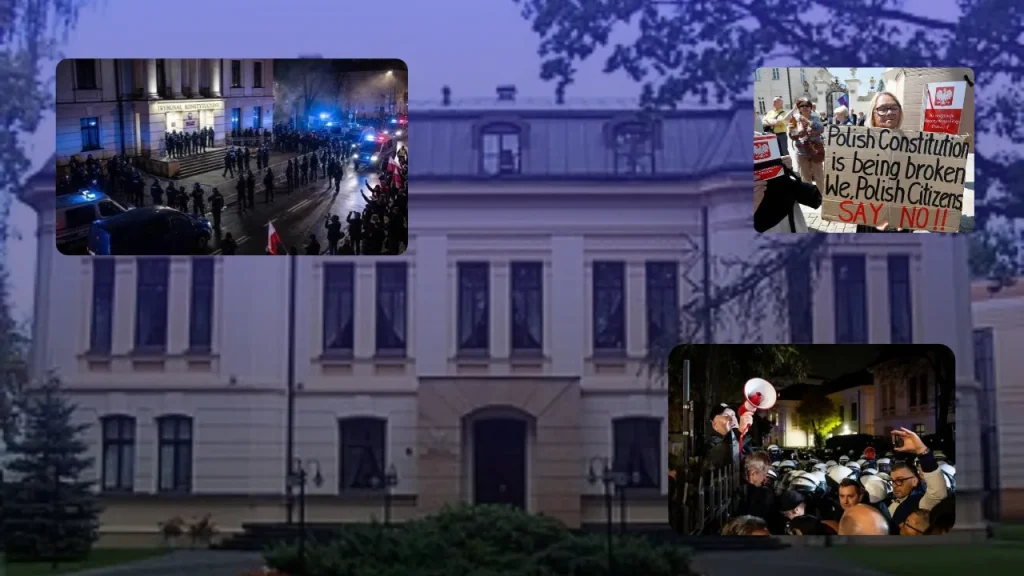
Police were deployed around the Tribunal in Warsaw, protesters clashed with officers, three people were detained, and President Karol Nawrocki cut short an official trip to Senegal and returned to Poland. The Tribunal’s leadership called the move a “coup d’état.”
The deeper question is not who controls the building. It is whether the people claiming authority over Poland’s top constitutional-review body have the legal power to do so.
As of October 31, 2026, no final court ruling has resolved the October 30 leadership dispute. Both sides advance competing interpretations of Polish law.
Poland Constitutional Tribunal Crisis: Quick Facts
| Detail | Information |
| Country | Poland |
| Court | Constitutional Tribunal (Trybunał Konstytucyjny), Warsaw |
| Tribunal President | Bogdan Święczkowski |
| Tribunal Vice-President | Bartłomiej Sochański |
| Judge who issued the suspension orders | Anna Korwin-Piotrowska |
| President of Poland | Karol Nawrocki |
| Prime Minister | Donald Tusk |
| Main opposition | Law and Justice (PiS) |
| Justice Minister and Prosecutor General | Waldemar Żurek |
| Latest confrontation | October 30, 2026 |
| Seats on the Tribunal | 15, each judge serving one 9-year term |
| Judges elected by the Sejm during 2026 | 8 |
| Judges whose oaths the president refused | 5 |
| ECHR case | Dziurda and Others v. Poland, application 17392/26 |
| EU Court of Justice case | Commission v Poland, C-448/23 (December 18, 2025) |
| Venice Commission opinion | CDL-AD(2026)031 (October 2026) |
| Key constitutional provisions | Articles 7, 8, 10, 173, 180, 188–190, 194–197 |
| Status | Unresolved; legality of the suspension orders not yet decided by any court |
The Short Version
- Poland’s Constitution says the Sejm elects the Tribunal’s 15 judges. A statute adds an oath before the president.
- President Nawrocki refused to receive the oaths of five elected judges. They swore in at the Sejm instead.
- Tribunal President Święczkowski refused to let them hear cases.
- On October 30, Judge Korwin-Piotrowska, herself one of the disputed judges, ordered a one-month break in the duties of the president and vice-president.
- The leadership rejects her authority. Experts are divided. No court has ruled.
1. What Is Poland’s Constitutional Tribunal and Why Does It Matter?
The Constitutional Tribunal examines whether laws and other legal acts comply with the Polish Constitution. It is not the Supreme Court, which handles appeals and extraordinary review.
Under Article 188, the Tribunal can review:
- Whether statutes comply with the Constitution.
- Whether international agreements comply with the Constitution.
- Whether acts of central state bodies comply with the Constitution, ratified treaties and statutes.
- Whether the aims or activities of political parties comply with the Constitution.
- Constitutional complaints about violations of rights (subject to Article 79).
Article 189 also lets it resolve jurisdictional disputes between central state institutions.
Under Article 190, its judgments are universally binding and final. They must be published in the official journal, and a judgment generally takes effect on publication, although the Tribunal can delay when an invalidated provision loses force.
Publication has itself become part of the dispute. The government has declined to publish certain Tribunal judgments because it disputes the court’s composition, while the Tribunal maintains they remain binding.
2. How Is the Tribunal Supposed to Work?
Article 194 sets the structure:
- The Tribunal has 15 judges.
- Each is elected individually by the Sejm, Poland’s lower house, for a single nine-year term, with no re-election.
- The President of Poland appoints the Tribunal’s President and Vice-President from candidates presented by the Tribunal’s General Assembly.
The Constitution gives the president no express power to choose or replace the judges the Sejm elects. However, ordinary legislation requires newly elected judges to take an oath before the president. That oath is where the current conflict began.
Article 195 says Tribunal judges are independent and subject only to the Constitution. Article 196 gives them criminal immunity: a judge cannot be held criminally liable or deprived of liberty without the Tribunal’s prior consent, apart from being caught in the act where detention is necessary.
The question of how far a head of state can shape a court after appointment is not unique to Poland. AllAboutLawyer has covered a U.S. angle in Can The President Influence A Supreme Court Justice After Appointment?, though the two systems work very differently.
3. Where Did the Crisis Begin? The 2015 Appointment Dispute
In 2015 Poland was governed by a Civic Platform-led coalition heading into an election. The outgoing parliament tried to elect five Tribunal judges before its term ended. Three seats were due to open in November 2015, and two in December, after the new parliament would take office.
December 3, 2015 (K 34/15). The Tribunal ruled that the outgoing parliament could validly elect judges for the three seats that fell vacant during its own term, but not for the two that fell vacant during the next parliament’s term.
Law and Justice takes power. After winning the October 2015 election, PiS rejected the earlier appointments and elected five replacements on December 2, 2015. President Andrzej Duda received their oaths. Three of those seats had already been validly filled, so two sets of people claimed the same three seats.
December 9, 2015 (K 35/15). The Tribunal ruled the replacement appointments to the three already-filled seats unconstitutional.
The EU Court of Justice later cited the irregular appointment of three members as a key reason the Tribunal did not meet the standard of an independent and impartial tribunal established by law.
4. 2016 to 2023: A Decade of Escalation
After 2015, PiS passed repeated changes affecting the Tribunal, Supreme Court, ordinary courts and the National Council of the Judiciary. Critics, including European institutions and judges’ associations, said the changes increased political influence over the courts. The former government said the reforms improved efficiency and accountability.
Changes to the Tribunal covered panel composition, case assignment, internal organization, judge status and the selection of its president.
- December 2016: Julia Przyłębska became Tribunal President. The procedure was later criticized, since Article 194(2) requires selection from candidates presented by the General Assembly.
- October 22, 2020 (K 1/20): The Tribunal ruled unconstitutional the abortion ground for severe fetal abnormalities. The ruling took effect on publication on January 27, 2021 and triggered mass protests.
- 2021 EU-law rulings: In P 7/20 (July 14, 2021) and K 3/21 (October 7, 2021), the Tribunal rejected interpretations of EU treaty obligations it saw as incompatible with the Polish Constitution. EU institutions viewed this as a challenge to the primacy of EU law.
The European Court of Human Rights also weighed in. In Xero Flor w Polsce v. Poland (application 4907/18, May 2021), it found a violation of Article 6(1) of the European Convention because an improperly appointed judge took part in a Tribunal panel. That judgment concerned the specific proceedings, not every Tribunal ruling.
5. Why Did Donald Tusk’s Government Stop Recognizing the Tribunal?
Donald Tusk’s coalition took power in December 2023, promising to restore judicial independence. It argued that the presence of improperly appointed judges undermined the Tribunal’s legitimacy, so it stopped publishing certain judgments.
The government cannot simply remove judges, because they hold nine-year terms and vacancies must be filled through the constitutional process. Progress was also slowed by the opposition of President Duda, whose term ended in August 2025, and later by President Nawrocki.
The European Commission formally closed its Article 7(1) procedure against Poland on May 29, 2024, after concluding the new government’s action plan had addressed the identified risk. That did not resolve every judicial dispute, and other proceedings continued.
6. Filling the Vacant Seats in 2026
By early 2026 only nine of the 15 seats were filled. On March 13, 2026, the Sejm elected six judges: Krystian Markiewicz, Maciej Taborowski, Marcin Dziurda, Anna Korwin-Piotrowska, Dariusz Szostek and Magdalena Bentkowska. PiS and other opposition members opposed the elections.
President Nawrocki, who took office in August 2025 and is politically aligned with the PiS camp, accepted the oaths of two of the six. He did not invite the other four, citing concerns about the selection procedure and qualifications.
The four (Korwin-Piotrowska, Dziurda, Markiewicz and Taborowski) took oaths at the Sejm on April 9, 2026 and sent notarized versions to the president. Święczkowski still refused to recognize them as judges entitled to work.
The Sejm kept filling seats. By October 30, eight judges had been elected in 2026 and the president had refused the oaths of five. Maciej Berek, for example, took his oath in the Sejm on October 14.
7. The ECHR Interim Measure (May 2026)
The four judges brought Dziurda and Others v. Poland (application 17392/26) to the European Court of Human Rights. On May 6, 2026, the Court indicated an interim measure under Rule 39, asking Polish authorities to ensure the applicants were not hindered in taking up and exercising their duties, and to provide information.
This was a provisional measure, not a final ruling on whether every appointment is lawful. It also did not remove Święczkowski or transfer leadership of the Tribunal. The existing leadership disputes its effect.
8. What the Venice Commission Said About the Oath
The Venice Commission is the Council of Europe’s advisory body on constitutional law. Its opinion CDL-AD(2026)031, published October 13, 2026, examined the president’s role in the oath-taking of Tribunal judges.
It concluded that the oath is a formal step, not a veto over the Sejm’s selection. The president should not use it to review the Sejm’s choices or indefinitely block elected judges. Where the president refuses or delays, it said the oath could be completed without his participation if the formal requirements are preserved, the oath is properly verified and it is submitted to the president.
The opinion is advisory. It is not a Polish court judgment and does not change Polish law, but it adds pressure to resolve the dispute through a coherent legal process.
9. What Happened on October 30, 2026
Judge Korwin-Piotrowska issued two orders, one for Święczkowski and one for Sochański, providing for a one-month break in official duties. She and her supporters gave three reasons:
- Blocking newly elected judges from taking up duties and adjudicating.
- Irregular assignment of cases to judicial panels.
- Failure to convene the General Assembly to discuss the 2027 budget.
These are allegations, not findings by a court.
She claims authority as the longest-serving judge, citing a judicial career dating to 1995. But her own status as a serving judge is disputed by the existing leadership, which creates a circular problem: can someone whose judicial status is contested use that status to suspend the court’s president?
The Tribunal’s official social media account declared the court’s website unlawfully taken over and said Święczkowski remained president.
10. The Legal Basis Korwin-Piotrowska Relied On
This is the most technical issue in the confrontation. She used a chain of cross-references:
- Article 19 of the Act on the Status of Constitutional Tribunal Judges applies Supreme Court judges’ rules to matters not otherwise regulated.
- Article 10 of the Supreme Court Act applies ordinary-court rules where matters are not regulated.
- Article 130 of the Common Courts Organisation Act allows an immediate break in a judge’s duties if the judge was caught committing an intentional offence, or if the nature of the act requires immediate removal because of the authority of the court or important service interests.
Under Article 130, the break lasts until a disciplinary court decides and cannot exceed one month. The disciplinary court must be notified within three days and decides whether to suspend the judge or revoke the break. Article 130(2) gives a special rule when the judge is a court president: the order belongs to the Minister of Justice.
Why it is contested
- Written for ordinary courts. Critics say a provision built for ordinary-court presidents cannot automatically be used against the head of a constitutional court.
- Independence of the Tribunal. Article 173 makes courts and tribunals a separate power, independent of other authorities.
- Irremovability. Article 180 says judges may be suspended against their will only by court decision in cases prescribed by law.
- Procedural limits. Article 130 defines who may order the break, when, for how long and with what review. How those requirements adapt to the Tribunal is disputed.
University of Warsaw constitutional law professor Marcin Matczak questioned whether the provision can lawfully be applied to Tribunal judges. Tribunal judge Jakub Stelina criticized the sequence, arguing the usual route is for an acting leader to take over when a president cannot perform the role, not for another judge to remove the president first and then claim authority.
Questions about who may decide matters involving a judge are familiar in other systems too. For a U.S. comparison, see AllAboutLawyer’s explainer on What Is Judicial Recusal And Can A Judge Be Forced To Step Down From A Case?
As of October 31, no court has decided whether the orders were lawful.
11. The Immunity Requests and Earlier Criminal Investigation
Waldemar Żurek, Poland’s justice minister and prosecutor general, submitted five requests (four for Święczkowski, one for Sochański) seeking the Tribunal’s consent to pursue criminal responsibility. They were delivered to Korwin-Piotrowska as the longest-serving judge, which raises its own question about who may handle an immunity request when the recipient’s status is disputed.
An immunity request is not a charge, and a charge is not a conviction. Under Article 196, immunity does not mean a judge can never be prosecuted, only that the required authorization comes first.
Separately, on September 23, 2026, the National Prosecutor’s Office presented allegations to two people performing official duties at the Tribunal over alleged obstruction of the four newly elected judges, citing Article 231 §1 and Article 218 §1a of the Criminal Code. Both reportedly denied the allegations. A criminal allegation is not proof of guilt.
12. Police, Protests and the President’s Return
Large numbers of police were deployed around the Tribunal. Protesters, including PiS supporters and politicians such as Jarosław Kaczyński, accused the government of a coup and of building a “police state.” Some demonstrators tried to cut through fences, and objects were thrown at officers.
Warsaw police said they received a request from the Prosecutor General to pay attention to security, and a letter from Korwin-Piotrowska warning of threats to judges and staff. They said their activity was limited to the exterior area and the public street, Aleja Szucha, and that they did not enter the building or act against Tribunal security staff. Three people who jumped the fence were detained, with the investigation directed toward Article 193 of the Criminal Code (unlawful entry).
Some reports said officers prevented Święczkowski from entering the grounds. The official account denies intervention inside the institution, so it would be inaccurate to state as fact that police seized the Tribunal.
President Nawrocki ordered his plane back from Senegal, saying the president must be in Poland at a moment like this. After returning he met Święczkowski and First President of the Supreme Court Zbigniew Kapiński, and Polish reporting said he entered the Tribunal building overnight. Prime Minister Tusk has described restoring the rule of law as a difficult process that requires decisive action.
13. The Constitutional Provisions at Stake
| Provision | What it says | Why it matters |
| Article 7 | Public authorities act on the basis of and within the limits of law | Every official act needs a legal basis |
| Article 8 | The Constitution is the supreme law | Laws and decisions must comply |
| Article 10 | Separation and balance of powers | Prevents one branch from taking over another’s role |
| Article 173 | Courts and tribunals are independent of other powers | Protects the Tribunal |
| Article 180 | Judges are irremovable; suspension only by court decision as prescribed by law | Central to suspending a judge |
| Article 188 | Tribunal’s review jurisdiction | Defines its powers |
| Article 190 | Judgments are universally binding and final | Why rulings matter |
| Article 194 | Sejm elects 15 judges for nine-year terms | Selection of judges |
| Article 195 | Judges are independent, subject only to the Constitution | Judicial independence |
| Article 196 | Criminal immunity | Relevant to immunity requests |
| Article 197 | Statute sets the Tribunal’s organization and procedure | Legislative framework |
Article 7 is invoked by both camps. The government-backed side says the old leadership acted unlawfully by blocking elected judges. The leadership and opposition say the suspension orders lacked a valid legal basis. A public authority cannot create powers just because it believes action is necessary.
14. The EU Court of Justice Judgment (C-448/23)
On December 18, 2025, the Grand Chamber of the Court of Justice of the European Union ruled in European Commission v Poland (C-448/23) that Poland had failed to meet its EU obligations. It covered the rule of law, effective judicial protection, and the autonomy, primacy and uniform application of EU law, including the binding effect of the Court’s judgments.
The Court examined the 2015 appointment of three Tribunal members and the December 2016 appointment of the Tribunal’s president. It concluded those irregularities meant the Tribunal did not meet the requirements of an independent and impartial tribunal previously established by law, in breach of Article 19(1) TEU.
This does not mean every Tribunal judgment is automatically void. The ruling addressed specific EU-law violations and the Tribunal’s composition. It does, however, give the current government a strong European legal basis for its position that the Tribunal’s composition is flawed. The opposition and the existing leadership dispute how the government is implementing it.
The European Commission’s 2026 Rule of Law Report also flagged the non-publication of Tribunal judgments, the Sejm’s elections of judges on March 13 and June 11, 2026, and the ECHR interim measures.
The relevant EU provisions include Articles 2, 4(3) and 19(1) of the Treaty on European Union, Article 47 of the EU Charter of Fundamental Rights, and Articles 258 and 279 of the Treaty on the Functioning of the European Union.
15. Coup or Restoration of the Rule of Law? Both Sides
The opposition and existing leadership say:
- The new judges never completed the required oath before the president.
- Święczkowski remains the lawful president.
- Korwin-Piotrowska has no power to suspend him.
- The police deployment and access restrictions are improper interference.
The government and its allies say:
- Three judges were improperly appointed in 2015 and European courts have confirmed concerns about the Tribunal.
- The Sejm lawfully elected the new judges.
- The president cannot indefinitely block the oath.
- The leadership should not stop elected judges from working.
Neither label, “coup” or “restoration,” is a legal finding. The questions must be decided separately: whether the elections were valid, whether the president can refuse an oath, whether the alternative oath is sufficient, whether Święczkowski could bar the judges from work, whether Korwin-Piotrowska could order the suspension, and whether the police deployment stayed within public-order duties. One answer does not decide the others.
16. What Happens to Existing Tribunal Judgments?
The effect depends on the particular judgment, its publication status, applicable law and any court decisions. It would be wrong to assume every ruling is ineffective because the government disputes the court’s composition, and equally wrong to assume none can be challenged.
Article 190(4) allows reopening of proceedings where a provision underlying a final decision is later found unconstitutional, subject to procedural rules. Constitutional review touches taxation, property, employment, regulation, procurement and fundamental rights, so uncertainty about the Tribunal affects legal certainty for citizens and businesses.
17. What Happens Next?
- Suspension orders: The one-month break is not a permanent removal. Whether the Article 130 review route can apply to the Tribunal is unresolved.
- General Assembly: Korwin-Piotrowska announced she would convene it on November 3, 2026. Who may participate is contested, since the Tribunal’s rules tie membership to judges who took the prescribed oath before the president.
- The five disputed judges: The government and the new judges want them seated. The president and existing leadership reject their status. The ECHR measure and Venice Commission opinion support arguments against obstruction, but neither is a final domestic ruling.
- European scrutiny: The CJEU judgment, the ECHR proceedings and the Venice Commission opinion remain in the background, and further proceedings may clarify the position.
18. Timeline of the Poland Constitutional Tribunal Crisis
| Date | Development |
| October 2015 | Outgoing parliament elects five Tribunal judges |
| December 2–9, 2015 | PiS-led parliament elects replacements; President Duda takes their oaths |
| December 3, 2015 | Judgment K 34/15 |
| December 9, 2015 | Judgment K 35/15 |
| December 2016 | Julia Przyłębska becomes Tribunal President |
| October 22, 2020 | Abortion judgment K 1/20 (in force January 27, 2021) |
| May 2021 | ECHR judgment in Xero Flor v Poland |
| July 14 and October 7, 2021 | EU-law judgments P 7/20 and K 3/21 |
| December 2023 | Tusk coalition takes power |
| May 29, 2024 | European Commission closes Article 7(1) procedure |
| August 2025 | Karol Nawrocki becomes president |
| December 18, 2025 | CJEU judgment in C-448/23 |
| March 13, 2026 | Sejm elects six judges |
| April 9, 2026 | Four judges take oaths in the Sejm |
| May 6, 2026 | ECHR interim measure in Dziurda and Others v Poland |
| June 11, 2026 | Sejm elects another judge |
| September 23, 2026 | Prosecutors present allegations to two Tribunal officials |
| October 13, 2026 | Venice Commission publishes opinion |
| October 14, 2026 | Maciej Berek takes oath in the Sejm |
| October 30, 2026 | Suspension orders, police deployment, president returns |
| November 3, 2026 | General Assembly announced by Korwin-Piotrowska |
19. Is There a Lawsuit or a Settlement?
There are several proceedings, but none is a consumer lawsuit. There is no claim form or compensation fund for ordinary citizens.
- C-448/23: An EU infringement action decided against Poland on December 18, 2025.
- Dziurda and Others v. Poland (17392/26): A pending ECHR case. The May 2026 measure was provisional.
- Domestic criminal matters: Allegations against two Tribunal officials and the October 30 immunity requests. None is a conviction.
20. Why This Matters Beyond Poland
The Tribunal rules on laws that shape everyday life. Doubts about who may sit on it affect legal certainty, the separation of powers, judicial independence and Poland’s EU and Convention obligations.
Judicial independence disputes are debated in many democracies. For a U.S. example, see AllAboutLawyer’s coverage of the lawsuit against Justice Roberts and what the FOIA case means for judicial independence. These U.S. discussions do not govern Poland and are comparative background only.
Frequently Asked Questions
What is happening with Poland’s Constitutional Tribunal?
There is a dispute over judicial appointments and leadership. On October 30, 2026, Judge Anna Korwin-Piotrowska announced one-month breaks in duties for Tribunal President Bogdan Święczkowski and Vice-President Bartłomiej Sochański. The leadership disputes her authority.
Who is the President of the Constitutional Tribunal?
Bogdan Święczkowski is the incumbent. The validity of the order removing him temporarily is disputed.
Who is Anna Korwin-Piotrowska?
She is a judge elected by the Sejm on March 13, 2026, one of four who applied to the ECHR after the president did not administer her oath.
Why did President Nawrocki refuse to swear in five judges?
He raised legal and qualification concerns and argued the oath procedure had to be completed before him. The Venice Commission later said the oath cannot serve as a discretionary veto over the Sejm’s election power.
Can the president legally block Tribunal judges?
This is disputed domestically. The Venice Commission’s advisory opinion says he cannot indefinitely block them, but the precise domestic consequences are still being contested.
Did police take over the Tribunal?
Police say they acted only outside the building and on the public street. Some reports described police blocking access to the grounds. A seizure of the institution has not been established.
Was Święczkowski convicted of a crime?
No. Requests to lift his immunity have been submitted. They are not charges or convictions.
What is Article 130 of the Common Courts Organisation Act?
It allows a temporary break in a judge’s duties in specified circumstances, subject to disciplinary court review. Its use for Constitutional Tribunal judges is disputed.
What did the ECHR decide in May 2026?
It asked Polish authorities not to hinder four newly elected judges from taking up and exercising their duties. This was an interim measure, not a ruling on the merits.
What did the EU Court of Justice rule in December 2025?
It found Poland breached EU law on effective judicial protection and the primacy of EU law, and that the Tribunal did not meet the requirement of an independent tribunal established by law because of appointment irregularities.
Are all Tribunal rulings now invalid?
No. Neither the CJEU nor the ECHR issued a blanket annulment of every Tribunal judgment.
Can Poland ignore European court decisions?
Poland is bound by applicable EU treaty and European Convention obligations. A domestic constitutional disagreement does not remove them, though enforcement mechanisms differ by instrument.
What happens next?
The legality of the suspension orders, the status of the five judges, the Tribunal’s leadership and the implementation of European decisions remain open. A General Assembly was announced for November 3, 2026.
Sources and Legal References
Polish constitutional and legislative sources
- Constitution of the Republic of Poland, English text (Senate of Poland)
- Polish Constitution, Chapter VIII, Courts and Tribunals
- Act on the Organization and Proceedings Before the Constitutional Tribunal, 2016
- Common Courts Organisation Act, Article 130 and related provisions
- Polish Criminal Code, Article 193
Appointment history
- Constitutional Tribunal Judgment K 34/15, December 3, 2015
- Constitutional Tribunal Judgment K 35/15, December 9, 2015
- Venice Commission, 2016 analysis of the Tribunal appointment crisis
Recent appointments and European proceedings
- Notes from Poland, Sejm elects six Constitutional Tribunal judges, March 13, 2026
- ECHR, Interim measure granted concerning Poland, May 6, 2026
- ECHR, Dziurda and Others v. Poland, application 17392/26
- Venice Commission, Opinion CDL-AD(2026)031
- CJEU, Commission v Poland, C-448/23, December 18, 2025
- European Commission, 2026 Rule of Law Report, Poland
- ECHR, Xero Flor v Poland, application 4907/18
October 2026 developments
- Notes from Poland, Chaos at Poland’s Constitutional Court, October 30, 2026
- Business Insider Polska, legal provisions cited by Korwin-Piotrowska
- Business Insider Polska, legal experts question the suspension orders
- Warsaw Metropolitan Police, official statement, October 30, 2026
- Associated Press, Police secure Poland’s Constitutional Tribunal as protests erupt
- Polish National Prosecutor’s Office, September 23, 2026 statement
About the Author
Researched and written by Israr Ahmad, legal content researcher covering U.S. legal developments, constitutional disputes, criminal cases, civil rights and major international legal developments.
This article draws on publicly available constitutional provisions, court decisions, European institutional documents, official statements and established news reporting. Allegations and legal interpretations are attributed to the institutions or individuals making them. No final ruling on the October 30, 2026 suspension dispute had been identified as of the publication date. The situation is developing, and this article will be updated.
Disclaimer: AllAboutLawyer.com is an independent legal information website, not a law firm. This material is for general informational purposes only and is not legal advice.
Last Updated: October 31, 2026
About the Author
Israr Ahmad is a legal content researcher with 4+ years of experience covering class action settlements and consumer rights cases. He has researched and published coverage of 2,500+ settlements using verified court records, settlement administrator filings, and government sources. Learn more about Israr.