
Minnesota Denaturalization Lawsuit, DOJ Seeks to Revoke Salah Osman Ahmed’s US Citizenship Over Al-Shabaab Case
The U.S. Department of Justice is asking a federal judge in Minnesota to revoke the citizenship of Salah Osman Ahmed, also known as Salman, a Somali-born man who became a naturalized U.S. citizen in 2007 and later pleaded guilty to providing material support to terrorists in connection with al-Shabaab.
The government filed a civil denaturalization lawsuit on May 7, 2026. It argues that Ahmed’s conduct within months of becoming a citizen shows he was not genuinely attached to the principles of the U.S. Constitution when he took his Oath of Allegiance.
Ahmed has not lost his citizenship. This is a lawsuit asking a court to revoke it, not a ruling that already has. He filed an answer on August 4, 2026, and no final judgment has been entered.
The case has also become a second legal fight. On October 20, 2026, the DOJ asked U.S. District Judge Patrick J. Schiltz to disqualify himself, citing his public comments about federal immigration enforcement. A hearing on that request is set for November 23, 2026.
The central legal question is whether the government can revoke citizenship because of conduct involving a terrorist organization that began just weeks after naturalization. Federal law has a specific provision on this, 8 U.S.C. § 1451(c), explained below.
Minnesota Denaturalization Lawsuit: Quick Facts
| Detail | Information |
| Case name | United States v. Ahmed |
| Defendant | Salah Osman Ahmed (also known as Salman) |
| Plaintiff | United States of America |
| Country of birth | Somalia |
| Naturalization date | August 15, 2007 |
| Earlier criminal case | United States v. Ahmed, No. 09-cr-00050 |
| Guilty plea | July 28, 2009 |
| Offense | Providing material support to terrorists, 18 U.S.C. § 2339A(a) |
| Prison sentence | 36 months (sentenced May 14, 2013) |
| Supervised release | 20 years imposed; early termination reported in 2022 |
| Civil lawsuit filed | May 7, 2026 |
| Court | U.S. District Court for the District of Minnesota |
| Civil case number | 0:26-cv-02536 |
| Judge / Magistrate judge | Patrick J. Schiltz / David T. Schultz |
| Main law | 8 U.S.C. § 1451(c) |
| Organization involved | Al-Shabaab |
| Defense attorney | Daniel L. Gerdts |
| Answer filed | August 4, 2026 |
| DOJ recusal motion | October 20, 2026 |
| Recusal hearing | November 23, 2026, 1 p.m. |
| Status | Pending; no revocation judgment |
The case was filed in Minnesota because Ahmed’s last known residence was in Fridley, Minnesota, and the government says key events connected to the case occurred in that district.
1. Who Is Salah Osman Ahmed?
Ahmed was born in Somalia in 1982. According to the government’s complaint, he entered the United States on September 30, 1999 and became a lawful permanent resident on May 27, 2004. He settled in Minnesota.
He signed Form N-400, the Application for Naturalization, on October 31, 2006 and filed it on November 3, 2006. On August 15, 2007, he took the Oath of Allegiance and became a U.S. citizen.
This is not a case claiming he was never eligible to be in the country or used a false identity. It is about whether his original naturalization was legally valid.
2. What Happened After He Became a Citizen?
The government’s most important allegations concern the months right after naturalization. These are allegations from the complaint, drawn largely from his earlier criminal case and testimony, not new court findings.
September 2007: planning and fundraising. The complaint says Ahmed began working with others in Minneapolis to support travel to Somalia to fight Ethiopian forces, who were then operating there. They allegedly raised money from the Somali-American community, describing it as funding for mosques, when it was actually meant to pay for travel and support the fighters.
December 2007: travel to Somalia. He allegedly traveled to Somalia, joined al-Shabaab and entered a training environment. The complaint says he learned the group also intended to fight Somalia’s Transitional Federal Government and kept participating anyway.
Training and support. Ahmed allegedly received weapons training involving AK-47 rifles, rocket-propelled grenades, machine guns and other small arms. The government also says he helped build a training camp and asked contacts in the United States for money to buy a firearm.
April 2008: return. He returned to the United States after developing a skin condition at the camp, among other reasons he gave for leaving.
3. What Is Al-Shabaab and Why Does It Matter Here?
Al-Shabaab is a Somalia-based militant group that has attacked civilians, government forces and other targets in Somalia and East Africa, and has been linked to al-Qaida. The United States designated it a Foreign Terrorist Organization on March 18, 2008, under 8 U.S.C. § 1189.
That date creates a timing issue. Ahmed allegedly joined in late 2007, before the designation. So the government does not rely only on the later designation. It argues al-Shabaab already met a separate definition in 8 U.S.C. § 1424(a)(4), which covers organizations that advocate or teach:
- Overthrowing a government by force, violence or other unconstitutional means.
- The unlawful assault or killing of government officers because of their positions.
- Unlawful damage, injury or destruction of property.
- Sabotage.
Whether al-Shabaab met that definition in 2007 is a live issue in the case.
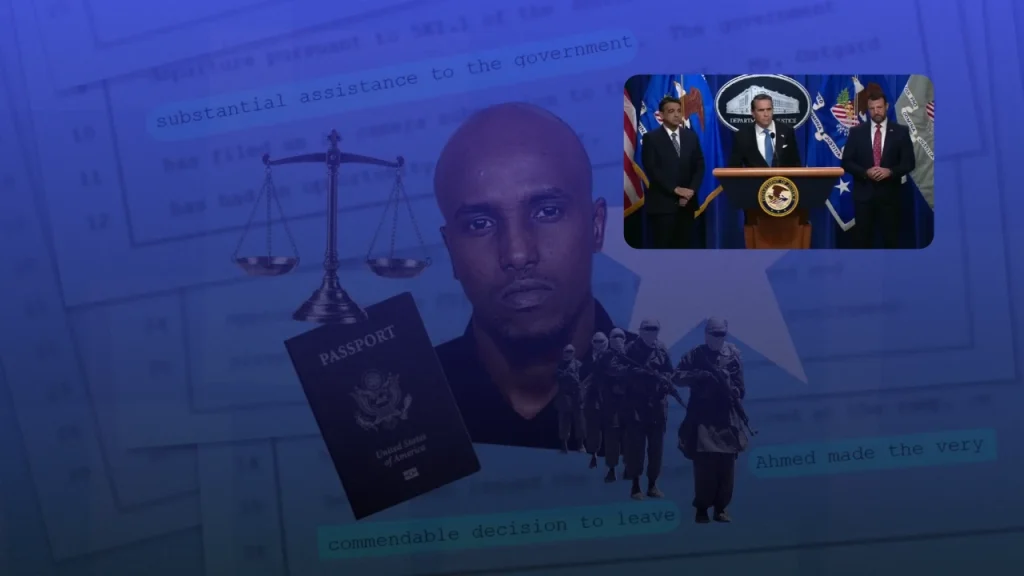
4. What Was Ahmed Convicted of in 2009?
The civil case grows out of an earlier federal criminal case, United States v. Ahmed, No. 09-cr-00050. On July 28, 2009, Ahmed pleaded guilty to one count of providing material support to terrorists under 18 U.S.C. § 2339A(a). His plea also acknowledged involvement in a conspiracy tied to killing Ethiopians in Somalia.
Section 2339A covers providing support knowing or intending it be used to prepare for or carry out specified terrorism-related crimes. It is different from 18 U.S.C. § 2339B, which addresses support to a designated Foreign Terrorist Organization. Ahmed’s plea was under § 2339A.
The case came out of a wider federal investigation, known as Operation Rhino, into fundraising and recruitment of people from Minnesota to fight in Somalia.
Cooperation and sentence
Ahmed cooperated with prosecutors and testified in the trial of Mahamud Said Omar, which involved money and logistical support for al-Shabaab fighters and the movement of recruits from Minnesota. The DOJ’s 2026 complaint quotes that testimony, so the government is using his own earlier statements.
Although he pleaded guilty in 2009, he was sentenced on May 14, 2013, by Chief Judge Michael J. Davis to 36 months in prison and 20 years of supervised release. That matched the sentences of two other cooperating defendants in the investigation.
His attorney has said a federal court ended his supervised release early in 2022 after a period of law-abiding behavior. That is relevant background, but early release does not by itself decide whether the 2007 naturalization complied with immigration law.
5. Why Is the DOJ Acting Nearly 19 Years After Naturalization?
The DOJ relies on a special provision, 8 U.S.C. § 1451(c). It says that if a naturalized citizen becomes a member of or affiliated with an organization described in § 1424 within five years after naturalization, that membership or affiliation is prima facie evidence the person was not attached to the principles of the Constitution when naturalized.
In plain terms, the law lets the government use certain post-naturalization conduct as evidence of the person’s state of mind at the time of naturalization. It does not automatically cancel citizenship. The government must still prove its case, and the defendant can present evidence to rebut the presumption.
| Event | Date |
| Naturalization | August 15, 2007 |
| Alleged start of association and support | September 2007 |
| Alleged travel to Somalia | December 2007 |
| Return to the United States | April 2008 |
| Fifth anniversary of naturalization | August 15, 2012 |
Because the alleged conduct began within about a month of naturalization, the government says the presumption applies.
6. What Does the DOJ Say Ahmed Misrepresented?
The complaint focuses on three questions in Part 10 of Form N-400:
| N-400 question | Subject |
| H34 | Whether he supported the Constitution and form of government of the United States |
| H35 | Whether he understood the full Oath of Allegiance |
| H36 | Whether he was willing to take the full Oath of Allegiance |
The government says Ahmed answered yes to all three and repeated those answers at his naturalization interview. It argues his later affiliation with al-Shabaab shows those answers did not reflect his true position.
The chronology matters. Ahmed had no terrorism conviction when he applied or naturalized. His plea came in 2009 and his sentence in 2013. This is not a case about a concealed conviction. It rests on the five-year presumption and what his later conduct allegedly shows about his eligibility and allegiance in 2007.
7. Federal Laws Involved
8 U.S.C. § 1451(a), revocation of naturalization. The main civil denaturalization statute. The government may bring an action in federal court to revoke naturalization that was illegally procured or obtained through concealment of a material fact or willful misrepresentation, supported by an affidavit showing good cause.
8 U.S.C. § 1451(c), five-year presumption. Affiliation with a qualifying organization within five years of naturalization is prima facie evidence of lack of attachment to the Constitution. It is not a rule that any crime within five years costs someone citizenship.
8 U.S.C. § 1424(a)(4), prohibited organizations. Defines the organizations whose members or affiliates can be barred from naturalization.
8 U.S.C. § 1427(a)(3), attachment to the Constitution. Requires good moral character, attachment to constitutional principles and being well disposed to the good order and happiness of the United States during the statutory period.
8 U.S.C. § 1101(e)(2), meaning of affiliation. Giving, lending or promising support or money to an organization can be presumed to constitute affiliation. The DOJ uses this to argue that alleged fundraising and support establish affiliation without proving Ahmed held any title.
18 U.S.C. § 2339A(a), material support. The criminal statute behind his 2009 plea, separate from this civil case.
8 U.S.C. § 1189, FTO designation. The basis for al-Shabaab’s March 18, 2008 designation.
28 U.S.C. §§ 1331 and 1345, jurisdiction. The complaint cites these for federal-question and United States-as-plaintiff jurisdiction.
8. What Must the Government Prove?
Citizenship is an exceptionally important status, and the burden in denaturalization cases is heavy. In Fedorenko v. United States, 449 U.S. 490 (1981), the Supreme Court said the evidence must be clear, unequivocal and convincing, leaving no serious doubt on the central issue. This is civil, not criminal, but the standard is higher than the usual civil one.
A prior conviction is strong evidence but does not automatically mean revocation. The court must still decide whether the statutory grounds are met.
Maslenjak v. United States, 582 U.S. 335 (2017), is also relevant background. It held that in a criminal naturalization-fraud prosecution under 18 U.S.C. § 1425, a false statement must have a meaningful connection to obtaining citizenship. It did not address the § 1451(c) presumption at issue here.
9. Ahmed’s Defense
Ahmed is represented by attorney Daniel L. Gerdts. When the lawsuit was reported in May 2026, Gerdts disputed the government’s account, arguing that the complaint omitted important facts and relied on a legal theory that does not support revocation. Critics and some legal observers have also questioned the government’s heavy reliance on post-naturalization conduct to infer what Ahmed believed years earlier, and that question about the limits of denaturalization authority is likely to matter in the case.
Ahmed filed an answer on August 4, 2026, so the case is actively contested. The public docket confirms the filing but not each admission, denial or defense inside it, so this article does not describe the answer’s contents. His later law-abiding record may be part of the broader story, but it does not by itself answer whether the 2007 naturalization was valid.
10. Why the DOJ Wants Judge Schiltz Removed
On October 20, 2026, the DOJ asked Judge Patrick J. Schiltz to disqualify himself. The dispute followed a September 17, 2026 New York Times article about the administration’s winter immigration enforcement operation in Minnesota, Operation Metro Surge, in which Schiltz was interviewed about its effect on the federal courts and concerns about compliance with court orders. On October 2, he also spoke at a University of St. Thomas School of Law event about the role of judges in immigration cases.
Associate Attorney General Stanley E. Woodward Jr. argued these public comments could lead a reasonable observer to question his impartiality in a case tied to administration immigration policy. Gerdts called the arguments baseless and said he would oppose the motion.
The governing law is 28 U.S.C. § 455(a), which requires disqualification where a judge’s impartiality might reasonably be questioned, and § 455(b)(1), which covers personal bias or knowledge of disputed facts. Criticizing a policy does not automatically disqualify a judge, and the court will look at the statements in context.
| Date | Development |
| October 20, 2026 | DOJ files motion and supporting memorandum |
| October 21, 2026 | Court notes the filing did not follow the local rule on coordinating a hearing date; amended notice sets November 23 at 1 p.m. |
| October 27, 2026 | Judge Schiltz allows Ahmed to respond by November 13 if he chooses |
| November 23, 2026 | Scheduled hearing |
As of October 31, 2026, no ruling on the motion has been reported. Even a ruling in the DOJ’s favor would only change the judge. It would not decide whether Ahmed keeps his citizenship. For more on this dispute, see AllAboutLawyer’s article, DOJ Seeks Recusal Of Minnesota Judges Schiltz And Tunheim.
11. What Happens If the Government Wins?
The DOJ asks the court to:
- Declare that Ahmed illegally procured his citizenship.
- Revoke and set aside the 2007 naturalization order, effective August 15, 2007.
- Cancel his Certificate of Naturalization.
- Bar him from claiming rights and benefits that depend on citizenship.
- Order him, within 21 days of final judgment, to surrender his certificate, U.S. passports, passport cards and citizenship-dependent enhanced driver’s licenses.
These are requested remedies, not orders.
Would he be deported automatically? No. Denaturalization and removal are separate proceedings. A final judgment would end his claim to the citizenship obtained in 2007, and his status as a lawful permanent resident since 2004 would then need to be assessed. The government could pursue removal proceedings if it has a legal basis.
12. Can the Government Revoke Citizenship for Any Crime?
No. A conviction after naturalization does not by itself cost someone citizenship. There must be a statutory ground tied to how citizenship was obtained or to the requirements for naturalization. Common grounds in civil denaturalization cases include:
- Criminal history concealed before naturalization.
- False statements in immigration applications.
- Fraudulent marriages used to obtain benefits.
- Concealed involvement in prohibited organizations.
- Failure to meet good-moral-character requirements.
Ahmed’s case rests on the special five-year affiliation provision, not on a general rule. For the broader legal framework, see AllAboutLawyer’s guide, Denaturalization, How the US Can Revoke Citizenship Under Federal Law.
13. Part of a Larger DOJ Denaturalization Campaign
The Minnesota case was one of 12 denaturalization actions the DOJ announced on May 8, 2026, targeting naturalized citizens accused of serious misconduct such as terrorist support, war crimes and sexual abuse of a minor. The DOJ later reported 25 complaints filed between July 20 and August 3, 2026, and another 40 between August 21 and October 2, 2026, which it called its largest filing period under the administration. Researchers have reported well over 170 civil denaturalization suits since the start of the second Trump administration.
These figures count complaints, not people who have lost citizenship. Every defendant can contest the case. A campaign announcement is not evidence against any individual, and enforcement priorities do not change the statutory requirements. Denaturalization remains rare compared with other immigration tools, and success is not automatic given the high burden.
Another example is covered in Emmanuel Tayo Akinkunmi Denaturalization Case Explained.
14. What Happens Next?
Track one: the recusal motion. Ahmed’s optional response is due November 13, and the hearing is November 23. The judge could deny the motion, grant it, or take other action first.
Track two: the merits. Regardless of who presides, the court will have to address:
- Whether al-Shabaab met the § 1424(a)(4) definition in 2007.
- Whether Ahmed was affiliated with it within five years of naturalization.
- Whether the § 1451(c) presumption applies and whether the evidence rebuts it.
- Whether the government has met its clear, unequivocal and convincing burden.
- Whether the naturalization was illegally procured or obtained by concealment or willful misrepresentation.
No trial date or revocation judgment had been identified as of October 31, 2026. The outcome could influence how the government pursues cases that rely on post-naturalization conduct.
15. What Naturalized Citizens Should Know
This case does not mean naturalized citizens generally risk losing citizenship over later crimes. Denaturalization requires a specific legal ground and proof by a high standard. Anyone who receives a government notice or complaint about their naturalization should speak with a qualified immigration or denaturalization attorney promptly, since each case turns on its own facts.
Timeline of the Salah Osman Ahmed Case
| Date | What happened |
| September 30, 1999 | Enters the United States |
| May 27, 2004 | Becomes a lawful permanent resident |
| October 31, 2006 | Signs Form N-400 |
| November 3, 2006 | Files naturalization application |
| August 15, 2007 | Becomes a naturalized citizen |
| September 2007 | Government alleges association and fundraising begin |
| December 2007 | Alleged travel to Somalia and joining al-Shabaab |
| March 18, 2008 | Al-Shabaab designated a Foreign Terrorist Organization |
| April 2008 | Returns to the United States |
| July 28, 2009 | Pleads guilty under 18 U.S.C. § 2339A(a) |
| October 2012 | Testifies in the Mahamud Said Omar trial |
| May 14, 2013 | Sentenced to 36 months and 20 years of supervised release |
| 2022 | Early termination of supervised release reported |
| May 7, 2026 | DOJ files civil denaturalization complaint |
| May 8, 2026 | DOJ announces 12-person denaturalization effort |
| August 4, 2026 | Ahmed files his answer |
| September 30, 2026 | DOJ files a judicial-misconduct complaint involving Minnesota federal judges |
| October 20, 2026 | DOJ moves to disqualify Judge Schiltz |
| October 21, 2026 | Hearing amended to November 23 |
| October 27, 2026 | Response deadline of November 13 set |
| November 13, 2026 | Ahmed’s optional response due |
| November 23, 2026 | Recusal hearing |
Frequently Asked Questions
Who is Salah Osman Ahmed?
A Somali-born man, also known as Salman, who became a naturalized U.S. citizen on August 15, 2007 and pleaded guilty in 2009 to providing material support to terrorists.
Why is the DOJ suing him?
It argues his alleged affiliation with al-Shabaab shortly after naturalization is evidence he lacked the required attachment to the Constitution when he took the oath.
Has he lost his citizenship?
No. As of October 31, 2026, no final judgment has revoked it.
What is the case number?
United States v. Ahmed, No. 0:26-cv-02536, U.S. District Court for the District of Minnesota.
Is this a criminal or civil case?
Civil. His 2009 material-support conviction was a separate criminal case.
When was the lawsuit filed?
May 7, 2026, and announced publicly May 8.
What terrorist group is involved?
Al-Shabaab, designated a Foreign Terrorist Organization on March 18, 2008.
What was his sentence?
36 months in prison and 20 years of supervised release, imposed May 14, 2013. His attorney says supervision ended early in 2022.
What is 8 U.S.C. § 1451(c)?
It makes affiliation with certain prohibited organizations within five years after naturalization prima facie evidence that the person lacked constitutional attachment at the time of naturalization.
Did Ahmed respond to the lawsuit?
Yes. He filed an answer on August 4, 2026, and his attorney has disputed the government’s account.
Why does the DOJ want Judge Schiltz removed?
It says his public comments on immigration enforcement raise a reasonable question about impartiality. Ahmed’s attorney opposes the motion.
Has the judge ruled on the recusal motion?
Not as of October 31, 2026. The hearing is November 23 at 1 p.m.
What burden of proof applies?
Clear, unequivocal and convincing evidence, under Fedorenko v. United States.
What happens if the DOJ wins?
The court could revoke the naturalization retroactively to August 15, 2007, cancel his certificate and order him to surrender citizenship documents. Removal would require separate proceedings.
Can the government revoke citizenship for any later crime?
No. It needs a recognized statutory ground. This case relies on the five-year affiliation provision.
Is this a class action?
No. It is an individual action by the United States. There is no settlement fund or claim form.
Is there a trial date?
None identified as of October 31, 2026. The November 23 hearing concerns recusal, not the merits.
Is he facing a new criminal charge?
No. This civil proceeding does not itself bring a new criminal charge.
Sources and Legal References
Government and court records
- DOJ, Complaint to Revoke Naturalization, United States v. Ahmed, 0:26-cv-02536 (May 7, 2026)
- Federal docket, United States v. Ahmed, 0:26-cv-02536 (Civil Rights Litigation Clearinghouse)
- DOJ, Moves to Denaturalize 12 Individuals for Concealing Terrorist Support, War Crimes, Sexual Abuse and More (May 8, 2026)
- DOJ, Four More Men Sentenced for Providing Material Support to Terrorists (May 14, 2013)
- DOJ, Terror Charges Unsealed in Minneapolis Against Eight Men (November 23, 2009)
Federal laws
- 8 U.S.C. § 1451, Revocation of Naturalization
- 8 U.S.C. § 1424, Prohibited Organizations
- 8 U.S.C. § 1427, Requirements of Naturalization
- 8 U.S.C. § 1101, Definitions
- 18 U.S.C. § 2339A, Providing Material Support to Terrorists
- 8 U.S.C. § 1189, Designation of Foreign Terrorist Organizations
- 28 U.S.C. § 455, Disqualification of Federal Judges
Supreme Court decisions
News reporting
- Minnesota Star Tribune, DOJ Seeks to Strip Citizenship of Man Convicted in Minnesota of Terrorism Charge (May 8, 2026)
- MPR News, Feds Seek to Revoke Citizenship of Minnesota Man (May 11, 2026)
- Minnesota Star Tribune, DOJ Seeks to Remove Two Minnesota Judges from Cases Over Public Immigration Remarks (October 21, 2026)
- Reuters, DOJ Seeks to Bar Minnesota Judges from Two Cases Over Immigration Statements (October 21, 2026)
- FOX 9, Federal Court Grants Early Termination of Supervised Release in Related Minnesota Terrorism Case
About the Author
Researched and written by Israr Ahmad, legal content researcher covering U.S. immigration law, federal court proceedings, constitutional issues, criminal cases and major legal developments.
This article is based on the federal government’s filed complaint, public docket information, Department of Justice records, federal statutes, Supreme Court decisions and established news reporting. The government’s allegations are not final judicial findings. Ahmed’s citizenship has not been revoked as of October 31, 2026.
Disclaimer: AllAboutLawyer.com is an independent legal information website, not a law firm. This article is for general informational purposes only and is not legal advice.
Last Updated: October 31, 2026
About the Author
Israr Ahmad is a legal content researcher with 4+ years of experience covering class action settlements and consumer rights cases. He has researched and published coverage of 2,500+ settlements using verified court records, settlement administrator filings, and government sources. Learn more about Israr.