
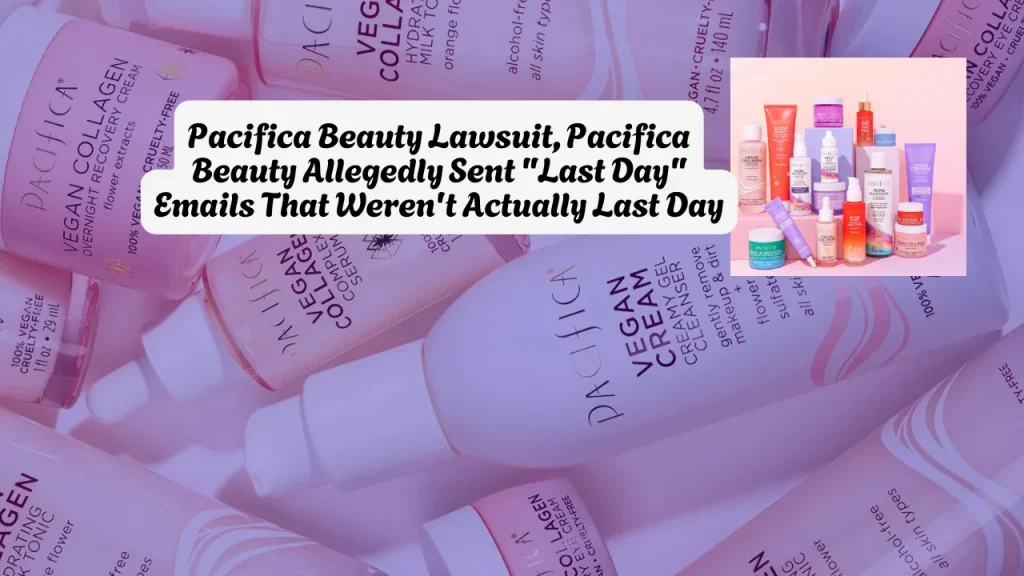
Pacifica Beauty Lawsuit, Pacifica Beauty Allegedly Sent “Last Day” Emails That Weren’t Actually Last Day
Plaintiff Jace Hoag filed a class action lawsuit against Pacifica Beauty LLC, alleging the vegan cosmetics brand systematically sent Washington state consumers marketing emails with subject lines that falsely declared sales were ending imminently — then extended those same promotions days later, according to the complaint filed in the Superior Court of Washington for Thurston County. The lawsuit alleges Pacifica violated Washington’s Commercial Electronic Mail Act (CEMA) and the Washington Consumer Protection Act through a repeated pattern of artificially manufactured deadline pressure.
Quick Facts
| Field | Detail |
| Case Name | Hoag v. Pacifica Beauty LLC |
| Case Number | No. 26-2-00983-34 |
| Court | Superior Court of the State of Washington, Thurston County |
| Date Filed | 2026 (exact filing date TBD — not yet confirmed on public docket) |
| Plaintiff | Jace Hoag |
| Defendant | Pacifica Beauty LLC |
| Alleged Violation | Washington Commercial Electronic Mail Act (CEMA), RCW 19.190.020(1)(b); Washington Consumer Protection Act |
| Settlement Amount | TBD — no settlement reached; case in early litigation phase |
| Claim Deadline | TBD — no settlement or claim process is open at this time |
| Lead Law Firms | Strauss Borrelli PLLC; CohenMalad LLP; Stranch, Jennings & Garvey PLLC |
| Case Status | Recently filed — litigation phase |
| Last Updated | April 24, 2026 |
Current Status
- The complaint was filed in Washington’s Thurston County Superior Court in 2026 and is in its earliest stage — no class has been certified, no hearing dates have been set, and Pacifica Beauty has not yet publicly responded to the allegations.
- No settlement exists, no claim form is available, and Washington consumers do not need to take any action right now.
- This case is part of a wave of over 100 lawsuits filed under CEMA since the Washington Supreme Court’s April 2025 ruling in Brown v. Old Navy dramatically expanded the law’s reach.
What Is the Pacifica Beauty Lawsuit About? Hoag v. Pacifica Beauty LLC, No. 26-2-00983-34
Plaintiff Jace Hoag alleges that Pacifica Beauty LLC — a Carpinteria, California-based vegan and cruelty-free cosmetics brand — ran a systematic and deliberate campaign to pressure Washington consumers into purchases through false deadline claims embedded directly in email subject lines. According to the complaint, Pacifica did not send occasional misleading emails; it followed a consistent, repeated pattern of announcing sale deadlines it never intended to honor.
The complaint cites three specific examples. On March 24, 2024, Pacifica allegedly sent an email with the subject line “Last Day! 20% OFF SITEWIDE” — then extended the promotion the following day. On May 26, 2024, Pacifica allegedly sent “ENDS TOMORROW: Free 5-Piece Summer Travel Kit” — and extended that offer two days later. On November 30, 2025, Pacifica allegedly sent “Last Chance to Glow Up: 35% OFF SITEWIDE Ends Soon” — which it also extended two days later. Hoag alleges she personally received the July 2025 and November 2025 emails at her personal email address.
Related article: CareCloud Data Breach Class Action Lawsuit Are You Affected And Who Is Eligible to Join?
The lawsuit asserts violations of Washington’s Commercial Electronic Mail Act (CEMA), RCW 19.190.020(1)(b) — a state law that prohibits sending commercial emails to Washington residents containing false or misleading information in the subject line — and the Washington Consumer Protection Act, which treats a CEMA violation as automatically unlawful consumer conduct. This case fits the broader pattern of deceptive email marketing class actions targeting retail brands that has swept Washington state courts since mid-2025. The key legal question in this and similar cases is whether Pacifica’s use of “last day” and “ends tomorrow” language constitutes a factual misrepresentation — not mere puffery — because CEMA’s subject-line prohibition, as interpreted by the Washington Supreme Court, covers any verifiably false factual claim about timing, duration, or availability.
Who Could Be Affected by the Pacifica Beauty Lawsuit?
The plaintiff seeks to represent a class of Washington residents who received Pacifica Beauty’s promotional emails during the relevant period. The court has not yet certified a class. The following describes who Hoag’s complaint seeks to include.
You may be affected if:
- You are a Washington state resident who subscribed to Pacifica Beauty’s marketing email list at any point during the class period
- You received a Pacifica Beauty promotional email with a subject line claiming a sale or offer was ending on a specific date — and that offer was later extended
- You received any of the specific emails cited in the complaint: the March 24, 2024 “Last Day! 20% OFF SITEWIDE” email; the May 26, 2024 “ENDS TOMORROW: Free 5-Piece Summer Travel Kit” email; or the November 30, 2025 “Last Chance to Glow Up: 35% OFF SITEWIDE Ends Soon” email
- You made a purchase from Pacifica Beauty based on a deadline stated in a promotional email subject line that was later proven false
No action is required now. If a class is certified and a settlement is reached, affected consumers will receive notice directly.
What Could Consumers Recover?
Under CEMA, each email sent to a Washington resident containing a false or misleading subject line constitutes a separate violation carrying $500 in statutory damages — with no requirement that the consumer prove actual harm. Receiving the email itself is treated as the injury under the statute.
The complaint demands actual or liquidated damages trebled, a permanent injunction against future violations, and attorneys’ fees for the class. Because CEMA violations automatically constitute violations of the Washington Consumer Protection Act, plaintiffs may also seek treble damages under the CPA — a provision that significantly multiplies potential exposure for Pacifica. Individual recovery amounts, if any, depend on how many qualifying emails each class member received, the total size of the certified class, and the ultimate outcome of litigation or settlement.
Important note for consumers filing after June 11, 2026: Washington’s legislature signed HB 2274 into law on March 23, 2026. Effective June 11, 2026, this amendment reduces the per-email statutory damage amount from $500 to $100 per violation for future cases. That reduction does not apply retroactively to pending litigation, including this case.
What Happens Next?
- Class certification motion: TBD — Pacifica Beauty must be served, respond to the complaint, and the court must schedule proceedings before a class certification motion can be briefed and argued
- Pacifica Beauty’s response: TBD — no public response from Pacifica Beauty has been reported as of April 24, 2026
- Discovery: TBD — pending class certification
- Trial date: TBD — no trial has been scheduled; this case is in its earliest litigation stage
- Settlement: TBD — no settlement discussions have been publicly reported
Pacifica Beauty Lawsuit: Frequently Asked Questions
Is the Pacifica Beauty lawsuit a class action?
It is a proposed class action. Plaintiff Jace Hoag filed the complaint in Thurston County Superior Court, No. 26-2-00983-34, seeking to represent all Washington residents who received the relevant promotional emails from Pacifica Beauty. The court has not yet certified a class.
Do I need to do anything right now?
No. No settlement is open and no claim form exists. If the court later certifies a class and a settlement is reached, affected Washington consumers will receive notice by email or mail. Monitor this page for updates as the case develops.
Has Pacifica Beauty responded to the lawsuit?
No public response from Pacifica Beauty has been reported as of April 24, 2026. The case is newly filed and in its earliest stage. Defendants in CEMA cases typically challenge the statute’s constitutionality, argue preemption by the federal CAN-SPAM Act, or dispute whether their specific subject lines qualify as false or misleading under CEMA.
When will the case be resolved?
TBD — no timeline has been set. CEMA cases in Washington have generally moved through early motions within six to twelve months of filing, though resolution depends on whether Pacifica contests class certification, appeals any ruling, or seeks early settlement.
How do I find out if I am part of the class?
You can monitor the case docket for Hoag v. Pacifica Beauty LLC, No. 26-2-00983-34, through the Thurston County Superior Court’s public records system. If the class is certified, affected Washington consumers will receive notice directly.
What makes a “fake urgency” email illegal under Washington law?
Washington’s CEMA, RCW 19.190.020(1)(b), prohibits any false or misleading information in a commercial email’s subject line sent to Washington residents. Following the Washington Supreme Court’s April 2025 ruling in Brown v. Old Navy, subject lines stating a sale ends on a specific date — when the seller already planned to extend the promotion — qualify as actionable false statements, not mere puffery. Each email is a separate violation.
Does the new Washington email law change this case?
Not for this lawsuit. Washington Governor Bob Ferguson signed HB 2274 on March 23, 2026, reducing per-email CEMA damages from $500 to $100 effective June 11, 2026. That change applies prospectively only — it does not reduce the potential $500-per-email exposure for emails already sent before the effective date, which covers all emails cited in Hoag’s complaint.
Sources & References
- Hoag v. Pacifica Beauty LLC, No. 26-2-00983-34, Superior Court of Washington, Thurston County
- Washington Commercial Electronic Mail Act, RCW 19.190.020(1)(b)
Prepared by the AllAboutLawyer.com Editorial Team and reviewed for factual accuracy against the complaint in Hoag v. Pacifica Beauty LLC, No. 26-2-00983-34, Thurston County Superior Court, Washington, on April 24, 2026. Last Updated: April 24, 2026
Disclaimer: This article is for informational purposes only and does not constitute legal advice. Legal claims and outcomes depend on specific facts and applicable law. For advice regarding a particular situation, consult a qualified attorney.
About the Author
Israr Ahmad is a legal content researcher with 4+ years of experience covering class action settlements and consumer rights cases. He has researched and published coverage of 2,500+ settlements using verified court records, settlement administrator filings, and government sources. Learn more about Israr.