
Nidal Hasan Execution Date, Pentagon Plans Livestream of December 3 Firing Squad at Fort Hood
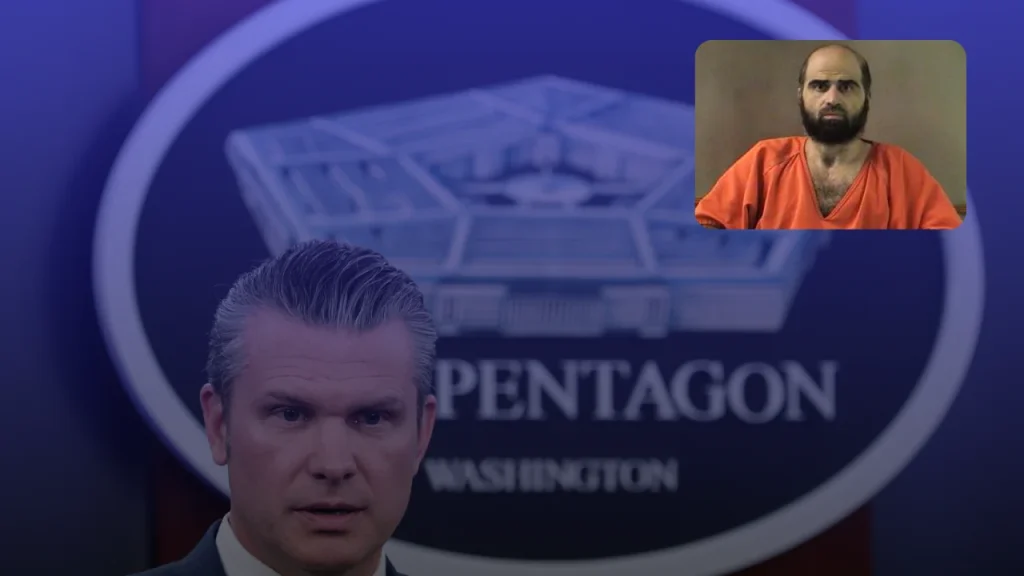
The U.S. Army has scheduled the execution of Nidal Malik Hasan, the former Army major and psychiatrist convicted of the November 5, 2009, Fort Hood shooting, for December 3, 2026, at 1 p.m. Central Time. The method is a firing squad, and the location is Fort Hood, Texas. The Pentagon says it plans to livestream the event. If carried out, it would be the first U.S. military execution in more than 65 years and the first Army firing-squad execution since 1945.
The execution has not happened. It is a scheduled date, and Hasan can still ask a civilian federal court for relief. This article explains the timeline, the legal authority behind the sentence, the remaining court options, the livestream questions, and what could delay the date.
Quick Facts: Nidal Hasan Execution
| Detail | Current information |
| Name | Nidal Malik Hasan (sometimes searched as “Nidal Hassan”) |
| Former position | U.S. Army major and psychiatrist |
| Attack | November 5, 2009, Soldier Readiness Processing Center, Fort Hood, Texas |
| Victims | 13 killed, 32 wounded |
| Conviction | August 2013 court-martial: 13 counts of premeditated murder, 32 counts of attempted premeditated murder |
| Sentence | Death |
| Supreme Court review | Declined March 31, 2025 |
| Presidential approval | October 2, 2026 (President Donald Trump) |
| Date set by | Acting Army Secretary Adam Telle (October 6, 2026) |
| Execution date and time | December 3, 2026, 1 p.m. Central Time, if not delayed |
| Method | Army firing squad |
| Location | Fort Hood, Texas |
| Livestream | Pentagon says it plans to livestream; details not yet released |
| Last U.S. military execution | 1961 (Pvt. John A. Bennett, hanged) |
| Last Army firing-squad execution | 1945 (Pvt. Eddie Slovik) |
| Can the date change? | Yes, through court orders or official action |
What Is the Latest News on the Hasan Execution?
The story developed over several days in October 2026:
- October 2: President Trump approved Hasan’s death sentence. Defense Secretary Pete Hegseth had recommended a firing squad, and the president approved that recommendation.
- October 6: Acting Army Secretary Adam Telle directed that the execution take place at Fort Hood on December 3 at 1 p.m. Central Time.
- October 7: The Army publicly announced the date.
- October 8: Hegseth said the execution would be public so people can watch it and understand the consequences of such crimes. A Pentagon official then confirmed the military plans to livestream it, with details to follow.
As of October 9, officials have not said which platform would carry the livestream, whether access would be restricted, whether there would be a delay or recording policy, or whether viewers would see the execution itself or a limited broadcast. The Army also has not publicly released a detailed, case-specific firing-squad procedure.
Who Is Nidal Malik Hasan and What Did He Do?
Hasan was an Army psychiatrist with the rank of major. On November 5, 2009, he entered the Soldier Readiness Processing Center at Fort Hood, where service members were completing medical and administrative processing before deployment, and opened fire. Thirteen people were killed, including 12 soldiers and one civilian, and 32 others were wounded. Responding civilian police officers shot Hasan, leaving him paralyzed from the waist down.
At his August 2013 court-martial, Hasan represented himself with standby counsel available and did not meaningfully contest that he was the shooter. A panel of military officers convicted him of 13 counts of premeditated murder and 32 counts of attempted premeditated murder and sentenced him to death. Hasan has said he acted to oppose U.S. military operations in Muslim countries. Those were his stated motives, not legal defenses.
Why Has It Taken More Than a Decade?
Military capital cases go through layers of mandatory review, and no military execution can proceed until the president personally approves the sentence. Hasan’s case moved through the military appellate courts, and the Army says they upheld the conviction and sentence. The U.S. Supreme Court declined to review the case on March 31, 2025. Only after that did the case reach the president for final approval.
What Law Allows the Military to Execute a Service Member?
Several bodies of law apply. Here is how each fits.
The Uniform Code of Military Justice (UCMJ), 10 U.S.C. §§ 801 et seq. The UCMJ is the criminal code for service members. Premeditated murder is charged under Article 118 (10 U.S.C. § 918), which allows death as a punishment, and attempted murder under Article 80 (10 U.S.C. § 880).
Presidential approval, Article 71 (10 U.S.C. § 871). A death sentence from a court-martial cannot be carried out until the president approves it. That is why the October 2, 2026 approval was the key step. Congress and the president have also set the procedures for capital courts-martial in the Manual for Courts-Martial, including Rule for Courts-Martial 1004, which governs capital sentencing and the aggravating factors a panel must find. In Loving v. United States, 517 U.S. 748 (1996), the Supreme Court upheld the president’s authority to prescribe those aggravating factors.
Appellate review, Articles 66 and 67 (10 U.S.C. §§ 866, 867) and 28 U.S.C. § 1259. Capital court-martial cases are reviewed by the Army Court of Criminal Appeals and the Court of Appeals for the Armed Forces. The Supreme Court can then review certain decisions of the Court of Appeals for the Armed Forces by writ of certiorari under 28 U.S.C. § 1259. The Court declined to take Hasan’s case.
Army Regulation 190-55 (Procedures for Military Executions). This regulation governs the process after presidential approval, including who transmits the record, how the execution date is set, who must be notified, and who may attend. The Army reports that the date must fall between 60 and 150 days after presidential approval. December 3 falls within that window counted from October 2.
The Eighth Amendment. Military capital punishment must also satisfy the ban on cruel and unusual punishment, which becomes relevant to any challenge to the method.
The federal civilian death penalty statutes, including the Federal Death Penalty Act, do not govern a court-martial sentence. Neither do state firing-squad statutes. The Army must act under military law and its own regulations.
When Is Nidal Hasan’s Execution Date?
The execution is scheduled for Thursday, December 3, 2026, at 1 p.m. Central Time at Fort Hood. This is an official military execution date, but it is not a guarantee. A federal court order, a procedural problem, or other official action could delay it. If the date passes without an execution, the reason should be confirmed from official statements or court records. A delay would not mean the conviction or sentence was overturned.
Why a Firing Squad?
Hegseth recommended the firing squad, and President Trump approved it. Army Regulation 190-55 does not lay out a detailed procedure for each possible method, which is one reason military-law experts quoted by the Associated Press have questioned how the Army will assemble and train a squad for a method it has not used since 1945.
Civilian practice is different. Lethal injection is the dominant method in the states that carry out executions, but a small number of states authorize firing squads in some circumstances, including Utah, South Carolina, and Idaho, and some others list it as a backup. Those state rules do not automatically apply to the military, and the Army has not said whether it will adopt any state protocol.
Will the Execution Really Be Public? Livestream vs. Public Execution
A public execution traditionally means members of the public can attend in person. A livestream lets people watch remotely. The Pentagon has used the word “public” and confirmed a livestream, but it has not explained the format. Fort Hood is an active military installation, and the livestream announcement does not mean civilians can attend.
Modern U.S. executions, state and federal, take place inside secure facilities with a limited group of authorized witnesses, and none has been broadcast for general public viewing. The last widely recognized public civilian execution in the United States was in Kentucky in 1936.
Is a Livestreamed Execution Legal?
There is no simple answer, and no court has ruled on this plan. Several points matter:
- No right to televise. Courts that have considered media requests to film executions have generally rejected them. Examples include Garrett v. Estelle, 556 F.2d 1274 (5th Cir. 1977), a Fifth Circuit case from Texas, and KQED, Inc. v. Vasquez (N.D. Cal. 1991). Those cases involved the media demanding access. Here it is the government that proposes to broadcast, so they do not settle the question.
- Government authority. The Army controls how it carries out a lawful sentence on a military installation. A challenge would turn on military regulations, constitutional claims, and the details of the final broadcast plan.
- Competing interests. Issues include the condemned person’s dignity, the privacy and wishes of victims’ families, security, and the public interest in transparency.
Until the Pentagon publishes the plan, the legality of the livestream cannot be judged. Any court challenge would depend on what the plan actually contains.
Can Hasan Still Appeal?
Yes, in a limited way. Direct military appeals are finished, but Hasan can seek relief in civilian federal court.
Habeas corpus, 28 U.S.C. § 2241. This is the main route. Review of court-martial cases in civilian court is narrow. Under Burns v. Wilson, 346 U.S. 137 (1953), federal courts generally ask whether the military courts gave a claim full and fair consideration, and they do not simply re-decide it. A petition does not automatically stop an execution. A judge would have to grant a stay.
Method-of-execution claims. Under the Eighth Amendment, a prisoner challenging a method generally must show the method poses a substantial risk of severe pain and identify a feasible, more humane alternative, according to Baze v. Rees (2008), Glossip v. Gross (2015), and Bucklew v. Precythe (2019). Whether and how those standards apply to a military firing squad would be for a court to decide.
Procedural claims. Hasan’s lawyers could argue the Army did not follow its own execution regulations. See the notification dispute below.
Clemency. The president holds final authority over a military death sentence, and no clemency has been reported.
As of this writing, no federal petition has been publicly reported as filed. Hasan’s future litigation choices are unknown. A court does not stop an execution simply because the public disagrees with the sentence or method. A stay requires a legally sufficient claim.
Did the Army Properly Notify Hasan?
The Associated Press reported that Hasan’s former attorney, retired Army Col. John Galligan, questioned whether the Army followed its procedures. Galligan said Hasan told him that legal counsel was not present when he was notified. Army procedures describe notification involving the commandant of the U.S. Disciplinary Barracks, a chaplain, and defense counsel where possible.
This is an attributed claim, not a court finding. The Army has not publicly provided enough detail to resolve it, and no court has ruled that the order is invalid on this ground.
Why Fort Hood Instead of Fort Leavenworth?
Hasan is held on military death row at the U.S. Disciplinary Barracks at Fort Leavenworth, Kansas. The Army has announced the execution will happen at Fort Hood, where the attack occurred. Officials have not fully explained the choice. The location has obvious symbolic weight, but the Army’s full reasoning has not been given. Hasan is paralyzed and uses a wheelchair, so transport and accommodation will require planning.
Where Is Fort Hood? Is It Fort Cavazos?
Fort Hood is a major Army installation in Central Texas near Killeen. It was renamed Fort Cavazos in 2023 and then renamed Fort Hood again in 2025, this time honoring World War I Col. Robert B. Hood. The Army has confirmed the execution will take place at Fort Hood but has not identified the specific facility.
Why Is This the First U.S. Military Execution Since 1961?
The last military execution was in 1961, when Army Pvt. John A. Bennett was hanged at Fort Leavenworth after a conviction for rape and attempted murder. The Army’s last known firing-squad execution was Pvt. Eddie Slovik in France on January 31, 1945, for desertion. Only a small number of prisoners are on military death row, which is why executions are so rare.
Military vs. State Executions: Key Differences
| Issue | Military execution | State execution |
| Source of sentence | Court-martial under the UCMJ | State criminal court |
| Final approval | President (Article 71) | Governor/state process |
| Governing rules | UCMJ, Manual for Courts-Martial, AR 190-55 | State statutes and protocols |
| Habeas review | Narrow civilian review (§ 2241, Burns v. Wilson) | State and federal habeas (§ 2254) |
| Firing squad rules | No detailed public protocol | Detailed in some states |
What the Livestream Means for Victims’ Families
Thirteen people were killed and 32 wounded, and their families have waited nearly 17 years. A livestream may affect them in different ways. Some may see it as final enforcement of the jury’s sentence, and others may be uncomfortable with a broadcast. The government has not said how families will be notified, whether they will get special access, or how their privacy will be protected. Those questions are separate from the legal validity of the sentence.
Perspectives on the Execution
Supporters say this is long-overdue justice for an attack on fellow service members, that the sentence was imposed by a military jury and upheld through review, and that openness shows the consequences of such crimes. Administration officials have taken this position.
Critics, including death-penalty opponents such as the Death Penalty Information Center, raise concerns about a livestreamed firing squad, the dignity and trauma questions of broadcasting a death, the unclear procedures for a method unused since 1945, and the irreversibility of capital punishment. Some legal experts have also questioned whether the Army followed its notification rules.
What Happens if the Execution Is Delayed?
If a court issues a stay, the Army must comply while the order remains in effect. A petition alone does not guarantee one. The date could also change if officials decide more steps are needed. A delay does not mean Hasan has won a new trial.
What to Watch Before December 3
- Federal court filings: a habeas petition or other challenge.
- Court orders: any stay or injunction.
- Notification issue: whether the Army resolves the reported concerns.
- Firing-squad protocol: any release of procedures.
- Livestream rules: platform, access limits, and what viewers will see.
- Victims’ families: notification and privacy arrangements.
- Official schedule: confirmation, change, or postponement of the date.
Rely on the Army, the Pentagon, court records, and established news organizations for updates, not social-media speculation.
Current Status of the Execution
As of October 9, 2026, Hasan’s execution is scheduled for December 3, 2026, by firing squad at Fort Hood, Texas, and the Pentagon says it will be livestreamed. The president approved the sentence on October 2, and the Army set the date on October 6. The military appeals process is over, and the Supreme Court declined review in March 2025. The execution has not taken place, Hasan may still seek federal court relief, and the Pentagon has not released full livestream or firing-squad details. This article will be updated as new information is released.
Frequently Asked Questions
When is Nidal Hasan’s execution date?
December 3, 2026, at 1 p.m. Central Time at Fort Hood, Texas. The date could change if legal proceedings or official action delay it.
Will the execution be livestreamed?
The Pentagon says it plans to livestream it. Details have not been released.
Who is Nidal Malik Hasan?
A former Army major and psychiatrist convicted of killing 13 people and wounding 32 in the November 5, 2009, Fort Hood shooting.
Why a firing squad?
Hegseth recommended it and President Trump approved it. The Army then set the date and location under its execution procedures.
Can Hasan stop the execution?
He may seek relief in civilian federal court, including through habeas corpus under 28 U.S.C. § 2241. Whether a court would grant a stay depends on his claims and the legal standards.
Who has authority to approve a military death sentence?
The president, under Article 71 of the UCMJ.
Has the U.S. military executed anyone recently?
No. The last military execution was in 1961.
Is a livestreamed execution the same as a public execution?
Not necessarily. A livestream allows remote viewing, while a traditional public execution involves people attending in person. The Pentagon has not released the viewing arrangements.
Is Fort Hood the same as Fort Cavazos?
The base was renamed Fort Cavazos in 2023 and renamed Fort Hood in 2025.
Has the execution already happened?
No. As of October 9, 2026, it is scheduled for December 3.
Disclaimer: This article is for general informational purposes only and is not legal advice. It describes the execution as scheduled based on official announcements and reporting available as of October 9, 2026. Court orders or official action may change the date or arrangements.
Sources
- U.S. Army: Army Sets Execution Date for Convicted Murderer Nidal Hasan
- Associated Press: Concerns Raised Over Firing-Squad Execution Process for Fort Hood Shooter
- Associated Press: Pentagon Says the Firing-Squad Execution Will Be Livestreamed
- CBS News: Fort Hood Shooter’s Execution Will Be Livestreamed, Pentagon Says
- Death Penalty Information Center: Nidal Hasan May Be Executed on December 3 by Firing Squad
- Court of Appeals for the Armed Forces: United States v. Hasan
- Army Lawyer: From Soldier to Condemned Prisoner, A Review of Modern Military Death Sentence Procedure
Researched and written by Israr Ahmad, legal content researcher, AllAboutLawyer.com | Last updated: October 9, 2026
This article is general legal information based on official announcements and public reporting. It is not legal advice. For questions about military justice or capital punishment, consult a licensed attorney.
About the Author
Israr Ahmad is a legal content researcher with 4+ years of experience covering class action settlements and consumer rights cases. He has researched and published coverage of 2,500+ settlements using verified court records, settlement administrator filings, and government sources. Learn more about Israr.