
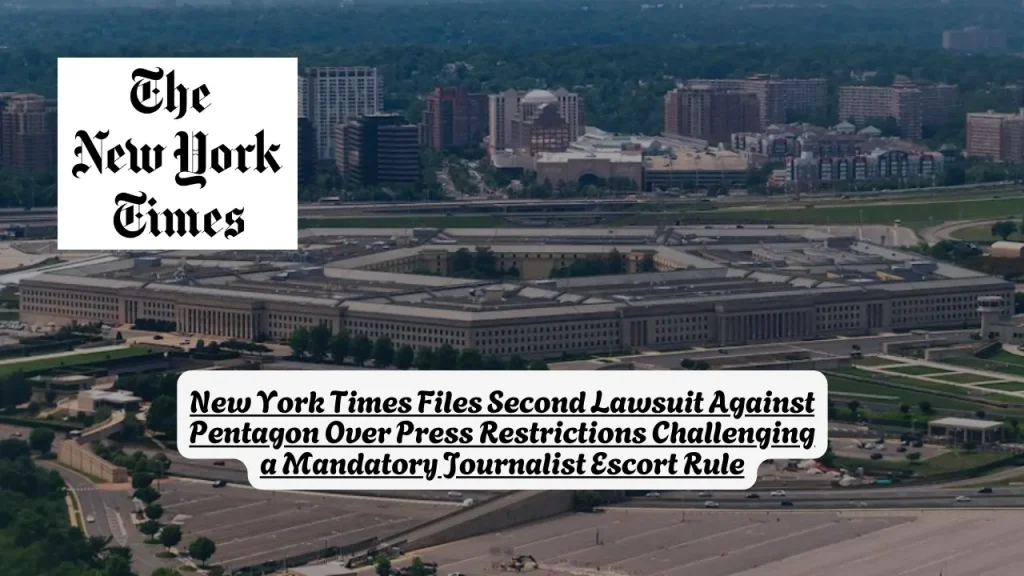
New York Times Files Second Lawsuit Against Pentagon Over Press Restrictions Challenging a Mandatory Journalist Escort Rule
The New York Times took the Pentagon back to federal court on May 18, 2026 — its second lawsuit in five months — arguing that a new rule requiring journalists to have a government escort at all times inside the building is unconstitutional and designed to shut down independent reporting on the U.S. military.
How This Dispute Started: The Original Hegseth Rules
The conflict began last fall when Defense Secretary Pete Hegseth imposed a new policy requiring reporters to sign onto a host of restrictions in order to maintain daily access to the Pentagon. One provision stated that reporters who “solicit” sensitive information from military personnel could be deemed a security risk and expelled from the building. Many news outlets — including CBS News, ABC News, NBC News, CNN, and Fox News — declined to sign the policy and were forced to vacate the Pentagon.
The policy extended beyond classified information and included a prohibition on reporting even unclassified material without the approval of Pentagon officials. The policy prompted widespread condemnation from press freedom groups.
On December 2, 2025, Hegseth’s team welcomed dozens of pro-Trump influencers and content creators to the Pentagon for orientation sessions and press briefings. These content creators, who agreed to the new restrictions, were billed by Hegseth’s communications team as the “new Pentagon press corps.”
The First Lawsuit and the Court Victory
On December 4, 2025, the New York Times and its national-security correspondent Julian E. Barnes filed a federal lawsuit against the U.S. Department of Defense in the U.S. District Court for the District of Columbia, challenging the sweeping new policy introduced under Defense Secretary Hegseth.
In the ruling in March 2026, U.S. District Court Judge Paul L. Friedman sided with the Times, writing that the First Amendment was designed to empower the press to publish information in the public interest “free of any official proscription.” Friedman said: “Those who drafted the First Amendment believed that the nation’s security requires a free press and an informed people and that such security is endangered by governmental suppression of political speech.”
Judge Friedman found the policy was unconstitutionally vague and viewpoint discriminatory, and ruled that its purpose and effect was to weed out disfavored journalists.
The Pentagon’s Response: A New Escort Policy
Rather than comply with Judge Friedman’s ruling, the Pentagon responded with a new set of rules.
The Pentagon responded by imposing a new policy that barred reporters from accessing the building altogether unless they are accompanied by a government escort. Judge Friedman also struck down a number of those new restrictions, but they remained in place as the Pentagon pursued an appeal.
The escort policy remained in place when an appeals court stayed part of Friedman’s ruling while the government appealed.
The practical impact on daily journalism was severe. The Times’ attorneys wrote that for reporters to now ask “even one question,” they “must call or email for an appointment, wait for a response, get an escort, ask their question, and return to the library outside the Pentagon — only to repeat the process for the next source.” For decades, the Pentagon’s press-access policies allowed reporters unescorted access in unsecured corridors so they could move from press office to press office and ask questions on short notice as events unfolded.
Related article: Lake Charles Family Files Federal Lawsuit After Deputy Shoots and Kills Their Dog in Their Own Yard
The Second Lawsuit: What the Times Is Now Arguing
The new lawsuit, filed by the Times and reporter Barnes in the District of Columbia district court, aims to get the courts to directly address the escort rule on constitutional grounds. In the filing, the Times contends the rule, like other Pentagon media restrictions, has a clear aim — “closing the Pentagon to any journalist or news organization unwilling to report only what Department officials approve.” This, the Times argues, is “patently unconstitutional.”
The suit claims the Pentagon’s policy is an effort to suppress speech and amounts to unconstitutional retaliation against the newspaper in violation of the First Amendment. It also argues the policy violates due process protections and that it is arbitrary and capricious.
Ted Boutrous of Gibson Dunn, representing the Times, said in a statement: “The Pentagon’s newly minted escort requirement for credentialed journalists is a blatant effort to thwart independent journalism that violates the First Amendment, defies the district court’s earlier injunction, departs from longstanding tradition, and hurts the American people by trying to hide important information from them during wartime.”
The suit seeks to block the escort requirement and return to the pre-Trump rules.
Both Sides State Their Positions
The Times was direct in framing this as a public interest issue, not just a newsroom dispute.
Times spokesman Charlie Stadtlander said: “Americans deserve visibility into how their government is being run, and the actions the military is taking in their name and with their tax dollars.”
The Pentagon pushed back just as firmly. Defense Department spokesperson Sean Parnell called the Times’ latest lawsuit “nothing more than an attempt to remove the barriers to them getting their hands on classified information.” He added: “The Department’s policy is completely lawful and narrowly designed to protect national security information from unlawful criminal disclosure.” Parnell also asserted that the Times and its journalists “want to roam the halls of the Pentagon freely and without an escort — a privilege that they do not have in any other federal building.”
Why the Outcome Matters Beyond One Newspaper
Pentagon reporters historically had 24/7 access to unclassified spaces and work areas, a practice that allowed routine questioning and unscripted reporting inside one of the country’s most sensitive institutions. Press-freedom advocates and the Pentagon Press Association argued that the new rules would reduce public oversight of national defense and foreign policy. If the escort requirement stands, the precedent would reach far beyond the Times, shaping what every newsroom can see, ask, and publish inside the Pentagon.
The Times lawsuit is another salvo in what has become an escalating tension between the U.S. media and the second Trump administration, which has played out both in the public arena and at times in the courts.
For related coverage on how First Amendment rights interact with government authority, see our full breakdown of the ACLU Indiana Lee Lawmaster “86” First Amendment Lawsuit — another 2026 case where a government official threatened legal consequences over protected speech.
Frequently Asked Questions
What is the escort rule the Times is challenging?
The Pentagon imposed a policy barring reporters from accessing the building unless they are accompanied by a government escort at all times. The policy was put in place after Judge Friedman struck down an earlier set of Hegseth press restrictions in March 2026.
Did a court already rule on this dispute?
Yes. U.S. District Court Judge Paul Friedman ruled in March 2026 in the Times’ favor, finding the original Pentagon press policy violated the First and Fifth Amendments. The Pentagon then imposed the escort rule as a replacement, prompting this second lawsuit.
Is the escort rule currently in effect?
Yes. The escort policy remained in place after an appeals court stayed part of Judge Friedman’s earlier ruling while the government pursued its appeal.
Who else was affected by the original Pentagon press rules?
Many major outlets — including CBS News, ABC News, NBC News, CNN, and Fox News — declined to sign Hegseth’s original media policy and were forced to vacate the Pentagon. They continue to cover the U.S. military from outside the building.
Where was the second lawsuit filed?
The new lawsuit was filed by the Times and reporter Julian Barnes in the U.S. District Court for the District of Columbia.
Prepared by the AllAboutLawyer.com Editorial Team and reviewed for factual accuracy against verified court filings and news sources on May 19, 2026. Last Updated: May 19, 2026
Disclaimer: This article is for general informational and educational purposes only and does not constitute legal advice. Laws vary by state and jurisdiction. For advice about your specific situation, consult a qualified attorney.
About the Author
Israr Ahmad is a legal content researcher with 4+ years of experience covering class action settlements and consumer rights cases. He has researched and published coverage of 2,500+ settlements using verified court records, settlement administrator filings, and government sources. Learn more about Israr.