
Elon Musk vs. OpenAI, Sam Altman & Microsoft, Breach of Charitable Trust Lawsuit Full Case Breakdown
This article covers an active trial. Information is based on official court records, live trial reporting from AP, CNN, NPR, and CNBC, and the CourtListener docket. This page will be updated as the case develops.
Elon Musk vs. OpenAI, Sam Altman, Greg Brockman, and Microsoft is a federal civil lawsuit in which Musk alleges that the defendants betrayed the founding mission of OpenAI — a nonprofit he co-founded in 2015 — by converting it into a for-profit company. Of the 26 claims Musk originally filed in 2024, only two remain going to trial: breach of charitable trust and unjust enrichment. The trial began April 28, 2026 in Oakland, California, with Musk himself as the first witness on the stand.
| Field | Detail |
| Plaintiff | Elon Musk |
| Defendants | Sam Altman, Greg Brockman, OpenAI Inc. and related entities, Microsoft Corporation |
| Case Name & Number | Musk v. Altman, No. 4:24-cv-04722-YGR |
| Court | U.S. District Court, Northern District of California |
| Presiding Judge | U.S. District Judge Yvonne Gonzalez Rogers |
| Date Filed | August 5, 2024 (refiled; originally filed February 2024) |
| Legal Claims | Breach of charitable trust; unjust enrichment |
| Damages Sought | Musk is now asking for all ill-gotten gains to go to the OpenAI charity, rather than to himself personally — with damages figures cited in filings exceeding $130 billion |
| Current Stage | Trial — liability phase underway |
| Next Scheduled Date | Trial continues through approximately mid-May 2026 |
| Attorneys of Record | Steven Molo (for Musk); William Savitt (for OpenAI/Altman) |
| Last Updated | April 30, 2026 |
Case Timeline
| Date | Event |
| 2015 | Musk co-founds OpenAI as a nonprofit with Altman, Brockman and others |
| February 2018 | Musk leaves OpenAI’s board following a leadership dispute |
| 2019 | OpenAI creates a for-profit subsidiary to attract outside investment |
| October 2025 | OpenAI completes full conversion to a public benefit corporation |
| February 29, 2024 | Musk files first lawsuit in San Francisco Superior Court |
| August 5, 2024 | Musk refiles amended federal complaint in the Northern District of California, adding Microsoft as a co-defendant |
| January 2026 | Court denies summary judgment on key claims; case proceeds to trial |
| April 27, 2026 | Jury selection begins; nine jurors seated |
| April 28, 2026 | Trial opens; Musk takes the stand as first witness |
| April 29, 2026 | Musk cross-examined by OpenAI attorney Savitt; continues testimony |
| Mid-May 2026 | Liability phase expected to conclude (TBD — trial schedule subject to change) |
What Is the Musk vs. OpenAI Lawsuit About? Musk v. Altman, No. 4:24-cv-04722-YGR
Musk claims that OpenAI’s shift from a nonprofit to a for-profit structure betrayed the company’s original mission to develop safe, open-source AI technology for the public good, and that Altman and Brockman wrongfully profited from his charitable contributions. The legal theory rests on breach of charitable trust — the argument that money donated to a charity cannot be redirected for private profit without the donor’s consent.
For the trust claim, Musk’s lawyers argue that the roughly $38 million he donated to OpenAI formed a charitable trust requiring the organization to remain a nonprofit in perpetuity. For the unjust enrichment claim, they intend to prove that OpenAI, Altman, and Brockman used those contributions for unauthorized commercial purposes.
Microsoft is accused of aiding and abetting OpenAI’s alleged breach of charitable trust, with Musk’s attorney arguing that OpenAI’s executives and Microsoft together “enriched themselves, made themselves more powerful, and breached the very basic principles on which the charity was founded.”
Related article: John Litterer vs. Vail Summit Resorts Inc. Snowmobile Injury & Epic Pass Waiver Lawsuit Full Case Breakdown
Who Are the Parties?
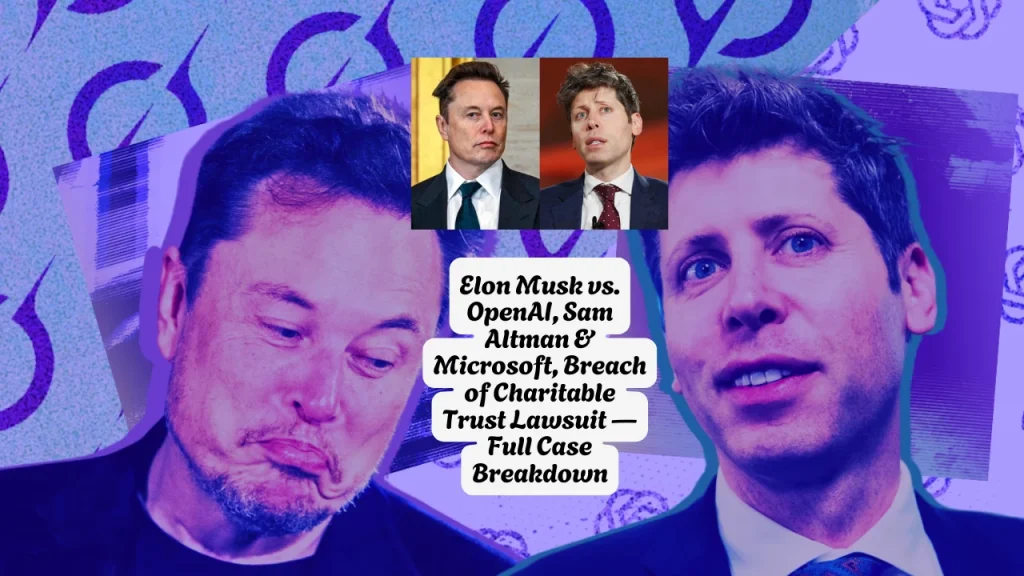
Elon Musk is the CEO of Tesla, SpaceX, and xAI — his own competing artificial intelligence company launched in 2023. He co-founded OpenAI in 2015 and contributed approximately $38 million to the organization before leaving its board in 2018. Musk claims OpenAI betrayed its initial nonprofit mission when it changed its corporate structure; OpenAI, for its part, claims Musk’s suit is meant to derail its position as a competitor to his own AI company, xAI.
Sam Altman is OpenAI’s CEO. Greg Brockman is OpenAI’s president and a co-founder. Both are named individually as defendants. OpenAI’s lead attorney argued in opening statements that Musk is suing because he is unhappy that OpenAI thrived after he left: “Mr. Musk may not like that, but it’s no basis for a lawsuit.”
Microsoft is named as a co-defendant. OpenAI recently closed a $122 billion funding round at an $852 billion valuation. The stakes of this trial — including OpenAI’s anticipated IPO — extend far beyond the courtroom. For context on how tech company valuations factor into civil damages claims.
What Is at Stake in This Lawsuit?
The jury’s verdict will advise Judge Gonzalez Rogers as she decides whether Musk gets his wish: reversion of OpenAI to a nonprofit structure, the removal of Altman and Brockman from OpenAI’s board, and around $130 billion in damages directed back into OpenAI’s nonprofit foundation.
The trial is divided into two phases. In the liability phase, the jury delivers an advisory verdict, with the judge making the final decision. If OpenAI and its co-defendants are found liable, the case moves to a remedies phase handled exclusively by the judge, with jurors excluded from any discussion of consequences or damages.
The trial threatens to derail one of the world’s largest AI companies as it makes plans to go public, potentially as early as this year. An order forcing OpenAI to unwind its public benefit corporation structure would affect every investor, employee, and partner connected to a company valued near $1 trillion.
What Happened in Court So Far
Musk spent two days on the witness stand, beginning April 28. He testified that he played a pivotal role in founding OpenAI — coming up with the idea, the name, recruiting key people, and providing initial funding — and said he would not have contributed if the founders intended to make a profit.
Musk said he “was a fool” for giving OpenAI and Altman the funding that was then used to create an $800 billion company. He accused OpenAI’s leaders of “looting the nonprofit” by profiting from what he considered a charitable institution.
The cross-examination grew heated. Musk told OpenAI attorney Savitt that his questions “are not simple — they are designed to trick me,” to which the judge interjected and cut off the exchange. Judge Gonzalez Rogers also scolded Musk on the first morning of trial for social media posts he made about the case, threatening a gag order, before all three principals — Musk, Altman, and Brockman — agreed to limit their posts during the proceedings.
What Happens Next?
OpenAI’s attorney Savitt expected to finish his cross-examination of Musk on Thursday, April 30. After Musk’s testimony concludes, Musk’s attorneys will call Jared Birchall — who manages Musk’s family office — as the next witness. Greg Brockman has been given a 48-hour notice to testify.
Altman is also expected to testify, along with Brockman and Microsoft CEO Satya Nadella, among other key witnesses. The trial is expected to last approximately three to four weeks total. If the jury finds OpenAI liable, the case moves to a separate remedies phase before Judge Gonzalez Rogers alone.
Frequently Asked Questions
Who filed this lawsuit and why?
Musk filed the lawsuit claiming that Altman and Brockman deceived him and betrayed OpenAI’s original nonprofit mission to develop safe, open-source AI for the public good. He argues his donations created a charitable trust that OpenAI violated when it converted to a for-profit structure.
What court is handling this case?
The case is being heard in the U.S. District Court for the Northern District of California in Oakland, before U.S. District Judge Yvonne Gonzalez Rogers. The case number is 4:24-cv-04722-YGR.
What is the current status of the case?
The liability phase of the trial began April 28, 2026 and is expected to run through mid-May 2026, with court in session from 8:30 a.m. to 1:40 p.m. PT each Monday through Thursday.
How much is Musk seeking in damages?
Musk previously sought up to $134 billion personally but is now asking for all ill-gotten gains to go back into the OpenAI nonprofit charity. He has stated publicly that he will not personally keep any proceeds from a legal victory.
Can I read the court documents?
Yes. The docket for Musk v. Altman, No. 4:24-cv-04722, is publicly available on CourtListener at courtlistener.com and through PACER at pacer.gov.
What claims actually went to trial?
Of the 26 claims Musk originally filed in 2024, only two remain: breach of charitable trust and unjust enrichment. All other claims were dismissed or dropped before trial.
What did OpenAI say about the lawsuit?
OpenAI’s lead attorney argued in opening statements that this is a case of sour grapes — that after Musk left OpenAI and it succeeded without him, he launched his own competitor and then launched lawsuits. OpenAI maintains that its nonprofit foundation remains in control of the organization.
Did Musk actually give $1 billion to OpenAI as promised?
OpenAI’s attorney pressed Musk on the fact that he pledged $1 billion in funding but only contributed approximately $38 million. Musk pushed back, saying he contributed his reputation and other intangibles, and believed his total contributions exceeded $100 million.
Sources & References
- CourtListener Docket — Musk v. Altman, No. 4:24-cv-04722: courtlistener.com
- Associated Press via BetaNews: betanews.com
Prepared by the AllAboutLawyer.com Editorial Team and reviewed for factual accuracy against official court records and verified public sources on April 30, 2026. Last Updated: April 30, 2026
Disclaimer: This article is for informational purposes only and does not constitute legal advice. Information about this ongoing legal case is based on publicly available court records and verified reporting. Allegations described have not been proven in court. For advice regarding a particular legal situation, consult a qualified attorney.
About the Author
Israr Ahmad is a legal content researcher with 4+ years of experience covering class action settlements and consumer rights cases. He has researched and published coverage of 2,500+ settlements using verified court records, settlement administrator filings, and government sources. Learn more about Israr.