
DOJ vs. Adrian Fontes, Arizona Voter Rolls Lawsuit Full Case Breakdown
“This article covers a concluded federal civil lawsuit. Information is based on official court records and verified reporting from AP, NBC News, The Hill, and the Arizona Attorney General’s office.”
U.S. Department of Justice vs. Adrian Fontes is a federal civil lawsuit in which the DOJ sued Arizona Secretary of State Adrian Fontes, demanding he hand over the state’s full voter registration database. U.S. District Judge Susan Brnovich dismissed the case with prejudice on April 29, 2026, ruling that Arizona’s statewide voter registration list is not a document the Attorney General has the legal right to request. The dismissal means the DOJ cannot refile this same claim against Arizona.
| Field | Detail |
| Plaintiff | U.S. Department of Justice |
| Defendant | Adrian Fontes, Arizona Secretary of State |
| Case Type | Federal Civil — Election Records / Civil Rights Act of 1960 |
| Court | U.S. District Court, District of Arizona |
| Presiding Judge | U.S. District Judge Susan Brnovich |
| Date Filed | January 2026 |
| Legal Claim | Civil Rights Act of 1960 — alleged right to obtain statewide voter registration list |
| Outcome | Dismissed with prejudice — April 29, 2026 |
| Settlement/Judgment Amount | N/A — case dismissed, no monetary award |
| Attorneys of Record | TBD — not confirmed in public reporting as of publication |
| Last Updated | April 30, 2026 |
Case Timeline
| Date | Event |
| July 2025 | DOJ first asked Fontes to provide an unredacted electronic copy of Arizona’s voter registration rolls |
| August 2025 | Fontes told the Trump administration that state and federal privacy laws bar him from complying |
| January 2026 | DOJ filed suit against Fontes, arguing he “refused” to provide the voter registration records |
| January 20, 2026 | Arizona Alliance for Retired Americans and Common Cause filed legal papers to intervene in the lawsuit |
| March 2026 | Fontes filed a motion asking the court to dismiss the case |
| April 29, 2026 | Judge Brnovich dismissed the lawsuit with prejudice, ruling that the voter registration list is not subject to the Attorney General’s request under federal law |
What Is the DOJ vs. Fontes Lawsuit About?
The DOJ asked the court to order Fontes to provide then-Attorney General Pam Bondi with a full electronic copy of Arizona’s voter registration list — including each registrant’s full name, date of birth, residential address, and either their driver’s license number, the last four digits of their Social Security number, or a unique identifier assigned under the Help America Vote Act of 2002.
The DOJ’s legal theory rested on the Civil Rights Act of 1960. The lawsuit alleged that Act imposes a “sweeping obligation on election officials” to retain and preserve election records and grants the Attorney General broad power to obtain those records. Fontes rejected that argument, saying the demand violated both state and federal privacy laws.
Fontes also argued in court filings that anyone who makes it onto Arizona’s voter rolls has already demonstrated United States citizenship under state law — making the federal request unnecessary even on its own stated terms. For readers who want more background on how federal election law intersects with state voter data rules.
Related article: $71,939 Sterling Farm & Fleet Overtime Pay Settlement, Check If You Qualify for a Payment Before June 11
Who Are the Parties?
Adrian Fontes is the elected Democratic Secretary of State of Arizona. His office manages the state’s official voter registration database, which according to the Arizona AG’s office covers the personal information of millions of registered Arizona voters. Fontes refused the DOJ’s request from the start, and his office was backed in court by Arizona Attorney General Kris Mayes.
The DOJ under Trump requested complete voter registration lists from the governments of at least 48 states and Washington, D.C., according to the Brennan Center for Justice, and sued 30 states and the District of Columbia for refusing to provide them. Arizona was one of those states that refused and got sued.
Related article: Elon Musk vs. OpenAI, Sam Altman & Microsoft, Breach of Charitable Trust Lawsuit Full Case Breakdown
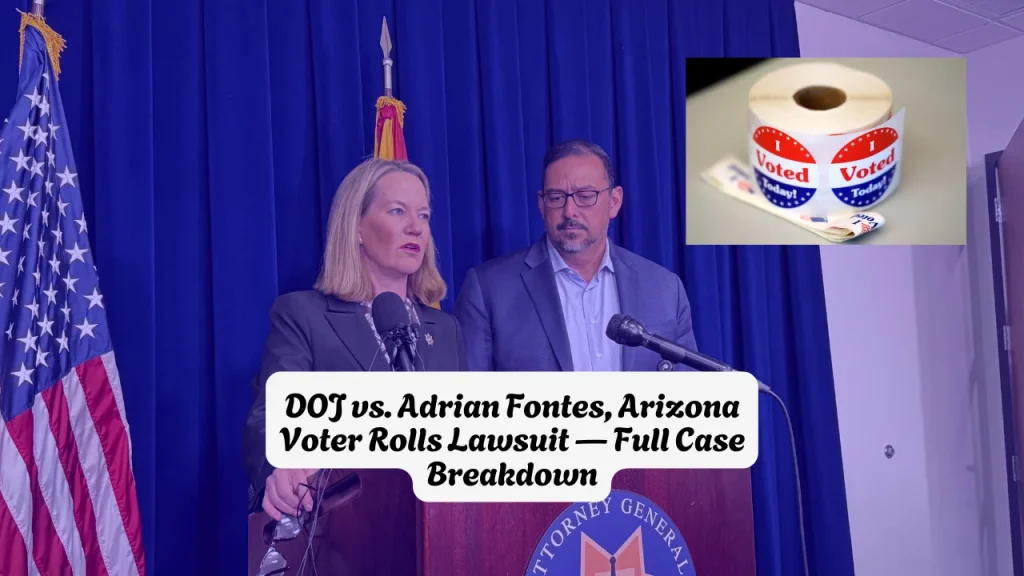
How Did the Lawsuit End?
Judge Brnovich — herself a Trump appointee — sided with Arizona and dismissed the case with prejudice, meaning it cannot be refiled. The court concluded that Arizona’s statewide voter registration list is not a document the Civil Rights Act of 1960 entitles the Attorney General to obtain.
Dismissed with prejudice means the case is permanently closed. The DOJ cannot fix its complaint and try again in the same court on the same legal theory. The ruling strikes at the core of the DOJ’s legal theory, finding that the Civil Rights Act provision at issue applies only to documents submitted by voters — such as registration forms — not statewide databases created and maintained by election officials.
Arizona Attorney General Kris Mayes and Secretary Fontes called the ruling a vindication, stating that the court was clear that Title III of the Civil Rights Act does not authorize this kind of demand, and noted it was the sixth federal court to reach the same conclusion. For more on how dismissals with and without prejudice differ in federal civil cases.
What Does This Case Mean for Arizona Voters and Other States?
Judges have now rejected similar DOJ efforts to obtain sensitive voter information in California, Massachusetts, Michigan, Oregon, and Rhode Island — making this the sixth straight loss for the federal government in this nationwide push.
At least 13 states — including Alaska, Arkansas, Indiana, Louisiana, Mississippi, Nebraska, Ohio, Oklahoma, South Carolina, South Dakota, Tennessee, Texas, and Wyoming — have either provided or promised to provide their detailed voter registration lists to the DOJ. So the legal battle continues in other courtrooms across the country.
In March 2026, a DOJ attorney acknowledged in the Rhode Island case that voter registration data collected from states is being shared with the Department of Homeland Security to check citizenship status. That admission gave additional legal weight to Arizona’s argument that the demand went beyond election law compliance. To understand how similar voter data disputes have played out nationally.
Frequently Asked Questions
Who filed this lawsuit and why?
The U.S. Department of Justice filed suit against Arizona Secretary of State Adrian Fontes in January 2026. The DOJ said it needed the voter registration records to check Arizona’s compliance with the National Voter Registration Act and the Help America Vote Act. Fontes refused, citing state and federal privacy protections.
What court handled this case?
U.S. District Judge Susan Brnovich heard the case and issued a 13-page ruling dismissing the DOJ’s claim with prejudice on April 29, 2026. The case was filed in the U.S. District Court for the District of Arizona.
Has the case been resolved?
Yes. The judge dismissed the lawsuit with prejudice, ruling that amendment would be legally futile. The DOJ cannot refile this same claim against Arizona.
What data did the DOJ want?
The DOJ sought detailed voter data including dates of birth, home addresses, driver’s license numbers, and partial Social Security numbers for all registered Arizona voters.
Can I read the court documents?
Yes. The case is a federal civil proceeding and the ruling is publicly accessible through the U.S. District Court for the District of Arizona via PACER (pacer.gov) or the free CourtListener database at courtlistener.com.
Was Arizona the only state to fight this?
No. The DOJ sued 30 states and the District of Columbia for refusing to hand over voter rolls, while at least a dozen GOP-controlled states chose to comply voluntarily.
What does dismissal with prejudice mean here?
Dismissal with prejudice means the lawsuit is permanently closed on its current legal theory. The DOJ cannot go back to the same court and refile the same claim against Fontes. It would need a fundamentally different legal argument or a new act of Congress to revisit the issue.
Sources & References
- Arizona Attorney General Press Release, April 29, 2026: azag.gov
Prepared by the AllAboutLawyer.com Editorial Team and reviewed for factual accuracy against official court records and verified public sources on April 30, 2026. Last Updated: April 30, 2026
Disclaimer: This article is for informational purposes only and does not constitute legal advice. Information about this concluded legal case is based on publicly available court records and verified reporting. For advice regarding a particular legal situation, consult a qualified attorney.
About the Author
Israr Ahmad is a legal content researcher with 4+ years of experience covering class action settlements and consumer rights cases. He has researched and published coverage of 2,500+ settlements using verified court records, settlement administrator filings, and government sources. Learn more about Israr.