
MLB Lawsuit 2026 Why Major League Baseball Sued the MLBPA and Eight Players Before a Possible Lockout
On November 25, 2026, Major League Baseball and the corporate entities that own its 30 teams filed a 38-page federal complaint in the U.S. District Court for the Southern District of New York (Manhattan). The defendants are the Major League Baseball Players Association (MLBPA) and the eight players on its executive subcommittee: Chris Bassitt, Jake Cronenworth, Pete Fairbanks, Cedric Mullins II, Marcus Semien, Paul Skenes, Tarik Skubal and Brent Suter.
MLB asks the court to declare that a lockout does not violate federal antitrust law, and that federal courts cannot enjoin it. It also asks that the players be treated as a defendant class. The current collective bargaining agreement (CBA) expires on December 1, 2026, and a lockout is widely expected. The MLBPA called the suit “completely frivolous.”
This is a labor and antitrust dispute between the league and the union. It is not a fan or consumer class action, and no settlement or claim form exists. No court has ruled on the merits, and the 2027 season has not been canceled.
MLB Lawsuit 2026: Quick Facts
| Item | Details |
| Plaintiffs | MLB and the entities owning its 30 teams |
| Defendants | MLBPA and eight executive subcommittee players |
| Filed | November 25, 2026 |
| Court | U.S. District Court, Southern District of New York |
| Complaint | 38 pages |
| Relief sought | Declaratory judgment, no-injunction ruling, defendant-class certification |
| Type | Putative defendant class action seeking declaratory relief |
| CBA expires | December 1, 2026 |
| MLB’s proposed 2028 cap and floor | $258.2 million cap, $180.2 million floor, per team |
| Final ruling | None |
The case number, assigned judge and first hearing date were not independently confirmed.
Why Is Major League Baseball Suing the MLB Players Association?
MLB says it has a “reasonable and imminent fear” that the union will declare it no longer represents players, so players can sue under antitrust law instead of bargaining. In antitrust cases, successful plaintiffs can recover three times their proven damages. MLB points to the NBA and NHL, where players’ unions disclaimed representation in 2011 and 2012.
An MLB spokesman called the filing “a defensive measure” meant to keep the parties bargaining toward “a full 2027 season.” MLB’s fear about what the union will do is an allegation, not a finding. The MLBPA says MLB chose to “run to court” in the middle of negotiations.
Which Players Is MLB Suing, and Is It Seeking Money From Tarik Skubal and Paul Skenes?
The eight players are named because of their union leadership roles. The reported relief is declaratory, not a damages award. Skubal, who this week agreed to a nine-year, $450 million contract with the New York Mets, and Skenes are named as union representatives. They are not accused of misconduct, and the suit is not about their individual contracts.
What Does MLB Ask the Federal Court to Decide?
MLB asks the court to:
- Declare that a lockout does not violate antitrust law and is not an unreasonable restraint of trade.
- Declare that federal courts lack jurisdiction to enjoin a lockout.
- Certify the players as a defendant class, which if granted could block individual lawsuits.
None of these requests has been granted.
What Is MLB’s 2028 Salary Cap and Salary Floor Proposal?
MLB has no conventional hard cap. It uses a Competitive Balance Tax. Its latest proposal would start a cap of $258.2 million and a floor of $180.2 million per team in 2028, the first cap proposal since 1994. The MLBPA calls a cap a non-starter. These are proposals, not adopted rules.
Under the proposal, eight teams including the Los Angeles Dodgers, New York Mets and New York Yankees would have to reduce payroll, and others would have to raise it to reach the floor. Actual effects would depend on accounting rules, exceptions and the treatment of existing contracts.
When Could the 2026 MLB Lockout Begin?
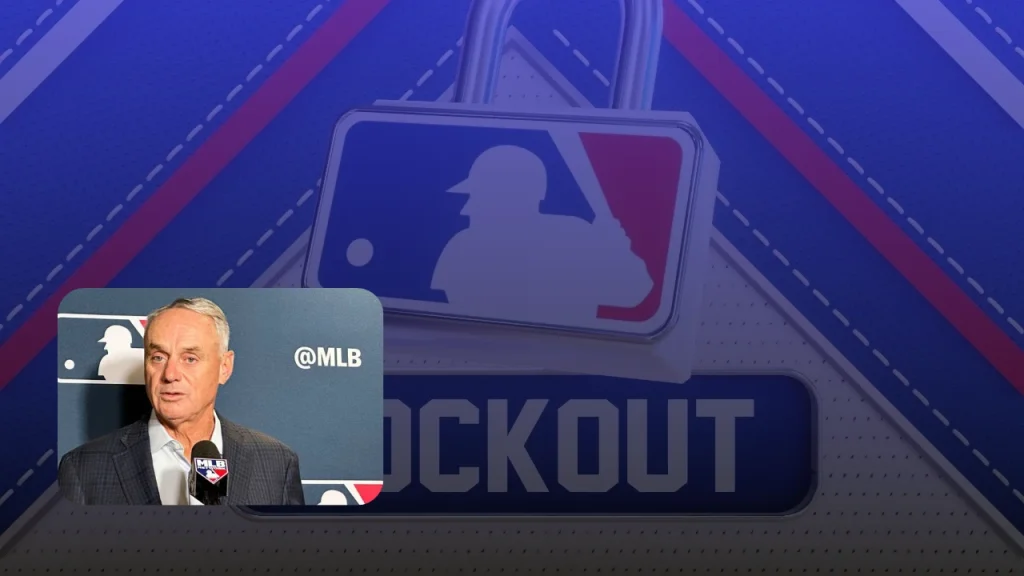
The CBA expires December 1, 2026. Expiration does not automatically cause a lockout, because owners must choose to impose one. Reporting says owners are expected to lock out players immediately, which would be the sport’s 10th work stoppage since 1972. A lockout would halt free-agent signings, trades and use of team facilities.
A lockout is imposed by owners. A strike is a player work stoppage. The current dispute concerns an expected lockout, not a player strike.
Will the 2027 MLB Season Be Canceled?
No cancellation has been announced. The 2021–22 lockout lasted 99 days and ended March 10, 2022, with a full 162-game season. The 1994–95 players’ strike, which began after players fought off a salary cap proposal, canceled the World Series. A long 2026–27 lockout could threaten spring training and games, but a deal could still protect the full schedule.
Which Federal Laws Apply to the MLB v. MLBPA Lawsuit?
| Law | Why it matters |
| National Labor Relations Act, 29 U.S.C. §§ 157–159 | Protects bargaining rights and requires good-faith bargaining under §§ 8(a)(5), 8(b)(3) and 8(d). It does not force either side to accept an economic proposal. |
| Sherman Act, 15 U.S.C. § 1 | Bars agreements that unreasonably restrain trade; players could invoke it if a bargaining exemption no longer applied. |
| Clayton Act, 15 U.S.C. §§ 15, 26 | Allows treble damages and injunctions for antitrust injury. |
| Curt Flood Act of 1998, 15 U.S.C. § 26b | Subjects major-league player employment to antitrust law but preserves the nonstatutory labor exemption. |
| Norris-LaGuardia Act, 29 U.S.C. §§ 101–115 | Limits federal courts’ power to enjoin labor disputes, central to MLB’s no-injunction request. |
| Declaratory Judgment Act, 28 U.S.C. § 2201 | Lets courts rule on legal rights in an actual controversy. The court may ask whether the dispute is concrete and imminent enough. |
| Federal Rule of Civil Procedure 23 | Governs class actions, including the defendant class MLB seeks; the case stays a putative class action until certified. |
The nonstatutory labor exemption is the judge-made doctrine that shields bargaining-related conduct from antitrust liability. The key question is whether it survives if the MLBPA disclaims representation. A disclaimer does not necessarily end the exemption immediately.
Which Court Cases Could Shape the MLB Lawsuit?
- Brown v. Pro Football, Inc., 518 U.S. 231 (1996): held that qualifying employer conduct arising from bargaining can keep antitrust protection after impasse.
- Brady v. NFL, 644 F.3d 661 (8th Cir. 2011): vacated an injunction against the NFL lockout because federal labor law limited the court’s power. It is persuasive but not binding in the Second Circuit.
- Flood v. Kuhn, 407 U.S. 258 (1972): upheld baseball’s antitrust exemption, which Congress later narrowed.
Can the MLBPA Legally Disclaim Representation?
Decertification is a formal process run by the National Labor Relations Board. A disclaimer is a union giving up its representative role. MLB argues a disclaimer could be a litigation tactic rather than a genuine end to representation. No court has found that the MLBPA did anything improper.
What Happens to MLB Player Contracts and Pay During a Lockout?
A lockout does not automatically end guaranteed contracts, but it can halt team-supervised training, facility access, trades and free-agent signings. Whether lost games affect pay or service time would depend on contracts and any final CBA.
Can Fans Get Refunds for 2027 MLB Games If There Is a Lockout?
No league-wide refund program exists. If games are canceled or postponed, refunds or credits depend on the seller’s terms and consumer law. Fans should:
- Keep their ticket confirmations.
- Check whether a game is canceled or postponed.
- Read the seller’s refund policy.
- Request refunds from the original seller.
- Contact their payment provider if a legitimate billing dispute stays unresolved.
Hotels and flights are covered by separate contracts. Stadium workers’ unemployment eligibility depends on state law and the circumstances, so they should keep employment records and contact their state agency.
Is the MLB Lawsuit a Class Action Settlement With a Claim Form?
No. The defendant class MLB seeks is a procedural tool to bind players to one ruling, not a fund for fans. Related baseball-law stories include MLB Players Union Vs. DraftKings: NIL Lawsuit Settled, Zack Gelof Sues Detroit Tigers Over Comerica Park Fence and The Truth About the Phillies Karen Lawsuit, The Viral Misinformation That Never Happened. None creates eligibility for payment under this case.
MLB Lawsuit 2026: Important Dates
| Date | Development |
| March 10, 2022 | 99-day lockout ends with a full 162-game season |
| November 25, 2026 | MLB files suit in Manhattan |
| December 1, 2026 | CBA expires |
| 2028 | Proposed start of the cap and floor |
Future dates depend on negotiations and the litigation.
What Happens Next in MLB v. MLBPA?
The union and players could oppose class certification or argue the court lacks jurisdiction because no concrete controversy exists yet. Bargaining can continue alongside the case. The dispute could end by agreement without a final ruling. Among MLB’s lawyers is former Solicitor General Paul D. Clement.
Frequently Asked Questions About the MLB Lawsuit
Why did MLB sue the players’ union?
To get a ruling that a lockout is lawful under antitrust law and can’t be enjoined, and to head off a possible union disclaimer.
Is MLB suing all players?
No. It named the MLBPA and eight executive subcommittee players, and asks the court to treat players as a defendant class.
Are Tarik Skubal and Paul Skenes being sued for money?
The relief reported is declaratory, not damages. They are named for their union roles.
Is the MLB lockout confirmed?
No lockout had begun as of November 26, 2026. One is expected after the December 1 expiration.
Does MLB have a salary cap now?
No. It uses a luxury tax, and the proposed cap targets 2028.
Has the 2027 season been canceled?
No.
Bottom Line on the MLB v. MLBPA Lawsuit
MLB wants the court to rule before a lockout that it can lock out players without antitrust liability. The union calls the case frivolous, and no court has ruled. For fans, the date to watch is December 1, 2026. Until a court rules or a deal is reached, the legal arguments and the cap proposal are unresolved.
Sources for the MLB v. MLBPA Lawsuit
- MLB: league’s November 25 announcement of the lawsuit
- MLBPA statement on bargaining
- MLB: revised salary cap and floor proposal
- Associated Press: Major League Baseball sues players’ union, asking court to declare lockout is legal
- Reuters: MLB sues players’ union, seeks ruling that lockout is legal
- National Labor Relations Act (NLRB)
- Curt Flood Act of 1998 (GovInfo)
- Brown v. Pro Football, Inc., 518 U.S. 231 (1996) (Justia)
- Brady v. NFL, 644 F.3d 661 (8th Cir. 2011) (Justia)
Disclaimer: AllAboutLawyer.com is a legal-information website, not a law firm, and this is not legal advice. Allegations in pending cases are not findings of liability.
Researched and written by Israr Ahmad, legal content researcher and founder of AllAboutLawyer.com. All facts cross-checked against MLB’s November 25 announcement, Associated Press and Reuters reporting, the MLBPA’s public statement, and the cited federal statutes and court opinions, as of November 26, 2026. Last Updated: November 26, 2026.
About the Author
Israr Ahmad is a legal content researcher with 4+ years of experience covering class action settlements and consumer rights cases. He has researched and published coverage of 2,500+ settlements using verified court records, settlement administrator filings, and government sources. Learn more about Israr.