
Walmart Text Message Class Action Lawsuit 2026, Could Customers Get $500 to $1,500 for Unwanted Marketing Texts?
Walmart Inc. faces a new federal putative class action alleging that the retailer sent unsolicited promotional text messages to consumers before 8 a.m. or after 9 p.m., potentially violating the Telephone Consumer Protection Act (TCPA). The case is Campos v. Walmart Inc., filed in the U.S. District Court for the Eastern District of California.
Sussan Campos, a California consumer, filed the lawsuit on November 5, 2026. She seeks to represent affected consumers nationwide and asks for statutory damages, increased damages for knowing or willful violations, and a court order stopping the alleged practices.
The TCPA allows $500 per qualifying violation, which a court may increase up to $1,500. Courts, however, disagree on whether consumers can recover these damages for quiet-hours text messages.
As of November 26, 2026, no Walmart text message settlement, certified class, official claim form or guaranteed payment has been identified. Walmart has not admitted liability, and the allegations are unproven.
Campos v. Walmart Inc.: Quick Facts
| Case information | Details |
| Lawsuit | Campos v. Walmart Inc. |
| Plaintiff | Sussan Campos (Visalia, California) |
| Defendant | Walmart Inc. |
| Filing date | November 5, 2026 |
| Court | U.S. District Court, Eastern District of California |
| Current civil case number | 1:26-cv-09126 |
| Earlier reported case number | 1:26-at-03863 |
| Assigned magistrate judge | Erica P. Grosjean |
| Plaintiff’s attorney | Vinit R. Venkatesh, PLG Damage Attorneys |
| Alleged violations | Unsolicited promotional texts during restricted hours |
| Federal law | Telephone Consumer Protection Act, 47 U.S.C. § 227 |
| Proposed class | Nationwide (not certified) |
| Potential statutory damages | $500 per qualifying violation |
| Potential enhanced damages | Up to $1,500 per qualifying violation |
| Initial scheduling conference | February 23, 2027, at 10 a.m. (may be rescheduled) |
| Class certification | Not granted |
| Settlement amount | None announced |
| Official settlement website | None. No settlement exists, so there is no administrator site |
| Claim deadline | None announced |
The public federal court docket on Justia shows the filing, parties, judicial assignment and scheduling conference. Early news coverage used the earlier number 1:26-at-03863; the docket now lists 1:26-cv-09126.
Why Is Walmart Inc. Being Sued Over Text Messages?
According to Top Class Actions’ November 24 report, Campos alleges she received promotional messages identifying Walmart while in Visalia, California, some of them sent outside federally permitted hours. She says she had not authorized the marketing messages and that they intruded on her privacy.
The lawsuit alleges Walmart either sent the texts itself or arranged for third-party marketing vendors to send them.
The case raises three central questions:
- Whether Walmart Inc. is responsible for the disputed messages.
- Whether the messages were telephone solicitations under the TCPA and FCC rules.
- Whether consumers can sue privately under 47 U.S.C. § 227(c)(5) over text messages sent during quiet hours.
The full complaint and message exhibits were not independently reviewed for this article. Walmart’s liability has not been established.
What Are the Legal Hours for Marketing Texts Under 47 C.F.R. § 64.1200(c)(1)?
Under 47 C.F.R. § 64.1200(c)(1), covered telephone solicitations to residential subscribers cannot be initiated before 8 a.m. or after 9 p.m. at the recipient’s location. FCC rules extend relevant telemarketing protections to wireless numbers and text messages.
| Recipient’s local time | Federal quiet-hours rule |
| 12 a.m. to before 8 a.m. | Restricted |
| 8 a.m. through 9 p.m. | Not restricted by the time-of-day rule alone |
| After 9 p.m. | Restricted |
The recipient’s local time controls, not the time at Walmart’s headquarters or its marketing vendor. A text sent at 10:30 a.m. Eastern reaches a California customer at 7:30 a.m. Pacific, which falls inside the restricted window.
Consent, an established business relationship and court interpretations can all affect whether a particular message is actionable.
Who Could Qualify for the Campos v. Walmart Inc. Class Action?
The proposed nationwide class reportedly covers consumers who received multiple Walmart telemarketing texts within a 12-month period during the preceding four years, including at least one initiated outside permitted hours. You may fit the proposed description if:
- You received promotional texts from Walmart or someone acting for it.
- You received more than one such message within a 12-month period.
- At least one was sent before 8 a.m. or after 9 p.m. in your local time zone.
- The messages fall within the proposed four-year period, which from the November 5, 2026 filing could reach back to about November 5, 2022.
The exact class definition depends on the complaint’s wording, any amendments and court approval. Fitting the description does not by itself establish a valid individual claim.
Can Walmart Customers Get $500 to $1,500 Per Text Under 47 U.S.C. § 227(c)(5)?
Under 47 U.S.C. § 227(c)(5), a qualifying consumer may seek actual monetary loss or $500 per violation, whichever is greater. If a court finds the defendant knowingly or willfully violated the regulations, it may increase the award to as much as three times that amount.
| Proven qualifying violations | Ordinary statutory damages | Potential maximum enhanced damages |
| 2 | $1,000 | $3,000 |
| 3 | $1,500 | $4,500 |
| 5 | $2,500 | $7,500 |
| 10 | $5,000 | $15,000 |
These are illustrative calculations, not predicted Walmart payments. Enhanced damages are discretionary, and class settlements often pay far less than the statutory maximum.
Similar allegations appear in the Flag & Anthem Text Message Class Action Lawsuit, Can Customers Get Paid for Early-Morning Promotional Texts?
Are Walmart Marketing Texts Always Illegal Before 8 A.M. or After 9 P.M.?
No. The quiet-hours rule applies to communications that meet the legal definition of a telephone solicitation. Under 47 U.S.C. § 227(a)(4) and 47 C.F.R. § 64.1200(f)(15), some messages fall outside that definition because of prior express permission, an established business relationship or a nonprofit exception.
An established business relationship generally means a purchase or transaction within the previous 18 months, or an inquiry or application within the previous three months, that has not been terminated. A company-specific do-not-call request can end that exemption for solicitation purposes.
Giving Walmart your number for delivery notices does not necessarily authorize every future promotional campaign.
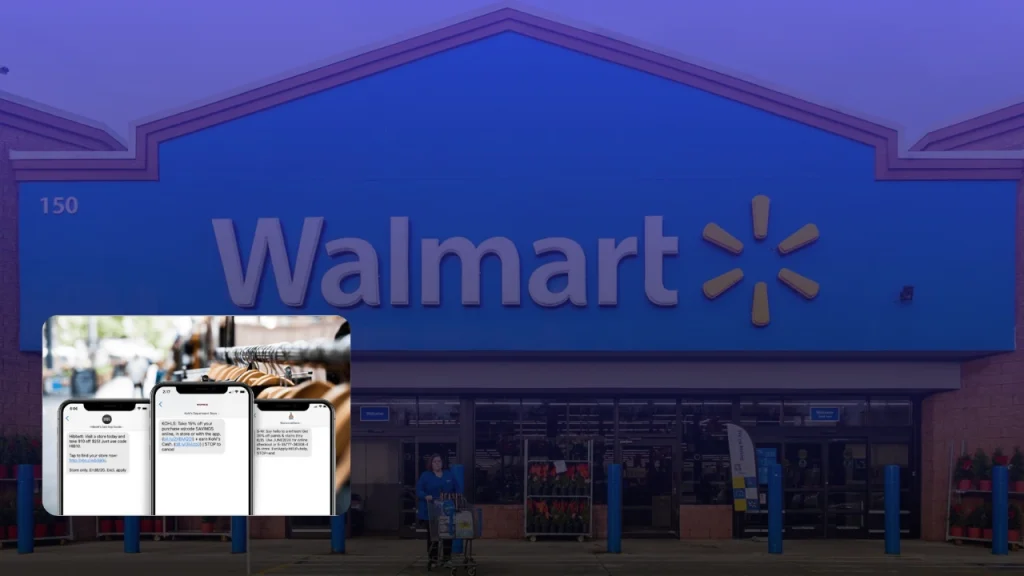
Are Walmart Order, Pickup and Delivery Texts Part of the Lawsuit?
The case concerns allegedly unauthorized promotional messages, not ordinary order updates.
| Type of Walmart text | Likely treatment |
| Order confirmation | Generally transactional |
| Grocery pickup notification | Generally transactional |
| Delivery status update | Generally transactional |
| Account verification code | Generally informational |
| Product discounts | Potential marketing |
| Holiday sale announcement | Potential marketing |
| Walmart+ promotional offer | Potential marketing |
A message mixing order information with advertising may need closer analysis. Walmart explains how order texts work in its official text messaging guidance. An overnight order notice alone does not make you eligible for compensation.
Which Federal and California Laws Apply to Campos v. Walmart Inc.?
1. Telephone Consumer Protection Act, 47 U.S.C. § 227(c)
Congress passed the TCPA in 1991 to limit intrusive telephone solicitations. Section 227(c)(5) gives a private right of action for repeated qualifying violations by or on behalf of the same entity within 12 months. Whether it covers text messages is now a disputed legal issue.
2. FCC Quiet-Hours Rule, 47 C.F.R. § 64.1200(c)(1)
This is the main regulation behind the alleged early-morning and late-night texts. Section 64.1200(e) extends relevant protections to wireless numbers and texts.
3. National and Company-Specific Do Not Call Rules, 47 C.F.R. § 64.1200(c)(2) and (d)
These rules are related to, but separate from, quiet hours. A quiet-hours theory does not necessarily require registration on the National Do Not Call Registry, while a registry-based claim carries additional requirements.
4. TCPA Autodialer Provision, 47 U.S.C. § 227(b), and Facebook, Inc. v. Duguid
Section 227(b) restricts certain autodialed and prerecorded communications. In Facebook, Inc. v. Duguid, 592 U.S. 395 (2021), the Supreme Court narrowed the definition of an automatic telephone dialing system. The Walmart quiet-hours case is not a conventional autodialer case.
5. California Business and Professions Code § 17538.41
California’s text advertising statute separately restricts certain unsolicited text ads, subject to exceptions. The available docket identifies a federal TCPA claim, and no separate California cause of action against Walmart Inc. has been independently confirmed.
6. Federal Rule of Civil Procedure 23
Rule 23 governs class certification. Campos must show, among other things, common questions, typicality, adequate representation and predominance. Filing a class complaint does not certify a nationwide class.
7. Four-Year Limitations Period, 28 U.S.C. § 1658
TCPA claims generally follow the four-year federal limitations period, which explains the proposed four-year lookback. Individual deadlines can depend on when each claim accrued.
Could Walmart Defeat the Lawsuit Because of Conflicting TCPA Text Message Rulings?
Possibly. Federal courts disagree on whether text messages fall under the private right of action in 47 U.S.C. § 227(c)(5).
Steidinger v. Blackstone Medical Services (7th Cir., July 14, 2026)
In Steidinger v. Blackstone Medical Services, No. 25-2398, the Seventh Circuit held that text messages are not “telephone calls” under § 227(c)(5). It binds federal courts in Illinois, Indiana and Wisconsin and may be cited as persuasive authority elsewhere.
Arguello v. R.E.S.A., Inc. (N.D. Cal., October 22, 2026)
In Arguello v. R.E.S.A., Inc., No. 3:26-cv-05536-JSC, Judge Jacqueline Scott Corley denied a motion to dismiss and concluded that § 227(c)(5) covers text messages. That supports the theory in Campos v. Walmart Inc. but does not bind every California federal judge.
Rocha v. All Things Go LLC (E.D. Cal., February 18, 2026)
Rocha v. All Things Go LLC involved TCPA claims over promotional messages sent outside permitted hours in the same district as the Walmart case.
Because of this split, no one should assume every unwanted promotional text produces a $500 payment. Other retailers face similar suits, including those covered in Skims, Birkenstock, Foot Locker and Urban Outfitters TCPA Class Action Lawsuits, Text Message Allegations, Case Numbers and What Customers Should Know.
Can Walmart Avoid Liability by Using a Third-Party Marketing Company?
Not automatically. A company can be held responsible for messages sent by another business on its behalf. Courts look at whether Walmart authorized or controlled the vendor’s conduct, or knowingly accepted the benefit of the campaign. Marketing agreements, transmission records and consent databases may be examined.
Walmart’s name in a text does not by itself prove Walmart sent it, since scammers also impersonate major retailers.
How to Preserve Evidence of Walmart Marketing Texts
Keep the evidence before deleting or blocking anything.
- Screenshot the full message, sender number or short code, and timestamp.
- Record the date, local time and your location when each message arrived.
- Keep the original conversation on your phone.
- Save any Walmart marketing sign-up or consent records.
- Keep copies of any opt-out requests and later messages.
- Note whether each message was advertising or about an existing order.
- Speak with a consumer protection attorney if you believe repeated violations occurred.
Do not share verification codes, passwords or sensitive personal data publicly. The same records help in other quiet-hours cases, such as the Iberostar Beachfront Resorts Text Message Lawsuit, Were You Sent Vacation Offers Before 8 A.M. or After 9 P.M.?
How to Stop Unwanted Walmart Text Messages
For legitimate Walmart messages, review the Walmart Mobile Alerts Terms of Use. Different Walmart programs may have different unsubscribe steps. You can generally reply STOP to a subscribed program or call Walmart customer service at 1-800-925-6278.
You can also report unwanted texts to the FCC consumer complaint system and register your number at DoNotCall.gov. An FCC complaint does not start a lawsuit or entitle you to payment. If a message looks fraudulent, do not click its links or share personal information.
How to Join the Campos v. Walmart Inc. Class Action
There is currently no settlement registration portal, claim form or official settlement website for Campos v. Walmart Inc., and no action is required from consumers now. If a class is later certified or a settlement approved, the official court-approved notice will explain eligibility, payment, exclusion rights and deadlines. No fee is required to take part in a court-approved class settlement.
Avoid any website or social post claiming you can file a Walmart text message payout claim today.
Campos v. Walmart Inc. Timeline
| Date | Development |
| About November 5, 2022 | Possible start of the proposed four-year lookback |
| July 14, 2026 | Seventh Circuit decides Steidinger v. Blackstone Medical Services |
| October 22, 2026 | N.D. Cal. decides Arguello v. R.E.S.A., Inc. |
| November 5, 2026 | Sussan Campos files suit against Walmart Inc. |
| November 24, 2026 | Case reported by Top Class Actions |
| November 26, 2026 | No settlement or class certification confirmed |
| February 23, 2027 | Initial scheduling conference (a procedural event, not a settlement hearing) |
Frequently Asked Questions About the Walmart Inc. Text Message Lawsuit
Is Walmart Inc. being sued for unsolicited text messages?
Yes. Sussan Campos filed a federal putative class action on November 5, 2026, alleging unlawful promotional texting.
Is the Walmart $1,500 text message settlement real?
No settlement has been announced in Campos v. Walmart Inc. The $1,500 figure is the maximum enhanced statutory damages for an established willful or knowing violation.
Can I qualify for the Campos v. Walmart Inc. lawsuit with only one marketing text?
One message alone would ordinarily not meet the repeated-violation requirement of 47 U.S.C. § 227(c)(5). Other legal provisions might apply depending on your facts.
Can I qualify if I live outside California?
The proposed class is nationwide, but court interpretations, consent and other requirements could affect eligibility.
Do I need proof that I replied STOP?
Not necessarily for a quiet-hours theory, though opt-out records can matter for consent, business-relationship and other telemarketing claims.
Has Walmart admitted violating the TCPA?
No admission of liability or judgment against Walmart Inc. was identified in the records reviewed.
Where is the Walmart text message settlement claim form?
There is no verified claim form or settlement website for this lawsuit.
Bottom Line
Campos v. Walmart Inc. raises real questions about promotional texting and the TCPA’s quiet-hours rules. Because the Seventh Circuit and a California federal court have split on whether § 227(c)(5) covers texts, payment for quiet-hours messages cannot be guaranteed. Consumers who received repeated unwanted promotional texts should keep their records and follow the case through official court records.
Sources
- Campos v. Walmart Inc., federal docket (Justia)
- 47 U.S.C. § 227
- 47 C.F.R. § 64.1200
- Steidinger v. Blackstone Medical Services, No. 25-2398
- Arguello v. R.E.S.A., Inc., No. 3:26-cv-05536-JSC
- Rocha v. All Things Go LLC
- Walmart Mobile Alerts Terms of Use
- FCC consumer complaints
- Official settlement website: none exists, as no settlement has been announced.
Researched and written by Israr Ahmad, legal content researcher and founder of AllAboutLawyer.com. All facts verified against the federal court docket, 47 U.S.C. § 227, 47 C.F.R. § 64.1200 and the court opinions cited, as of November 26, 2026. Last Updated: November 26, 2026.
Disclaimer: AllAboutLawyer.com is an independent legal-information website, not a law firm, and this is not legal advice. The allegations are unproven.
About the Author
Israr Ahmad is a legal content researcher with 4+ years of experience covering class action settlements and consumer rights cases. He has researched and published coverage of 2,500+ settlements using verified court records, settlement administrator filings, and government sources. Learn more about Israr.