
Magic The Gathering Proxy Lawsuit 2026 | Wizards Seeks Up to $28.65 Million, and Are MTG Proxies Illegal?
On November 23, 2026, Wizards of the Coast sued Ryan James Dunn and a large network of individuals and businesses in federal court in Seattle. The 97-page complaint accuses them of running what it calls the “PrintMTG Enterprise,” which Wizards says made and sold counterfeit Magic: The Gathering cards under the label of “proxies.”
Wizards says it is entitled to up to $28.65 million in statutory copyright damages alone, plus other money damages and court orders. That number comes from 191 allegedly infringed registered works multiplied by $150,000, the maximum for willful infringement. It is a ceiling Wizards is claiming, not an award.
The lawsuit does not make every Magic proxy illegal. The complaint itself says Wizards does not want to police players who use proxies to test decks or play casually with friends. It targets what it calls counterfeits, sold commercially and designed to pass as real cards.
There is no settlement, claim form or payout for players or card buyers. This is a company-filed intellectual property and racketeering case, not a consumer class action. The allegations are unproven, and I did not find a formal response from the defendants.
MTG Proxy Lawsuit: Quick Facts
| Detail | Information |
| Case | Wizards of the Coast LLC v. Dunn et al. |
| Case number | 2:26-cv-04617 |
| Court | U.S. District Court, Western District of Washington (Seattle) |
| Filed | November 23, 2026 |
| Plaintiff | Wizards of the Coast LLC |
| Lead defendant | Ryan James Dunn, alleged founder and principal operator |
| Alleged network | “PrintMTG Enterprise” |
| Alleged print shop | Springville, Utah |
| Other defendants | Dozens of individuals, eight Utah LLCs, an unidentified Reddit user and 15 “Doe” defendants |
| Registered works at issue | 191 |
| Trademark registrations cited | 29 |
| Maximum copyright damages claimed | $28,650,000 |
| Plaintiff’s counsel | Davis Wright Tremaine LLP |
| Jury demanded | Yes |
| Class action | No |
| Settlement | None verified |
Read the original filing: Wizards of the Coast LLC v. Dunn, Complaint (PDF).
Why Is Wizards of the Coast Suing?
The core of the complaint is the difference between a proxy and a counterfeit. Wizards describes an honest proxy as a stand-in that makes no claim to be real, such as a card with a name written on it in marker or a slip of paper in a sleeve. It says a counterfeit is made to be mistaken for the real card and to be traded or sold as one.
According to the complaint, the defendants’ cards reproduce the artwork, text, card frames, card backs, trademarked symbols and copyright notices, and in some cases anti-counterfeiting features. Wizards quotes the defendants’ own site as saying their cards are made so that people at the table may not notice a proxy in your deck, and says the “proxy” label is a fig leaf.
Wizards argues these cards harm it, its retail partners and players. It says counterfeits displace sales of genuine product, damage trust in secondary markets, and can lead to a player being disqualified even if they were handed a fake without knowing. The court has not decided whether any of this is true.
Who Is Being Sued?
Wizards names Ryan James Dunn as the founder and principal operator. The complaint also names many other individuals described as playing roles in management, printing, design, fulfillment, accounting and marketing, as well as eight Utah limited liability companies:
| Named company | State |
| CK Brands LLC | Utah |
| CK Cards LLC | Utah |
| JR Cards LLC | Utah |
| Proxy Paradise LLC | Utah |
| Cardcrafters Proxy LLC | Utah |
| MTG APP, LLC | Utah |
| Black Walnut Properties LLC | Utah |
| Shelikof Capital LLC | Utah |
Being named in a lawsuit is not proof of wrongdoing, and the complaint describes different alleged roles for different people. Liability has to be proven defendant by defendant.
How the Alleged Operation Developed
According to the complaint, the story began in 2020.
| Date | Alleged development |
| August 17, 2020 | ProxyMTG.com registered; hosted on Shopify with hundreds of listings |
| October 7, 2020 | Wizards sends DMCA takedown requests; Shopify removes the listings |
| Within about two weeks | Listings reappear; Wizards sends a second round, including a trademark notice, and Shopify disables the site |
| About October 27, 2020 | Hosting moved offshore; visitors pointed to ProxyKing.biz |
| 2021 to 2025 | Wizards alleges more storefronts, companies and sticker websites were added |
| 2026 | Wizards says it learned who was behind the storefronts and that they were commonly controlled |
| November 23, 2026 | Federal complaint filed |
Wizards alleges that offshore hosting, privacy-shielded contact details, aliases and a web of seemingly independent storefronts hid who was responsible. It also alleges the network included counterfeit Pokémon cards and LEGO minifigures, and that some websites that looked like independent reviewers were controlled by the defendants. All of this is allegation.
Proxy vs. Counterfeit: What Is the Legal Difference?
| Card or activity | General legal and policy position |
| Genuine card | Authentic collectible |
| Handwritten or plain placeholder | Consistent with Wizards’ stated tolerance for casual, noncommercial playtesting |
| Judge-issued tournament proxy | Allowed only in narrow situations under event rules |
| Replica using official art, frames, logos and notices | Potential copyright and trademark infringement |
| Replica designed to pass as real | Potential counterfeiting and unfair competition claims |
| Replica sold as authentic | Potential fraud and consumer protection violations |
| Resale of a genuine, lawfully acquired card | Generally allowed under the first-sale doctrine (17 U.S.C. § 109) |
A card is not automatically lawful because it is called a proxy, and it is not automatically unlawful because it stands in for another card. The complaint argues that selling a counterfeit “for use as a proxy” is still a commercial use of Wizards’ intellectual property.
Related article: 3.5 Billion Records Leaked, Two Open Databases Exposed Passwords, Session Cookies and ID Numbers
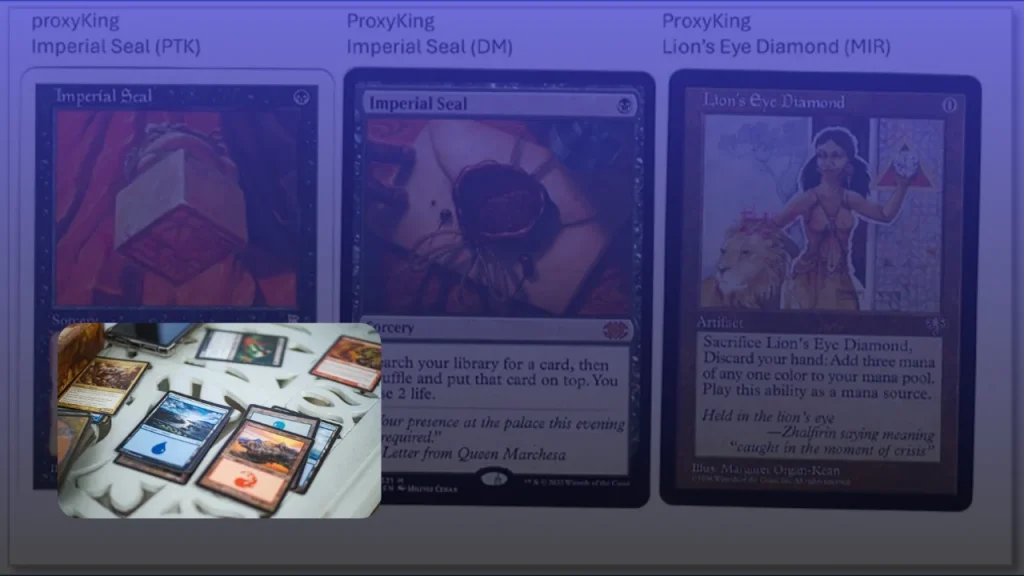
Why a “proxy” disclaimer may not be enough
A buyer may know a card is unofficial, but a later trade partner, opponent, judge or retailer might not. Trademark law can recognize this kind of post-sale confusion. The complaint alleges the defendants kept the original artwork, copyright notices and card backs with the intent to cause it. A disclaimer is relevant evidence, but it does not by itself settle trademark confusion, and it does nothing about whether the artwork was copied without permission. Those are separate questions.
The Legal Claims in the Complaint
The complaint lists copyright and trademark infringement, unfair competition, false advertising, violations of the Lanham Act and the Digital Millennium Copyright Act, violations of the Washington Consumer Protection Act, civil RICO and civil conspiracy.
Copyright infringement
Under 17 U.S.C. § 106, copyright owners control reproduction and distribution of their works, and § 501 makes infringement actionable. Wizards also asserts contributory and vicarious liability, which can reach people who did not personally print every card but knowingly contributed to or profited from infringement they could control.
Trademark counterfeiting and false designation
The Lanham Act protects registered marks and bars false designation of origin. Wizards cites 29 registrations, including its name, the Magic: The Gathering marks, the mana symbols and the Planeswalker symbol. See 15 U.S.C. § 1114 and § 1125(a).
DMCA copyright management information
This is a claim that most gaming coverage skips. Under 17 U.S.C. § 1202, knowingly providing false copyright management information, or removing or altering it, can create separate liability. The complaint says the cards carry Wizards’ copyright notices and artist credits, suggesting they are genuine. Statutory damages under § 1203 range from $2,500 to $25,000 per violation, if the knowledge requirements are met.
Civil RICO
Wizards alleges an enterprise engaged in a pattern of racketeering, with predicate acts such as criminal copyright infringement, trafficking in counterfeit goods, and mail and wire fraud. A successful private RICO plaintiff can recover three times its damages under 18 U.S.C. § 1964(c). This is a private civil claim, not a criminal prosecution. No one has been criminally charged or convicted as a result of this filing. For a similar theory in gaming, see Blizzard Sues Project Ascension Over Copyright and Racketeering Claims Tied to Private WoW Server.
Washington Consumer Protection Act
RCW 19.86.020 prohibits unfair or deceptive acts in trade or commerce, and RCW 19.86.090 allows private claims for injury to business or property.
Deceptive review allegations
Wizards alleges that websites presented as independent reviewers were actually controlled by the defendants and consistently ranked the defendants’ businesses first, without disclosing the relationship. It points to the FTC’s rule on company-controlled review websites, 16 C.F.R. § 465.6. I did not find any separate FTC enforcement action tied to this case.
Civil conspiracy
Wizards alleges the defendants agreed to carry out unlawful conduct together. Family or business relationships alone do not prove a conspiracy.
How Was the $28.65 Million Figure Calculated?
The figure comes from the statutory damages option in 17 U.S.C. § 504(c). A copyright owner may elect statutory damages per work instead of actual damages and profits.
| Circumstance | Statutory damages per work |
| Ordinary infringement | $750 to $30,000 |
| Innocent infringement | As low as $200 |
| Willful infringement | Up to $150,000 |
191 works × $150,000 = $28,650,000. That assumes the court finds willful infringement of all 191 works and awards the maximum for each. A court sets the amount within the range and is not required to award the top.
Why registration timing matters
Under 17 U.S.C. § 412, statutory damages and attorney’s fees are limited for infringement that begins before a work is registered, unless registration was timely. The complaint addresses this by splitting the works by whether they were registered before publication or within three months, versus later. It argues that even for later registrations, many took effect before the defendants’ alleged infringement began in 2020, so § 412 would not limit Wizards’ remedies. The defendants may challenge this work by work.
That is why $28.65 million should be described as a claimed maximum, not a debt or a settlement.
Could the total be higher?
Potentially, but the maximums cannot simply be added together. The complaint also seeks actual damages, profits, trademark remedies and possible trebling under RICO. Federal trademark law allows statutory damages for willful counterfeiting that can reach $2 million per mark per type of goods. Courts apply limits on duplicative recovery, and a final award depends on what is proven.
What else does Wizards want?
Injunctions, an accounting, impoundment and destruction of infringing goods, interest and costs. A request is not an order, and nothing in the complaint shows that any website has been shut down by the court.
Are Magic: The Gathering Proxies Illegal?
Not necessarily. Three questions are separate:
- Is it lawful under copyright and trademark law? Commercial replicas that copy art, branding and notices carry the most risk.
- Does it comply with Wizards’ policies? Wizards’ 2016 policy post recognizes personal, noncommercial proxying, but its Fan Content Policy prohibits creating counterfeit or proxy Magic cards and selling fan content made with its IP.
- Does your group or event allow it? Sanctioned events generally require genuine cards, and a judge may issue a limited proxy for a card damaged during play.
The answer to one question does not decide the others. Wizards’ policy is not a legal license to copy every element of a card.
Can Wizards copyright Magic’s game mechanics?
No. Under 17 U.S.C. § 102(b), copyright does not extend to ideas, systems or methods of operation, so game rules are not protected. Original artwork, written expression and other creative elements can be, and trademark law separately protects source-identifying branding. A rule not being copyrightable does not permit commercial copying of the whole card on which it appears.
Does fair use protect homemade proxies?
Fair use under 17 U.S.C. § 107 weighs four factors: purpose and character of the use, the nature of the work, how much was used and the effect on the market. Personal, noncommercial use may help a fair-use argument, but it is not an automatic defense, and commercial copying of an entire card is much harder to defend. No court has ruled in this case that every private proxy infringes.
Can you use proxies in Commander?
In private casual games, groups usually decide for themselves, so talk to your playgroup. Officially sanctioned events follow Wizards’ rules. Game stores should review the current Wizards Play Network policies if casual and sanctioned play share a space.
Can you buy, own or sell proxies?
Buying or owning a reproduction for personal use is not the same as manufacturing or trafficking in counterfeits, but knowingly distributing unauthorized reproductions can raise copyright and trademark issues, and selling a counterfeit as authentic can create fraud and consumer protection liability. First-sale protection covers lawfully made copies, not counterfeits. For most players, the practical risk is misrepresenting or passing along questionable cards, not owning a proxy.
What If You Bought Counterfeit Magic Cards?
You may have refund rights that are separate from Wizards’ lawsuit.
- Keep the listing, receipt and messages.
- Do not resell the card until you know it is authentic.
- Get it assessed by a reputable specialist or authentication service.
- Ask the seller or marketplace for a refund.
- If refused, contact your payment provider promptly.
- Report suspected counterfeits through Wizards’ counterfeit identification and reporting page. Wizards says it does not replace counterfeit cards.
Can your credit card company refund a counterfeit purchase?
Potentially. Billing-error disputes under the Fair Credit Billing Act generally must be sent in writing within 60 days after the statement with the charge, and card networks have their own chargeback rules for items not as described. Describe the problem accurately and do not call an authorized purchase unauthorized. See the FTC’s guidance on disputing credit card charges.
Is There a Settlement or Claim Form?
No. Wizards is suing for its own claims and does not represent a class of buyers. Any damages it wins would not automatically go to players or collectors. Be wary of any site claiming you can claim a share of a $28.65 million MTG settlement or pay a “proxy fine.”
Is this connected to the Hasbro overprinting lawsuit?
No, they are separate. Hasbro has faced investor litigation over Magic product practices, while this case is about alleged copying and counterfeiting.
| PrintMTG proxy lawsuit | Hasbro investor litigation | |
| Dispute | Alleged unauthorized reproduction and counterfeiting | Alleged investor misrepresentations |
| Plaintiff | Wizards of the Coast | Investors or shareholders |
| Main law | Copyright, trademark, RICO | Securities and corporate law |
| Player claim form | None | None |
See Hasbro MTG Lawsuit, Investor Claims Of Overprinting And Brand Devaluation and Magic The Gathering Lawsuit, What’s At Stake And What Collectors Should Know.
What Happens Next?
The defendants must respond to the complaint, and they may dispute the claims, move to dismiss or challenge the damages theories. Possible next steps include requests for preliminary injunctions, discovery of financial and website records, and disputes over willfulness, the RICO elements and which remedies are available. No settlement, judgment or trial date has been announced.
Frequently Asked Questions About the MTG Proxy Lawsuit
Why is Wizards of the Coast suing PrintMTG?
Wizards alleges the defendants commercially made and sold counterfeit Magic cards that could be mistaken for genuine ones.
Is Wizards suing people for using homemade proxies?
No. The complaint targets the alleged commercial operation and says Wizards has no desire to police casual proxy use.
Is the $28.65 million lawsuit a class action?
No. It is an intellectual property and civil racketeering suit brought by Wizards.
Are personal playtest cards banned?
Wizards’ published position recognizes clearly distinguishable, noncommercial playtest proxies outside sanctioned events.
Can you sell proxies if you label them unofficial?
A label does not automatically resolve copyright or trademark problems.
Can I receive compensation from this case?
No consumer compensation program exists. Separate refund claims against a seller may be available.
Is owning a counterfeit Magic card a crime?
Possession alone does not automatically meet the elements of criminal counterfeiting or trafficking. Knowledge, intent and conduct matter.
Has PrintMTG responded to the lawsuit?
I did not find a formal response in the records reviewed as of November 25, 2026.
Where can I read the complaint?
It is posted on the RECAP archive through CourtListener. Search Case No. 2:26-cv-04617 for updates.
Latest Status
The case is at its earliest stage. It raises a live question about where casual proxying ends and commercial counterfeiting begins, and its outcome could affect print-on-demand sellers, game stores and online marketplaces. For ordinary players, the filing does not create a new ban on substitute cards. For sellers, using protected art and branding can create serious legal exposure even when buyers know the cards are unofficial. This article will be updated at this URL as the case develops.
Sources and Legal References
- Wizards of the Coast LLC v. Dunn, Complaint, Nov. 23, 2026
- Wizards: On Proxies, Policy, and Communication (2016)
- Wizards Fan Content Policy
- 17 U.S.C. § 504, § 412, § 1203 and § 107
- 18 U.S.C. § 1964
- Washington RCW Chapter 19.86
Research note: I read the first 57 pages of the 97-page complaint directly. Later sections, including the full claim-by-claim breakdown and the registration exhibits, are summarized from the complaint’s introduction and from your research, so confirm those details against the document. I could not access the live docket.
Legal disclaimer: AllAboutLawyer.com is an independent legal information website, not a law firm. This article is not legal advice. The allegations in the complaint are unproven. Liability and consumer remedies depend on the facts and applicable law.
About the Author
Israr Ahmad is a legal content researcher with 4+ years of experience covering class action settlements and consumer rights cases. He has researched and published coverage of 2,500+ settlements using verified court records, settlement administrator filings, and government sources. Learn more about Israr.