
DOJ Apologizes for False Statement in Ilhan Omar Case, What Happened and What Comes Next
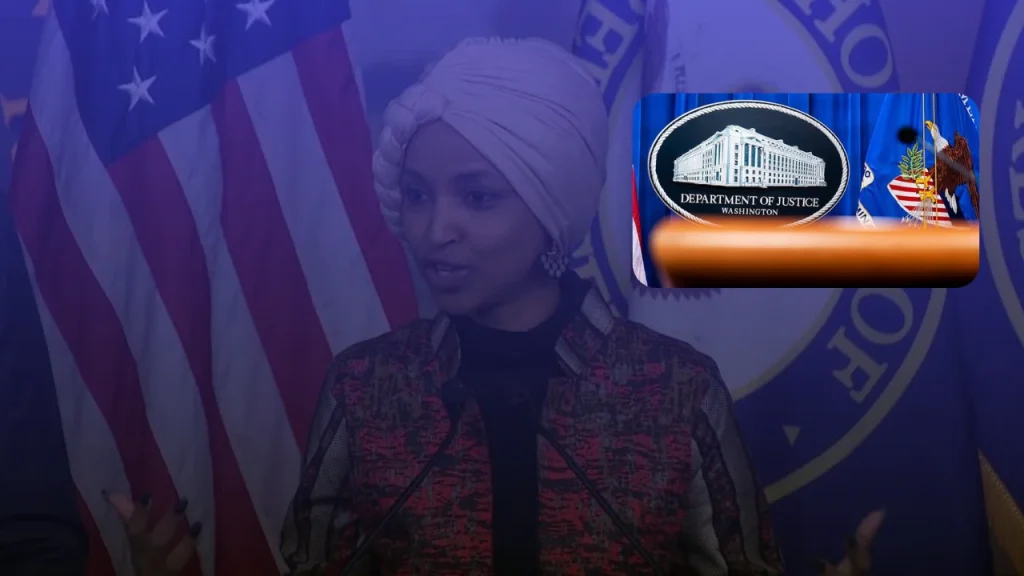
The U.S. Department of Justice apologized on November 24, 2026, after telling a federal court that the House of Representatives’ top lawyer agreed with its reading of constitutional protections in the search of Rep. Ilhan Omar’s Washington, D.C., home. House General Counsel Matthew Berry called that claim “categorically false,” and prosecutors filed a correction calling it an “inadvertent misunderstanding.”
The apology does not cancel the search warrant or end the investigation. It does raise real questions about what prosecutors told the court, how the Speech or Debate Clause applies to a lawmaker’s home, and how seized materials are handled.
Ilhan Omar DOJ Case: Key Facts at a Glance
| Detail | What is known |
| Latest development | DOJ acknowledged a misstatement and apologized (Nov. 24, 2026) |
| House lawyer involved | Matthew Berry, House General Counsel |
| Court | U.S. District Court for the District of Columbia |
| Magistrate judge | Matthew J. Sharbaugh |
| Judge handling public access | Chief Judge James E. Boasberg |
| Constitutional issue | Speech or Debate Clause |
| Home search | October 12, 2026, by Homeland Security Investigations |
| Records unsealed | November 23, 2026 (heavily redacted) |
| Probable-cause affidavit | 67 pages, still sealed |
| Grand jury | Reportedly hearing evidence |
| Charges against Omar | None publicly identified |
| Next deadline | November 30, 2026, on proposed redactions |
What Happened Between the DOJ and Matthew Berry?
What the DOJ told the court
In court filings tied to the search, prosecutors said Berry had declined to take part in the search and shared the government’s view that Speech or Debate protections do not extend to a member’s private residence. The records show the filings were signed by U.S. Attorney Jeanine Pirro’s office.
How Berry responded
After the records became public, Berry said that account was wrong. His office, he explained, represents the institutional interests of the House. It does not represent individual members who are the targets of criminal investigations, and a member’s personal lawyer is the one who should help identify privileged material. Declining to participate, in his view, was not an endorsement of the DOJ’s constitutional theory.
The correction and apology
Prosecutors then conceded they had misread part of his correspondence. They apologized for an “inadvertent misunderstanding” and acknowledged that Berry had not sided with their argument. Reporting on the corrective filing also indicates Berry had not been told which member of Congress was involved, so his position cannot fairly be read as approval of an investigation into Omar.
No judge has publicly found that the error was deliberate.
What Exactly Did the DOJ Get Wrong?
The dispute turns on three separate questions that the DOJ’s filing blurred together.
| Question | Berry’s position |
| Should a House lawyer take part in a criminal search of a member’s home? | No, because his office represents the House as an institution. |
| Does legislative privilege vanish inside a member’s private residence? | He did not endorse that argument. |
| Who should advise the member on privileged material? | The member’s personal attorney. |
Treating a refusal to participate as agreement on the law was the core mistake.
Why a Federal Judge Pushed Back Before the Search
The warrant timeline
Prosecutors applied for the warrant on October 2, 2026. Magistrate Judge Sharbaugh raised concerns about the government’s showing for some suspected offenses and about protections for congressional material, then asked for more legal argument on October 7. He approved the warrant on October 9 with added safeguards, and agents carried it out on October 12.
The judge’s reasoning
The government argued the investigation concerned private conduct unrelated to Omar’s legislative duties. The judge disagreed with a categorical reading. As he put it in substance, a member’s legislative work is not confined to office hours or Capitol buildings, so a home search can sweep in protected material.
Safeguards the judge required
The judge required a revised search protocol so Omar could assert legislative privilege before investigators reviewed protected items. Reporting on the unsealed records also says the DOJ must obtain a second warrant before accessing files on seized electronic devices, including her phone.
For a full breakdown of the released documents, read our report on the Ilhan Omar search warrant unsealing.
Who Is Matthew Berry?
Matthew Berry has served as General Counsel of the U.S. House of Representatives since 2023. According to his official biography, he previously worked at Akin Gump, held senior roles at the Federal Communications Commission, served in the Justice Department’s Office of Legal Counsel and Office of Legal Policy, and clerked for Justice Clarence Thomas and Judge Laurence Silberman. He is a graduate of Dartmouth College and Yale Law School.
He is not Omar’s defense lawyer. His client is the House as an institution, which is why he stayed out of the search.
What Is the Speech or Debate Clause?
What the Constitution says
The clause sits in Article I, Section 6, Clause 1 of the Constitution. It shields members of Congress from certain executive and judicial interference with legislative activity. Its reach goes beyond floor speeches.
What it does and does not protect
| Activity or material | Likely protection |
| Votes and committee work | Generally protected |
| Internal legislative deliberations | Potentially protected |
| Draft legislation and related communications | Potentially protected |
| Personal immigration paperwork | Not ordinarily legislative activity |
| Private financial transactions | Not ordinarily legislative activity |
| Political campaigning | Generally outside core protection |
The clause protects Congress’s independence. It is not a general shield against criminal investigation, and federal authorities can investigate a sitting member if they follow constitutional and procedural rules.
Why the 2007 Rayburn Case Matters
The key precedent is United States v. Rayburn House Office Building, Room 2113, 497 F.3d 654 (D.C. Cir. 2007). Agents had searched the congressional office of then-Rep. William Jefferson, and the D.C. Circuit held that the procedure violated legislative privilege because the member never had a fair chance to identify protected material first. Privileged items had to be returned.
That is why the magistrate judge cared about safeguards, and why the DOJ’s mischaracterization of Berry’s views carried legal weight. The question is not only where a document sits. It is whether it reflects legislative activity and whether the search procedure protects it.
Could the False Statement Invalidate the Search Warrant?
The Franks standard
Not automatically. Under Franks v. Delaware, 438 U.S. 154 (1978), a defendant can challenge a warrant affidavit only when it contains a materially false statement made knowingly, intentionally or with reckless disregard for the truth, and that statement was necessary to establish probable cause.
Why the apology alone falls short
The misstatement publicly identified so far concerns search procedures and constitutional privilege, not the facts underlying probable cause. The record does not show it was in the probable-cause affidavit or that the judge needed it to approve the warrant. The probable-cause affidavit also remains sealed, so this cannot be fully assessed. The disputed filing appears in court records dated October 16, after the October 9 approval and the October 12 search.
Omar’s lawyers could still examine earlier representations, how the search was carried out, and how materials were handled afterward. Any remedy would require evidence and a judge’s ruling.
Could Omar’s Lawyers Demand Return of Seized Property?
Potentially. Federal Rule of Criminal Procedure 41(g) lets a person aggrieved by an unlawful search or seizure ask for the return of property. Lawyers can also ask the court to limit government review of privileged material.
Omar’s team has accused agents of breaking court-ordered search restrictions, including notice requirements and limits on contacting counsel during the search. The DOJ disputes the claims and says it followed the court’s orders. Possible outcomes include return of protected documents, restricted access to privileged files, or suppression of evidence in a later prosecution. None is automatic, and no order requiring return of all seized property has been identified since the apology.
What Is the Grand Jury Investigating?
The immigration-paperwork focus
Reporting indicates a federal grand jury is hearing evidence and that subpoenas have gone out, including to some of Omar’s relatives. Earlier reporting says investigators are examining historical immigration and citizenship records, with filings seeking records going back decades. Omar has repeatedly denied wrongdoing.
What cannot yet be verified
The specific criminal statutes in the warrant are redacted and the 67-page affidavit remains sealed. The full allegations and any potential charges cannot be independently evaluated. This probe is also separate from reported inquiries into her financial disclosures, covered in How Many Investigations Is Ilhan Omar Facing in 2026?
Does a Grand Jury Mean an Indictment Is Coming?
No. A federal grand jury decides whether there is probable cause to bring charges. Under Federal Rule of Criminal Procedure 6, it has 16 to 23 members, and at least 12 must agree to return an indictment.
| Development | What it means |
| Grand jury convened | An investigation is underway |
| Subpoenas issued | Investigators are seeking testimony or records |
| Indictment returned | Charges have been formally authorized |
| Conviction | Guilt established by plea or trial |
Grand jury proceedings are confidential, and their existence does not show wrongdoing or predict a charging decision. Even after an indictment, a defendant is presumed innocent.
Questions About Timing and Fairness
The pre-election search
The search took place about three weeks before the November 3 midterm election. Former federal prosecutors have noted that DOJ’s long-standing unwritten practice is to avoid overt steps against candidates close to an election. The DOJ’s filings say Attorney General Todd Blanche approved the warrant and that it was not timed to affect any election. That norm is informal, not a legal rule, and no court has found improper motive.
What was taken
Reporting on the unsealed records says agents seized 17 items, including a phone, laptop, notebooks and a passport. A seizure list does not show that any item is evidence of a crime.
Can DOJ Lawyers Be Punished for a False Statement to a Judge?
Attorneys owe courts accurate information and a duty to correct material errors. Knowingly misleading a court can lead to sanctions, bar discipline or review by the Justice Department’s Office of Professional Responsibility.
Consequences depend on intent, materiality and whether the lawyer corrected the error promptly. An inaccurate statement is not automatically perjury, which requires a knowingly false statement under oath. The DOJ attributes this error to a misunderstanding, and no contempt finding, sanction or charge against the prosecutors has been publicly identified.
Can Omar Lose Citizenship, Be Deported, or Be Removed From Congress?
Citizenship and deportation
The apology changes nothing about her citizenship. Federal law, including 8 U.S.C. § 1451, allows revocation in limited cases, such as naturalization obtained unlawfully or through deliberate material misrepresentation. A warrant, subpoena or allegation does not revoke citizenship, and no denaturalization case against her has been publicly identified. For the difference between revocation and deportation, see Ilhan Omar Immigration Investigation: Relatives Subpoenaed.
Her seat in Congress
Neither the investigation nor an indictment automatically vacates a House seat. Under Article I, Section 5, the House can expel a member only by a two-thirds vote, and no removal effort has been established.
Why Were the Warrant Records Unsealed?
Fourteen media organizations and the group Judicial Watch pushed for public access. After a hearing on November 17, Chief Judge Boasberg allowed heavily redacted records out on November 23 while keeping the affidavit sealed. The government argued that early disclosure could reveal sources and targets and harm an active investigation.
The November 30 deadline concerns responses on proposed redactions. It is a court-records deadline, not a deadline for charging Omar.
Ilhan Omar Investigation Timeline
| Date | Development |
| Oct. 2, 2026 | DOJ submits search warrant application |
| Oct. 7, 2026 | Judge asks for more legal argument and safeguards |
| Oct. 9, 2026 | Warrant approved with special procedures |
| Oct. 12, 2026 | Agents search Omar’s Washington home |
| Oct. 16, 2026 | DOJ filing contains the disputed account of Berry’s position |
| Nov. 17, 2026 | Public-access hearing before Chief Judge Boasberg |
| Nov. 23, 2026 | Redacted records released |
| Nov. 24, 2026 | Berry disputes the claim; DOJ corrects and apologizes |
| Nov. 30, 2026 | Deadline for responses on proposed redactions |
What Happens Next?
Three tracks are now running side by side. The court may release more records. Omar’s attorneys may challenge the search procedures or the handling of privileged files. And the grand jury may continue, ending in an indictment or in no charges at all.
The apology does not show that the immigration allegations are false, and the investigation does not show they are true. The open questions are whether investigators honored the required safeguards and whether prosecutors have enough admissible evidence to bring a case.
Frequently Asked Questions
Why did the DOJ apologize in the Ilhan Omar case?
Prosecutors wrongly told the court that House General Counsel Matthew Berry agreed with their view on constitutional protections for a member’s home. Berry disputed it, and they corrected the record.
Is Matthew Berry Ilhan Omar’s lawyer?
No. He is the House’s General Counsel and represents the institution, not individual members under investigation.
Has Ilhan Omar been indicted?
No indictment connected to this investigation has been publicly identified as of November 25, 2026.
Was the search of Omar’s home illegal?
A federal magistrate judge authorized it with added safeguards. Whether agents followed every requirement is disputed, and the apology alone does not make the search unlawful.
Did the DOJ admit the immigration allegations were false?
No. The correction concerns how it described Berry’s position, not the underlying allegations.
When will more court documents be released?
The next scheduled step is the November 30 deadline on proposed redactions. No date has been announced for the full affidavit.
Sources and Legal References
- The Hill, DOJ apologizes to House’s top lawyer for dispute about Omar home search, Nov. 24, 2026.
- Outlook India, DOJ apologises to House counsel over Ilhan Omar search.
- Fox News, Records show judge, DOJ officials debating before raid of home, Nov. 24, 2026.
- U.S. House Office of General Counsel, Staff biography: Matthew Berry.
- D.C. Circuit, United States v. Rayburn House Office Building, Room 2113 (2007).
- U.S. Supreme Court, Franks v. Delaware, 438 U.S. 154 (1978).
- Federal Rules of Criminal Procedure, Rule 41 and Rule 6.
- Reuters, U.S. probes Omar’s decades-old immigration paperwork, Oct. 16, 2026.
Legal and editorial disclaimer: AllAboutLawyer.com provides legal information and news reporting, not legal advice. The author is a legal content researcher, not an attorney. The investigation is ongoing, and no allegations have been proven in court.
As of November 25, 2026, no criminal charges against Omar have been publicly identified. She denies wrongdoing and calls the probe politically motivated.
Published November 25, 2026 | By Israr Ahmad, Legal Content Researcher, AllAboutLawyer.com
About the Author
Israr Ahmad is a legal content researcher with 4+ years of experience covering class action settlements and consumer rights cases. He has researched and published coverage of 2,500+ settlements using verified court records, settlement administrator filings, and government sources. Learn more about Israr.