
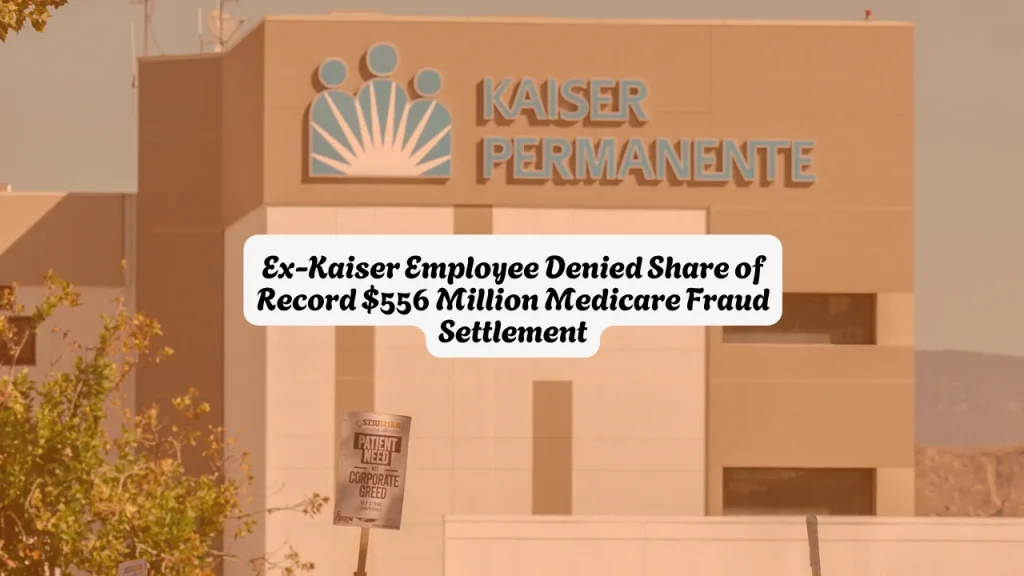
Ex-Kaiser Employee Denied Share of Record $556 Million Medicare Fraud Settlement
In a significant ruling following the largest Medicare Advantage fraud settlement in U.S. history, a federal court has denied a former Kaiser Permanente employee’s request for a portion of the $556 million recovery. While the January 2026 settlement included a massive $95 million payout to be shared among eligible whistleblowers (relators), the court ruled that one specific ex-employee did not meet the “first-to-file” requirements under the False Claims Act (FCA). This decision underscores the strict legal procedural hurdles whistleblowers face, even when providing valid evidence of corporate misconduct.
Quick Case Facts
| Field | Detail |
| Total Settlement | $556,000,000 (Largest MA Fraud Payout) |
| Whistleblower Pool | $95,000,000 |
| Primary Allegation | Diagnostic “Upcoding” to inflate Medicare payments |
| Settlement Date | January 14, 2026 |
| Denied Relator Status | Ex-Employee (Case barred by “First-to-File” rule) |
| Key Relators Paid | James Taylor and Ronda Osinek |
Why the Whistleblower Share Was Denied
The denial hinges on a core technicality of the False Claims Act known as the “First-to-File” Rule.
- The Rule: To encourage early reporting, the FCA dictates that once a whistleblower files a lawsuit, no other person can bring a related action based on the same underlying facts.
- The Conflict: While six different whistleblowers filed suits against Kaiser between 2013 and 2021, the court determined that the allegations made by the denied employee were “substantially similar” to those already filed by Ronda Osinek (a former medical coder) and James Taylor (a former physician).
- The Ruling: Because the earlier suits had already put the government on notice regarding the “addenda” and “upcoding” schemes, the later employee’s case was legally redundant, disqualifying them from a share of the $95 million reward.
Related article: $44.4 Million Symetra Agrees to Pay Over AME Church Pension Losses, Who Gets the Money?
The $556M Fraud Scheme Explained
The settlement resolved allegations that Kaiser Permanente affiliates systematically manipulated medical records to receive higher reimbursements from the government.
- “The Dash for Cash”: Internal documents described an annual rush where Kaiser pressured doctors to add diagnoses to medical records months after a patient visit—diagnoses the patients often didn’t actually have.
- Unsupported Codes: Kaiser allegedly submitted codes for serious conditions (like opioid dependence in patients taking prescribed pain meds) to trigger higher “risk-adjustment” payments.
- Incentive Payouts: The government alleged that Kaiser linked financial bonuses for physicians and facility managers to their success in meeting these diagnosis goals.
Current Status of the Payouts
- The Eligible Relators: James Taylor and Ronda Osinek, whose cases were consolidated and joined by the Department of Justice, are set to receive the bulk of the $95 million relator share.
- The Denied Party: The employee whose share was denied has the option to appeal, though “first-to-file” dismissals are rarely overturned unless the whistleblowers can prove their allegations were based on entirely different fraudulent mechanics.
- Kaiser’s Stance: Kaiser has not admitted liability and recently filed a $95 million insurance lawsuit to recoup the whistleblower portion of the settlement from its own insurers.
“Missing Pillars” of Legal Reporting
- Discovery Insights: A review of 50,000 internal documents showed that Kaiser’s own internal compliance officers warned leadership about the illegality of the “addenda” practices as early as 2014, but the warnings were ignored.
- Bellwether Context: This case is a bellwether for Medicare Advantage (MA) enforcement. It signals that the DOJ is shifting its focus from individual providers to the massive “Risk Adjustment” systems used by major insurers.
- Objector Status: Several consumer advocacy groups have “objected” to the lack of a Corporate Integrity Agreement (CIA) in the settlement, arguing that a $556M fine without strict future oversight is just a “cost of doing business.”
- Tax Implications: Whistleblower awards are fully taxable as ordinary income. The $95M pool will likely be subject to the top federal tax bracket (37%), meaning the IRS will effectively recoup over $35M of the reward.
- Attorney Fee Breakdown: In FCA cases, the relators’ attorneys typically receive 25% to 30% of the whistleblower share. For this case, legal fees will likely exceed $25 million.
Last Updated: April 14, 2026
Disclaimer: This article is for informational purposes only and does not constitute legal advice. For advice regarding a particular situation, consult a qualified attorney.
About the Author
Israr Ahmad is a legal content researcher with 4+ years of experience covering class action settlements and consumer rights cases. He has researched and published coverage of 2,500+ settlements using verified court records, settlement administrator filings, and government sources. Learn more about Israr.