
Grid Shutdown November 17, 2026 | Is the US Power Going Out? Simpsons Prediction, Microsoft Outage and FEMA Alert Explained
There is no verified nationwide power-grid shutdown scheduled for November 17, 2026. Viral warnings about a worldwide blackout, a 72-hour electricity failure and a 90-day shutdown are not supported by official electricity-grid announcements.
What is actually scheduled is a nationwide Federal Emergency Management Agency (FEMA) Emergency Alert System test at approximately 2:20 p.m. Eastern Time on Tuesday, November 17. The test will briefly interrupt participating television and radio broadcasts for about one minute. It does not require utility companies to turn off electricity, shut down the internet or suspend banking services.
The rumors spread after social media users connected three separate developments: a 2023 episode of The Simpsons featuring a fictional blackout, a major Microsoft outage that began November 12, and the government’s November 17 emergency-alert test. A nationwide FAA ground stop on November 13 added to the anxiety.
There is even a viral theory involving Microsoft’s reported 11:17 a.m. outage timestamp and the date 11/17. But those matching numbers do not establish any connection between the events.
Here is what federal regulators have actually announced, why the predictions are misleading, what genuine power-grid vulnerabilities exist, and what legal protections Americans have if their electricity is interrupted.
Grid Shutdown November 17: What Is Confirmed?
| Question | Verified information |
| Is a nationwide U.S. grid shutdown scheduled? | No credible evidence or official announcement |
| Is a worldwide blackout confirmed? | No |
| Is a 72-hour blackout planned? | No credible evidence |
| Is a 90-day shutdown planned? | No credible evidence; the viral Trump clip was manipulated |
| Is FEMA conducting an emergency-alert test? | Yes |
| FEMA test date | November 17, 2026 |
| Test time | About 2:20 p.m. Eastern |
| What will be interrupted? | Participating TV and radio broadcasts |
| Will the test turn off electricity? | No |
| Will phones receive a nationwide alert? | No |
| Expected broadcast interruption | Approximately one minute |
| FEMA backup date | December 3, 2026 |
| Did Microsoft experience a major outage? | Yes, beginning November 12 |
| Did Microsoft identify a cyberattack? | No; Microsoft said it saw no indication of malicious activity |
| Was the Microsoft outage an electrical-grid failure? | No |
| Did the FAA have a nationwide ground stop? | Yes, on November 13; the FAA said it was not a cyberattack |
Sources: FCC Public Notice DA 26-989, FEMA’s September 2026 bulletin, Microsoft’s preliminary post-incident report, FAA statements and federal energy reliability information.
Why Are People Searching for a Grid Shutdown on November 17?
Interest increased after several unrelated incidents became linked through online speculation.
The first was an episode of The Simpsons depicting a large fictional power outage.
The second was Microsoft’s November 12 service disruption, which affected Outlook, Teams, Copilot and other online services.
The third was the confirmed November 17 emergency-alert exercise.
Social media posts began presenting these events as evidence of a predicted worldwide electricity failure. Some claims went further, suggesting that banks would stop working, internet access would disappear and the government would activate extraordinary emergency powers. Those claims have not been supported by the official evidence reviewed.
The critical distinction is that a fictional television storyline, an internet-service outage and a government communications exercise are not the same as a physical power-grid shutdown.
What Did The Simpsons Actually Show About November 17?
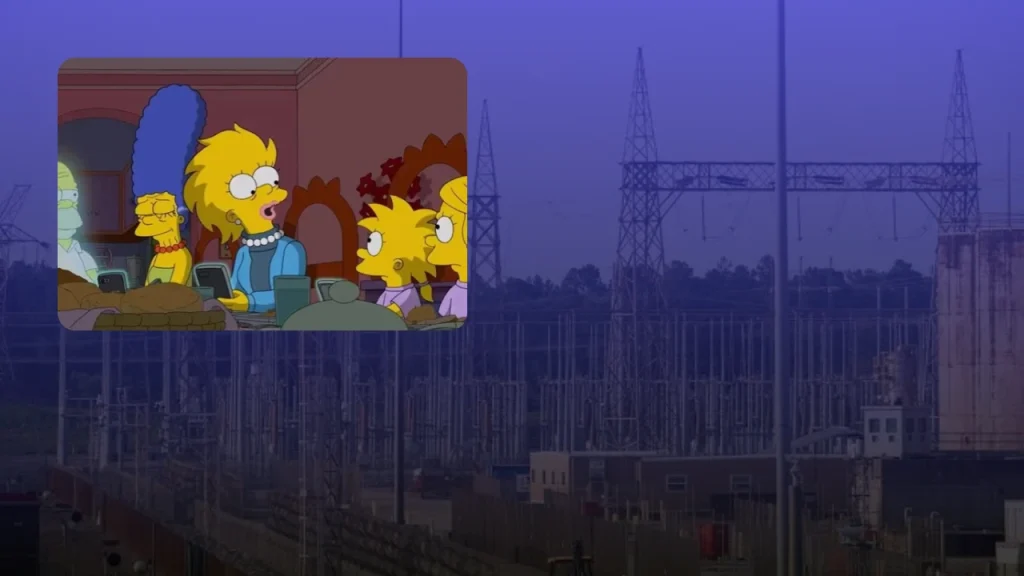
The viral theory comes from It’s a Blunderful Life, Season 35, Episode 7 of The Simpsons, originally broadcast on November 19, 2023.
In a flashback, an older Lisa Simpson recalls a six-day power outage that affected Springfield. A diary page shows the date “17 November” with a note about a storm approaching. The power returns on Thanksgiving. Homer is initially blamed for the disaster, but the storyline ultimately identifies Mr. Burns as responsible, and the family later lights candles in remembrance.
Social media users clipped this scene in late 2026 and linked the diary date to November 17, 2026. Some versions added dramatic narration warning of electricity, internet and banking failures. Fact-checkers in several countries, including Lupa in Brazil and Boatos.org, rated the claim false.
Did the episode specifically predict a 2026 blackout?
No.
The episode does not mention 2026 or any real-world global event. It does not predict that every U.S. state, or every country in the world, will lose electricity. The fictional outage concerns Springfield and is caused by a storm and Mr. Burns, not a worldwide infrastructure collapse.
Another important problem with the prediction involves Thanksgiving. The fictional timeline places the restoration of electricity on Thanksgiving, six days after the outage began. In 2023, Thanksgiving fell on November 23, exactly six days after November 17. In 2026, Thanksgiving falls on November 26, nine days after November 17. The episode’s internal calendar fits 2023, not 2026.
A date appearing in a fictional cartoon is not technical evidence of an upcoming electrical-system failure.
Related artice: Coffee Bean & Tea Leaf $900K Data Breach Settlement, Claim $25 or Up to $5,000 by February 10, 2027
What Does Microsoft’s 11:17 Outage Have to Do With the Rumor?
Microsoft experienced a genuine major service outage beginning Thursday, November 12, 2026.
The problems affected Outlook, Exchange Online, Microsoft Teams, Copilot and other Microsoft 365 services. Businesses, airlines, governments, healthcare organizations, schools and other users had difficulty reaching email and collaboration tools.
Microsoft tracked the disruption under service incident identifiers including EX1550543 and MO1550821.
Why is 11:17 important?
Reports examining the Exchange Online incident identified an estimated start time of 11:17 a.m. Eastern on November 12. Microsoft’s own preliminary post-incident report lists the incident start as 4:20 p.m. UTC (11:20 a.m. Eastern), and its timeline shows automation beginning to redirect traffic at 4:17 p.m. UTC, which is 11:17 a.m. Eastern.
Social media users noticed that 11:17 resembles 11/17, the November 17 date from The Simpsons. A new theory suggested that the animated episode’s supposed prediction might have referred to a clock time rather than a date. One widely shared post asked whether the “November 17 blackout” was pointing at the clock instead of the calendar.
There is no evidence supporting that interpretation. This is classic pattern-seeking. The numerical coincidence is real in the sense that both numbers appear in separate contexts, but nothing links the 2023 cartoon to Microsoft’s 2026 technical failure. The episode contains no reference to Microsoft, cloud services, email outages or any technology company. The Microsoft problem also began on November 12, five days before the rumored November 17 blackout.
What actually caused Microsoft’s outage?
Microsoft said its disruption was a technical infrastructure failure, not a cyberattack. A Microsoft executive publicly said there was no indication of malicious activity.
According to Microsoft’s preliminary post-incident report dated November 15, three factors combined into a cascading failure of the networking gateway that fronts many Microsoft 365 services:
- A latent software defect. A fix prepared specifically for Microsoft 365 networking gateway servers, first deployed in July 2026, caused servers to become overwhelmed and unresponsive under certain load conditions because of lock contention inside an internal Windows process. It ran for more than three months without a problem. Microsoft’s load testing missed it because the lab hardware and traffic mix differed from production. Microsoft said neither the defect nor the fix applies to broader Windows deployments.
- A routine traffic shift. About fifteen hours before the outage, Teams traffic automatically failed over onto the same gateway that supports Exchange Online, raising its load. Microsoft described this as a normal part of its resiliency design.
- Reduced capacity. Nearly 14% of gateway server capacity was out of service because of an unrelated issue from the previous day.
When servers stopped responding, automated systems rerouted traffic to the remaining healthy servers, which then hit the same defect. In less than two hours the problem spread across the fleet, and at its lowest point more than 80% of the servers were unresponsive. Recovery was slowed by a “thundering herd” effect: restarted servers were immediately swamped by queued traffic and failed again. Engineers deployed an update that returned the code to a known good state and brought servers back in batches.
Microsoft’s report lists the incident as running from 4:20 p.m. UTC on November 12 (11:20 a.m. Eastern) to 4:10 p.m. UTC on November 13 (11:10 a.m. Eastern), nearly 24 hours, with final customer updates issued early on November 14. A final post-incident report with longer-term fixes is due by November 20, 2026, so details may change.
This was a significant digital infrastructure outage, but it was not evidence that power plants, substations or electricity transmission networks had stopped functioning. It demonstrated how a problem at one major technology provider can affect many dependent services.
Was email lost?
According to Microsoft’s report, delayed incoming messages were given an extended delivery window rather than being returned as undeliverable. If you sent something important on November 12 or 13 and have not heard back, it is reasonable to check with the recipient. The bug was in a fix made only for Microsoft’s gateway servers, so there is nothing to repair on your own device.
Did the FAA Ground Stop and the Microsoft Outage Signal a Larger Shutdown?
The November 13 nationwide FAA ground stop also contributed to public concerns about infrastructure reliability.
The FAA halted departures nationwide after a telecommunications problem affected air traffic control facilities. The disruption began at about 3:30 p.m. Eastern, and the ground stop was lifted at about 8:15 p.m. Eastern the same evening. The FAA said the problem was not the result of a cyberattack. In its November 15 update, the agency said aging equipment on its telecommunications network became unstable after receiving a flood of connection attempts, and the root cause was still under investigation. The FAA said airlines canceled approximately 12,462 flights on November 13, although not all of those cancellations were directly caused by the ground stop.
The incident was separate from Microsoft’s technical failure. Neither incident establishes that the U.S. electrical grid was compromised.
For the aviation timeline and passenger refund protections, see FAA Flight Cancellations November 16, How to Get a Refund or Rebook.
Problems involving banking apps, email systems, air traffic communications and electricity can all disrupt daily life, but they do not necessarily share a cause. Investigators and infrastructure operators must establish an actual technical connection before treating separate incidents as evidence of a coordinated attack.
What Is FEMA Doing on November 17, 2026?
FEMA and the Federal Communications Commission are conducting a nationwide test of the Emergency Alert System. It is the first nationwide EAS test since October 2023.
The scheduled start time is 2:20 p.m. Eastern Time. The test uses FEMA’s Integrated Public Alert and Warning System to send a message to participating broadcasters and communications providers. The alert will indicate that the transmission is a nationwide test and that no action is required by the public.
The official test message refers to the period from 2:20 to 2:50 p.m. Eastern. That does not mean television and radio will be off the air for half an hour. The effective interruption is expected to last approximately one minute, after which programming returns to normal.
If severe weather or an actual emergency forces a postponement, the backup date is Thursday, December 3, 2026.
What time will the alert happen in each U.S. time zone?
| Time zone | November 17 test time |
| Eastern | 2:20 p.m. |
| Central | 1:20 p.m. |
| Mountain | 12:20 p.m. |
| Pacific | 11:20 a.m. |
| Alaska | 10:20 a.m. |
| Hawaii | 9:20 a.m. |
| Puerto Rico (Atlantic) | 3:20 p.m. |
The test does not include a nationwide Wireless Emergency Alert to cellphones.
Why does the government conduct the test?
Federal law requires periodic nationwide testing of public emergency-warning capabilities. Under 6 U.S.C. § 321o, FEMA is required to conduct nationwide alert-and-warning tests at least once every three years. FCC regulations under 47 CFR Part 11 establish requirements for covered broadcasters and communications providers, including post-test reporting deadlines.
The purpose is to identify weaknesses in the warning system before a real disaster. The statute does not direct FEMA to disconnect electricity as part of these tests.
For a detailed explanation of the federal alert schedule and legal requirements, see What Is Happening on November 17, 2026? FEMA Nationwide Emergency Alert System Test Explained.
Did President Trump Announce a 90-Day Blackout?
No verified presidential announcement establishes a nationwide 90-day electricity shutdown.
A viral video circulated on TikTok appearing to show President Donald Trump warning that a 90-day blackout was coming. PolitiFact examined the material and determined that the clip had been manipulated. The original November 9 White House press briefing remarks did not contain the claimed announcement. Snopes also found similar manipulated Trump videos on Facebook and Instagram.
The manipulated videos were also used in posts promoting cryptocurrency purchases. That detail matters because alarming predictions can be used to pressure consumers into financial decisions. Americans should not withdraw their savings, purchase cryptocurrencies or make emergency payments based on an unverified social media video.
Why These Theories Spread So Effectively
The Simpsons has a decades-long record of coincidental parallels with real events, which makes audiences quick to treat any new clip as a prediction. When a real disruption, such as the Microsoft outage or the FAA ground stop, lands near a date that appears in an episode, the brain readily connects the dots. The 11:17 timestamp added a fresh, shareable layer of supposed proof.
Anxiety about cyberattacks, critical infrastructure and prolonged power failures further fuels readiness to believe dramatic claims. The Microsoft outage showed how dependent daily life has become on a handful of cloud providers, and that real vulnerability makes fictional prophecies feel more plausible. The mix of nostalgia, the thrill of secret knowledge and genuine concern about technological fragility is what makes these stories travel.
Could the U.S. Power Grid Really Experience a Major Blackout?
Yes. Large-scale outages are physically possible, even though the November 17 prediction is unsupported. The real vulnerabilities are more complicated than the viral claims suggest.
The U.S. electricity system includes power generation facilities, substations, transformers, transmission lines and local distribution networks. According to the U.S. Energy Information Administration, the contiguous United States has three major electrical interconnections:
- Eastern Interconnection: Covers much of the eastern United States.
- Western Interconnection: Covers much of the West.
- ERCOT: Covers most of Texas.
These networks operate largely independently, with limited transfers of electricity between them. That means the country does not operate as one simple electrical switch that can be turned off everywhere at once.
What can actually cause a major power outage?
Real electricity disruptions can result from severe weather, wildfires, equipment failures, extreme demand, generation shortages, physical attacks and cyber incidents. Regional grid operators may sometimes direct controlled reductions in electricity use or rotating outages to prevent broader instability. Such actions are governed by technical operating requirements and applicable legal rules.
The existence of these risks does not mean officials have identified a specific attack or failure scheduled for November 17.
Are cyberattacks against the power grid a genuine concern?
Yes. The Federal Energy Regulatory Commission oversees mandatory reliability standards for much of the bulk-power system. The North American Electric Reliability Corporation develops standards addressing operations, emergency preparedness, physical security and cybersecurity. Those standards become enforceable after FERC approval. Under 16 U.S.C. § 824o, covered grid operators can face regulatory consequences for violating applicable reliability standards.
But the fact that cybersecurity standards exist does not establish that a coordinated attack is underway.
Can FEMA or the Federal Government Legally Shut Down Electricity?
The November 17 EAS test does not authorize a nationwide disconnection of power.
FEMA administers emergency management and public warning programs. It does not ordinarily operate local electrical distribution systems. Electric utilities, transmission operators, regional grid organizations and other entities manage electricity service under applicable federal and state frameworks.
Emergency shutdowns may occur under legitimate circumstances, such as immediate safety threats, system instability or wildfire prevention. Those decisions involve different legal and technical authorities from FEMA’s routine broadcast-alert test.
A government emergency declaration also does not automatically impose martial law or suspend constitutional rights. For the distinction between emergency powers and military control, see What To Do If Martial Law Is Declared? Your Constitutional Rights Still Apply And 6 Critical Steps To Protect Yourself.
What Legal Rights Do Americans Have During a Real Power Outage?
If an actual outage occurs, consumers’ rights depend on their state, the electricity provider, the cause of the interruption and the terms of applicable tariffs or service agreements.
1. Can you receive compensation for spoiled food or damaged appliances?
Potentially, but payment is not automatic. Some utilities provide limited reimbursement under their policies or applicable state rules. Homeowners or renters insurance may also cover certain losses, depending on the policy, exclusions and deductible. A major storm or other event outside the utility’s control may affect whether compensation is available.
If you experience significant damage, preserve receipts, photographs, outage records and communications with your provider.
2. Can electricity companies disconnect service without warning?
Rules vary by state. Many jurisdictions require particular notices before terminating service for nonpayment and provide additional protections during extreme weather or for certain vulnerable customers. An emergency safety shutdown is legally different from disconnection for an unpaid bill. Consumers should contact their utility and state public utility commission for the rules governing their accounts.
3. What about people who depend on electricity-powered medical equipment?
People using oxygen concentrators, home ventilators or other medically necessary equipment should make backup-power and relocation arrangements with their healthcare providers and utilities. Some states and utilities maintain medical-priority notification or disconnection-protection programs. However, enrollment does not guarantee uninterrupted electricity or priority restoration in every emergency.
4. What if a bank’s systems stop working?
A temporary banking technology outage does not automatically mean deposited money has disappeared. The Consumer Financial Protection Bureau recommends contacting the financial institution, checking alternative payment methods and requesting reversal of fees caused by a system disruption where appropriate. If a bank does not resolve a qualifying problem, consumers may submit a complaint to the CFPB.
5. What if a cloud or software outage affects your business?
A software outage like Microsoft’s is not a power outage, and the rules are different. Microsoft 365 business customers may be able to request service credits under their service agreement, which an administrator would normally file. Those credits are typically small compared with the cost of a disruption, so businesses should review their contract terms and any continuity plans.
How to Check Whether Your Area Has a Real Power Outage
If you lose electricity on November 17 or another date, do not automatically assume that a national blackout has begun. First determine whether the problem is local.
- Check your electricity provider’s official outage map or customer-service line.
- Look for emergency notices from your city, county or state emergency management agency.
- Check your local National Weather Service office for storm warnings.
- Monitor official announcements from regional grid operators when a larger transmission issue is reported.
- Report downed power lines or immediate electrical danger to emergency services.
The U.S. Department of Energy also recommends relying on utility companies and government emergency-management authorities for current restoration information. Individual local outages can happen on any date without indicating a nationwide emergency.
What Should Families Do During a Genuine Blackout?
Although the November 17 prediction lacks supporting evidence, ordinary emergency preparedness remains worthwhile. FEMA and the CDC recommend keeping an emergency communications plan, necessary medications, working flashlights and backup charging options.
During an outage:
- Keep refrigerator and freezer doors closed. An unopened refrigerator typically keeps food cold for about four hours, while a full freezer can maintain safe temperatures for approximately 48 hours.
- Never operate a fuel-powered generator indoors or inside a garage.
- Keep generators outdoors, at least 20 feet from doors, windows and other building openings.
- Avoid downed electrical lines and standing water near electrical equipment.
- Use battery-powered lights rather than candles when practical.
- Have an emergency plan for people with temperature-sensitive medications or electricity-dependent medical devices.
These are standard precautions for storms and unexpected service failures, not confirmation of a scheduled November 17 shutdown. Real infrastructure risks exist, and preparing for genuine outages from weather, cyber incidents or technical failures remains sensible. Relying on out-of-context cartoon clips does not.
Watch for Scams Using the Blackout Rumor
The Federal Trade Commission warns that scammers impersonate utility companies and threaten immediate disconnection unless customers pay through unusual methods.
A person might use the grid-shutdown rumor to claim that an emergency reconnection fee, special electricity protection plan or cryptocurrency payment is required. Do not provide your account credentials, Social Security number or financial information to someone using threats or unverifiable claims.
Contact your utility directly using the number on your bill or its official website. Report suspected fraud at ReportFraud.ftc.gov.
Frequently Asked Questions About the November 17 Grid Shutdown Rumor
Is the power going out on November 17, 2026?
There is no credible evidence of a scheduled nationwide or worldwide blackout on November 17. Local outages remain possible for ordinary reasons.
Did The Simpsons predict a global blackout?
No. The viral episode depicts a fictional Springfield outage and does not identify November 17, 2026, as the date of a real global power failure. Its calendar matches 2023, not 2026.
Why does Microsoft’s outage time match 11/17?
The reported 11:17 a.m. Eastern timestamp for a November 12 Exchange Online incident resembles the date 11/17. There is no evidence that the numerical coincidence represents a prediction.
Was the Microsoft outage a cyberattack?
No. Microsoft said it saw no indication of malicious activity and attributed the outage to a latent software defect, a traffic shift and reduced server capacity.
Was the FAA ground stop a cyberattack?
The FAA said the November 13 communications problem was not the result of a cyberattack. The root cause was still under investigation as of its latest update.
Will FEMA turn off the internet or electricity?
No. FEMA’s November 17 event is a nationwide emergency broadcast test. The official FCC notice contains no instruction to shut down electricity or internet infrastructure.
Will my phone get an alert?
No. The test is directed at television and radio and does not include a nationwide Wireless Emergency Alert to cellphones.
Will banks close or money disappear during the test?
No banking shutdown is part of the announced FEMA test. An unrelated banking-service outage would have to be evaluated separately.
Will there be martial law or a national curfew?
No announcement of martial law or a national curfew is associated with FEMA’s scheduled emergency-alert test.
Is a 90-day blackout coming?
No credible evidence supports that claim. A viral video appearing to attribute such an announcement to President Trump was manipulated.
The Bottom Line: What Is Actually Happening November 17?
The November 17 grid-shutdown story combines a fictional television episode, a real but unrelated Microsoft technical failure, a separate FAA communications outage and a scheduled federal emergency-alert test.
The Microsoft outage highlighted genuine concerns about dependence on major digital infrastructure providers. Separately, the U.S. power grid faces real reliability and cybersecurity challenges. Neither fact establishes a planned nationwide electricity shutdown.
The confirmed November 17 event is FEMA’s approximately one-minute emergency-alert test at about 2:20 p.m. Eastern Time.
There is no credible evidence that it will disable the country’s electricity, internet or banking systems. Americans should rely on verified government and utility announcements rather than viral predictions, and treat any actual local power failure as a separate incident requiring local confirmation.
Update Log
| Date | Update |
| November 17, 2026 | Article published before the scheduled 2:20 p.m. Eastern test. It does not claim the test has already occurred. |
Update this article after the test only if there is a verified development, such as an official postponement to December 3, an unexpected disruption, a new federal announcement or Microsoft’s final post-incident report due by November 20.
Primary Sources and Verification
- FCC Public Notice DA 26-989: Nationwide Emergency Alert System Test, September 16, 2026
- FEMA Bulletin, Week of September 22, 2026: 2026 Nationwide EAS Test
- National Weather Service: Nationwide Emergency Alert Test Information
- Microsoft 365 Service Health
- Microsoft Preliminary Post Incident Report EX1550543/MO1550821, as reproduced by Office Watch
- PolitiFact: No evidence that a U.S. blackout is expected Nov. 17
- U.S. Energy Information Administration: How the Electric Power Grid Works
- Federal Energy Regulatory Commission: Reliable Operation of the Bulk Power System
- 16 U.S.C. § 824o, Electric Reliability
- FTC: Scammers Pretend to Be Your Utility Company
- CFPB: What Happens During a Bank or Credit Union Outage?
- CDC: Power Outage Safety
Researched and written by Israr Ahmad, legal content researcher and founder of AllAboutLawyer.com. All facts verified against FCC Public Notice DA 26-989, FEMA’s September 2026 bulletin, Microsoft’s preliminary post-incident report, PolitiFact’s November 16, 2026 fact check, FAA statements and U.S. government energy and consumer-protection sources, as of November 17, 2026. Last Updated: November 17, 2026.
This article is for informational purposes only and does not constitute legal advice. Laws vary by state and individual circumstances differ. For advice about your specific situation, consult a qualified attorney. Actual utility outages, service rules and compensation rights depend on the location and circumstances. Readers should follow official utility and emergency-management announcements.
About the Author
Israr Ahmad is a legal content researcher with 4+ years of experience covering class action settlements and consumer rights cases. He has researched and published coverage of 2,500+ settlements using verified court records, settlement administrator filings, and government sources. Learn more about Israr.