
Georgia Renter Tree Collapse Lawsuit, Appeals Court Revives Tenant’s Case Against Landlord After Oak Tree Destroyed Rental Home
Quick Facts: What Happened in the Georgia Renter Tree Collapse Lawsuit?
On October 14, 2026, the Georgia Court of Appeals reversed a trial court’s grant of summary judgment to a landlord in William Frank Jennings v. Romulus Investments, LLC et al., a case in which an oak tree on a neighboring lot fell on Jennings’s rental home and left him permanently paralyzed from the chest down. The court found genuine factual disputes about the landlord’s duties and whether it had notice of the danger. It did not find the landlord liable. The case goes back to the trial court.
| Case detail | Information |
| Case | William Frank Jennings v. Romulus Investments, LLC et al., No. A26A1018 |
| Court | Georgia Court of Appeals, Third Division (Presiding Judge Dillard, Judges Gobeil and Pipkin; Gobeil and Pipkin concurred) |
| Decided | October 14, 2026 (oral argument May 5, 2026) |
| Tenant | William Frank Jennings |
| Defendants | Romulus Investments, LLC, and its owners Christopher Alvey and Wendell Rhodes |
| Rental | 10 Circle Drive, Lindale, Georgia; lease signed April 5, 2021, rent $650 per month |
| Tree | About 80 years old; trunk on neighboring lot at 8 Circle Drive; limbs overhung the rental |
| Collapse | About noon, July 14, 2022 |
| Outcome | Summary judgment reversed; punitive damages and attorney fees dismissal vacated and remanded |
| Status | Back in the trial court; no liability finding, damages award or settlement |
Why Is the Georgia Renter Tree Collapse Lawsuit Trending?
The October 14 decision shows that a Georgia landlord may not escape a tenant’s claim simply because the dangerous tree’s trunk stood on a neighbor’s land. The opinion turned on the lease’s maintenance language, the history of falling branches, the tenant’s reported warnings and Georgia’s landlord statutes. It does not make every landlord liable for every neighbor’s tree. It addresses one lease and one record, viewed in the light most favorable to the tenant, as is required at the summary-judgment stage.
What Happened to William Jennings?
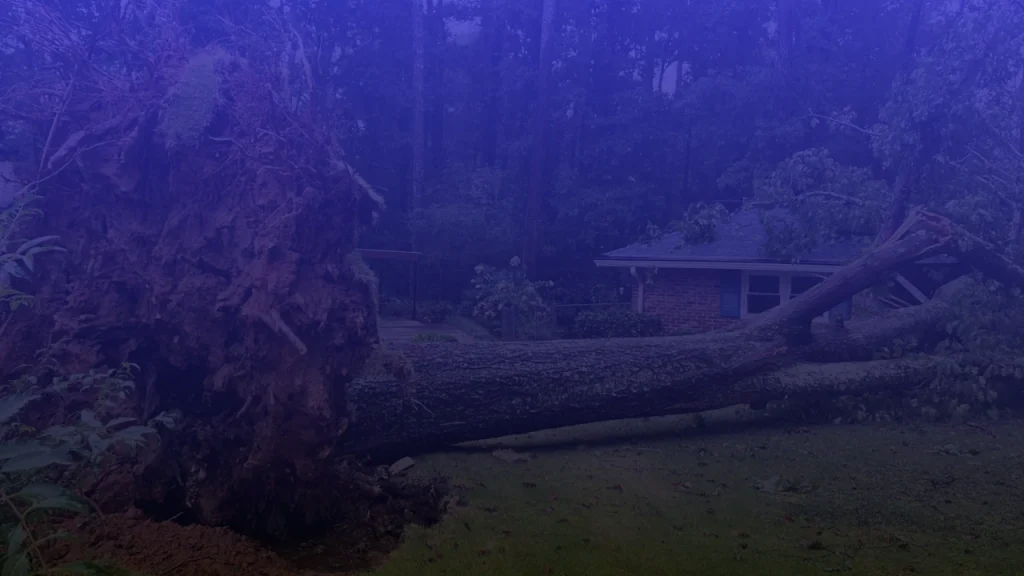
According to the opinion, Romulus bought 10 Circle Drive on April 2, 2021 and leased it to Jennings three days later. The lot next door, 8 Circle Drive, was owned by a neighbor, Misty Carroll. A huge oak near the boundary had its trunk on her lot, but large limbs extended over Jennings’s house.
- Earlier warnings. At least twice after Jennings moved in, large branches fell on the house. In spring 2022, lightning struck the tree and a limb fell on his truck.
- Reports to the landlord. Jennings said he told Alvey the tree looked decayed and dangerous and needed to be inspected, and raised the concern with others at Romulus’s office when he paid rent each month. Alvey testified he was never told.
- No action. According to the evidence, neither Romulus nor the neighbor inspected the tree or removed overhanging limbs, and the two never discussed it.
- The collapse. Around noon on July 14, 2022, the tree fell through the roof and pinned Jennings. It took nearly two hours to free him. He suffered a spinal cord injury that left him permanently paralyzed from the chest down.
Jennings sued Romulus, Alvey and Rhodes for breach of the lease, premises liability, failure to keep the premises in repair and fit for habitation, and common-law negligence, and sought compensatory and punitive damages and attorney fees.
How Did the Case Reach the Court of Appeals?
- The trial court (Floyd County Superior Court) granted Romulus summary judgment on all claims.
- Jennings appealed. In an unpublished opinion decided November 3, 2025 (No. A25A1111), the Court of Appeals vacated that order, without deciding the merits, because the trial court had not explained its ruling on the lease claim.
- On remand, the trial court again granted summary judgment, adding a section on the lease claim.
- Jennings appealed again, and the Court of Appeals reversed on October 14, 2026.
Summary judgment is allowed only when there is no genuine dispute of material fact and the moving party is entitled to judgment as a matter of law (O.C.G.A. § 9-11-56(c)). The appeals court reviews the decision fresh, with no deference, and views the evidence in the non-moving party’s favor. It also may not weigh credibility. Because Alvey and Jennings disagreed about whether Jennings warned him, that conflict alone could not be resolved against Jennings.
What Did the Court Decide? The Georgia Statute Analysis
1. The lease and the implied warranty of habitability
The lease said the landlord “shall maintain the property at all times,” that the tenant must report problems immediately, and that the landlord would repair them as soon as possible. A separate “Hazards” clause required known safety hazards to be reported. The trial court said the lease did not mention the tree. The Court of Appeals called that focus misplaced and held that whether the landlord’s maintenance duty covered large overhanging limbs it knew were repeatedly falling on the roof is a genuine fact question.
The trial court also said the implied warranty of habitability did not apply because the express statute, O.C.G.A. § 44-7-13(b), took effect on July 1, 2024, after the 2021 lease. The Court of Appeals held that was error. Georgia courts recognized the implied warranty before it was codified, including in Thompson v. Crownover, 259 Ga. 126 (1989). Under § 44-7-13(a), a landlord must also keep rented premises in repair.
2. Premises liability (O.C.G.A. § 51-3-1) versus the landlord statute (§ 44-7-14)
This is the most technical part of the ruling.
- § 51-3-1 makes an owner or occupier who invites others onto land liable for failing to use ordinary care to keep the premises and approaches safe. It rests on control of the property.
- § 44-7-14 provides that a landlord who has “fully parted with possession and the right of possession” is not responsible to third persons for damages resulting from the tenant’s negligence or illegal use, but is responsible for damages from defective construction or from failure to keep the premises in repair.
- Georgia courts treat the two as mutually exclusive sources of liability (Cham v. ECI Management Corp., 311 Ga. 170 (2021)). If a landlord is out of possession, only § 44-7-14 applies.
Jennings argued that § 44-7-14 only shields landlords from claims by “third persons,” not tenants, and that § 51-3-1 should still apply. The court said it was “sympathetic” to that plain reading but was bound by earlier decisions of its own court and the Georgia Supreme Court holding that § 51-3-1 does not apply to an out-of-possession landlord.
The court then held that whether Romulus had actually surrendered possession is a fact question. A landlord’s retained right to inspect does not by itself show control. But the lease here also required Romulus to maintain the property at all times, and the trial court ignored that clause. So there were genuine issues about whether Romulus fully parted with possession and therefore whether § 51-3-1 applies.
3. Even under § 44-7-14, there was a repair-and-notice dispute
An out-of-possession landlord is liable for failing to repair only where there is a duty to repair and notice of the defect. With notice, the landlord must inspect and investigate to make the repairs the tenant’s safety requires. Viewing the evidence for Jennings, he gave notice of the overhanging limbs and Romulus did nothing. That is enough to create a jury question under § 44-7-14 as well. The court also noted that Georgia cases have held a hazard need not originate on the owner’s own land.
4. Punitive damages and attorney fees
The trial court dismissed these claims only because it had granted summary judgment on the underlying claims. The Court of Appeals vacated that dismissal and sent the claims back to the trial court to decide whether they are warranted. This does not mean they will be awarded. Punitive damages in Georgia generally require clear and convincing evidence of willful misconduct, malice, fraud, wantonness or conscious indifference to consequences (O.C.G.A. § 51-12-5.1), and attorney fees need a separate legal basis, such as O.C.G.A. § 13-6-11.
For general background on duty, notice and proof in property injury claims, see All About Lawyer’s article Slip And Fall Accident Lawyer Who Is Liable When You Fall on Someone Else’s Property.
What Is the Lawsuit’s Current Status?
- Reversed, not decided. Summary judgment was reversed. No court has found Romulus negligent or awarded damages, and there has been no settlement or trial date.
- Not final yet. Under the Court of Appeals’ notice, a motion for reconsideration is due within 10 days of the October 14 decision. A party can also ask the Georgia Supreme Court for certiorari, generally within 20 days of the judgment or denial of reconsideration. Check the docket for any filings.
- Back to the trial court. After the appeals court’s judgment is returned (the remittitur), the Floyd County Superior Court will handle the remaining claims, including the lease, habitability, § 44-7-14 and possibly § 51-3-1 claims, plus punitive damages and fees.
- Possible further defenses. Georgia’s apportionment statute (O.C.G.A. § 51-12-33) lets a jury assign fault to non-parties in some cases, so the defense might point to the neighboring landowner. The opinion does not discuss this, and the neighbor was not a defendant. Any claim is also subject to Georgia’s two-year personal injury limitation period (O.C.G.A. § 9-3-33).
Can a Georgia Landlord Be Responsible for a Neighbor’s Tree?
Potentially, depending on the lease, what the landlord knew, and who had possession and control. The tree’s location is not an automatic defense. But the ruling does not apply to every tree collapse. Other cases may involve different leases, no prior notice, or a hazard that could not reasonably have been discovered. Georgia residential leases also cannot generally waive a landlord’s duty to repair (see O.C.G.A. § 44-7-2).
What Should Georgia Renters Do If a Tree Looks Dangerous?
- Report it in writing. Send dated notice describing the tree, its location, overhanging limbs and prior damage, and keep a copy.
- Document incidents. Photograph fallen branches, roof damage and vehicle damage, with dates.
- Request an inspection. Do not assume one occurred just because you complained.
- Keep your lease. Maintenance and repair clauses may matter.
- Stay safe. If a tree looks unstable, keep away from it and call local authorities or emergency services if needed. Do not attempt to remove it yourself.
- Get legal advice. A Georgia landlord-tenant or injury lawyer can review your lease and facts.
These steps do not guarantee a claim will succeed.
Georgia Renter Tree Collapse Lawsuit: Frequently Asked Questions
What is the Georgia renter tree collapse lawsuit?
William Frank Jennings v. Romulus Investments, LLC et al., No. A26A1018, a civil personal injury case over a tree that fell on his rental in July 2022. The Georgia Court of Appeals reversed summary judgment for the landlord on October 14, 2026.
Did the tree belong to the landlord?
No. The trunk stood on a neighbor’s vacant lot at 8 Circle Drive, but large limbs extended over the rental.
Did the court find the landlord liable?
No. This is a civil case, and the court only held that factual disputes require further proceedings.
What does reversing summary judgment mean?
It means the claims were wrongly ended before trial. The case can continue in the trial court.
What is O.C.G.A. § 44-7-14?
A Georgia statute limiting liability of a landlord who has fully parted with possession, but preserving liability for defective construction and failure to keep the premises in repair.
How is § 44-7-14 different from § 51-3-1?
Georgia courts treat them as mutually exclusive. § 44-7-14 governs out-of-possession landlords, and § 51-3-1 applies only if the landlord has not fully given up possession and control.
Why did the lease language matter?
It required the landlord to maintain the property at all times and repair problems promptly, creating a fact question about whether that covered the overhanging limbs.
Did Jennings win compensation?
No award or settlement was established. The ruling only returns the case to the trial court.
Can he get punitive damages and attorney fees?
The trial court must now decide whether they are warranted. Nothing is awarded yet.
Is the ruling final?
Not necessarily. A party may seek reconsideration or review by the Georgia Supreme Court, and the trial court must still act after the judgment is returned.
Is this a class action?
No. It is an individual personal injury lawsuit with no public claims process.
Conclusion: A Revived Lawsuit, Not a Final Verdict
The Georgia Court of Appeals revived William Jennings’s lawsuit because the lease’s maintenance language, the history of falling limbs and the tenant’s reported warnings created genuine disputes about the landlord’s duty and notice. The court did not decide liability or damages. The central question going forward is not who owned the tree, but what the landlord knew, what the lease required and what Georgia law demanded of it.
Sources and Official Records
- Georgia Court of Appeals, William Frank Jennings v. Romulus Investments, LLC et al., No. A26A1018 (October 14, 2026): https://law.justia.com/cases/georgia/court-of-appeals/2026/a26a1018.html
- Georgia Code § 44-7-13: https://law.justia.com/codes/georgia/title-44/chapter-7/section-44-7-13/
- Georgia Code § 44-7-14: https://law.justia.com/codes/georgia/title-44/chapter-7/section-44-7-14/
- Georgia Code § 51-3-1: https://law.justia.com/codes/georgia/title-51/chapter-3/section-51-3-1/
- Cases cited in the opinion: Cham v. ECI Management Corp., 311 Ga. 170 (2021); Thompson v. Crownover, 259 Ga. 126 (1989)
- O.C.G.A. §§ 9-3-33, 9-11-56(c), 13-6-11, 44-7-2, 51-12-5.1, 51-12-33
- All About Lawyer, Slip And Fall Accident Lawyer Who Is Liable When You Fall on Someone Else’s Property: https://allaboutlawyer.com/slip-and-fall-lawyer/
This article provides general legal information, not legal advice. The claims in Jennings’s lawsuit remain subject to further proceedings. Information reflects the Georgia Court of Appeals’ decision issued October 14, 2026.
About the Author
Israr Ahmad is a legal content researcher with 4+ years of experience covering class action settlements and consumer rights cases. He has researched and published coverage of 2,500+ settlements using verified court records, settlement administrator filings, and government sources. Learn more about Israr.