
Why Are There So Many Shootings in Lakewood, Colorado? Crime Data, Shooting History and Colorado Law (2026)
Excerpt: A November 5, 2026 shooting killed a Lakewood police officer and wounded three others, renewing questions about gun violence in the Denver suburb. This guide reviews Lakewood’s crime statistics, its major shootings, what Colorado law says about firearms, police use of force and victim rights, and what the data do and do not prove.
Last Updated: November 6, 2026 By: Israr Ahmad, AllAboutLawyer.com
Lakewood, Colorado, is again at the center of public concern about gun violence after a shooting involving police officers and an RTD bus on November 5, 2026 (see our full breaking coverage: Lakewood Shooting, One Police Officer Killed, Three Wounded in RTD Bus Gunfight; Suspect Dead). One Lakewood police officer died, three other officers were wounded, a civilian was injured and the suspected gunman was killed.
It was not the city’s first serious shooting. In December 2021 a gunman killed five people across Denver and Lakewood. In April 2024 a 14-year-old was killed after an argument outside a house party. In July 2025 a shooting at a Lakewood apartment complex left one person dead and two wounded.
The question residents are asking is bigger than any single event: Is Lakewood actually experiencing more gun violence, and why do serious shootings keep making headlines?
The short answer, based on the available evidence:
- Lakewood’s violent-crime rate has been higher than Colorado’s and the national average for years.
- The rate peaked in 2022 in the 2014-2023 historical series and fell in 2023.
- Colorado state data show Lakewood’s reported violent offenses fell 11.2% in the first half of 2025 compared with the first half of 2024.
- No comparable citywide annual series for shootings specifically was verified, so a continuing surge in shootings has not been established.
- The incidents have different circumstances, and no single common motive has been identified.
This article covers the crime data, each major shooting, possible contributing factors, the Colorado laws that apply to firearms, homicide cases and police shootings, and the legal options available to victims and families.
Quick Facts: Lakewood Shootings and Crime Trends
| Question | What the evidence shows |
| City / County | Lakewood, Jefferson County, Colorado |
| Population | Approximately 156,000 |
| Population density | About 3,588 people per square mile (CPSM assessment) |
| Neighboring jurisdictions | Denver, Wheat Ridge, Edgewater, unincorporated Jefferson County |
| Highest violent-crime rate, 2014-2023 series | 814 per 100,000 (2022) |
| Lakewood violent-crime rate, 2023 | 716 per 100,000 |
| Colorado rate, 2023 | 474 per 100,000 |
| U.S. rate, 2023 | 377 per 100,000 |
| Violent offenses, Jan-Jun 2024 / Jan-Jun 2025 | 636 / 565 (down 11.2%) |
| Regional shooting spree | December 27, 2021 |
| Fatal shooting of 14-year-old | April 13, 2024 |
| Fatal police shooting behind Best Buy | December 2, 2024 |
| Winddrift Apartments triple shooting | July 23, 2025 |
| Latest major incident | November 5, 2026 (officer killed) |
| Investigating agency, Nov. 5 | Jefferson County Critical Incident Response Team with CBI support |
| Common motive across incidents | None established |
| Verified citywide annual shooting trend | Not established |
1. Are Shootings Actually Increasing in Lakewood?
Three different statistics are often confused:
- Shootings or gunfire incidents (including shots-fired calls).
- Firearm homicides.
- Overall violent crime (murder, rape, robbery and aggravated assault).
An aggravated assault may involve a gun, a knife or another weapon. A shots-fired call may involve no injury. A fatal police shooting is a different category from a criminal homicide. So a rise or fall in overall violent crime does not by itself tell us whether shootings rose or fell.
Lakewood’s Violent-Crime Rate, 2014-2023
A 2025 Police Operations and Data Analysis Report by the Center for Public Safety Management (CPSM) examined Lakewood Police Department data for 2014 through 2023:
| Year | Violent crimes per 100,000 residents |
| 2014 | 482 |
| 2015 | 568 |
| 2016 | 566 |
| 2017 | 644 |
| 2018 | 664 |
| 2019 | 538 |
| 2020 | 565 |
| 2021 | 684 |
| 2022 | 814 |
| 2023 | 716 |
These figures cover all violent crime, not firearms-only incidents. Three patterns stand out. The 2022 rate was far above 2014. The trend was not a straight line: it dipped in 2019, climbed through 2022 and fell in 2023. And the 2023 rate was still above 2014.
Lakewood vs. Colorado and the United States (2023)
| Location | Violent crimes per 100,000 |
| Lakewood | 716 |
| Colorado | 474 |
| United States | 377 |
Lakewood’s 2023 rate was roughly 51% above the state figure and roughly 90% above the national figure. These are reported violent offenses, not counts of gunshots or fatal shootings, and they do not mean every neighborhood faces the same level of risk.
What About 2024?
Some secondary compilations of FBI data place Lakewood’s 2024 violent-crime rate near 787 per 100,000, which would mean a rise after the 2023 decline. Because those compilations use varying methods and population estimates, readers should treat that figure as unconfirmed until it is checked against the Lakewood Police Department’s or the FBI’s published 2024 tables. If it holds, it would reinforce the main point: the trend is cyclical, not a one-way surge.
First Half of 2025
The Colorado Department of Public Safety’s midyear crime-trends report, using Colorado Bureau of Investigation data, compared January-June 2024 with January-June 2025:
| Period | Reported violent offenses |
| January-June 2024 | 636 |
| January-June 2025 | 565 |
| Change | 71 fewer (-11.2%) |
Half-year figures are affected by seasonality and reporting lags, and they do not prove firearm incidents fell by the same percentage. They do show why describing Lakewood as having an across-the-board crime surge would be misleading.
2. Lakewood’s Major Shootings: What Happened and What the Law Did
The incidents below differ in type. Treating them as one trend obscures more than it explains.
December 27, 2021: The Denver-Lakewood Shooting Spree
Lyndon James McLeod carried out a series of shootings across Denver and Lakewood. According to the First Judicial District Attorney’s Office, he killed five people and wounded two. Three victims were killed in Denver. McLeod then went to Lucky 13 Tattoo Parlor on Kipling Street in Lakewood and killed the manager. He was fatally shot in a confrontation with Lakewood officers, during which Agent Ashley Ferris was wounded. Agent Brianna Hagan also responded.
The First Judicial District Critical Incident Response Team investigated the officers’ use of force. In August 2022 the district attorney announced Hagan and Ferris would not face charges, concluding their actions were legally justified.
Why it matters: this was one offender’s regional spree, not evidence of a repeated dispute between groups in Lakewood.
April 13, 2024: The Killing of 14-Year-Old Francisco Laqui
Shortly before 4 a.m. on April 13, 2024, near Garrison Street, Francisco “Cisco” Laqui was hosting a house party at a vacation rental with about 15 people. Two vehicles arrived to pick up attendees, and an argument began outside. According to the district attorney, three people in the departing vehicles fired handguns. Laqui was struck in the head by a bullet from a .22-caliber handgun and died on April 19, 2024.
Five participants were prosecuted. On March 6, 2026, the district attorney announced the final two defendants had been sentenced: Anthony Allen and Philix Baca each received 25 years in prison. Other participants received earlier sentences, including probation and credit for time served.
Why it matters: it shows how a dispute among young people with guns can kill someone who was not the original focus of the conflict. It does not prove youth violence explains other Lakewood shootings.
December 2, 2024: Fatal Police Shooting Behind Best Buy
Shortly after 3:30 a.m., Lakewood agents Mason Fine and Jared White fatally shot Robert Glen King behind the Best Buy on South Wadsworth Boulevard. The Critical Incident Response Team investigated. On June 10, 2025, the district attorney issued a decision letter finding the use of deadly force legally justified to protect the officers and others, and no charges were filed.
Why it matters: police gunfire is a different category from a criminal shooting of members of the public and should be counted separately.
July 23, 2025: Winddrift Apartments Triple Shooting
Around 1:20 a.m. on July 23, 2025, police received reports of gunfire at Winddrift Apartments on South Reed Street. Officers found one man dead in the parking lot, and a man and a woman were taken to a hospital with gunshot wounds. Earlier that evening officers had responded to a disturbance at the same complex, but those responsible had left. Witnesses described a party involving family members, and investigators believed multiple shooters were involved. The full motive had not been established in the reporting reviewed.
Why it matters: it shows how a disturbance can be followed by a far more serious confrontation, but it does not prove apartment gatherings generally cause shootings.
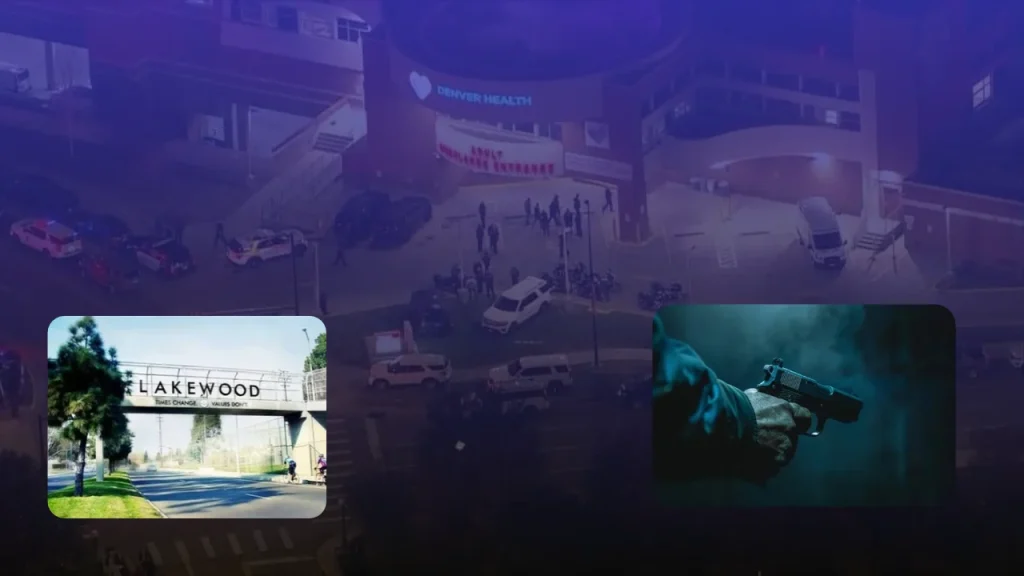
November 5, 2026: RTD Bus Shooting That Killed a Lakewood Officer
At about 6:30 p.m. on Thursday, November 5, Lakewood officers responded near West Colfax Avenue and Wadsworth Boulevard to a report of a suspicious person trying to board an RTD Route 76 bus. Police spokesperson John Romero said the person may also have been involved in a hit-and-run earlier that day. According to police, the suspect opened fire within seconds of officers approaching. Four officers were shot, one died and three were hospitalized. The suspect was killed and a civilian was injured. RTD confirmed a contracted bus on Route 76 was involved.
The Jefferson County Critical Incident Response Team is investigating with support from the Colorado Bureau of Investigation. As of November 6, the suspect’s identity and motive had not been publicly established, and no connection to earlier incidents has been shown. For the full timeline, eyewitness accounts and open questions, read our dedicated report: Lakewood Shooting, One Police Officer Killed, Three Wounded in RTD Bus Gunfight; Suspect Dead.
3. Does Lakewood’s Location Next to Denver Matter?
According to the CPSM report, Denver borders Lakewood to the east and southeast, Wheat Ridge and Edgewater lie to the north, and the Jefferson County Sheriff’s Office patrols areas to the west and south. With roughly 3,588 people per square mile, Lakewood operates as a dense urban city rather than an isolated suburb, and the report discussed the challenges of cities with that density next to a larger jurisdiction.
Proximity to Denver does not show that Denver residents or outside offenders are responsible for Lakewood shootings, and no evidence supports that claim. What location does establish is that Lakewood is part of a regional network of commuting, retail, transit and shared public-safety demands, which helps explain why its profile differs from smaller suburbs. Lakewood is also within the broader Front Range, where several cities, including Denver, Aurora and Colorado Springs, have recorded elevated violent-crime rates in recent years. Nationally, many cities saw sharp increases in homicide and aggravated assault in 2020-2022 followed by declines, and Lakewood’s 2022 peak roughly tracks that arc.
4. Crime Is Concentrated in Specific Places
The CPSM analysis mapped locations generating many crime-related police calls and found many of the busiest were in the North Sector:
| Location | Crime-related runs in the study |
| West Colfax Avenue Walmart | 369 |
| Spur Crossing Apartments, Ammons Street | 265 |
| Colorado Mills shopping center | 212 |
| Safeway, West Colfax Avenue | 107 |
| Walgreens, West Colfax Avenue | 96 |
| Home Depot, West Colfax Avenue | 90 |
| Convenience store, Wadsworth Boulevard | 75 |
| West Colfax Avenue and Wadsworth Boulevard | 40 |
These are not counts of shootings. A theft, disturbance or suspicious-person call appears in these figures with no firearm involved. They show that police demand is concentrated at certain businesses, apartment properties and intersections, which is why location-specific prevention can be more effective than treating the whole city alike. They do not establish confirmed gunfire hotspots.
This matches broader research. A 2024 systematic review, Crime Concentrations at Micro Places, covering 47 studies, found a median of roughly 50% of reported crime occurring on about 4.5% of street segments. National Institute of Justice research on hot-spots policing points the same way.
5. Disputes, Parties and Retaliation
Some documented cases involved a conflict before the gunfire. The Laqui case began with an argument outside a party, and the Winddrift shooting followed an earlier disturbance. Possible mechanisms in shootings generally include personal disagreements, family conflicts, retaliation, group disputes, threats and confrontations at gatherings, with a firearm turning a dispute into a fatal event. But these are possible mechanisms, not a proven common explanation for Lakewood. The evidence does not show that all recent shootings involve gangs, drug markets, family conflict or organized groups, and the motive in the November 2026 incident is still unconfirmed.
6. Firearm Access
A confrontation does not become a shooting without a firearm, and a gun makes any dispute more lethal.
ATF trace data show 386 firearms recovered and traced in Lakewood in 2024 and 302 in 2025. These are not counts of shootings or of all guns recovered, and they depend on whether and when agencies submit traces, so they cannot show whether gun ownership is rising or falling.
Statewide data: the Johns Hopkins Center for Gun Violence Solutions reports Colorado had 961 firearm deaths in 2024: 209 homicides, 712 suicides and 40 other deaths. It also reports Colorado’s firearm homicide rate rose 40% between 2015 and 2024. These are statewide numbers, not Lakewood figures, and most firearm deaths were suicides, so totals must not be confused with gun crimes.
7. Alcohol, Drugs and Domestic Conflict
The CDC identifies heavy alcohol and drug use, relationship conflict, economic stress, social isolation and concentrated disadvantage as risk factors for violence in some contexts. These are general risk factors only. No verified evidence ties the documented Lakewood shootings to one shared substance-related or domestic-violence cause, so each incident must be assessed on its own facts.
8. Why Headlines and Data Can Diverge
- High baseline: even after a decline, a rate well above state and national averages leaves residents facing elevated risk.
- Composition of violence: firearm assaults and robberies generate more fear than their share of reports.
- Media amplification: an officer killed or a teenager shot at a party gets sustained coverage, while dozens of lesser assaults do not.
- Clustering: several high-profile incidents can occur close together even in a period of overall decline.
- Trust: when officers or children are shot, questions about prevention arise beyond any year’s statistics.
This perception is not unreasonable. The deaths are real. But news visibility and crime frequency are different measurements, and answering the question properly requires separately published figures for shots-fired calls, confirmed gunfire incidents, nonfatal shootings and firearm homicides.
9. Colorado Law: What Applies to Shootings, Firearms and Police Use of Force
This section summarizes Colorado and federal law relevant to the events above. Statutes change, so check the current Colorado Revised Statutes (C.R.S.) or consult an attorney for a specific situation.
Homicide and Related Offenses
- Murder: first-degree murder is defined in C.R.S. 18-3-102 and second-degree murder in C.R.S. 18-3-103. Killing a peace officer in the line of duty is an aggravating circumstance under the first-degree murder statute. Colorado abolished the death penalty in 2020 (SB20-100, effective July 1, 2020), so an adult convicted of first-degree murder faces life imprisonment without parole.
- Assault and menacing: assault is addressed in C.R.S. 18-3-202 and following, and menacing with a weapon in C.R.S. 18-3-206.
- Juveniles: young defendants may be handled in juvenile court or, in serious cases, charged as adults under C.R.S. Title 19, Article 2.5. This affects sentencing outcomes in cases such as the Laqui prosecution.
- Accomplice liability: under C.R.S. 18-1-603, a person who aids or encourages a crime can be held responsible for it, which is why multiple participants can be prosecuted for one shooting.
Self-Defense
Colorado allows the use of physical force in defense of a person under C.R.S. 18-1-704, and deadly force only where a person reasonably believes it necessary against imminent use of unlawful deadly force or similar serious threats. Section 18-1-704.5 (the “Make My Day” law) addresses force against an unlawful entry into a home. A claim of self-defense is evaluated by prosecutors and courts on the specific facts.
Colorado Firearm Laws
Colorado has enacted several firearm laws that bear on the factors discussed above:
- Background checks on all transfers (2013, C.R.S. 18-12-112), including private sales.
- Magazine capacity limit of 15 rounds (C.R.S. 18-12-302).
- Extreme Risk Protection Orders (“red flag” law), enacted in 2019 (C.R.S. 13-14.5-101 and following), allowing a court to temporarily remove firearms from a person found to pose a significant risk. Later amendments expanded who may petition.
- 2023 legislation raised the minimum age to buy firearms to 21, created a three-day waiting period for purchases and addressed untraceable “ghost guns.”
- Safe-storage requirements enacted in 2021 require firearms to be secured against access by minors and prohibited persons.
- Local regulation: a 2021 law repealed Colorado’s preemption of local gun regulation, allowing cities and counties to adopt their own rules.
- Federal law: 18 U.S.C. 922(g) prohibits firearm possession by felons, certain domestic-violence offenders and other categories, and 18 U.S.C. 924(c) adds penalties for using a firearm in certain federal crimes.
None of these laws guarantees fewer shootings, and their local effect has not been measured for Lakewood in the data reviewed here.
Police Use of Force in Colorado
- Standard: C.R.S. 18-1-707 governs when peace officers may use physical and deadly force. It requires officers to apply non-violent means first when possible and permits deadly force only in defined circumstances, such as to defend against an imminent threat of serious bodily injury or death. The standard was strengthened by the 2020 Law Enforcement Integrity Act (SB20-217).
- Independent investigation: C.R.S. 16-2.5-301 requires officer-involved shootings that cause injury or death to be investigated by a multi-agency team and the results to be made public. This is why the First Judicial District team handled the 2021 and 2024 Lakewood incidents and why the Jefferson County team is handling November 5.
- Charging decisions: the district attorney decides whether to bring criminal charges after reviewing the investigation, and publishes a decision letter, as it did for the December 2024 Best Buy shooting.
- Duty to intervene: C.R.S. 18-8-802 requires an officer to intervene when another officer is using excessive force, and use-of-force reviews examine whether that duty was met.
- Body cameras: C.R.S. 24-31-902 requires body-worn cameras for local law enforcement and sets rules for releasing recordings.
A decision not to bring criminal charges is not the end of the legal picture, because civil claims follow different rules and a lower burden of proof.
10. Legal Rights and Options After a Shooting
For Victims and Families
- Crime victim rights: Colorado’s Victim Rights Act (Colo. Const. art. II, sec. 16a, and C.R.S. 24-4.1-301 and following) gives victims and certain family members rights to be informed, present and heard in criminal proceedings, including at sentencing.
- Crime Victim Compensation: the Colorado program (C.R.S. 24-4.1-100.1 and following) can reimburse eligible costs such as medical expenses, counseling, funeral costs and lost income. Applications are filed through the district attorney’s victim services unit, and deadlines apply.
- Wrongful death: (for a recent example of a wrongful death case that ended in settlement, see Razzle’s Wrongful Death Lawsuit Settled, Jared Ratisher Case, Underage Drinking Allegations and Nightclub Closure) under the Colorado Wrongful Death Act (C.R.S. 13-21-201 and following), certain family members may sue a person whose wrongful act caused a death. The general deadline is two years from the date of death (C.R.S. 13-80-102). Damage limits were raised by legislation in 2024, so consult current law.
- Property owners: in some cases an injured person may also bring a premises-liability claim against a property owner that failed to provide reasonable security, but success depends on the specific facts, including what the owner knew in advance.
Claims Involving Police Shootings
- State civil-rights claim: C.R.S. 13-21-131, created by the 2020 Law Enforcement Integrity Act, lets a person sue a peace officer for violating state constitutional rights and removes qualified immunity as a defense. The statute also contains provisions on employer indemnification and attorney fees.
- Federal claim: claims under 42 U.S.C. 1983 may be brought for violations of federal constitutional rights, such as excessive force under the Fourth Amendment, and remain subject to federal immunity doctrines.
- Governmental Immunity Act: claims against public entities under C.R.S. 24-10-101 and following generally require written notice within 182 days of discovering the injury (C.R.S. 24-10-109). Whether that notice requirement applies depends on the type of claim, so a lawyer should be consulted promptly.
- Examples from other cases: see Urban Seay Family Files $30 Million Tort Claim Against Seattle After Fatal Southwest Precinct Police Shooting and James Williams Canton Police Shooting, City Proposes $3.5 Million Settlement With Family for how claims after police shootings have been handled elsewhere.
- Separate processes: the criminal investigation, the charging decision, an internal police review and a civil lawsuit are independent. One does not control the outcome of the others. For how a decision not to charge and the release of video fit together, see Saveion McConnell Police Shooting, Body-Camera Video Released After Missouri Prosecutor Declines Charges.
For the Families of Officers Killed in the Line of Duty
Federal Public Safety Officers’ Benefits (34 U.S.C. 10281 and following) provide a one-time death benefit to eligible survivors of public safety officers killed in the line of duty, administered by the U.S. Department of Justice. Survivors may also be eligible for state and local pension and workers’ compensation benefits.
Need Legal Guidance?
If you or a family member was affected by a shooting or a police use-of-force incident, you can send your question through Ask a Lawyer. Browse more in our Government & Civil Rights lawsuits, Personal Injury and Assault sections.
For Anyone Who Witnesses or Is Contacted in an Investigation
You may be asked for a statement by investigators. You are entitled to consult an attorney before answering questions if you may be a suspect or are unsure of your rights. Do not discuss active cases on social media, because those posts can be used as evidence.
11. What Could Reduce Gun Violence in Lakewood?
The CPSM report and violence-prevention research point to several approaches:
- Publish firearm-specific data separating confirmed shootings, shots-fired calls, other-weapon assaults and police shootings.
- Target verified high-risk locations by examining lighting, security, repeat disturbances and services at properties that repeatedly generate serious incidents.
- Intervene earlier in recurring disputes at addresses or among groups that police repeatedly respond to.
- Support at-risk youth through mentoring, education, employment and conflict-resolution programs.
- Coordinate prevention among public health agencies, police, schools, housing groups and community organizations, as the CDC recommends.
- Enforce firearm laws on unlawful possession, stolen guns and illegal transfers.
- Promote safe storage and use of ERPOs so that families know a court process exists to remove firearms when someone is in crisis.
No measure guarantees an end to shootings, and effectiveness depends on local evidence, implementation and evaluation.
12. What We Still Do Not Know
| Question | What the evidence establishes |
| Are annual shootings increasing? | No comparable citywide annual shooting series was verified. |
| Is violent crime higher than state averages? | Yes, in the historical comparisons reviewed. |
| Did violent crime fall in early 2025? | Yes, by 11.2% compared with early 2024. |
| Are the shootings connected? | No evidence establishes a connection. |
| Are gangs responsible? | No shared gang explanation established. |
| Are drugs responsible? | No common drug-related motive established. |
| Are shootings concentrated in certain places? | Crime calls are concentrated, but this does not establish shooting hotspots. |
| Is the Nov. 5 shooting linked to earlier incidents? | No link established. |
| Is there one main cause? | No. |
The most useful public dataset would separate gun homicides, nonfatal shootings, shots-fired calls, domestic-violence shootings, police-involved shootings and accidental discharges.
Related AllAboutLawyer Coverage
- Lakewood Shooting, One Police Officer Killed, Three Wounded in RTD Bus Gunfight; Suspect Dead
- Saveion McConnell Police Shooting, Body-Camera Video Released After Missouri Prosecutor Declines Charges
- Urban Seay Family Files $30 Million Tort Claim Against Seattle After Fatal Southwest Precinct Police Shooting
- James Williams Canton Police Shooting, City Proposes $3.5 Million Settlement With Family
- Razzle’s Wrongful Death Lawsuit Settled, Jared Ratisher Case, Underage Drinking Allegations and Nightclub Closure
Frequently Asked Questions
Why are there so many shootings in Lakewood, Colorado?
Several serious shootings have drawn attention to Lakewood. Violent-crime rates have been higher than Colorado and national averages, and possible factors include urban density, concentrated crime locations, interpersonal disputes and firearm access. No single common cause has been identified.
Are shootings increasing in Lakewood?
The available evidence does not establish a continuous increase. The violent-crime rate peaked in 2022 and fell in 2023, and Colorado data show an 11.2% drop in violent offenses in the first half of 2025 versus 2024. These figures measure violent crime generally, not gunfire alone.
What happened in the November 5, 2026 Lakewood shooting?
At about 6:30 p.m., officers responding to a suspicious person near an RTD Route 76 bus at West Colfax and Wadsworth were fired on. One officer died, three were hospitalized, a civilian was injured and the suspect was killed. The Jefferson County Critical Incident Response Team is investigating with CBI support.
Who investigates a police shooting in Colorado?
Under C.R.S. 16-2.5-301, a multi-agency team outside the involved department investigates officer-involved shootings that cause injury or death. The district attorney then decides whether to file charges.
Can the family of someone killed by police sue in Colorado?
Possibly. C.R.S. 13-21-131 allows civil-rights claims against peace officers without qualified immunity, and federal claims under 42 U.S.C. 1983 may also be available. Deadlines, including a possible 182-day notice period for some claims against public entities, are short, so speak with a civil-rights attorney quickly.
What are the penalties for killing a police officer in Colorado?
First-degree murder of a peace officer in the line of duty is an aggravated form of first-degree murder under C.R.S. 18-3-102. Because Colorado abolished the death penalty in 2020, an adult convicted receives life imprisonment without the possibility of parole.
What happened to the people who killed Francisco Laqui?
Five participants were prosecuted. The final two defendants, Anthony Allen and Philix Baca, were sentenced on March 6, 2026, each receiving 25 years in prison.
What happened at Winddrift Apartments in 2025?
On July 23, 2025, one man was killed and a man and a woman were wounded. Police had earlier responded to a disturbance at the same complex, and investigators believed multiple shooters were involved.
Is West Colfax Avenue a shooting hotspot?
West Colfax appears often in crime-related call data, but those figures cover all crime calls, not gunfire. It would be inaccurate to call it a confirmed shooting hotspot without firearm-specific data.
Does living near Denver increase shooting risk in Lakewood?
Lakewood’s urban setting is relevant to its policing and crime patterns, but no evidence shows that proximity to Denver alone causes its shootings or that outside residents are responsible.
Are gangs, drugs or alcohol behind Lakewood’s shootings?
No common gang, drug or alcohol explanation has been established. These can be risk factors for violence in general, but each Lakewood incident has its own circumstances.
Is Lakewood more dangerous than Denver?
The sources reviewed give Lakewood’s 2023 rate (716 per 100,000), but a fair ranking requires Denver’s rate from the same source and year, and one rate cannot describe every neighborhood.
Can Colorado courts remove guns from a person who may be dangerous?
Yes. Colorado’s Extreme Risk Protection Order law (C.R.S. 13-14.5-101 and following) lets a court order temporary removal of firearms from a person found to pose a significant risk of harm. Eligible petitioners are defined by statute, so check current law or consult an attorney.
Is there financial help for shooting victims in Colorado?
The Colorado Crime Victim Compensation Program may cover eligible medical, counseling, funeral and lost-income costs. Applications go through the district attorney’s victim services office, and deadlines apply.
Does Lakewood publish crime statistics?
Yes. The Lakewood Police Department publishes annual reports, a records-request process and an interactive crime map, but these should be distinguished from firearm-only incident statistics.
The Bottom Line
Lakewood has a real and long-standing violent-crime problem, and its recent shootings are serious. The 2021 regional spree, the 2024 death of 14-year-old Francisco Laqui, the 2025 apartment shooting and the November 5, 2026 killing of a Lakewood officer show that gun violence has repeatedly affected the community.
But the data do not prove a continuous citywide surge in shootings. The violent-crime rate fell after its 2022 peak, Colorado’s figures show an 11.2% decline in early 2025, and the incidents differ in cause: a regional mass shooter, a youth dispute, a residential disturbance and a gunfight during a police response. No single motive explains them.
The most useful response is evidence-based: publish firearm-specific data, concentrate prevention on documented high-activity locations, use Colorado’s existing legal tools such as ERPOs and safe-storage rules, and ensure victims and families know their rights to investigation, compensation and civil remedies. Until comparable annual shooting data are published, the safest conclusion is that Lakewood has experienced repeated serious gun violence and a high broader violent-crime burden, while an ongoing increase in shootings has not been established.
Sources and References
Crime Statistics
- Center for Public Safety Management, February 2025: Lakewood Police Department, Police Operations and Data Analysis Report (cpsm.us).
- Colorado Department of Public Safety, January 2026: Colorado Crime Trends, 2025 Midyear Report (cdpsdocs.state.co.us).
- City of Lakewood, Colorado: Police Department, About Us and Annual Reports (lakewoodco.gov).
- Map the Block, updated October 17, 2026: Lakewood, Colorado Crime Statistics and FBI Data (maptheblock.com). Used only for supplemental, unverified 2024 figures.
- ATF: Firearms Trace Data, Colorado, 2024 and 2025 (atf.gov).
Shooting Investigations and Case Records
- First Judicial District Attorney’s Office, August 22, 2022: Decision clearing officers responding to the 2021 shooting spree (firstda.co).
- First Judicial District Attorney’s Office, March 6, 2026: Defendants sentenced in the murder of 14-year-old Francisco Laqui (firstda.co).
- First Judicial District Attorney’s Office, June 10, 2025: Critical Incident Response Team decision letter, December 2, 2024 Lakewood police shooting (firstda.co).
- CBS Colorado, July 23, 2025: Fatal triple shooting at Lakewood apartment complex (cbsnews.com/colorado).
- Associated Press, November 6, 2026: One officer killed and three wounded in firefight with suspect in Lakewood (apnews.com).
- RTD, November 5, 2026: Statement regarding the shooting near West Colfax Avenue and Wadsworth Boulevard (rtd-denver.com).
Research and Public Health
- Centers for Disease Control and Prevention: About Community Violence and Its Risk Factors; A Public Health Approach to Community Violence Prevention (cdc.gov).
- National Institute of Justice: Understanding Developmental Crime Trajectories at Places; CrimeSolutions, Hot Spots Policing (nij.ojp.gov, crimesolutions.ojp.gov).
- Johns Hopkins Center for Gun Violence Solutions: Colorado Gun Death and Homicide Statistics (publichealth.jhu.edu).
- Crime Concentrations at Micro Places, 2024 systematic review.
Laws Referenced
- Colorado Revised Statutes: 13-14.5-101 et seq. (Extreme Risk Protection Orders); 13-21-131 (civil action for peace officer violations); 13-21-201 et seq. (Wrongful Death Act); 13-80-102 (limitations); 16-2.5-301 (officer-involved shooting investigations); 18-1-603 (complicity); 18-1-704 and 18-1-704.5 (self-defense); 18-1-707 (peace officer use of force); 18-3-102, 18-3-103 (murder); 18-3-202, 18-3-206 (assault, menacing); 18-12-112 (background checks); 18-12-302 (magazine capacity); 24-4.1-100.1 et seq. and 24-4.1-301 et seq. (victim compensation and rights); 24-10-101 et seq. and 24-10-109 (Governmental Immunity Act); 24-31-902 (body-worn cameras); Title 19, Article 2.5 (juvenile justice).
- Colorado Constitution, art. II, sec. 16a (victim rights).
- Colorado SB20-100 (abolition of the death penalty); SB20-217 (Law Enforcement Integrity Act).
- Federal law: 18 U.S.C. 922(g), 924(c); 42 U.S.C. 1983; 34 U.S.C. 10281 et seq. (Public Safety Officers’ Benefits).
Research note: The 2014-2023 crime-rate series comes from CPSM’s Lakewood report, and the January-June 2025 comparison comes from Colorado Bureau of Investigation data. Crime-call clusters are expressly distinguished from shootings. Incident histories rely on First Judicial District Attorney records, CBS Colorado and Associated Press reporting. A complete annual citywide firearm-only shooting series was not verified. Statutory citations should be confirmed against the current Colorado Revised Statutes before publication, since several provisions were amended after 2020.
About the Author: Researched and written by Israr Ahmad, using public crime statistics, police investigation records, government reports and established research on gun violence and crime prevention.
Disclaimer: This article is for informational purposes only and is not legal advice. AllAboutLawyer.com is a legal information website, not a law firm. Crime statistics describe reported incidents and do not establish the guilt of any individual. Deadlines and legal rights depend on the specific facts of a case, so consult a licensed Colorado attorney. Investigations and public-safety information may change as authorities release further findings.
About the Author
Israr Ahmad is a legal content researcher with 4+ years of experience covering class action settlements and consumer rights cases. He has researched and published coverage of 2,500+ settlements using verified court records, settlement administrator filings, and government sources. Learn more about Israr.