
Trump Arch Lawsuit, Judge Blocks Construction for 14 Days After 8-4 Approval of 250-Foot Arch Near Arlington National Cemetery
Excerpt: On November 5, 2026, the National Capital Planning Commission approved President Trump’s proposed 250-foot arch near Arlington National Cemetery by an 8-4 vote. Hours later, U.S. District Judge Tanya Chutkan issued a 14-day temporary restraining order barring construction. Three lawsuits challenge the project over congressional authorization, the Height of Buildings Act, environmental review, historic preservation and traffic. This guide explains each case, the laws involved and what could happen next.
Last Updated: November 6, 2026 By: Israr Ahmad, AllAboutLawyer.com
A federal judge has temporarily blocked construction of President Donald Trump’s planned 250-foot triumphal arch near Arlington National Cemetery, shortly after a key planning commission gave the project final approval.
On November 5, 2026, the National Capital Planning Commission (NCPC) voted 8-4 to approve the final site and building plans after a hearing of roughly nine hours, during which more than 100 people reportedly testified, most in opposition. The National Park Service also approved the project that day. Late on November 5, U.S. District Judge Tanya S. Chutkan issued a 14-day temporary restraining order (TRO) barring the government from starting construction. Some reports place the order in the early hours of November 6.
The approval and the court order do not contradict each other. The planning commission approved the design and site plans, while the court temporarily limited the government’s ability to start work. The arch has not been permanently rejected, and the TRO is not a final ruling on whether the project is lawful.
The project, officially called the New Monumental Arch and nicknamed the “Arc de Trump” by critics, raises legal questions that go beyond architecture:
- Did Congress authorize this monument when it approved the Arlington Memorial Bridge in 1925?
- Does the Commemorative Works Act require specific congressional approval?
- Does a 250-foot structure violate Washington’s building-height limits?
- Did the government complete adequate environmental and historic-preservation reviews?
- Can work begin while courts consider those claims?
This article walks through the project, the three lawsuits, the November 5 ruling, the statutes at stake and the likely next steps.
Quick Facts: Trump Arch Lawsuit
| Detail | Latest information |
| Official name | New Monumental Arch (also called the Trump Arch or “Independence Arch” in some filings) |
| Overall height | About 250 feet |
| Main arch height | About 166 feet, topped by three gilded figures |
| Location | Memorial Circle, Columbia Island, Washington, D.C. |
| Nearby landmarks | Arlington Memorial Bridge, Lincoln Memorial, Arlington National Cemetery |
| NCPC final approval | November 5, 2026, by an 8-4 vote |
| National Park Service approval | November 5, 2026 |
| Judge | Tanya S. Chutkan, U.S. District Court for D.C. |
| Temporary restraining order | 14 days, issued November 5, 2026 |
| Government status report due | November 9, 2026 |
| Lawsuit 1 | Lemmon v. Trump, No. 1:26-cv-00544 (D.D.C.), filed February 19, 2026 |
| Lawsuit 2 | District of Columbia and Commonwealth of Virginia v. National Park Service, No. 1:26-cv-03838 (D.D.C.), filed October 31, 2026 |
| Lawsuit 3 | Arlington County Board v. National Park Service, No. 1:26-cv-03372 (E.D. Va.), filed October 8, 2026 |
| Main legal issues | Congressional authorization, height limits, NEPA, historic preservation, Administrative Procedure Act |
| Estimated construction time | About two to three years (33 to 39 months in government planning figures) |
| Final project cost | Not publicly established |
| Final ruling on legality | None as of November 6, 2026 |
| Class action or compensation | No |
1. What Is the Proposed Arch?
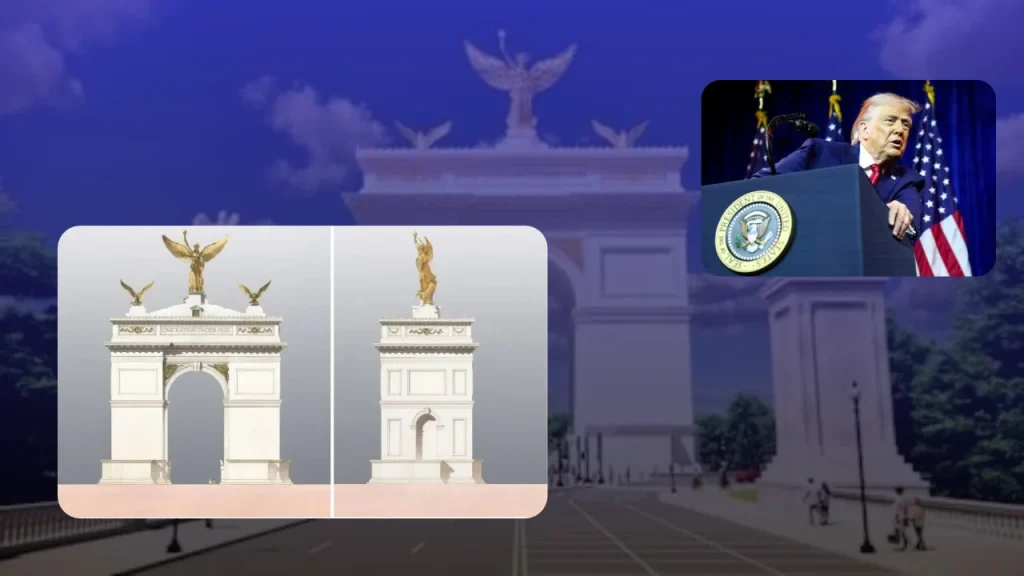
The New Monumental Arch is a neoclassical structure planned for Memorial Circle, the traffic circle at the western end of Arlington Memorial Bridge. It sits between the Lincoln Memorial corridor and the entrance area of Arlington National Cemetery, which holds the remains of more than 400,000 service members, veterans and family members. The arch would stand on federal land east of the cemetery, not inside it.
According to planning documents, the structure includes:
- A main arch about 166 feet tall, with a central opening about 55 feet wide.
- Three gilded figures on top, bringing the total height to about 250 feet, more than twice the height of the 99-foot Lincoln Memorial.
- The inscription “One Nation Under God.”
- An observation deck, gallery and exhibition spaces, an eternal flame, elevators and stairways.
- A landscaped plaza, lighting, utility work and changes to local traffic patterns.
Supporters, including administration officials, describe it as a commemoration of the nation’s 250th anniversary and a tribute to American history and veterans, and they compare it to the Arc de Triomphe in Paris. Opponents, including veterans, preservationists and local governments, say its scale and placement would permanently alter one of the most solemn and carefully designed viewsheds in the country. National Park Service environmental documents discussed daily visitor estimates ranging from about 2,000 to 22,000 people.
2. Why the Location Is So Controversial
Memorial Circle is part of the historic landscape that links the Lincoln Memorial, Arlington Memorial Bridge (opened in 1932) and Arlington National Cemetery. The bridge and associated structures are listed on the National Register of Historic Places.
Preservation advocates argue that a monument this large could interfere with the established sightline, change how visitors experience the cemetery and compete visually with existing memorials. Supporters argue the arch would complement the existing monuments. This is partly a design dispute and partly a legal one: the question is whether federal agencies can approve a structure of this scale at this site without further congressional authorization or deeper historic and environmental review.
3. The 1925 Law at the Center of the Dispute
The administration argues that Congress already authorized the project through an act of February 24, 1925 (43 Stat. 974, ch. 313) that authorized the Arlington Memorial Bridge and its approaches, including roads, avenues and landscape features. The law also gave the bridge commission some flexibility over design and location without increasing authorized cost.
The government’s position: the statute was broad and left design of the approaches to federal authorities, and historical plans for Memorial Circle contemplated monumental features. The NCPC’s November staff report accepted the administration’s reading on both the authorization and height questions.
The challengers’ position: the 1925 law authorized a bridge and its approaches, not a new commemorative monument of this size. They point out that the monumental columns planned for the site in the 1920s, about 166 feet tall, were never built, and that a single 250-foot arch is not the same thing.
A planning commission’s reading of a statute does not bind a federal court. The court will decide independently whether the agencies acted within their legal authority. As of November 6, 2026, no court has ruled on whether the 1925 law authorizes this arch.
4. The Three Lawsuits
Lawsuit 1: Lemmon v. Trump (D.D.C.)
Filed on February 19, 2026, this suit was brought by three Vietnam War veterans (Michael Lemmon, Shaun Byrnes and Jon Gundersen) and retired architectural historian Calder Loth. They argue the government lacks adequate congressional authority and that the arch would damage the historic landscape. They seek declaratory and injunctive relief.
Early in the case, in April 2026, the government agreed in a consent order to give 14 days’ notice before starting construction, and Judge Chutkan sharply questioned the administration’s authority at a hearing. When the Interior Secretary said in early September that excavation could begin within about two weeks, the plaintiffs filed an emergency request, and the judge ordered 48 hours’ notice before any activity at the site, other than archaeological information-gathering. The government’s motion to dismiss and the parties’ cross-motions for summary judgment have not been decided.
Lawsuit 2: D.C. and Virginia v. National Park Service (D.D.C.)
On October 31, 2026, the District of Columbia and Commonwealth of Virginia sued the National Park Service, the Interior Department and federal officials. Their roughly 46-page complaint argues that:
- Congress has not specifically authorized the monument as the Commemorative Works Act requires.
- The structure exceeds applicable building-height limits.
- The environmental and historic reviews were inadequate.
- Construction would disrupt Memorial Circle, which the complaint says carries about 27,000 vehicles, 1,100 bicyclists and 1,200 pedestrians daily, and could interfere with emergency-response coordination across jurisdictions.
The plaintiffs also cite planning estimates of an extended construction period with substantial daily truck traffic. These figures come from the plaintiffs’ filings and planning materials, not from a court finding. Judge Chutkan consolidated this case with Lemmon for coordinated briefing, which is why the governments’ emergency request reached her.
Related article: The Pitt vs. ER Lawsuit Appeals Court Lets Michael Crichton Estate Sue Warner Bros. Television, Dismisses Noah Wyle and John Wells
Lawsuit 3: Arlington County v. National Park Service (E.D. Va.)
Arlington County filed its own suit on October 8, 2026 in the Eastern District of Virginia. It challenges the environmental review and the decision to proceed without a full Environmental Impact Statement, citing traffic, public safety, emergency response, noise, air quality and historic resources. The complaint also raises concerns that construction vibration could affect an aging federal water main serving important facilities. That is the county’s allegation, and no court has found it.
This suit is not consolidated with the two cases before Judge Chutkan, so a ruling in one does not automatically resolve the others.
| Case | Plaintiffs | Court | Main concerns |
| Lemmon v. Trump | Three veterans and an architectural historian | D.D.C. | Congressional authority, historic landscape |
| D.C. and Virginia v. NPS | District of Columbia, Virginia | D.D.C. | Authority, height, traffic, emergency response, environmental review |
| Arlington County v. NPS | Arlington County | E.D. Va. | Environmental review, infrastructure, traffic, local impacts |
5. November 5, 2026: Approval and Court Order
The Planning Approvals
The Commission of Fine Arts gave preliminary concept approval in April 2026 and final design approval on May 21, 2026. The NCPC gave preliminary approval to the site and building plans in July and final approval on November 5. The administration had told the court that construction could begin the same day if the commission approved. Planning approvals are separate processes and do not by themselves decide whether Congress authorized the monument.
The Temporary Restraining Order
Judge Chutkan found that the District and Virginia had shown a sufficiently immediate risk of harm, including traffic disruption, interference with emergency-response coordination and unrecoverable costs for local agencies, to justify temporary relief. She also questioned the government’s argument that a 1925 statute authorizes a monument of this scale. The order bars construction, excavation and related activities for 14 days, and the government must file a compliance and status report on November 9, 2026.
Why 14 Days?
Under Federal Rule of Civil Procedure 65(b)(2), a TRO issued without a full hearing generally expires after 14 days unless the court extends it for good cause or the parties consent to a longer period. Counting from November 5, the order would run out around November 19, 2026 unless it is extended or replaced by a preliminary injunction. The standard for such relief comes from Winter v. Natural Resources Defense Council, 555 U.S. 7 (2008): the plaintiffs must show a likelihood of success on the merits, likely irreparable harm without relief, that the balance of equities favors them and that an injunction serves the public interest.
6. The Legal Issues
| Law | Issue |
| Commemorative Works Act, 40 U.S.C. 8901 and following (including 8903) | Whether the arch is a commemorative work requiring specific congressional authorization |
| Height of Buildings Act, D.C. Code 6-601.05 | Whether a 250-foot structure exceeds height limits (generally about 130 feet on business streets, with exceptions) or was exempted by the 1925 law |
| National Environmental Policy Act, 42 U.S.C. 4321 and following | Whether the Environmental Assessment and Finding of No Significant Impact were adequate |
| National Historic Preservation Act, 54 U.S.C. 306108 (Section 106) | Whether effects on historic properties were properly considered and consulted |
| National Capital Planning Act, 40 U.S.C. 8721 and following | NCPC’s review authority |
| Administrative Procedure Act, 5 U.S.C. 702 and 706 | Whether agency decisions were unlawful, arbitrary and capricious or beyond statutory authority |
Commemorative Works Act
This law governs commemorative works on certain federal land in the capital area. For works in the most protected zone, it generally requires specific congressional authorization. The question is whether the arch qualifies and whether the 1925 act satisfies the requirement.
Height of Buildings Act
The challengers say 250 feet far exceeds the usual limit. The government argues the 1925 authorization implicitly waived the restriction. No court has decided this.
NEPA
The National Park Service prepared an Environmental Assessment and issued a Finding of No Significant Impact on October 9, 2026, which allowed it to proceed without a full Environmental Impact Statement. Plaintiffs argue the review was too narrow, considered limited alternatives and underestimated traffic, noise, air, drainage and historic effects. The government says it completed the required review and adjusted the design in response to concerns. One legal wrinkle: in Seven County Infrastructure Coalition v. Eagle County (2025), the Supreme Court told courts to give agencies substantial deference on NEPA judgments, which may make NEPA claims harder to win than in the past.
Historic Preservation
Section 106 requires agencies to consider effects on historic properties and consult with interested parties. The government says it completed consultation with the Advisory Council on Historic Preservation and others. The plaintiffs dispute that the review adequately addressed the project’s effects.
Administrative Procedure Act
Because the plaintiffs challenge agency approvals, the APA is the vehicle for much of the case. A court may set aside agency action found to be arbitrary, capricious, contrary to law or beyond authority. Courts can also require agencies to redo an analysis instead of permanently barring a project.
Standing
To sue, plaintiffs must show an injury that is concrete, traceable to the government and redressable (Lujan v. Defenders of Wildlife, 504 U.S. 555 (1992)). Judge Chutkan found that the District and Virginia had shown a likelihood of standing based on the immediate traffic, emergency and cost harms described. The government may continue to contest standing for each plaintiff, particularly the veterans and the historian.
7. Traffic, Emergency Response and Cost
Traffic is one of the plaintiffs’ strongest points because the harm would begin as soon as construction starts. Memorial Circle connects Memorial Bridge, Memorial Avenue and Washington Boulevard, and serves commuters, cemetery visitors, funeral processions, cyclists and pedestrians. The government’s plans include signal changes and controlled crossings, and November design revisions reduced the number of proposed traffic-signal poles from 32 to 17. The plaintiffs argue construction and the finished monument would worsen congestion and complicate emergency routing between D.C., Arlington and Virginia. The court’s TRO means it found these concerns serious enough for temporary relief. It did not find that an emergency-response failure will occur.
A final total cost has not been publicly established. Earlier reports suggested more than $100 million, and the administration has discussed private contributions alongside federal anniversary funding. The final public versus private split, and long-term maintenance costs, are unclear.
8. What Could Happen Next
- November 9 status report. The government must explain its compliance with the order.
- Possible preliminary injunction. Judge Chutkan may hold a hearing on whether to keep construction blocked beyond the TRO period while the case proceeds.
- Appeals. A TRO is generally not appealable, but a preliminary injunction can be appealed to the D.C. Circuit under 28 U.S.C. 1292(a)(1), and the government could seek emergency relief from higher courts. Reporting indicates the Supreme Court recently let construction continue on a separate White House ballroom project over a dissent, a reminder that higher courts can reach different results on emergency requests. Each case turns on its own facts and statutes.
- Rulings on pending motions. Judge Chutkan still has to decide the government’s motion to dismiss and the summary judgment cross-motions in Lemmon.
- Arlington County’s case. The Eastern District of Virginia will handle the county’s environmental challenge on its own track.
- Congress. Congress could pass legislation authorizing the arch or restricting funding. None was enacted as of November 6, 2026, and Democrats are set to control the House and Senate when the new Congress convenes on January 3, 2027, according to reporting on the midterm results.
If the Government Wins
The legal obstacles to construction would be removed, subject to any remaining orders, and the agencies could proceed. Further disputes could still arise from appeals or new claims.
If the Plaintiffs Win
The court could set aside the challenged approvals, require further environmental analysis or historic consultation, require congressional authorization, or issue a longer injunction. A win on one claim would not necessarily end the project forever. A court could instead order the agencies to redo their analysis.
9. What This Means for the Public
This case is not a class action, and there is no compensation or claims process. The plaintiffs seek declaratory and injunctive relief about government authority. Members of the public have limited direct roles, but they can submit comments in agency proceedings and contact their members of Congress. If you live or work near Memorial Circle, watch for official notices from the National Park Service and local transportation agencies about road changes, since these will depend on the court’s orders. For general legal questions about government projects, you can use Ask a Lawyer or browse our Government & Civil Rights lawsuits coverage.
10. Timeline
| Date | Event |
| February 19, 2026 | Lemmon v. Trump filed |
| April 2026 | Judge Chutkan questions the administration’s authority; government agrees to give 14 days’ notice before construction; Commission of Fine Arts gives preliminary approval |
| May 21, 2026 | Commission of Fine Arts gives final design approval |
| July 2026 | NCPC gives preliminary approval |
| Early September 2026 | Interior Secretary says excavation could begin within about two weeks; judge orders 48 hours’ notice of site activity |
| October 8, 2026 | Arlington County sues |
| October 9, 2026 | National Park Service issues Finding of No Significant Impact |
| October 31, 2026 | D.C. and Virginia sue |
| November 5, 2026 | NCPC votes 8-4; National Park Service approves; Judge Chutkan issues 14-day TRO |
| November 9, 2026 | Government status report due |
| About November 19, 2026 | TRO expires unless extended or replaced |
Frequently Asked Questions
Did a judge block Trump’s 250-foot arch?
Yes, temporarily. On November 5, 2026, Judge Tanya Chutkan issued a 14-day TRO barring construction after the D.C. and Virginia request.
Was the arch approved?
Yes. The NCPC approved the final site and building plans 8-4 on November 5, and the National Park Service also approved the project. The court’s order separately blocks construction for now.
Is the arch permanently canceled?
No. The TRO is temporary and is not a final judgment on the project’s legality.
How tall would the arch be?
About 250 feet overall, including three gilded figures. The main arch is about 166 feet.
Where would it be built?
At Memorial Circle on Columbia Island in Washington, D.C., at the western end of Arlington Memorial Bridge, near but not inside Arlington National Cemetery.
Who is the judge?
U.S. District Judge Tanya S. Chutkan of the District of Columbia.
Who is suing?
Three groups: three Vietnam veterans and an architectural historian; the District of Columbia and Virginia; and Arlington County.
What is the 1925 law the administration relies on?
An act of February 24, 1925, authorizing the Arlington Memorial Bridge and its approaches. The government says it covers the arch. The challengers say it does not.
Does Congress have to approve the arch?
That is a central question. Plaintiffs say the Commemorative Works Act requires specific authorization. The government says the 1925 law is enough. No court has decided it.
Does the arch violate the D.C. height limit?
The challengers say it exceeds the limit. The government says the 1925 law implicitly waived it. This remains undecided.
Did the government complete an environmental review?
It issued an Environmental Assessment and a Finding of No Significant Impact on October 9, 2026. Plaintiffs say the review was inadequate and a full Environmental Impact Statement was needed.
Why does the TRO last 14 days?
Federal Rule of Civil Procedure 65(b) limits a TRO issued before a full hearing to 14 days unless extended for good cause or by consent.
When could construction start?
Not while the TRO is in place. After it expires, the court could extend it or issue a preliminary injunction. No confirmed start date can be given.
How much will it cost?
A final cost has not been publicly established.
Is this a class action?
No. There is no claims process or compensation.
What happens on November 9?
The government must file a compliance and status report with the court.
The Bottom Line
The Trump arch has cleared the planning stage but not the courtroom. On November 5, 2026, the NCPC approved the 250-foot New Monumental Arch 8-4, and the National Park Service signed off. Hours later, Judge Chutkan barred construction for 14 days, citing the risk of immediate traffic, emergency-response and cost harms and questioning whether a 1925 bridge statute authorizes a monument of this size.
Three lawsuits, over congressional authorization, height limits, environmental review and historic preservation, remain unresolved. The administration says it has the approvals and authority it needs. The challengers say it needs specific congressional approval and a fuller review. For now, the arch is approved on paper and blocked in practice. The next date to watch is November 9, followed by any ruling on whether the restriction continues past the 14-day period.
Related AllAboutLawyer Coverage
- Joyce Beatty Kennedy Center Lawsuit, Trump Name Ruling, Closure Fight and What Happens Next
- Trump Executive Privilege Kennedy Center Lawsuit, What Was Asserted, What the Court Must Decide and What It Means
- Eisenhower Executive Office Building Paint Plan Draft Assessment
Sources and References
Court Filings
- Lemmon v. Trump, No. 1:26-cv-00544 (D.D.C.).
- District of Columbia and Commonwealth of Virginia v. National Park Service, No. 1:26-cv-03838 (D.D.C.), complaint filed October 31, 2026.
- County Board of Arlington County v. National Park Service, No. 1:26-cv-03372 (E.D. Va.).
Planning and Design Records
- National Capital Planning Commission: Project 8778, New Monumental Arch, including the November 2026 project synopsis, staff report and final renderings (ncpc.gov).
- National Park Service: Environmental Assessment and Finding of No Significant Impact, October 9, 2026.
News Reporting
- Reuters, November 5 to 6, 2026: Trump’s 250-foot arch blocked by federal judge after planning approval.
- Associated Press, November 5 to 6, 2026: Federal judge orders 14-day delay on any work beginning on Trump’s monumental arch.
- CBS News, November 6, 2026: Judge blocks construction on Trump’s 250-foot arch for now.
- ABC News: D.C., Virginia file suit to block construction on Trump’s proposed arch.
- Bloomberg Law, April 2, 2026: Judge says she fears waking up to bulldozers in Trump arch case.
- Reuters, September 5, 2026: Judge reinforces order barring immediate work on Trump arch in Washington.
Laws and Cases Referenced
- Act of February 24, 1925, 43 Stat. 974, ch. 313 (Arlington Memorial Bridge).
- Commemorative Works Act, 40 U.S.C. 8901 et seq.; National Capital Planning Act, 40 U.S.C. 8721 et seq.; D.C. Code 6-601.05 (Height of Buildings Act).
- National Environmental Policy Act, 42 U.S.C. 4321 et seq.; National Historic Preservation Act, 54 U.S.C. 306108; Administrative Procedure Act, 5 U.S.C. 702 and 706.
- Federal Rule of Civil Procedure 65; 28 U.S.C. 1292(a)(1).
- Winter v. Natural Resources Defense Council, 555 U.S. 7 (2008); Lujan v. Defenders of Wildlife, 504 U.S. 555 (1992); Seven County Infrastructure Coalition v. Eagle County (2025).
Research note: The November 5 NCPC vote, the 14-day TRO and the November 9 status-report deadline were checked against contemporaneous reporting. Case numbers, filing dates, traffic figures and construction estimates come from court filings and planning documents as reported and are attributed to the parties. The 1925 statute, Commemorative Works Act, height-limit and environmental claims are presented as competing legal positions, not findings. No final cost, permanent ban or final judicial decision is asserted. Statutory citations and the date the TRO expires should be confirmed against the docket and current law before publication. This is a developing story.
About the Author: Researched and written by Israr Ahmad using federal court filings, National Capital Planning Commission documents, government announcements and applicable federal and D.C. law.
Disclaimer: This article is for informational purposes only and is not legal advice. AllAboutLawyer.com is a legal information website, not a law firm. Legal allegations and disputed statutory interpretations are not findings of fact unless established by a court.
About the Author
Israr Ahmad is a legal content researcher with 4+ years of experience covering class action settlements and consumer rights cases. He has researched and published coverage of 2,500+ settlements using verified court records, settlement administrator filings, and government sources. Learn more about Israr.