
Russell Brand Lawsuit Update, Convicted of Rape and Three Sexual Assaults, Civil Cases and Two More Allegations Under Investigation
Excerpt: A jury at Southwark Crown Court found Russell Brand guilty of one count of rape and three counts of sexual assault, and acquitted him of two rape counts and one attempted indecent assault. He is in custody awaiting sentencing on November 9, 2026. He also faces civil claims in New York and London, and police are investigating two further rape allegations.
Last Updated: November 6, 2026 | Written by: Israr Ahmad
Russell Brand’s legal troubles reached a turning point on November 5, 2026, when a London jury convicted the comedian and actor of one count of rape and three counts of sexual assault.
The verdict followed an approximately four-week trial at Southwark Crown Court. It concerned allegations by six women about incidents between 1999 and 2009. Jurors found Brand guilty on four counts involving four women and not guilty on three counts: two of rape and one of attempted indecent assault.
Judge Joel Bennathan refused bail and remanded Brand in custody, warning that he faces a significant prison term. Sentencing is scheduled for Monday, November 9, 2026.
The criminal verdict is only part of the picture. Brand also faces a New York civil lawsuit over an alleged assault during the filming of Arthur in 2010, and a separate High Court claim in London over an alleged 2008 incident at his Los Angeles home. The Metropolitan Police also confirmed on November 5 that files on two further rape allegations have been sent to the Crown Prosecution Service (CPS). No new charges had been announced as of November 6, 2026.
Brand, 51, pleaded not guilty and has consistently denied non-consensual activity. His team has indicated they will review possible appeal grounds.
This article separates what a jury has decided, what was decided in Brand’s favor, and what remains allegation or investigation. Allegations in civil claims and police investigations are not findings of fact.
Quick Facts: Russell Brand Lawsuit
| Detail | Information |
| Defendant | Russell Edward Brand, British comedian, actor and former broadcaster |
| Criminal court | Southwark Crown Court, London |
| Police operation | Operation Actinolite (Metropolitan Police) |
| Allegations made public | September 16, 2023 (The Times, The Sunday Times, Channel 4 Dispatches) |
| First charges authorized | April 4, 2025 (five counts) |
| Further charges authorized | December 23, 2025 (two counts) |
| Counts at trial | Seven counts, six complainants |
| Trial | October to November 2026, about four weeks |
| Verdicts | November 5, 2026 |
| Guilty | One rape and three sexual assaults (four women) |
| Not guilty | Two rape counts and one attempted indecent assault |
| Bail | Refused; remanded in custody |
| Sentencing | November 9, 2026, Southwark Crown Court |
| Further police investigation | Two additional rape allegations; files with the CPS |
| New York civil case | Jane Doe v. Russell Brand et al., Index No. 952136/2023 |
| London civil claim | Alleged 2008 Los Angeles incident, up to £100,000 sought |
| Civil settlement | None publicly confirmed |
| Class action | No |
What Is the Russell Brand Lawsuit About?
“Russell Brand lawsuit” covers more than one legal matter:
- A criminal prosecution in England over historical rape and sexual assault allegations by six women. This produced the November 5 verdicts.
- A New York civil lawsuit by an anonymous woman, Jane Doe, alleging sexual assault on the Arthur film set in 2010.
- A London High Court civil claim by a woman alleging a sexual assault at Brand’s Los Angeles mansion in 2008.
- A continuing police investigation into two further rape allegations.
These involve different alleged incidents, different evidence and different legal standards. The criminal verdict does not automatically decide the civil claims, and the acquittals do not erase the convictions.
September 2023: How the Allegations Became Public
On September 16, 2023, The Times, The Sunday Times and Channel 4’s Dispatches published a joint investigation. Women accused Brand of rape, sexual assault and abusive or controlling behavior during his rise as a comedian, broadcaster and Hollywood actor. The reported incidents spanned roughly 2006 to 2013, and one woman described an incident when she was 16 and Brand was in his thirties.
Before publication, Brand released a video denying the allegations. He acknowledged a promiscuous past but said all his relationships were consensual. He maintained that position through the trial. The media investigation was not a court judgment. It led to police inquiries and, later, charges.
Operation Actinolite: The Police Investigation
The Metropolitan Police opened Operation Actinolite after the 2023 reports. Historical cases are hard to investigate because there is little contemporary CCTV or forensic evidence, so detectives rebuilt events from witnesses, records, communications, photographs, floor plans and hundreds of hours of Brand’s public material.
In its November 5, 2026 announcement the force said it had traced more than 100 witnesses and reviewed more than 1,400 documents. Reported statement totals vary, from more than 340 to more than 400, so check the Met’s own release for the exact figure.
April 4, 2025: First Charges Authorized
The CPS authorized five charges on April 4, 2025, covering four women and alleged incidents between 1999 and 2005: two counts of rape, one of indecent assault and two of sexual assault, with locations including Bournemouth and London. Authorization meant prosecutors judged the evidential and public-interest tests were met. It was not a finding of guilt.
Why Can Decades-Old Offences Be Prosecuted?
England and Wales has no general limitation period for serious indictable offences, so serious sexual offences can be prosecuted many years later. Delay can make evidence harder to gather, and the prosecution must still prove guilt so that the jury is sure.
Because some alleged conduct predates the Sexual Offences Act 2003, which came into force on May 1, 2004, those counts are charged under the law in force at the time, such as the Sexual Offences Act 1956 (rape under section 1 and indecent assault under section 14). Attempts are charged under the Criminal Attempts Act 1981.
December 23, 2025: Two More Charges
On December 23, 2025 the CPS authorized two more charges involving two additional women and alleged incidents in 2009: one rape count (between February 7 and March 1, 2009) and one sexual assault count (between August 31 and December 1, 2009). This brought the case to seven counts involving six women. Some online summaries still report only the original five charges.
The Trial at Southwark Crown Court
The trial began in October 2026. Prosecutor Riel Karmy-Jones KC described Brand’s conduct as calculated and manipulative. Prosecutors argued he used fame and professional influence to pursue women who did not consent, relying on witness testimony, communications, supporting witnesses and historical records.
Brand pleaded not guilty to all seven counts and gave evidence. He denied forcing anyone into sexual activity, argued the encounters were consensual and said later media coverage had led people to reinterpret events. He acknowledged being promiscuous and having used his celebrity status in relationships.
Where several complainants make allegations against one defendant, courts decide under the Criminal Justice Act 2003 (the bad character provisions, section 101) whether evidence on one count can be considered on another. The jury must still consider each count separately, which is reflected in the mixed verdicts.
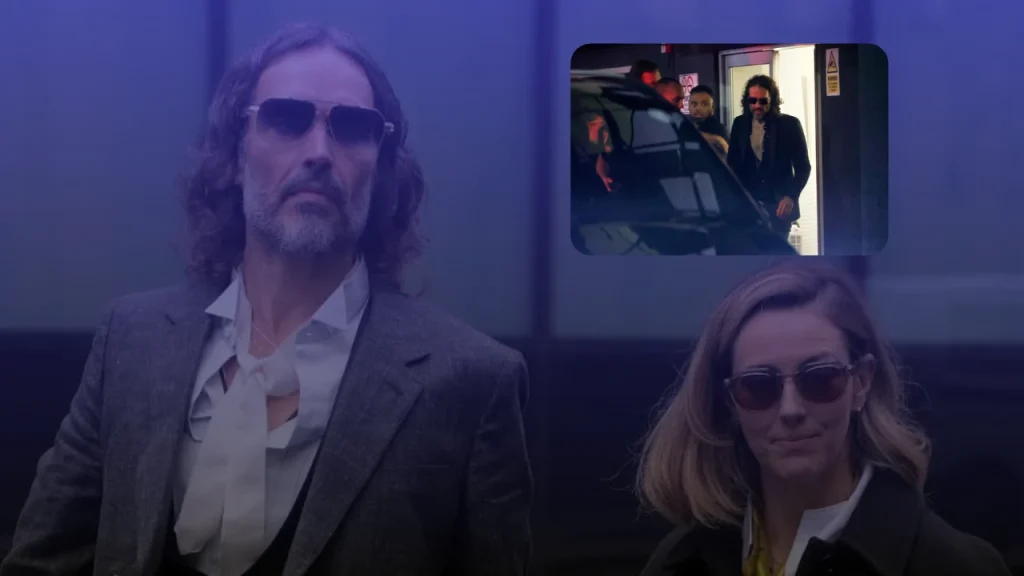
November 5, 2026: The Verdicts, Count by Count
The jury found Brand guilty on four counts and not guilty on three, involving four women in the convictions. Police said the four convictions were unanimous.
| Count | Alleged incident | Verdict |
| 1 | Rape, hotel in Bournemouth during the Labour Party conference, autumn 1999 | Not guilty |
| 2A | Attempted indecent assault, MTV offices, London, 2001 | Not guilty |
| 3 | Sexual assault at a London bar party, 2004 (grabbing breasts) | Guilty |
| 4 | Rape of the same complainant as Count 3 (oral rape in a bathroom) | Not guilty |
| 5 | Sexual assault at a London radio station, 2004 or 2005 | Guilty |
| 6 | Rape at Brand’s home, 2009 | Guilty |
| 7 | Sexual assault during a Channel 4 project, 2009 | Guilty |
What the Complainants Alleged
- Count 3 (bar, 2004): The woman said Brand grabbed her breasts shortly after they started talking. She also alleged a separate rape later (Count 4), of which Brand was acquitted. The jury therefore convicted on the touching and acquitted on the alleged rape.
- Count 5 (radio station): A woman working there said Brand grabbed her, pushed her against a wall, kissed her and groped her.
- Count 6 (home, 2009): A woman said she met Brand after a comedy show and that sexual activity began consensually at his home. She said he then changed the nature of the encounter and raped her without consent.
- Count 7 (Channel 4 project, 2009): A woman said Brand’s associates told her he would continue working only if she gave him a massage, and that he then pushed his head into her groin.
Accurate reporting requires stating the three acquittals alongside the four convictions.
Bail Refused and Sentencing on November 9
Brand had been on bail during the trial. His lawyers asked for it to continue after the verdicts. Judge Bennathan refused, citing the prospect of a substantial sentence and a risk of flight, and remanded him in custody.
Sentencing will take place on November 9, 2026. No sentence had been announced as of November 6.
How Much Prison Time Could Brand Face?
The sentence will depend on the offence dates, the statute and guideline in force, aggravating and mitigating factors and the principle of totality.
| Offence | Law | Maximum | Sentencing Council guideline range |
| Rape | Sexual Offences Act 2003, s.1 | Life imprisonment | 4 to 19 years’ custody |
| Sexual assault | Sexual Offences Act 2003, s.3 | 10 years (on indictment) | Community order to 7 years’ custody |
Points that affect the final outcome:
- Totality. The judge must impose a total sentence that reflects the overall offending without being disproportionate. Sentences can run concurrently or consecutively.
- Offence dates. Offences before May 1, 2004 are sentenced with regard to the law and maximums that applied then, while following current guidelines where applicable.
- Dangerousness. The court must consider the dangerous offender provisions in the Sentencing Act 2020, which can lead to extended sentences or, for rape, a life sentence in the most serious cases.
- Release. Release timing depends on the sentence type under current statute. Qualifying serious sexual offences with a determinate sentence of seven years or more are generally served to a later release point than ordinary sentences. Check the current provisions of the Sentencing Act 2020 once the sentence is announced.
- Ongoing consequences. A sexual offence sentence of this kind brings sex offender notification requirements under Part 2 of the Sexual Offences Act 2003, and the court can impose a sexual harm prevention order (section 103A).
It would be premature to predict a number of years before the hearing.
Can Brand Appeal?
Brand can apply to the Court of Appeal (Criminal Division) under the Criminal Appeal Act 1968. The court allows an appeal against conviction only if it finds the conviction unsafe (section 2). It is not a retrial. Possible grounds include legal misdirection, wrongly admitted evidence, a procedural irregularity or a sentence that is wrong in law or manifestly excessive. Applications must generally be made within 28 days, with permission needed in most cases.
The three acquittals do not themselves give grounds to overturn the four convictions. No appeal or overturned conviction had been reported as of November 6, 2026.
Two More Rape Allegations Under Investigation
After the verdicts the Metropolitan Police confirmed it is investigating two further rape allegations made by two women. Brand has been interviewed under caution and files have been submitted to the CPS. Detectives have urged other potential victims to come forward.
A police referral is not a charge. The CPS must independently decide whether to prosecute. No new charges or trial date had been announced as of November 6, 2026, and the allegations remain investigations, not proven offences.
Because further charges could be brought, the Contempt of Court Act 1981 strict liability rule means publishers must avoid reporting that creates a substantial risk of serious prejudice to active proceedings. This is one reason reporting focuses on verified court outcomes.
The New York Civil Lawsuit: Jane Doe v. Brand
Case: Jane Doe v. Russell Brand, Warner Bros. Pictures, Inc., Warner Bros. Discovery, Inc., MBST Entertainment, Inc., Benderspink, Inc., and Langley Park Pictures. Court: New York Supreme Court, New York County. Index No.: 952136/2023. Filed: November 3, 2023.
What the Plaintiff Alleges
Doe says she was an extra on Arthur in New York City on July 7, 2010. She alleges Brand exposed himself in front of cast and crew, and that later that day he followed her into a bathroom, pushed her into a stall and sexually assaulted her. She alleges a crew member stood outside the door. Her claims include assault, battery, false imprisonment and intentional infliction of emotional distress.
Why Are Warner Bros. and the Producers Defendants?
The complaint alleges the companies had responsibility for workplace safety and that production personnel failed to intervene. Liability theories in such cases typically involve negligence, negligent supervision and employer or principal responsibility, and each defendant can contest them. Naming a company in a complaint does not mean it knew of or is responsible for the alleged conduct.
One report indicates that in November 2026 a Manhattan judge denied Warner Bros.’ motion to dismiss, saying constructive knowledge and the ability to intervene are factual questions for a jury. We could not confirm that ruling in a published order, so treat it as reported and check the New York County court docket before relying on it.
The Adult Survivors Act
Doe sued under New York’s Adult Survivors Act, CPLR §214-j, which created a one-year revival window from November 24, 2022 to November 24, 2023 for adult survivors whose civil claims were otherwise time-barred. Doe filed on November 3, 2023, within the window. The Act removed a limitation defense for qualifying claims. It did not prove any allegation.
January 30, 2026 Ruling on the Defense Expert
On January 30, 2026 (filed with the court clerk on February 2), Justice Adam Silvera denied Doe’s motion to preclude defense expert Dr. Alexander Sasha Bardey from testifying. Doe argued he asked about her finances in an independent psychiatric examination in breach of an earlier instruction. The defense said the questions were relevant because her therapy records listed financial and legal disputes as stressors. The judge found preclusion an extreme remedy.
This was a nonfinal evidentiary ruling. It did not dismiss the case or decide whether Brand assaulted Doe. No final judgment or settlement had been identified as of November 6, 2026.
The London High Court Civil Claim: Alleged 2008 Incident
A woman has brought a civil claim in London’s High Court alleging Brand sexually assaulted her at his Los Angeles mansion in 2008. According to The Guardian, she says she was traumatized by his anger when she refused and feared for her safety if she reported it. She says she reported it to police in 2025, and a claim form filed in February 2025 reportedly seeks up to £100,000.
The claim was stayed during the criminal trial. Its next procedural steps had not been confirmed after the verdict. Brand, through his lawyers, has denied the allegation and described it as fundamentally dishonest.
Why Was This Allegation Not in the Criminal Trial?
Reporting indicates the alleged assault happened in Los Angeles. Offences committed outside the UK generally need a specific jurisdictional basis before they can be prosecuted in England and Wales, whereas an English civil court can hear a properly issued civil claim subject to jurisdiction and applicable-law rules. Civil and criminal jurisdiction are different questions.
Time Limits in the UK Civil Claim
Personal injury claims normally face a three-year limit under the Limitation Act 1980 (section 11), but the court has a discretion to allow a claim out of time under section 33, and that discretion is regularly considered in historical sexual abuse cases. A defendant can raise limitation as a defense, and the court decides it on the evidence.
Does the Criminal Conviction Affect the Civil Cases?
Yes, in principle, and it matters for the standard of proof.
- Standard of proof. The criminal jury had to be sure of guilt beyond reasonable doubt. A civil court decides on the balance of probabilities, meaning more likely than not.
- Conviction as evidence. In English civil proceedings, section 11 of the Civil Evidence Act 1968 makes a conviction admissible as proof that the defendant committed the offence, and the burden then shifts to the defendant to show otherwise. This applies to the convicted offences and the same facts, not to different incidents or claimants.
- Different incidents. The New York and London claims involve different alleged incidents and claimants, so the November 5 verdicts do not automatically establish liability in them. How far a UK conviction can be used in a New York court depends on New York evidence and preclusion rules, and nothing indicates that has been decided.
- Compensation. Damages in a civil case can cover physical and psychological harm, medical costs, lost earnings and other recoverable losses. No settlement or award had been publicly confirmed in either claim. The Guardian reported that none of the criminal trial complainants had publicly submitted compensation claims as of November 5, 2026. Victims of crime in England and Wales may also have other routes to compensation, such as the Criminal Injuries Compensation Scheme.
What Did Channel 4 Know?
Channel 4 announced an internal investigation on September 17, 2023 into whether anyone there knew of alleged conduct while Brand worked on its programs between 2004 and 2007. Its March 21, 2024 summary said it found no evidence that personnel knew of the allegations in the 2023 documentary. It did find that a separate 2009 complaint from a Channel 4 employee was not escalated or investigated as it should have been, and it apologized to her and strengthened its procedures. These findings do not decide any criminal or civil allegation, and they do not determine the liability of the companies in the New York case.
Laws Behind the Criminal Case
- Sexual Offences Act 2003, section 1 (rape): intentional penile penetration of the vagina, anus or mouth, where the other person does not consent and the defendant does not reasonably believe they consent.
- Section 3 (sexual assault): intentional sexual touching without consent and without a reasonable belief in consent.
- Section 74 (consent): a person consents if they agree by choice and have the freedom and capacity to make that choice. Consent can be withdrawn, and agreeing to one act is not agreeing to another, which is central to a count where activity began consensually.
- Section 78 (meaning of sexual): an act is sexual if a reasonable person would consider it sexual by its nature, or by its circumstances or the purpose behind it.
- Sexual Offences Act 1956 and Criminal Attempts Act 1981: the earlier law for offences before May 1, 2004 and the basis for the attempted offence.
- Criminal Justice Act 2003 (bad character) and Sentencing Act 2020: evidence rules between counts and dangerousness and sentencing provisions.
- Criminal Appeal Act 1968: appeals against conviction and sentence.
Why the Complainants Are Not Named
Under section 1 of the Sexual Offences (Amendment) Act 1992, complainants in sexual offence cases have lifetime anonymity. Publication of anything likely to identify them, including addresses, workplaces and photographs, is restricted, so they are referred to by numbers or description. The New York plaintiff proceeds under the pseudonym Jane Doe.
What Happens Next?
- November 9, 2026: sentencing at Southwark Crown Court. Brand stays in custody.
- Possible appeal against conviction or sentence.
- CPS decisions on the two further rape allegations, which could lead to another trial.
- New York case: further pretrial proceedings, a possible decision on the reported motion to dismiss, a trial or settlement.
- London High Court claim: the stay can now be lifted, though the next steps had not been confirmed.
- Possible new complainants, since police have invited others to come forward.
Frequently Asked Questions
Was Russell Brand found guilty?
Yes. On November 5, 2026 a jury found him guilty of one count of rape and three counts of sexual assault involving four women.
Was he convicted on all seven charges?
No. He was convicted on four counts and acquitted on three: two rape counts and one attempted indecent assault.
Is Russell Brand in jail?
He is in custody. The judge refused bail and remanded him pending sentencing.
When is the sentencing?
Monday, November 9, 2026, at Southwark Crown Court.
How long could he go to prison?
Rape carries a maximum of life imprisonment and sexual assault carries a maximum of 10 years. The actual sentence depends on the guidelines, the offence dates and the circumstances.
What is the Jane Doe lawsuit?
A New York civil case filed November 3, 2023 by an anonymous woman alleging a sexual assault during the filming of Arthur in July 2010. It names Brand and several production companies.
What is the New York case number?
Index No. 952136/2023, New York County Supreme Court.
Was the New York case dismissed?
No final dismissal or judgment has been confirmed. The January 30, 2026 order denying exclusion of the defense expert was nonfinal. One report says a motion to dismiss by Warner Bros. was denied in November 2026, but that was not confirmed in a published order.
Is there another civil claim?
Yes. A London High Court claim over an alleged 2008 incident in Los Angeles seeks up to £100,000. It had been stayed during the criminal trial.
Are there more criminal charges?
Not yet. Two further rape allegations are under investigation and files are with the CPS.
Did Brand deny the allegations?
Yes. He pleaded not guilty, denied forcing anyone into sexual activity and says the encounters were consensual. His lawyers have also disputed the civil allegations.
Can the civil cases continue after the criminal verdict?
Yes. They are separate proceedings. In English civil proceedings a conviction can be used as evidence of the convicted offence under the Civil Evidence Act 1968.
Can the women from the criminal trial get compensation?
The criminal verdict does not itself award damages. They could pursue civil claims or other compensation schemes. None had been publicly reported as of November 5, 2026.
Did Channel 4 know about the allegations?
Its 2024 review found no evidence it knew of the 2023 allegations, but it said a separate 2009 complaint was not handled properly.
Is this a class action?
No. The criminal case is a state prosecution and the civil claims are individual. There is no settlement fund or claim form.
The Bottom Line
Russell Brand has been convicted of one count of rape and three counts of sexual assault, acquitted of three other counts and remanded in custody ahead of sentencing on November 9, 2026. The civil claims in New York and London are separate and unresolved, and two more rape allegations are with prosecutors. Four convictions are established, three counts ended in acquittal, and everything else remains a civil allegation or an investigation until a court decides otherwise.
Sources and Legal Authorities
Official and court sources
- Crown Prosecution Service, “Russell Brand convicted of non-recent sexual offences against four women,” November 5, 2026. https://www.cps.gov.uk/national-news-london-south/news/russell-brand-convicted-non-recent-sexual-offences-against-four
- Metropolitan Police, “Russell Brand convicted of rape and other sexual offences,” November 5, 2026. https://news.met.police.uk/news/russell-brand-convicted-of-rape-and-other-sexual-offences-514748
- Crown Prosecution Service, “CPS authorises further charges against Russell Brand,” December 23, 2025. https://www.cps.gov.uk/london-south/news/cps-authorises-further-charges-against-russell-brand
- Crown Prosecution Service, “CPS authorises charges against Russell Brand,” April 4, 2025. https://www.cps.gov.uk/london-north/news/authorises-charges-against-russell-brand
- New York Supreme Court, Doe v. Brand, 2026 NY Slip Op 30408(U), Index No. 952136/2023, January 30, 2026. https://www.nycourts.gov/reporter/pdfs/2026/2026_30408.pdf
- Channel 4, summary report on whether Channel 4 was aware of allegations about Russell Brand, March 21, 2024. https://www.channel4.com/press/news/channel-4-publishes-summary-report-regarding-whether-channel-4-was-aware-allegations
News reporting
- Reuters, “Details of Russell Brand’s convictions,” November 5, 2026. https://www.reuters.com/business/media-telecom/details-russell-brands-convictions-2026-11-05/
- Associated Press, “Russell Brand convicted of rape and sexual assault,” November 5, 2026. https://apnews.com/article/russell-brand-rape-sexual-assault-trial-f840ec56b2c8dd88941460d81de81fc7
- The Guardian, “Police investigating two further rape allegations against Russell Brand,” November 5, 2026. https://www.theguardian.com/culture/2026/nov/05/russell-brand-detective-other-potential-victims
- ABC News (Australia), Russell Brand jury verdict, November 6, 2026. https://www.abc.net.au/news/2026-11-06/russell-brand-jury-verdict/107353304
- USA Today, “Russell Brand sued over alleged sexual assault on the Arthur film set,” November 2023. https://www.yahoo.com/entertainment/russell-brand-sued-alleged-sexual-184032273.html
Laws and guidance
- Sexual Offences Act 2003, sections 1, 3, 74, 78, 103A and Part 2. https://www.legislation.gov.uk/ukpga/2003/42/body/enacted
- Sexual Offences Act 1956; Criminal Attempts Act 1981; Criminal Justice Act 2003 (section 101); Sentencing Act 2020; Criminal Appeal Act 1968; Contempt of Court Act 1981; Civil Evidence Act 1968 (section 11); Limitation Act 1980 (sections 11 and 33). https://www.legislation.gov.uk
- Sentencing Council, rape and sexual assault guidelines. https://sentencingcouncil.org.uk/guidelines/rape/ and https://sentencingcouncil.org.uk/guidelines/sexual-assault/
- Sexual Offences (Amendment) Act 1992, section 1. https://www.legislation.gov.uk/ukpga/1992/34/section/1
- New York CPLR §214-j (Adult Survivors Act). https://www.nysenate.gov/legislation/laws/CVP/214-J
Research limitation: Verdicts and counts follow the CPS and Metropolitan Police announcements, cross-checked against Reuters and AP. The January 30, 2026 New York order was reviewed directly. The London civil claim, the two further investigations and the reported November 2026 New York ruling rely on news reporting, and the full High Court claim, New York complaint and trial transcript were not independently obtained. Statement totals differ between reports. The sentencing, release and limitation points describe how the law generally works and should be checked against current legislation after sentencing. No unidentified complainant has been named, and no pending allegation is described as a proven offence.
About the Author: Researched and written by Israr Ahmad using official prosecution announcements, police statements, court decisions, statutory provisions and contemporaneous reporting.
Disclaimer: This article is for informational purposes only and is not legal advice. AllAboutLawyer.com is a legal information website, not a law firm. Criminal verdicts, acquittals, civil allegations and pending investigations are distinguished according to their legal status, and future court decisions may change it. Consult a qualified lawyer about your own situation.
About the Author
Israr Ahmad is a legal content researcher with 4+ years of experience covering class action settlements and consumer rights cases. He has researched and published coverage of 2,500+ settlements using verified court records, settlement administrator filings, and government sources. Learn more about Israr.