
Charges Dropped Against Eljay Crisp-Carr in the Toledo Old West End Festival Shooting
Lucas County prosecutors have dropped every charge against 20-year-old Eljay Crisp-Carr, who spent about five months in the Lucas County Jail after police accused him of being one of two gunmen in the June 6, 2026 shooting at Toledo’s Old West End Festival that wounded 12 people. On Friday, October 30, 2026, prosecutors asked Judge Lori Olender of the Lucas County Common Pleas Court to dismiss the case because of “new and developing evidence.” She granted the request, and Crisp-Carr walked out of jail that day.
The dismissal came without prejudice. That means prosecutors can legally bring the charges again. It also means no court has declared him guilty or innocent. And the shooting itself is still unsolved: another adult, Ka’Nye Taylor, remains jailed, and a separate juvenile case is moving through court.
Below is what happened at the festival, why the identification was challenged, what the dismissal does and does not mean under Ohio law, what Crisp-Carr and the 12 shooting victims can do next, and the deadlines that apply.
Toledo Festival Shooting and Crisp-Carr Dismissal: Key Facts
| Detail | What is confirmed |
| Incident | Shooting at the Old West End Festival, Toledo, Ohio |
| Date | Saturday, June 6, 2026, shortly after 5:30 p.m. |
| Location | Festival grounds near the Agnes Reynolds Jackson Arboretum; police responded to the area of Delaware Avenue and Glenwood Avenue |
| People wounded | 12, ages 14 to 61 |
| Bystanders | Police said 9 of the 12 were innocent bystanders |
| Man whose case was dropped | Eljay Crisp-Carr, 20 |
| Arrest | June 11, 2026 |
| Charges | More than 50 felony counts, reported to include 25 counts of attempted murder |
| Time in jail | About five months |
| Dismissal date | October 30, 2026 |
| Judge | Lori Olender, Lucas County Common Pleas Court |
| Prosecutor | Lucas County Prosecuting Attorney Julia R. Bates |
| Defense attorney | Alex Bodiford |
| Type of dismissal | Without prejudice (charges can be refiled) |
| Other adult defendant | Ka’Nye Taylor, 20, still in custody; next pretrial conference reported for November 9, 2026 |
| Juvenile case | A 17-year-old, not named here because of age; hearing reported for November 20, 2026 |
| Investigation | Toledo police say it remains active |
| Public settlement or claim form | None identified |
What Happened at the Old West End Festival Shooting on June 6, 2026?
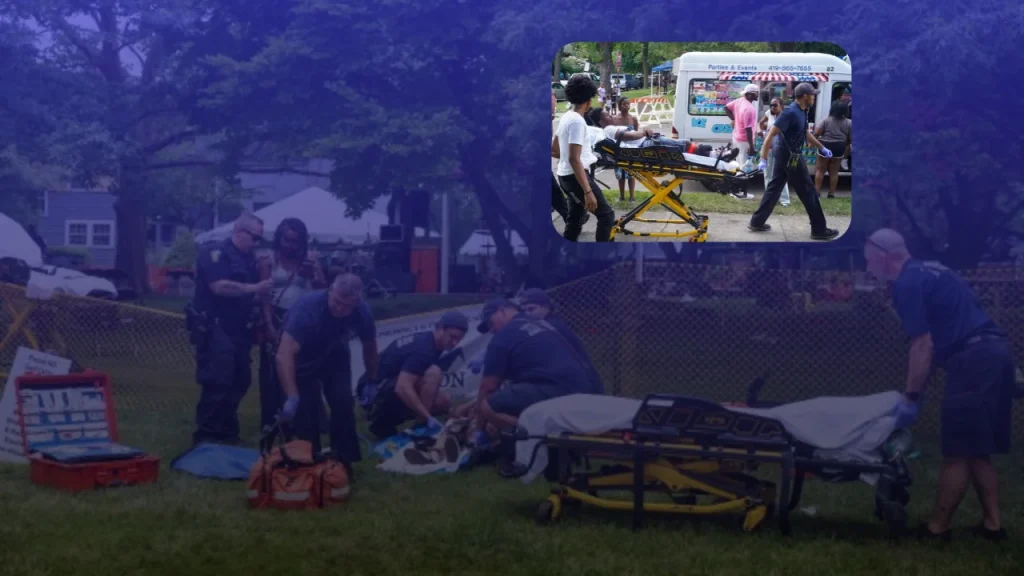
The Old West End Festival is an annual neighborhood event in a historic district of Victorian homes. On June 6, the grounds were full of tents, music and food trucks when gunfire broke out shortly after 5:30 p.m.
At a June 9 briefing, Toledo Police Chief Michael Troendle said investigators believed the shooting came out of a confrontation between two rival groups. Police described a sequence in which a deputy approached someone to check a bag, another person grabbed the bag and ran because it held a firearm, and shots followed soon after. Investigators concluded that two people fired at each other in a crowded space.
Twelve people were hit. The youngest was 14 and the oldest was 61. Chief Troendle said three of the wounded had ties to the groups involved, and nine were bystanders. Two victims were first reported in critical condition. By June 9, nine had left the hospital and three were stable. Organizers canceled the festival’s second day.
Why Was Eljay Crisp-Carr Arrested and Charged?
Police arrested Crisp-Carr on June 11, 2026. A grand jury indictment followed with more than 50 felony counts, reported to include 25 counts of attempted murder, multiple counts of felonious assault, a gang-participation charge and firearm offenses. Police said they identified him as one of the two shooters using video footage and witness statements.
A detective’s account in the criminal complaint described a person who joined an altercation with a group of men, backed away when someone else started shooting, then turned and fired into the crowd. That was the state’s original theory. It was an allegation, not a finding.
Crisp-Carr was also facing a probation violation tied to the arrest. Judge Olender dismissed that as well on October 30.
What Evidence Did the Defense Use to Argue Eljay Crisp-Carr Was Misidentified?
Crisp-Carr has said from the start that he was not at the festival. According to his attorney’s October 12 alibi filing and later reporting, the defense pointed to several pieces of evidence. These are the defense’s claims. Prosecutors have not publicly confirmed each one.
Cellphone location data. The defense said an FBI-sponsored cellphone analysis put Crisp-Carr’s phone in the 2000 block of Glenwood Avenue, several blocks from the festival, and showed calls being made there around the time of the shooting. Reporting describes that area as being on the other side of Interstate 75 from the festival grounds.
Doorbell camera video. A homeowner’s doorbell camera reportedly recorded Crisp-Carr about 20 minutes after the shooting asking for help getting a gas can because his truck had run out of fuel. His attorney said he was wearing different clothes than the person seen in the shooting footage.
An alibi witness. Some court-filing coverage also refers to a witness who supported his account.
A masked shooter with long dreadlocks. Bodiford argued the person in the shooting video was masked, and that other potential suspects fit the description better than his client did. He also noted that a .45-caliber Glock allegedly linked to Crisp-Carr was recovered at another person’s home.
Phone data has limits. It shows where a device probably was, not who was holding it. That is why defense lawyers pair it with video and witnesses, and why prosecutors weigh all of it together.
Why Did Lucas County Prosecutors Drop the Charges After Five Months?
Prosecutor Julia Bates said her office told Crisp-Carr’s attorney in September 2026 about discovery that could support his defense. On October 30, the state asked the court to dismiss, citing new and developing evidence. Toledo police said the investigation remains active, and Bates said her office and the department will keep following the evidence.
Prosecutors have not said which specific evidence drove the decision, and they have not publicly named a replacement suspect. Bodiford thanked prosecutors for dismissing the case but said he is worried the actual shooter may still be free.
The timing raises a fair question: if discovery material in September could help the defense, why did the case stay open until late October? The public record does not answer that. Ohio’s discovery rules require the state to turn over evidence favorable to the accused, and how and when that happened here is something only the court file and later proceedings can show.
What Does “Dismissed Without Prejudice” Mean for Eljay Crisp-Carr?
Under Ohio Criminal Rule 48(A), the state may dismiss an indictment, information or complaint, but it needs the court’s permission. Judge Olender gave it.
A dismissal without prejudice means:
- The case ended before trial, with no verdict of guilty or not guilty.
- Prosecutors keep the legal ability to indict him again if they develop enough evidence and meet all procedural requirements.
- It is not an exoneration, and it is not a finding that he committed the shooting.
It does not mean prosecutors can refile on a whim. Any new case would have to clear the statute of limitations, constitutional speedy-trial protections and the requirement of probable cause before a grand jury. Double jeopardy does not block a refiled case here, because jeopardy attaches only once a jury is sworn or the first witness is sworn at a bench trial, and that never happened.
Crisp-Carr’s attorney reportedly objected to the without-prejudice condition because he did not want the threat of new charges hanging over his client.
What Ohio Laws Applied to the Charges in the Toledo Festival Shooting?
These statutes explain the original allegations and the exposure faced by anyone who is convicted in this case. They do not mean Crisp-Carr committed any offense.
Attempted murder, R.C. 2903.02 and 2923.02. A person commits murder by purposely causing another’s death. Attempt covers conduct that would be that crime if completed. Nobody has to die. The state must prove purpose, meaning a conscious aim to kill, and one count can be charged for each person allegedly targeted. Attempted murder is generally a first-degree felony, and under Ohio’s indefinite sentencing law for first-degree felonies (R.C. 2967.271), judges set a minimum term and a maximum of up to one and a half times that minimum.
Felonious assault, R.C. 2903.11. This covers knowingly causing serious physical harm, or causing or attempting to cause physical harm with a deadly weapon. A firearm qualifies. It is generally a second-degree felony.
Participating in a criminal gang, R.C. 2923.42. The state must show active participation in a criminal gang, knowledge of its pattern of criminal activity, and purposeful promotion, assistance or commission of an offense. Knowing someone in a group is not enough. This is a second-degree felony.
Firearm offenses and specifications.
- R.C. 2923.13: having weapons while under disability
- R.C. 2923.161: improper discharge of a firearm at or into certain places
- R.C. 2941.141: one-year firearm specification
- R.C. 2941.145: three-year firearm specification, which carries a mandatory prison term that is served consecutively to the sentence for the underlying offense when proven
Complicity, R.C. 2923.03. Ohio treats someone who aids or abets an offense, with the required intent, as liable like the principal offender. Prosecutors sometimes use it in group shootings. Being near a fight, or knowing the people in it, does not meet that standard.
Statute of limitations, R.C. 2901.13. Murder has no limitation period. Most other felonies, including attempted murder and felonious assault, generally carry a six-year limit. A refiled case against Crisp-Carr would have to come within that window.
Which Ohio Rules Protect Someone Who Says Police Identified the Wrong Person?
This case turns on identification, so the procedural rules matter as much as the criminal statutes.
Presumption of innocence and proof beyond a reasonable doubt. The state carries the burden on every element, including that the defendant was the person who fired. Both the Fifth and Fourteenth Amendments and Article I, Section 10 of the Ohio Constitution apply.
Notice of alibi, Crim.R. 12.1 and R.C. 2945.58. A defendant who plans to offer an alibi must give the state written notice at least seven days before trial under the rule, naming where he says he was. This is the procedural vehicle for the alibi filing in this case.
Discovery and exculpatory evidence, Crim.R. 16 and Brady v. Maryland. Prosecutors must disclose evidence favorable to the defense that is material to guilt or punishment. Bates’s statement that her office flagged helpful discovery in September fits within this framework.
Eyewitness identification procedures, R.C. 2933.83. Ohio requires specific procedures for live lineups and photo arrays, including blind or blinded administration. It does not directly govern video comparisons, but defense lawyers cite the same reliability concerns when attacking an identification built on footage of a masked person.
Speedy trial, R.C. 2945.71 and the Sixth Amendment. A felony defendant must generally be tried within 270 days, and each day spent in jail on the pending charge counts as three days under R.C. 2945.71(E). Defense motions and continuances can pause that clock. Time already spent in jail does not erase the state’s ability to refile within the limitations period.
Bail, Ohio Const. Art. I, Sec. 9 and Crim.R. 46. Most defendants are bailable, but courts can deny or set very high bail for serious charges. With dozens of attempted-murder counts, a long pretrial detention was not unusual. That does not make it fair if the identification was wrong.
Can Eljay Crisp-Carr Sue for His Five Months in Jail?
Possibly, but the dismissal does not by itself win a lawsuit. The question is whether police or prosecutors violated his legal rights, as opposed to making an honest investigative mistake.
Federal civil-rights claim, 42 U.S.C. § 1983. This allows damages when someone acting under state authority violates constitutional rights. Theories that fit a mistaken-arrest case include arrest without probable cause, fabricated or knowingly misleading identification evidence, suppression of exculpatory evidence, and unlawful pretrial detention.
Malicious prosecution under the Fourth Amendment. In Thompson v. Clark (2022), the U.S. Supreme Court held that a person only has to show the prosecution ended without a conviction, not that it ended in a way that shows innocence. A dismissal like this one generally satisfies that element. He would still have to prove the other parts, including lack of probable cause. Manuel v. City of Joliet (2017) confirmed that a person can challenge pretrial detention under the Fourth Amendment even after legal process begins.
Defenses he would face. Officers can raise qualified immunity. A claim against the City of Toledo would require showing a municipal policy or custom under Monell v. Department of Social Services. Ohio law also shields political subdivisions and their employees under R.C. Chapter 2744, with exceptions for conduct done with malicious purpose, in bad faith, or in a wanton or reckless manner (R.C. 2744.03(A)(6)).
Ohio wrongful-imprisonment compensation, R.C. 2743.48. This statutory process is limited to people who were convicted, sentenced to a state prison term, and later had the conviction overturned or the case dismissed under the statute’s conditions. Based on public reporting, Crisp-Carr was held before trial and was never convicted, so this route does not appear to apply. It should not be confused with a civil lawsuit for wrongful arrest.
Deadlines. Federal § 1983 claims borrow Ohio’s two-year personal-injury period (R.C. 2305.10). A state-law malicious-prosecution claim is subject to a one-year period under R.C. 2305.11(A), which generally starts when the prosecution ends in his favor. Because the dismissal happened on October 30, 2026, the shorter deadline is the one a lawyer would watch.
His mother told reporters the family is considering legal action. No lawsuit had been reported as of November 1, 2026.
Clearing his record. Ohio’s sealing statute for dismissed cases, R.C. 2953.52, lets a person ask a court to seal records after charges are dismissed. When a dismissal is without prejudice, the timing is tied to the statute of limitations, so he should have a lawyer confirm when he can file.
For how misidentification claims play out in other cases, see our coverage of Jason Killinger’s Lawsuit, AI Facial Recognition Got It Wrong — Jason Killinger’s 11-Hour Nightmare and $20M Fight for Justice.
Who Else Is Charged in the Old West End Festival Shooting?
Ka’Nye Taylor, 20. Arrested in Columbus on June 17, 2026. Reporting on his indictment describes 20 counts of attempted murder and 21 counts of felonious assault, plus other felony allegations. He remains in custody, and his next pretrial conference was reported for November 9, 2026. The dismissal of Crisp-Carr’s case says nothing about whether Taylor is guilty.
A 17-year-old. A separate juvenile case involves a teenager accused of handling or trying to take a firearm recovered at the scene. Because he is a minor, we are not naming him. Reporting reviewed for this article does not identify him as one of the two people who fired shots. A hearing on possible transfer to adult court was reported for November 20, 2026. Ohio’s bindover process for juveniles is set out in R.C. 2152.10 and 2152.12, and a serious allegation does not automatically send a teen to adult court.
Can the 12 People Shot at the Toledo Festival Sue or Get Compensation?
Yes, they may have several paths. None of them depends on Crisp-Carr’s case.
Suing the shooter. Ohio’s R.C. 2307.60 lets anyone injured by a criminal act sue the person responsible, and a criminal conviction is not required to file. Claims can include assault, battery and negligence-based injury. The practical problem is collecting: an individual defendant often has no insurance or assets.
Suing the organizers or the City of Toledo. A shooting at a public event does not by itself prove negligent security. A lawyer would look at who organized and controlled the event, who controlled the park, whether there were earlier warnings, and what security was in place. A claim against the city would also face immunity under R.C. 2744.02. No such lawsuit connected to this shooting has been verified. For an Ohio example of how a city can end up in a shooting-related civil case, see James Williams Canton Police Shooting, City Proposes $3.5 Million Settlement With Family.
Damages and caps. Recoverable losses can include medical bills, lost income, future care and pain and suffering. Ohio limits non-economic damages in most injury cases under R.C. 2315.18 to the greater of $250,000 or three times economic loss, up to $350,000 per person or $500,000 per occurrence, with no cap for permanent and substantial physical deformity or loss of a limb or bodily organ system.
Ohio Crime Victims Compensation Program. Run through the Ohio Attorney General under R.C. 2743.51 to 2743.72, it can pay eligible victims up to $50,000 for medical costs, counseling, lost wages and certain other out-of-pocket expenses, even when no one has been convicted. It does not generally cover pain and suffering or costs insurance already paid. Applications generally must be filed within three years of the crime, with extra time for minors. Confirm current rules and apply at the Ohio Attorney General’s Crime Victim Compensation page.
Victims’ rights in the criminal case. Ohio’s Marsy’s Law (Ohio Const. Art. I, Sec. 10a) and R.C. Chapter 2930 give crime victims the right to notice of court dates, to be heard at certain proceedings and to ask for restitution.
What Are the Filing Deadlines for Toledo Festival Shooting Lawsuits?
The shooting happened on June 6, 2026.
| Claim | General Ohio deadline |
| Assault or battery | One year, R.C. 2305.111 |
| General bodily injury or negligence | Two years, R.C. 2305.10 |
| Claim against a political subdivision such as a city | Generally two years, R.C. 2744.04, subject to exceptions |
| Malicious prosecution under Ohio law | One year from favorable termination, R.C. 2305.11(A) |
| Federal § 1983 claim | Two years in Ohio |
| Crime victims compensation | Generally three years from the crime |
| Injured minors (three of the 12 victims were 14 to 16) | Clock generally paused until age 18, R.C. 2305.16 |
Because the one-year assault and battery deadline is the shortest and could expire on June 6, 2027, anyone shot at the festival should talk to a personal injury attorney well before then. Deadlines depend on the claim, the defendant and when the claim accrued.
Is There a Settlement or Claim Form for the Toledo Festival Shooting?
No. As of November 1, 2026, we found no class action, public settlement or compensation fund tied to the June 6 shooting. The Crime Victims Compensation Program is a standing state program, not a settlement from this event. Be wary of ads or messages that promise a payout to all 12 victims.
What Happens Next in the Toledo Shooting Investigation?
| Date | Event |
| November 9, 2026 | Ka’Nye Taylor’s reported pretrial conference, Lucas County Common Pleas Court |
| November 20, 2026 | Reported hearing in the juvenile case, including possible transfer to adult court |
| Ongoing | Toledo police review of video, phone records, firearms evidence and witness accounts |
As of early November 2026, no additional arrests for the second shooter had been publicly announced. Prosecutors could still refile against Crisp-Carr, and they could charge someone new if evidence points elsewhere.
Frequently Asked Questions About the Crisp-Carr Dismissal
Why were charges dropped against Eljay Crisp-Carr?
Prosecutors told the court they had new and developing evidence. His attorney had argued that cellphone data, video and a witness put him blocks from the festival and that police had misidentified a masked shooter.
Is Eljay Crisp-Carr innocent?
He says he was not at the festival. The charges were dismissed before trial, so no court has ruled him guilty or not guilty.
Can prosecutors charge Eljay Crisp-Carr again?
Yes, in theory. The dismissal was without prejudice. A new case would need new probable cause, a grand jury and compliance with the statute of limitations and speedy-trial rules.
How long was Eljay Crisp-Carr in jail?
About five months, from his June 11 arrest to his release on October 30, 2026.
Does Ohio pay people who are jailed and then have charges dropped?
Not automatically. R.C. 2743.48 is limited to people who were convicted and imprisoned. Someone held before trial usually has to pursue a civil lawsuit instead.
Is Ka’Nye Taylor still charged in the Toledo festival shooting?
Yes. He remains in custody, with a pretrial conference reported for November 9, 2026.
Is the 17-year-old accused of firing shots at the festival?
Reporting reviewed describes allegations about a firearm recovered at the scene, not that he was one of the two shooters.
How many people were shot at the Old West End Festival?
Twelve, ages 14 to 61, according to Toledo police.
Can the Old West End Festival shooting victims get compensation?
Possibly through a civil suit under R.C. 2307.60 or a claim to the Ohio Crime Victims Compensation Program. No public settlement fund has been announced.
Did police arrest the wrong man?
The prosecutor has not said so publicly. What is on the record is that the state dismissed the case citing new evidence, and that the defense argued misidentification.
Sources and Court Records
- Lucas County Prosecutor Julia R. Bates’s October 30, 2026 statement, as published by WTVG
- Toledo Police Department statement, October 30, 2026
- The Blade, October 22 and October 30, 2026, reporting on the alibi filing and dismissal hearing
- Associated Press, October 30, 2026
- WTVG/13abc, June 6 and June 9, 2026, reporting on the shooting and police briefing
- Ohio Revised Code §§ 2152.10, 2152.12, 2301 et seq. as applicable, 2305.10, 2305.11, 2305.111, 2305.16, 2307.60, 2315.18, 2743.48, 2743.51–2743.72, 2744.02, 2744.03, 2744.04, 2901.13, 2903.02, 2903.11, 2923.02, 2923.03, 2923.13, 2923.161, 2923.42, 2933.83, 2941.141, 2941.145, 2945.58, 2945.71, 2953.52, 2967.271, and Chapter 2930
- Ohio Rules of Criminal Procedure 12.1, 16, 46 and 48(A); Ohio Const. Art. I, Secs. 9, 10 and 10a
- Thompson v. Clark, 596 U.S. 36 (2022); Manuel v. City of Joliet, 580 U.S. 357 (2017); Brady v. Maryland, 373 U.S. 83 (1963); Monell v. Department of Social Services, 436 U.S. 658 (1978)
This article is for informational purposes only and does not constitute legal advice. Laws vary by state and individual circumstances differ. For advice about your specific situation, consult a qualified attorney. Criminal charges are allegations, and every defendant is presumed innocent unless proven guilty.
Researched and written by Israr Ahmad, legal content researcher and founder of AllAboutLawyer.com. All facts verified against Lucas County Prosecutor and Toledo Police Department statements, WTVG/13abc, The Blade and Associated Press reporting, and the Ohio Revised Code and Ohio Rules of Criminal Procedure, as of November 1, 2026. Last Updated: November 1, 2026.
About the Author
Israr Ahmad is a legal content researcher with 4+ years of experience covering class action settlements and consumer rights cases. He has researched and published coverage of 2,500+ settlements using verified court records, settlement administrator filings, and government sources. Learn more about Israr.