
OpenAI’s $20 Billion Project Camellia Lawsuit in Effingham County, Georgia, Residents Allege Secret Land Deal, Fraud and Racketeering. Can the Data Center Be Stopped?
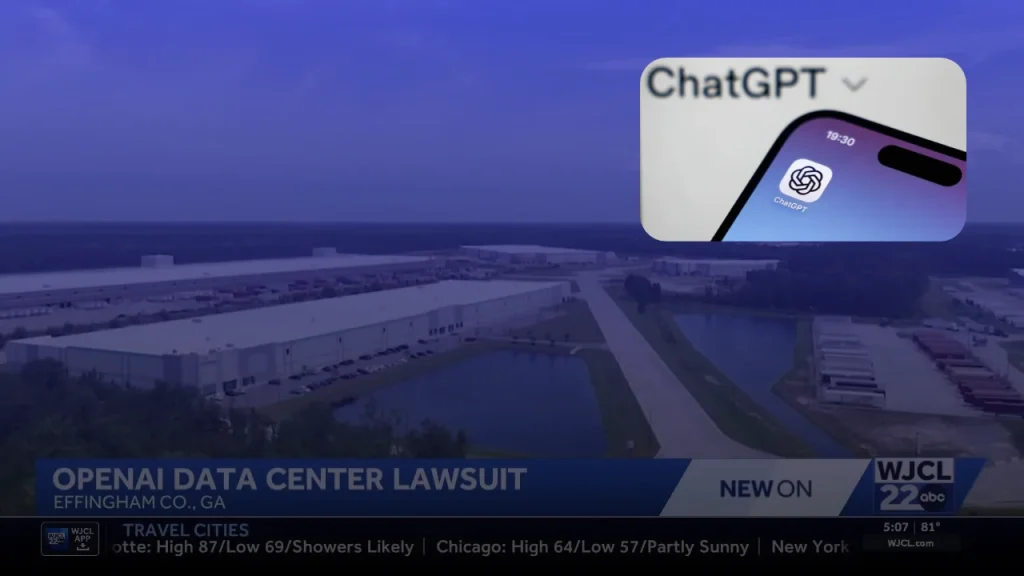
Three Effingham County, Georgia residents have sued OpenAI-related companies, the Effingham County Industrial Development Authority (IDA) and county officials over the approval of Project Camellia, a proposed data center campus near Rincon, Georgia that has been described as a $20 billion project. The complaint was filed November 6, 2026 in the State Court of Effingham County. It alleges fraud, concealment, civil conspiracy and violations of Georgia’s Racketeer Influenced and Corrupt Organizations (RICO) Act.
These are allegations. No court has found OpenAI or any county official liable. The lawsuit does not cancel the land transaction or halt the project. It is also one of three separate legal challenges to how Project Camellia was approved, and it is the first to seek money damages. Effingham County commissioners have postponed their vote on the preliminary site plan until November 17, 2026.
Effingham County Project Camellia Lawsuit: Key Facts
| Detail | Information |
| Case | Finch-Mincey et al. v. Rahn et al. |
| Case number | STCV2026000649 |
| Filed | November 6, 2026 |
| Court | State Court of Effingham County, Georgia |
| Plaintiffs | Dr. Michelle Finch-Mincey, Lehman Mincey Jr., Raymond Carver |
| Corporate defendants | OpenAI OpCo LLC, Octans GA LLC, Savannah Industrial Development LLC |
| Other defendants | Effingham County IDA and its executive director Brandt Herndon, County Manager Tim Callanan, all six county commissioners |
| Project | Project Camellia, Savannah Gateway Industrial Hub, near Rincon |
| Reported size and cost | About 1,400 to 1,440 acres; about $20 billion (some outlets report higher) |
| Planned power demand | About 3.2 gigawatts (3,210 megawatts) |
| Claims | Fraud, concealment, civil conspiracy, improper land transaction, Georgia civil RICO |
| Compensation sought | Unspecified damages, including treble damages under Georgia RICO |
| Class action? | No |
| Liability ruling or settlement? | None |
| Next local decision | November 17, 2026 site-plan consideration |
Why Are Effingham County Residents Suing OpenAI Over Project Camellia?
The plaintiffs say the defendants worked together to advance the project and the land sale before residents could learn what was happening, and to lock in commitments until public input could no longer change the outcome. They also allege the project has hurt nearby property values, citing purchase offers for neighboring homes that dropped or were withdrawn.
The plaintiffs’ lawyers say the case is about process, not opposition to artificial intelligence or data centers in general. The complaint focuses on five issues:
- Confidentiality agreements and private negotiations.
- The transfer of land originally acquired by the IDA.
- The county’s change to its zoning rules.
- Tax incentives and possible conflicts of interest.
- Alleged harm to neighboring residential property.
What Is OpenAI’s Project Camellia?
Project Camellia was publicly announced around July 22, 2026. Public descriptions put it at roughly 1,400 acres at the Savannah Gateway Industrial Hub, with several data center buildings totaling about 4.4 million square feet. Reported investment figures vary by source: $4 billion in phased commitments, about $20 billion in overall project cost, and higher estimates from some outlets. The planned power demand is up to about 3.2 gigawatts, a planned maximum rather than current use.
County and IDA materials describe benefits that include construction and permanent jobs (about 400 long-term jobs by one estimate), long-term tax revenue (some documents estimate about $870 million over 15 years), an $80 million community investment commitment and a $2 million grant for the Atlas Park trail system. These are projections and commitments, not guaranteed results. Critics have raised concerns about transparency, nearby homes and schools, power and water demand, noise and environmental effects. The plaintiffs in the second lawsuit say the challenged agreement included nearly $900 million in tax abatements.
What Do the Secret Agreement Allegations Say?
According to the complaint:
- October 27, 2025: The IDA signed a mutual nondisclosure agreement with OpenAI. The complaint says IDA CEO Brandt Herndon signed it.
- Early 2026: OpenAI circulated further confidentiality agreements to other local officials, including County Manager Tim Callanan.
- April 2026: Herndon allegedly indicated publicly that the county was not actively pursuing data centers while talks with OpenAI were underway.
Nondisclosure agreements are not illegal by themselves. Economic development agencies often use them during negotiations. The legal question is whether they were used in a way that violated Georgia’s open-government or zoning requirements, or amounted to fraud. That depends on the exact statements, what the speakers knew, whether anyone relied on them and what harm resulted.
Did OpenAI’s Affiliate Buy 1,440 Acres of Land for $10?
The complaint says a deed dated July 24, 2026, transferring about 1,440.66 acres to Octans GA LLC, recites $10 in consideration. That recital should not be read as the actual purchase price. Deeds often state nominal consideration while the real economic terms are in separate agreements. The complaint separately refers to about $350 million tied to the transaction.
The IDA acquired a larger tract through condemnation in 2005 and 2006. In 2016, it gave Savannah Industrial Development LLC a recorded power of attorney over about 2,584 acres. The plaintiffs argue that letting a private company sell publicly connected land avoided public oversight. The defendants can argue the IDA lawfully authorized its agent. No court has invalidated the deed.
What Happened at the July 21, 2026 IDA Meeting?
The complaint says the IDA met on July 21, 2026 with an agenda that listed the matter only as “Project Gateway,” then spent more than an hour in executive session before unanimously approving a memorandum of understanding with Octans. Project Camellia was announced the next day. The separate Open Meetings lawsuit adds that a key meeting was rescheduled without the seven days’ notice the plaintiffs say is required and that the agenda did not disclose the data center or the tax abatements.
Not every closed meeting violates Georgia law. The Georgia Open Meetings Act, O.C.G.A. § 50-14-1 et seq., requires public notice and agendas but allows executive sessions for specific reasons, including certain discussions about real estate (§ 50-14-3). The questions here are whether the notice and agenda were adequate and whether the executive session fell within an exception and followed the Act’s procedures. Enforcement is governed by § 50-14-5.
Did Effingham County Change Its Zoning Rules to Help OpenAI?
The first lawsuit, filed September 2, 2026 in Effingham County Superior Court, challenges Ordinance 2026-352, adopted August 4, 2026. County officials described the amendment as technical. The plaintiffs say it amended the permitted-uses table (reporting says it added hundreds of land-use definitions, including “data center”) so that data centers became a permitted use on industrial land, without the individualized review that might otherwise apply.
They rely on Georgia’s Zoning Procedures Law, O.C.G.A. § 36-66-4, which generally requires notice and public hearings for covered zoning decisions, and on Section 9.2.2 of the county’s zoning ordinance, which they say required hearings before the Planning Board and the commissioners. The county’s position is that the amendment was technical and the project was already permitted under industrial zoning. Only Effingham County is a defendant in that case. OpenAI and Georgia Power are not.
What Georgia Law Covers the Fraud and Racketeering Claims?
Georgia civil RICO, O.C.G.A. § 16-14-1 et seq.:
- § 16-14-4: Prohibits acquiring or maintaining property through a pattern of racketeering activity, conducting an enterprise through such a pattern, and conspiring to do either.
- § 16-14-3: Defines racketeering activity by listing qualifying crimes. A “pattern” requires at least two related acts. The complaint is reported to allege false statements, concealment, perjury and forgery. Georgia’s perjury and forgery statutes are O.C.G.A. §§ 16-10-70 and 16-9-1. Reports say the complaint does not clearly identify the sworn statement or the document at issue.
- § 16-14-6(c): A person injured by a violation may recover three times actual damages plus reasonable attorney’s fees and costs.
- § 16-14-8: Sets a five-year limitations period for civil RICO actions.
Fraud and conspiracy:
- O.C.G.A. §§ 51-6-1 and 51-6-2: Georgia’s fraud and deceit statutes.
- O.C.G.A. § 9-11-9(b): Fraud must be pleaded with particularity.
- Civil conspiracy: Georgia treats it as dependent on an underlying wrong, so it rises or falls with the fraud or other claims.
- O.C.G.A. § 51-12-5.1: Governs punitive damages, which generally require clear and convincing evidence of willful misconduct, fraud or similar conduct and are capped in most cases.
- O.C.G.A. § 13-6-11: Attorney’s fees where there is bad faith or stubborn litigiousness.
Claims against local government and officials:
- Sovereign and official immunity: Counties and officials may raise immunity defenses. Georgia’s constitution and case law set out when they apply, and individual-capacity claims face different rules than official-capacity claims.
- O.C.G.A. § 36-11-1: Claims for money against a county generally must be presented within 12 months.
Development authority law: IDAs operate under Georgia’s Development Authorities Law, O.C.G.A. § 36-62-1 et seq., which defines their powers over property and projects.
Is OpenAI Being Prosecuted Criminally for Racketeering?
No. This is a civil racketeering allegation, not a criminal indictment. A civil RICO plaintiff must prove the statute’s elements, including qualifying racketeering conduct and a connection between that conduct and the plaintiff’s injury. Courts can dismiss RICO claims that are not adequately pleaded, even when the underlying dispute involves questionable government practices.
The complaint names all six county commissioners (Chairperson Damon Rahn, Forrest Floyd, Roger Burdette, Jamie DeLoach, Elizabeth Helmly and Phil Kieffer) among the defendants. The RICO count itself is reported to name OpenAI OpCo LLC, Octans GA LLC, Savannah Industrial Development LLC, Herndon, Callanan, Rahn and Burdette, with the individuals sued in their individual capacities.
Could OpenAI Be Ordered to Pay Triple Damages?
Only if the plaintiffs prove a qualifying RICO claim and actual damages. As an illustration, not a prediction: if a plaintiff proved $100,000 in recoverable actual damages, the treble measure under § 16-14-6(c) would be $300,000.
The complaint does not state a total demand. It seeks compensatory damages, punitive damages where available, treble damages, attorney’s fees, costs, interest and a jury trial. The $20 billion figure is the project’s reported investment, not the amount sought. No damages have been awarded.
Can Homeowners Sue Over Lower Property Values From a Data Center?
Possibly, but disliking a development is not enough. A plaintiff generally needs a recognized legal claim, evidence of wrongdoing, a measurable loss and causation. Appraisals and documented withdrawn offers could matter, and defendants can argue that market conditions caused any decline. Georgia nuisance law and zoning-challenge procedures are separate routes with their own requirements.
This is not a class action. Other residents are not automatically entitled to any recovery.
What Are the Three Project Camellia Lawsuits in Effingham County?
| Lawsuit | Filed | Defendants | Main issue |
| First | September 2, 2026 (Superior Court) | Effingham County | Whether Ordinance 2026-352 was lawfully adopted |
| Second | September 21, 2026 (Superior Court) | Effingham County IDA, Octans GA LLC | Open Meetings Act and Open Records Act compliance |
| Third | November 6, 2026 (State Court) | OpenAI OpCo LLC, Octans GA LLC, Savannah Industrial Development LLC, IDA, officials | Fraud, conspiracy, civil RICO, damages |
Second lawsuit: Open meetings and records
The Southern Environmental Law Center represents One Hundred Miles and several residents (including Amy Collins, Robert Collins, Elizabeth Fisher, Crystal Hayes and Manjusha Sheobaran). They allege inadequate notice for a key July 2026 meeting, an agenda that listed only “Project Gateway,” closed-session discussion and failure to produce land-sale records. They ask the court to invalidate the related agreements and the land transaction. In late October, they asked Superior Court Judge Michael Muldrew for summary judgment, meaning a ruling without a full trial (see O.C.G.A. § 9-11-56).
The Georgia Open Records Act, O.C.G.A. § 50-18-70 et seq., requires agencies to respond to records requests within three business days (§ 50-18-71) and allows fee awards in enforcement actions (§ 50-18-73).
A ruling in one case does not decide the others.
Does the Lawsuit Stop Project Camellia?
No. A lawsuit does not stop construction unless a court issues an order such as an injunction (see O.C.G.A. § 9-5-1). The November 6 case seeks money damages. The September cases ask for declaratory and other relief on the zoning and open-government issues and could have different consequences if the plaintiffs win.
On November 3, commissioners voted unanimously to postpone the preliminary site plan until November 17. Commissioner Roger Burdette sought written assurances on a noise-control berm near neighborhoods, and others raised questions about water, wetlands and backup generators. The latest plan includes six data center buildings. That delay is a local administrative decision, not a court order.
Will Project Camellia Raise Electricity Bills or Strain Water Supplies?
The lawsuit does not resolve those questions. The county says large-load customers are expected to bear their own infrastructure and service costs under Georgia Public Service Commission requirements, and that OpenAI plans closed-loop cooling using treated surface water rather than groundwater, with further permits and reviews still required. Critics question the effect on utilities, resources and neighbors. These issues may bear on land-use review, permits or nuisance claims, but they do not prove the fraud or RICO counts.
What Have OpenAI and the Defendants Said?
OpenAI and county officials emphasize the investment, jobs and community funding. As of November 12, no substantive filed response to the November 6 complaint had been verified. Reports say OpenAI and the IDA did not respond to requests for comment, the IDA said earlier it would not comment until formally served in the second case, and the county commission says it does not comment on pending litigation. None of that is an admission of wrongdoing. Defendants can answer or move to dismiss (O.C.G.A. § 9-11-12).
How Does This Compare With Other Data Center Lawsuits?
- Birmingham Residents Sue Nebius and the City Over AI Factory, Is the 300-Megawatt Data Center Built on Illegal Permits? concerns allegedly improper local approvals in Alabama.
- Valara Data Center Lawsuit Dismissed, Why a South Carolina Judge Threw Out the Spartanburg County Challenge shows how standing and appeal requirements can decide whether a court reaches the merits.
- SpaceXAI Mississippi Data Center Lawsuit, Judge Rejects xAI’s Bid to Dismiss NAACP Clean Air Act Case as Southaven Residents Pursue Noise Claims covers air-permit and neighborhood-impact claims.
These cases involve different defendants, states and laws.
Project Camellia Lawsuit Timeline
| Date | Development |
| October 27, 2025 | IDA and OpenAI allegedly sign a nondisclosure agreement |
| July 21, 2026 | IDA approves a memorandum of understanding with Octans |
| July 22, 2026 | Project Camellia publicly announced |
| July 24, 2026 | Deed for about 1,440 acres executed |
| August 4, 2026 | County adopts Ordinance 2026-352 |
| September 2, 2026 | Zoning lawsuit filed |
| September 21, 2026 | Open-government lawsuit filed |
| Late October 2026 | Plaintiffs in the second case seek summary judgment |
| November 3, 2026 | Commissioners postpone site-plan vote |
| November 6, 2026 | Fraud and civil RICO lawsuit filed |
| November 17, 2026 | Next scheduled site-plan consideration |
Frequently Asked Questions About the OpenAI Effingham County Lawsuit
Is Effingham County suing OpenAI?
No. Three residents are suing OpenAI-related entities, the IDA and local officials.
What is Project Camellia?
A proposed AI data center campus of about 1,400 to 1,440 acres in Effingham County, described as a $20 billion project and associated with OpenAI’s affiliate Octans GA LLC.
Is OpenAI accused of racketeering?
Yes, in a civil complaint under Georgia’s RICO Act. The allegations are unproven.
Is this a criminal case?
No. It is a civil suit.
Did OpenAI pay $10 for the land?
The deed reportedly recites $10, which does not show the full economic price.
Who are the plaintiffs?
Dr. Michelle Finch-Mincey, Lehman Mincey Jr. and Raymond Carver.
Can homeowners get triple damages?
Possibly, under O.C.G.A. § 16-14-6(c), if they prove a RICO violation and actual harm. None has been awarded.
Has the data center been stopped?
No. The county postponed its site-plan decision to November 17, but no court order has halted the project.
Is this a class action?
No.
Is there a settlement or claim form?
No.
What happens next?
Defendants may answer or move to dismiss, the other two cases continue and commissioners consider the site plan on November 17.
What Happens Next?
Watch for responses to the November 6 complaint, any ruling on the summary judgment motion in the second case, and the November 17 site-plan decision. The core questions are whether the plaintiffs can plead and prove fraud and a pattern of racketeering, whether Georgia’s notice, hearing and records laws were followed, and whether any court will unwind the land and incentive agreements. No court has ruled that the land was obtained illegally, that fraud occurred or that Georgia’s RICO Act was violated.
Primary Sources and Legal References
- Finch-Mincey, Mincey and Carver v. Rahn et al., complaint filed November 6, 2026
- Effingham County: Project Camellia resource center
- Effingham County: project review and approval process
- Effingham County: October 22, 2026 Atlas Park grant announcement
- Southern Environmental Law Center: September 21 open-government lawsuit
- Georgia Attorney General: Open Government FAQs
- O.C.G.A. § 36-66-4, Zoning Procedures Law
- O.C.G.A. § 16-14-6, Georgia RICO civil remedies
- Effingham Herald: county tables Project Camellia site plan
- The Current: November 9 report on the new lawsuit
- WTOC: residents file damages lawsuit
- CBS News Atlanta: zoning lawsuit
Disclaimer: This article is general information, not legal advice. Allegations in a complaint are not findings of wrongdoing. Property and land-use remedies depend on Georgia law, the evidence and court procedure.
Researched and written by Israr Ahmad, legal content researcher and founder of AllAboutLawyer.com. All facts verified against reporting from the Effingham Herald, WTOC, WSB-TV, CBS News Atlanta and Tom’s Hardware, the Southern Environmental Law Center’s September 21 release, county project materials and the Official Code of Georgia Annotated, as of November 12, 2026. Last Updated: November 12, 2026.
About the Author
Israr Ahmad is a legal content researcher with 4+ years of experience covering class action settlements and consumer rights cases. He has researched and published coverage of 2,500+ settlements using verified court records, settlement administrator filings, and government sources. Learn more about Israr.