
Birmingham Residents Sue Nebius and the City Over AI Factory, Is the 300-Megawatt Data Center Built on Illegal Permits?
Nebius Group and the City of Birmingham face a class action lawsuit filed May 13, 2026, in Jefferson County Circuit Court by Oxmoor Valley residents who say the city let a 300-megawatt AI data center move forward without the required zoning approvals or public hearings. Plaintiffs Madelyn Greene and David Butler, who live near the site, claim the city allowed the project to move forward without required zoning approvals or public hearings, and argue the site’s mixed-use zoning does not allow a hyperscale AI facility. They have asked a judge to stop construction immediately and award damages for falling property values and reduced quality of life.
Quick Facts: Birmingham Nebius AI Factory Lawsuit
| Field | Detail |
| Lawsuit Filed | May 13, 2026 |
| Defendants | Nebius Group N.V. and the City of Birmingham, Alabama |
| Alleged Violation | Violation of Birmingham zoning code; unlawful permit issuance; improper override of Zoning Board denial |
| Who Is Affected | Oxmoor Valley area residents near Milan Parkway and Venice Road, Birmingham, AL |
| Current Court Stage | Early litigation — preliminary injunction motion filed, no ruling yet |
| Court & Jurisdiction | Jefferson County Circuit Court, Alabama |
| Lead Plaintiffs | Madelyn Greene and David Butler |
| Injunction Requested | Yes — plaintiffs seek halt to all construction and grading immediately |
| Next Hearing Date | TBD — injunction motion pending before the court |
| Official Case Website | TBD — none established |
| Last Updated | May 16, 2026 |
Current Status: Construction Is Underway While the Lawsuit Is Filed
- Residents living near the Nebius AI factory site off Lakeshore Parkway filed both a class action complaint and a motion for a preliminary injunction — asking a judge to stop construction on behalf of Oxmoor Valley residents who claim the city violated its own zoning laws when it approved the project.
- Demolition and grading work are already underway. The city issued a roughly $7 million permit tied to the project. Construction is actively progressing while the injunction request sits before the court.
- The City of Birmingham’s Office of Public Information said in a statement: “To my knowledge, we have not been served. Regarding lawsuits, the city does not discuss pending litigation.” Nebius has not publicly responded to the lawsuit.
What Is the Nebius Birmingham Lawsuit About? Greene and Butler v. Nebius Group N.V. and the City of Birmingham, Jefferson County Circuit Court
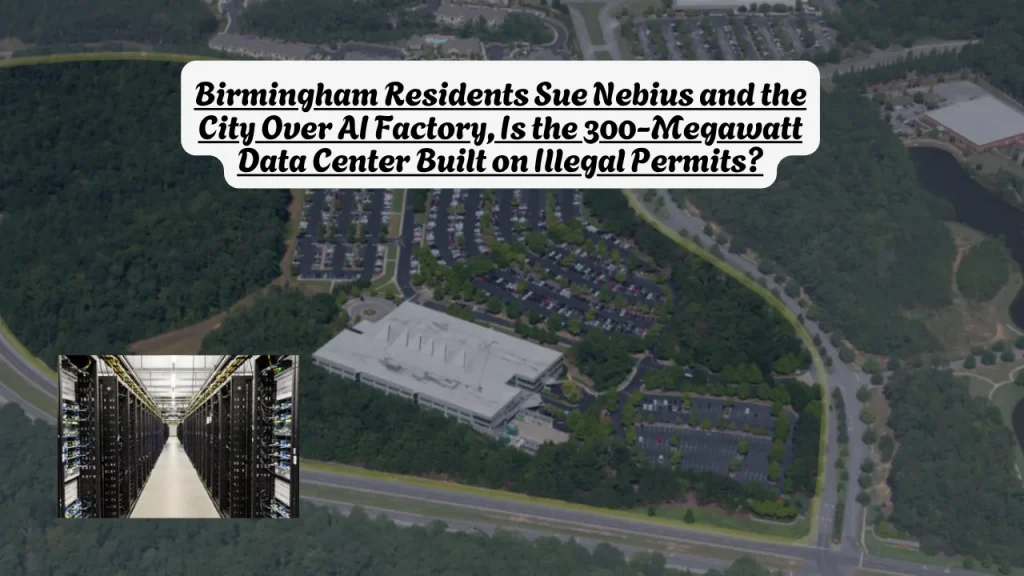
The Nebius Birmingham AI factory — internally designated BHM01 and marketed as the Birmingham AI Factory — is a planned 300-megawatt data center to be operated by Nebius Group N.V. of Amsterdam on the site of the former Regions Lakeshore Operations Center at 201 Milan Parkway in the Oxmoor Corporate Park. A Nebius affiliate bought the properties last September for about $90 million, according to the filing.
The legal dispute centers on a chain of zoning decisions — and the city’s response to them — that residents say added up to an unlawful path to construction. At a March 26 meeting of the Birmingham Zoning Board of Adjustments, a vote was taken to grant a special exemption for an electrical utility substation at the site, but a special exception for an electrical switching station was denied. City Attorney Nicole King later clarified that the three votes in favor of the exception did not carry the motion.
An April 9 memo from City Attorney Nicole King provided a crucial legal interpretation that allowed the project to move forward without obtaining special exceptions — finding that, because the substation and switching station are designed to serve only the Nebius project and not the surrounding residential area, they are not “neighborhood facilities” but rather private industrial infrastructure. Residents argue this memo was drafted with Nebius’s input and improperly overrides the Zoning Board’s own decision.
Related article: $557500 Lennox International Pay Transparency Settlement, Do You Qualify for a Payment? Deadline to Claim is July 13
The complaint also argues Nebius lost any “grandfathered” development rights when the former Regions Bank operations center on the property was demolished. Under Birmingham’s zoning rules, plaintiffs contend, once the original building came down, new construction on the site must comply with current zoning — and the current zoning for a mixed-use district does not permit a hyperscale AI facility. This type of community class action over industrial development in residential zones has parallels to other environmental damage lawsuits brought by neighborhoods facing large-scale infrastructure projects.
Are You Part of the Birmingham Nebius Class Action?
If you live near the Oxmoor Valley area and the proposed Birmingham AI Factory site, here is how to know whether this case covers you.
You may be part of this class if:
- You own or rent a home in the Oxmoor Valley, Oxmoor Glen, Sand Ridge, Ross Bridge, or Grasselli Heights neighborhoods near Birmingham’s Lakeshore Parkway corridor
- You live near the former Regions Bank operations center site at or near 201 Milan Parkway, Birmingham, Alabama
- You have experienced or anticipate experiencing harm from the project — including noise from construction or facility operations, air quality concerns from 32 temporary generators planned for the site, traffic increases, or declining property values
- You opposed the project at prior public hearings or zoning board meetings
You are likely NOT included if:
- You live in a Birmingham neighborhood with no geographic proximity to the Oxmoor Corporate Park or Lakeshore Parkway corridor
- You have not experienced and do not anticipate any harm from the project’s development or operation
The project sparked nearly five hours of objections from nearby neighborhoods, including Oxmoor Valley, Ross Bridge, and Grasselli Heights, as well as residents from the greater Birmingham area. The class is not yet certified — the court must first determine whether the case proceeds on behalf of all affected residents or remains an individual complaint.
What Oxmoor Valley Plaintiffs Are Seeking
The lawsuit asks the court for two things: stop the project now, and compensate residents for harm already done.
Plaintiffs are asking the court to stop further work and award damages tied to property values and quality of life. The preliminary injunction request, if granted, would halt all demolition, grading, and construction on the 79-acre site while the merits of the case are decided.
Residents say the development could hurt their property values and are worried about possible environmental impacts and how loud the facility could be. Southern Environmental Law Center attorney Patrick Anderson expressed concerns about the localized impacts of Nebius running 32 temporary generators. Burning fuels can produce ground-level ozone, or smog, which is a serious risk for respiratory health, and when natural gas is burned, formaldehyde, a carcinogenic air pollutant, can accumulate in the air.
Birmingham was ranked 45th-worst among metro areas nationwide for ozone pollution in the American Lung Association’s 2026 State of the Air report, giving it an “F” grade. An average of six days a year, the air here reaches levels deemed unhealthy to breathe. Residents argue that adding 32 generators to an already air-stressed metro compounds a pre-existing public health problem.
What Nebius and Birmingham Say
Nebius has not publicly responded to the lawsuit itself, but the company has defended the project throughout the months-long public debate. Nebius has said the project could generate around $80 million annually. At previous city council meetings and public hearings, Nebius said it wants to be good neighbors and listen to residents’ concerns. On its website, the company promises noise-reduction technology, minimal water use, and says residents will see no impact to their electric bills.
Nebius representatives said the AI factory would provide more than 100 jobs and bring in an estimated $80 million for Birmingham City and Jefferson County Schools. The company also said partnerships in higher education for workforce development are possible, including with colleges such as Miles College and Lawson State.
The city has said the Nebius project is exempt from the temporary moratorium on large data centers because the company submitted its application before the ban took effect. The city’s position is that Nebius was grandfathered into the permitting process and the moratorium cannot retroactively apply.
What Oxmoor Valley Residents Should Do Right Now
The case is in early litigation. No settlement exists and no claim form is open. Here is what affected residents can do right now:
- Document your concerns in writing. If you have already experienced noise, dust, traffic disruption, or declining interest in your property related to the Nebius construction site, write it down with dates. Photographs and dated notes are essential evidence in a nuisance lawsuit settlement or damages claim.
- Contact the attorneys on this case. The plaintiffs are represented by counsel in Jefferson County Circuit Court. If you live in the Oxmoor Valley area and want to understand whether you are part of the class, reach out to plaintiffs’ attorneys directly.
- Attend the Birmingham City Council public hearing on data center regulations. The city has set a public hearing to discuss proposed data center regulations. This hearing gives residents a formal opportunity to put concerns on the public record — separate from the court case.
- Monitor the court docket. The case is pending in Jefferson County Circuit Court, Alabama. The next critical event is the judge’s ruling on the preliminary injunction — if the court grants it, all construction stops while the case is litigated.
- Do not sign any release from Nebius or the City without legal advice. If any representative of either defendant contacts you about settling concerns or signing documents, consult a property damage compensation attorney first.
Birmingham Nebius Lawsuit Timeline
| Milestone | Date |
| Nebius acquires 79-acre site for $90 million | September 2025 |
| Demolition permit issued for former Regions Bank building | January 2026 |
| Special public meeting — Oxmoor Neighborhood Association votes against project | February 9, 2026 |
| Birmingham Zoning Board of Adjustment hearing — substation rejected, switching station denied | March 26, 2026 |
| Birmingham City Council passes temporary data center moratorium | March 3, 2026 (Nebius exempt — already in permitting) |
| City Attorney Nicole King issues memo allowing Nebius to bypass ZBA approval | April 9, 2026 |
| First construction permits issued | April 2026 |
| Greater Birmingham Humane Society files separate legal appeal | April 24, 2026 |
| Residents file class action and preliminary injunction in Jefferson County Circuit Court | May 13, 2026 |
| Preliminary injunction ruling | TBD — pending before Jefferson County Circuit Court |
| Birmingham City Council public hearing on data center regulations | TBD — scheduled for early June 2026 |
Frequently Asked Questions
Is there a class action lawsuit against Nebius over the Birmingham AI factory?
Yes. The class action lawsuit was filed May 13, 2026, in Jefferson County Circuit Court. Plaintiffs Madelyn Greene and David Butler filed on behalf of Oxmoor Valley residents, seeking to stop construction of the planned Birmingham AI Factory and win damages tied to property values and quality of life.
Do I need to do anything right now to be included?
Not yet. The class has not been certified by the court. If you live in the Oxmoor Valley area near the site and have concerns, contact the plaintiffs’ attorneys to understand your options. Documenting any harm you experience now — noise, dust, property value concerns — preserves your position as a potential class member.
When will a settlement be reached in the Nebius Birmingham case?
TBD. This case was filed three days ago as of this writing. No settlement discussions have been publicly reported. Land use and zoning lawsuits of this type typically take one to three years to resolve, though the injunction motion could produce a ruling within weeks.
Can I file my own lawsuit against Nebius instead of joining the class?
Yes. You have the right to opt out of any class action and pursue an individual claim. If your property has already suffered measurable damage — or if you have specific harm distinct from the broader class — consult an environmental damage lawsuit attorney familiar with Alabama property and nuisance law.
What is the City of Birmingham’s role in this lawsuit?
The City of Birmingham is a named defendant. Plaintiffs argue the city allowed the project to move forward without required zoning approvals or public hearings, and that the city attorney’s April 9 memo improperly attempted to override the Zoning Board’s action. The city has not yet publicly responded to the lawsuit.
How will I know if the Nebius case settles or the injunction is granted?
Court filings in Jefferson County Circuit Court are publicly accessible. You can also monitor local Birmingham news — WBRC, ABC 3340, Birmingham Times, and BirminghamWatch are all covering this case closely. AllAboutLawyer.com will update this article as developments occur.
What does Nebius say about the noise and environmental concerns?
On its website, Nebius promises noise-reduction technology, minimal water use, and says residents will see no impact to their electric bills. The company has not publicly responded to the specific lawsuit allegations. At public hearings, Nebius representatives said they are excited about being in Birmingham and hope to earn the trust of community members through their actions in construction, design, and operation of the building, as well as through their investments and community partnerships.
Prepared by the AllAboutLawyer.com Editorial Team and reviewed for factual accuracy against the Birmingham Times (May 13, 2026), WBRC reporting (May 13, 2026), ABC 3340 (May 13, 2026), and BirminghamWatch court and public meeting coverage on May 16, 2026. Last Updated: May 16, 2026
Sources & References
- Birmingham Times — Lawsuit coverage, May 13, 2026: birminghamtimes.com
Disclaimer: This article is for informational purposes only and does not constitute legal advice. Legal claims and outcomes depend on specific facts and applicable law. For advice regarding your specific situation, consult a qualified attorney.
About the Author
Israr Ahmad is a legal content researcher with 4+ years of experience covering class action settlements and consumer rights cases. He has researched and published coverage of 2,500+ settlements using verified court records, settlement administrator filings, and government sources. Learn more about Israr.