
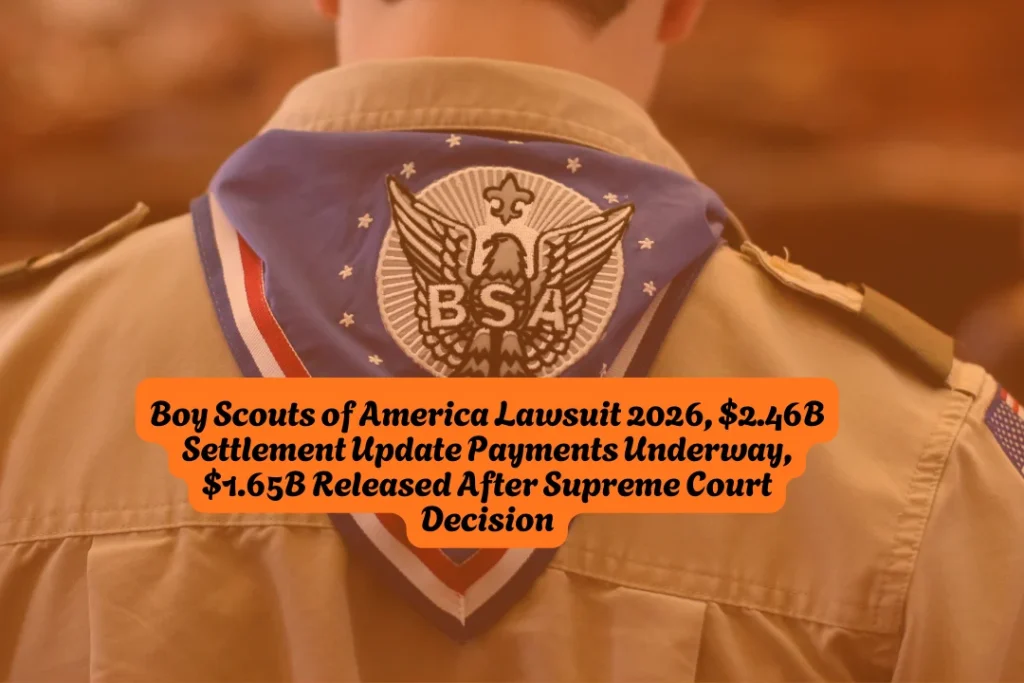
Boy Scouts of America Lawsuit 2026, $2.46B Settlement Update Payments Underway, $1.65B Released After Supreme Court Decision
The Boy Scouts of America sexual abuse settlement — $2.46 billion — addresses over 82,000 claims of sexual abuse by former Scouts against troop leaders and others associated with the organization. Approved by U.S. Bankruptcy Judge Laurie Selber Silverstein on September 8, 2022, it is one of the largest sexual abuse settlements in U.S. history.
On January 14, 2026, the U.S. Supreme Court declined to review the settlement, rejecting an appeal by approximately 75 survivors. On February 11, 2026, BSA’s plan of reorganization was finalized, allowing approximately $1.65 billion held in escrow to be released — unlocking the bulk of the settlement fund for distribution to survivors.
At a Glance
| Settlement amount | $2.46 billion |
| Total claims filed | 82,000+ |
| Claims determined | 50,800+ as of January 27, 2026 |
| Payments approved | 39,170+ survivors — $316M+ paid out |
| $1.65B escrow | ✅ Released — February 11, 2026 |
| Supreme Court appeal | ✅ Denied — January 14, 2026 |
| Official trust website | ScoutingSettlementTrust.com |
| Trust administrator | Hon. Barbara J. Houser (Ret.) |
| New name | Now operating as Scouting America |
Latest Updates — 2026
February 11, 2026 — $1.65B Escrow Released The Boy Scouts’ plan of reorganization has been finalized, allowing approximately $1.65 billion held in escrow to be released so the trust can continue providing compensation to survivors. This is the single biggest development in the case since the settlement was approved in 2022.
January 27, 2026 — Payment Milestone The Boy Scouts Settlement Trust has issued determinations on more than 50,800 claims and approved over 39,170 payments to survivors, totaling more than $316 million in payouts.
January 14, 2026 — Supreme Court Closes the Door on Appeal The group of victims — 75 people out of more than 82,000 who filed claims — argued the justices should reopen the settlement in light of the Purdue Pharma ruling, which blocked non-debtor liability shields in bankruptcy. The Supreme Court declined without explanation.
Following the decision, BSA — now known as Scouting America — stated it “can now expedite the payment of compensation to survivors of historical abuse,” calling it “an important moment of healing and closure that survivors have long deserved.”
Related article: Nissan Recalls 642,698 Rogue SUVs for Engine Failure and Fire Risk, 2023–2025 Models Affected
How Compensation Is Calculated
The settlement uses a claims matrix categorizing abuse into six tiers based on severity — ranging from anal or vaginal penetration by an adult perpetrator ($600,000 base, $2.7 million maximum) to sexual abuse with no touching ($3,500 base, $8,500 maximum). Scaling factors adjust awards based on aggravating circumstances such as multiple perpetrators or mitigating factors such as statute of limitations issues.
On average, settlements range from $3,500 initial payments for expedited claims to as much as $2.7 million for the most severe cases.
The Third-Party Release Controversy
The most contested issue in the entire case involves organizations that ran or sponsored BSA programs — churches, civic groups, and local councils.
Under the non-debtor releases, organizations affiliated with BSA — such as independent councils, churches, and other groups that supported scouting programs — are shielded from future civil lawsuits as long as they paid into the victims’ compensation fund.
The small group of objecting survivors wanted to sue those independent councils and third-party organizations separately. The Supreme Court’s refusal to hear the appeal means those organizations retain their liability shield permanently.
Critics note BSA itself will pay less than 10% — $219 million — of the $2.46 billion plan. The rest is paid by insurance companies and local councils. BSA paid more to its own attorneys (over $300 million) than it contributed directly to survivors.
Ongoing Insurance Litigation
A lawsuit is pending against approximately 90 insurance companies that have not contributed to the settlement. Successful litigation could significantly increase the total funds available to survivors.
The Trustee’s litigation against non-settling insurers continues — and any recovery will be distributed to claimants on top of existing payments.
If You Filed a Claim — What to Do Now
Visit ScoutingSettlementTrust.com to check your claim status. With the $1.65 billion escrow now released, second-round distributions are expected to begin accelerating significantly in 2026.
Total costs of compensating survivors have exceeded $7 billion according to the Wall Street Journal — more than twice the amount originally estimated — reflecting the enormous scale of abuse within the organization over decades.
If you have not yet filed a claim, contact a sexual abuse attorney immediately — claim filing windows are subject to trust deadlines. Firms actively representing survivors include Sokolove Law (800-995-1212), ASK LLP, and Krause & Kinsman.
FAQs
Is it too late to file a claim?
The original claim filing window has closed. If you believe you have an unresolved claim, contact the Settlement Trust directly at ScoutingSettlementTrust.com or consult a sexual abuse attorney immediately about remaining options.
When will second distributions go out?
With the $1.65 billion escrow released on February 11, 2026, the Trustee is now authorized to issue larger second-round distributions. No specific date has been announced — monitor ScoutingSettlementTrust.com for updates.
Can survivors still sue sponsoring churches or councils?
No. The Supreme Court’s January 14, 2026 decision leaves the non-debtor releases intact, permanently shielding contributing organizations from future civil lawsuits.
Is BSA still operating?
Yes. BSA officially rebranded as Scouting America in 2025 and has exited bankruptcy.
For related coverage on large-scale institutional abuse and civil rights litigation, see AllAboutLawyer.com’s reporting on the Camp Lejeune Lawsuit 2026 update — another massive federal compensation program navigating delayed distributions — and the Gavalas v. Google wrongful death lawsuit — the latest high-profile case involving institutional failure to protect vulnerable individuals from foreseeable harm.
By AllAboutLawyer.com Staff | Last Updated: March 5, 2026
This article is for informational purposes only and does not constitute legal advice. Legal claims and outcomes depend on specific facts and applicable law. For advice regarding a particular situation, consult a qualified attorney. If you are a survivor of sexual abuse, support is available — contact RAINN at 1-800-656-4673 or rainn.org.
About the Author

Sarah Klein, JD, is a licensed attorney and legal content strategist with over 12 years of experience across civil, criminal, family, and regulatory law. At All About Lawyer, she covers a wide range of legal topics — from high-profile lawsuits and courtroom stories to state traffic laws and everyday legal questions — all with a focus on accuracy, clarity, and public understanding.
Her writing blends real legal insight with plain-English explanations, helping readers stay informed and legally aware.
Read more about Sarah
I filled a claim January 15.2023 and received initial payment of $ 1,658.10 last year. I have signed the Medicare release forms.. I cannot get an answer from my attorney when I will receive my balance of my award , $ 164.000. Can you tell how much longer I will have to wait. I’m 89 years of age and my health is in a fast decline.
Thank you for any information or help you can give me thank you. 5413018644 talent , Orego 97540
WHERE THE F–K IS MY MONEY