
Trader Joe’s Credit Card Receipt Class Action Lawsuit Settlement, Are You Eligible to Claim ~$102 Before June 9, 2026?
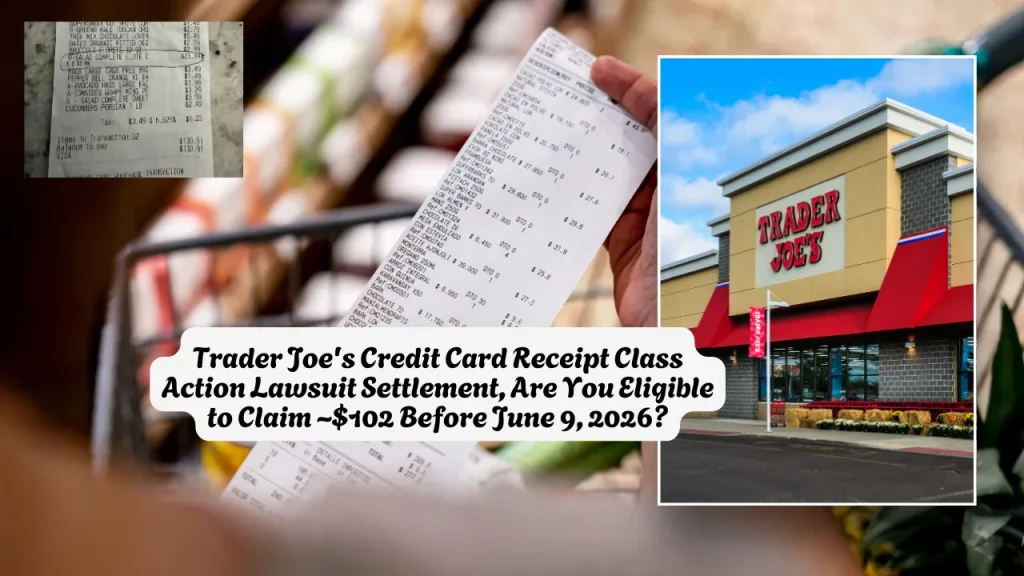
If you paid with a credit or debit card at Trader Joe’s between March 5, 2019, and July 19, 2019, you may be owed around $102.45 from a $7,400,000 class action settlement. The lawsuit alleged that Trader Joe’s printed receipts showing too many card digits, violating a federal consumer protection law designed to prevent identity theft. The deadline to file a claim is June 9, 2026.
Quick Facts
| Field | Detail |
| Settlement Amount | $7,400,000 |
| Claim Deadline | June 9, 2026 |
| Who Qualifies | Credit/debit card users who shopped at specific Trader Joe’s locations between March 5, 2019 – July 19, 2019 and received an affected receipt |
| Payout Per Person | ~$102.45 (estimated, pro-rata) |
| Proof Required | No — claim ID and PIN from settlement notice required |
| Settlement Status | Open for Claims |
| Administrator | Verita Global (888-444-7415 / [email protected]) |
| Official Website | tj-factasettlement.com |
Current Status and What Happens Next
- The settlement is open for claims right now. Eligible shoppers who received a mailed or emailed notice can file online, by mail, or by phone before June 9, 2026.
- The court holds a final fairness hearing on August 10, 2026, where a judge will decide whether to grant final approval.
- The settlement administrator will distribute payments within 45 days of the court resolving any appeals and granting final approval. If the August hearing proceeds without objections, expect payments by late 2026.
What Is the Trader Joe’s FACTA Lawsuit About?
A federal consumer protection law called the Fair and Accurate Credit Transactions Act — known as FACTA — limits how much card information a retailer can print on a customer receipt. FACTA prohibits retailers from printing more than the last five digits of an account number on an electronically printed receipt. The rule exists specifically to reduce the risk of identity theft.
The lawsuit alleged that during a specific period in 2019, certain Trader Joe’s stores printed receipts that displayed both the first six and last four digits of customers’ card numbers — a total of ten digits. Printing that many digits, the plaintiff argued, gave potential identity thieves far more information than the law allows.
Plaintiff Brian Keim filed the case in California state court (Case No. 19STCV36790). The court found that Keim’s allegation — that he suffered an increased risk of identity fraud due to Trader Joe’s violation of FACTA’s truncation requirements — constituted a sufficient injury to pursue the case. Trader Joe’s denies any wrongdoing but agreed to settle rather than face the expense of a trial.
Related article: $800K Widener University COVID-19 Tuition Fee Settlement, Are You Eligible for a Payment? Deadline is May 26, 2026
Who Is Eligible to File a Claim in This Settlement?
Not every Trader Joe’s shopper from 2019 qualifies. The class covers only a narrow, specific group:
- You may qualify if you used a credit or debit card at a Trader Joe’s store between March 5, 2019, and July 19, 2019.
- You may qualify if you received a printed receipt from that transaction that showed both the first six and last four digits of your card number — a total of ten digits.
- You may qualify if you are the account holder of the card used in that transaction.
- You may qualify if you received a settlement notice in the mail or by email containing a Claim ID and PIN — this is the strongest signal you are a confirmed class member.
- You do NOT qualify if your receipt only showed the standard last four digits. The affected receipts showed ten digits due to a specific software configuration at certain store locations.
The class includes an estimated 757,663 unique card numbers, representing the same number of class members. If you shopped at Trader Joe’s in that window and think you may have received an affected receipt, file a claim — the administrator will verify eligibility.
How Much Will You Get from the Trader Joe’s Settlement?
Each eligible class member who submits a valid claim form can receive a payment estimated at $102.45. That figure is an estimate, not a guarantee.
The final amount each claimant receives depends on how many valid claims the administrator receives in total. Fewer claims mean a larger share per person. More claims mean a smaller share. This pro-rata structure is standard in FACTA class actions.
Here is how the $7,400,000 settlement fund breaks down before payments reach class members:
Settlement administration costs run up to $977,000; attorneys’ fees up to $2,466,666.67; attorneys’ expenses up to $65,000; and a service award of up to $10,000 for the class representative. The remaining fund — estimated at $3,881,333.33 — goes to eligible claimants.
Any funds left unclaimed after the first and second distribution rounds will go to the Identity Theft Resource Center as a cy pres charitable award, not back to Trader Joe’s.
How to File a Claim Before June 9, 2026
Step 1 — Locate your notice. Check your mail and email for a notice from the Keim v. Trader Joe’s Co. Settlement Administrator. It contains your unique Claim ID and PIN, which you need to file.
Step 2 — Go to the official claim portal. Visit veritaconnect.com/tj-factasettlement to file online. This is the only legitimate online filing portal for this settlement.
Step 3 — Enter your Claim ID and PIN. These identifiers tie your claim to a specific card transaction in the settlement records. Do not share them with third parties.
Step 4 — Choose your payment method. Select either electronic deposit (fastest) or a paper check mailed by first-class mail. Note that mailed checks are valid for only 180 days — cash or deposit promptly.
Step 5 — Submit your claim and save your confirmation. Screenshot or print your confirmation. Keep it until your payment arrives.
Step 6 — Mail a paper form if preferred. Download the PDF claim form at veritaconnect.com/tj-factasettlement/Claimant and mail it to: Keim v. Trader Joe’s Co. Settlement Administrator, P.O. Box 301134, Los Angeles, CA 90030-1134. You can also call 888-444-7415 to file by phone.
Estimated time to complete: 5 minutes online.
Important Deadlines and Dates
| Milestone | Date |
| Qualifying Purchase Window | March 5, 2019 – July 19, 2019 |
| Settlement Open for Claims | April 2026 (notice mailing) |
| Claim Filing Deadline | June 9, 2026 |
| Opt-Out Deadline | TBD — contact administrator |
| Objection Deadline | TBD — contact administrator |
| Final Fairness Hearing | August 10, 2026 |
| Expected Payment Date | Within 45 days of final approval (est. late 2026) |
Frequently Asked Questions
Did Trader Joe’s actually steal my card information?
No. The lawsuit does not allege that Trader Joe’s stole any card data or that any identity theft actually occurred. The claim is that a software configuration printed more digits on receipts than federal law allows, which the plaintiff argued increased consumers’ theoretical risk of identity theft. Trader Joe’s denies wrongdoing.
I shopped at Trader Joe’s in 2019 but didn’t get a notice — can I still file?
Possibly. The class covers only shoppers whose receipts showed ten card digits due to specific software at certain locations. If you did not receive a notice, your transaction may not be part of the class, or your contact information may be outdated. Call the administrator at 888-444-7415 or email [email protected] to check whether your card number appears in the class data.
Do I need a lawyer to file a claim?
No. Filing a claim in this settlement is free and takes about five minutes online. You do not need an attorney. If you want to opt out and pursue an individual lawsuit instead, consulting an attorney before the opt-out deadline would be advisable.
Is this Trader Joe’s settlement legitimate?
Yes. The case is Keim v. Trader Joe’s Co., Case No. 19STCV36790, filed in Los Angeles Superior Court. Verita Global, a professional settlement administrator, manages the claims process. The only official settlement website is tj-factasettlement.com and the only official claim portal is veritaconnect.com/tj-factasettlement.
When will I receive my payment?
Payments go out within 45 days after the court grants final approval and resolves any appeals. The final fairness hearing is August 10, 2026. If no appeals delay the process, payments could arrive by late 2026.
What if I missed the June 9, 2026 claim deadline?
Once the deadline passes, the administrator will not accept new claim forms and you will forfeit your right to a payment from this settlement. If you think you qualify, file before June 9, 2026 — even a few days early, to be safe.
Will this settlement payment affect my taxes?
Possibly. Payments from FACTA settlements are generally considered statutory damages, not compensation for a documented financial loss. The IRS may treat this as taxable income. Consult a tax professional if you have questions about how to report your payment on your return.
What is FACTA and why does it matter?
FACTA stands for the Fair and Accurate Credit Transactions Act, a federal law that limits what card information a merchant can print on a customer receipt. FACTA requires that no more than the last five digits of a credit or debit card number appear on receipts, with all other digits masked. The rule protects shoppers from identity theft by ensuring a lost or stolen receipt cannot be used to reconstruct a card number.
Sources and References
- Official Settlement Website: tj-factasettlement.com
- Official Claim Portal: veritaconnect.com/tj-factasettlement
- Second Amended Settlement Agreement (PDF): Settlement Agreement
- Court Docket — Los Angeles Superior Court: Case No. 19STCV36790, Keim v. Trader Joe’s Co.
Last Updated: April 15, 2026
Disclaimer: This article is for informational purposes only and does not constitute legal advice. Legal claims and outcomes depend on specific facts and applicable law. For advice regarding a particular situation, consult a qualified attorney.
About the Author
Israr Ahmad is a legal content researcher with 4+ years of experience covering class action settlements and consumer rights cases. He has researched and published coverage of 2,500+ settlements using verified court records, settlement administrator filings, and government sources. Learn more about Israr.