
$4.5M Winston Weaver Fire Evacuation Settlement, Is Your Business Eligible to Claim? Deadline is July 15 2026
The Winston Weaver Company Settlement is a negligence and nuisance class action lawsuit where eligible businesses and charitable organizations within one mile of the Winston Weaver fertilizer plant in Winston-Salem, North Carolina, can receive cash compensation — from $10,000 up to the full amount of documented losses — by filing a claim before July 15, 2026. Plaintiffs alleged that negligence and regulatory violations caused the January 31, 2022 fire and the resulting financial losses to area businesses. About 500 businesses that had to evacuate and close for days following the fire are affected by this settlement. The settlement is currently open for claims following preliminary approval.
Quick-Facts
| Field | Detail |
| Settlement Amount | $4,500,000 |
| Claim Deadline | July 15, 2026 |
| Who Qualifies | Businesses or charitable organizations that operated within one mile of the Winston Weaver facility in Winston-Salem, NC, on January 31, 2022, and suffered economic or nuisance-related damages |
| Payout Per Business | $10,000 (flat, no documentation) up to $35,000 (flat, with proof of extended closure); actual net loss claims and extraordinary loss claims also available with documentation |
| Proof Required | Depends on claim tier — flat payment requires only a closure certification; documented loss claims require tax returns, bank records, or similar financial records |
| Settlement Status | Preliminarily approved — final fairness hearing scheduled May 20, 2026 |
| Administrator | Simpluris — Winston-Salem Business Settlement, PO Box 3207, Portland, OR 97208-3207 / 1-877-269-9879 |
| Official Website | winstonweaverclassaction.com/Business |
| Last Updated | April 21, 2026 |
Current Status & What Happens Next
- The deadline to request exclusion from the class is April 24, 2026, and the final fairness hearing is scheduled for May 20, 2026.
- The claim filing deadline is July 15, 2026. Eligible businesses can file online or by mail using the settlement administrator’s forms.
- The settlement administrator will distribute payments after the court resolves any appeals and grants final approval of the settlement. No specific payment date has been announced — TBD pending final court approval and resolution of any appeals.
What Is the Winston Weaver Lawsuit About? Thomas, et al. v. Winston Weaver Co. Inc., Nos. 22 CVS 929 and 22 CVS 683
This case is pending in the General Court of Justice, Superior Court Division, in the State of North Carolina, Forsyth County. The lawsuit alleges damages resulting from negligence, negligence per se, gross negligence, private nuisance, and public nuisance, which plaintiffs claim proximately caused the fire and the subsequent evacuation.
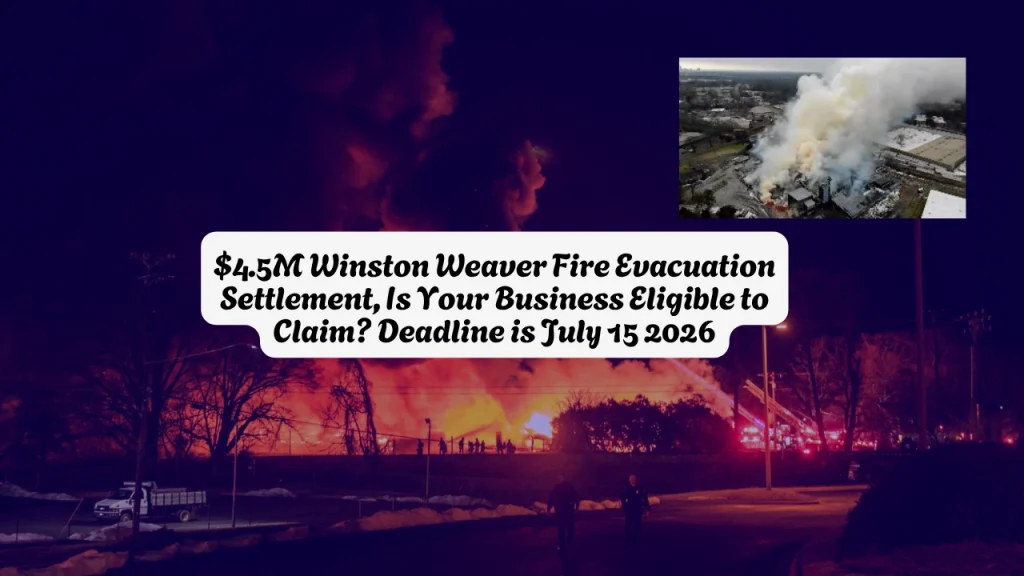
The fire broke out on the evening of January 31, 2022. It resulted in a voluntary evacuation affecting thousands of people after firefighters learned that the Weaver plant contained an estimated 600 tons of ammonium nitrate. The evacuation forced businesses in a one-mile radius to shut down, costing them days of revenue, spoiled inventory, and ongoing operational losses with no recourse until now.
Businesses that suffered these losses as a direct result of the plant’s alleged negligence — not personal injury — are the target class in this case. If your business had to close because of the evacuation, this settlement exists specifically to compensate you for those economic damages. This case is part of a broader set of consumer class actions involving industrial facility negligence — similar in structure to other environmental and nuisance settlements pursued by affected communities across the U.S..
Related article: E Benefit Solution Data Breach Settlement, Are You Eligible to Claim? Deadline is July 1, 2026
Who Is Eligible for the Winston Weaver Settlement?
To qualify, businesses or charitable organizations must meet all of the following criteria:
- You may qualify if you are a lawful, organized business entity — a corporation, LLC, partnership, or sole proprietorship — that engaged in commercial, industrial, or professional activity.
- You may qualify if your business operated or was physically located within the one-mile evacuation zone of the Winston Weaver facility on January 31, 2022.
- You may qualify if the fire and evacuation caused your business to suffer economic and/or nuisance-related damages, not personal injury.
- You may qualify if you are a tenant or lessee — you do not need to own the property where your business operated.
- You may qualify if your organization is a nonprofit or charitable organization that meets the location and damage requirements.
- You do NOT qualify if you already participated in the separate individual resident settlement as a natural person.
- You do NOT qualify if your activity was recreational, hobbyist, or involved temporarily peddling goods or services in a residential area.
Related article: $50M Google Racial Discrimination Class Action Settlement, Are You Eligible to Claim?
How Much Money Can You Get from the Winston Weaver Settlement?
The settlement offers several compensation tiers based on documentation:
Flat Election Payment (no detailed financial records required):
- Businesses that certify they closed during the three-day mandatory evacuation window can claim a flat payment of $10,000.
- Businesses that can prove closure for longer than three days, or that suffered extraordinary losses, can claim up to $35,000 under the flat election option.
Actual Net Business Loss (documented claims):
- Businesses with financial records — federal tax returns for 2022 and 2023, bank statements, sales tax returns, payroll records, or financial statements — can claim their actual net business losses. The settlement administrator calculates this as the difference between expected revenue and actual revenue during the claim period, plus continuing expenses, minus any insurance offsets.
Extraordinary Loss or Property Damage (documented):
- Businesses may also submit claims for extraordinary losses or physical property damage, supported by itemized documentation including invoices, receipts, and photos. For businesses that chose the flat payment option, extraordinary loss claims are capped at $25,000 per business.
All payments may be reduced on a pro-rata basis if total valid claims exceed the net settlement fund after attorneys’ fees (up to $1,485,000) and $50,000 in class representative service awards are deducted. For businesses pursuing complex documented loss claims, reviewing options with a business attorney is worth considering. You can also review how to document business losses in consumer class actions for guidance on assembling the strongest possible claim.
Step-by-Step: How to File Your Winston Weaver Business Claim Form
Step 1 — Visit the official claim portal at winstonweaverclassaction.com/LoginBusiness.
Step 2 — Enter the unique ID and PIN from the settlement notice your business received by mail.
Step 3 — Select your claim type: Flat Payment (Form I), Actual Net Business Loss (Form II), or Extraordinary Loss / Property Damage (Form III).
Step 4 — If filing a documented loss claim, upload your supporting financial records (tax returns, bank statements, payroll records, invoices, receipts, or photos as applicable).
Step 5 — Review your claim form for accuracy and submit electronically — or print, complete, and mail to: Winston-Salem Business Settlement, Settlement Administrator, PO Box 3207, Portland, OR 97208-3207.
Step 6 — Save your confirmation number or retain a copy of your mailed claim form as proof of submission.
Estimated time to complete: 10–30 minutes depending on claim type and documentation.
Important Deadlines & Dates
| Milestone | Date |
| Partial Settlement Agreement Reached | February 2026 |
| Class Notice Dissemination Order | October 4, 2025 |
| Claims Period Opens | April 2026 |
| Opt-Out / Exclusion Deadline | April 24, 2026 |
| Final Fairness Hearing | May 20, 2026 |
| Claim Filing Deadline | July 15, 2026 |
| Expected Payment Date | TBD — pending final court approval and resolution of any appeals |
Frequently Asked Questions
Do I need a lawyer to file a claim?
No. Eligible businesses can file directly at winstonweaverclassaction.com/LoginBusiness without hiring an attorney. However, businesses pursuing documented net loss or extraordinary loss claims may benefit from consulting a business attorney to ensure their financial records meet the settlement administrator’s calculation requirements.
Is this settlement legitimate?
Yes. This case — Thomas, et al. v. Winston Weaver Co. Inc., Nos. 22 CVS 929 and 22 CVS 683 — is pending before Judge Edwin G. Wilson, Jr. of the General Court of Justice, Superior Court Division, Forsyth County, North Carolina. The settlement administrator is Simpluris, a nationally recognized claims administration firm. The official website is winstonweaverclassaction.com/Business.
When will I receive my payment?
The settlement administrator will distribute payments after the court resolves any appeals and grants final approval. The final fairness hearing is May 20, 2026, and the claim deadline is July 15, 2026. Payments are TBD — pending post-approval processing and any appeal period.
What if I missed the claim deadline?
If you do not file by July 15, 2026, you will not receive a payment from this settlement. The Forsyth County court will not extend individual deadlines. If the opt-out deadline of April 24, 2026 has not yet passed, you can still exclude yourself from the class to preserve any independent legal claims.
Will this settlement payment affect my taxes?
Settlement payments received for business income losses are generally treated as taxable income by the IRS, replacing the revenue your business would otherwise have reported. Payments for property damage may receive different tax treatment. Consult a qualified CPA or tax professional to determine how your specific payout will affect your 2026 tax filing.
What is the difference between the business settlement and the resident settlement?
In December 2025, Judge Edwin Wilson signed off on a separate $8 million class action settlement for individuals — residents and workers — who lived within a mile of the site during the evacuation. The $4.5 million business settlement covers entities that suffered economic or nuisance-related business losses. If you already filed as an individual under the resident settlement, you cannot also file under the business settlement.
What if my business received insurance proceeds for the fire-related losses?
Insurance payments offset your recoverable net business losses under the documented loss claim tier. The settlement administrator subtracts insurance proceeds and other offset payments when calculating your actual net business loss. You may still qualify for a flat payment tier if you choose not to pursue documented losses.
Can a sole proprietor file under the business settlement?
Yes. Sole proprietorships qualify as long as the business operated within the one-mile evacuation zone on January 31, 2022, and suffered economic or nuisance-related damages. Sole proprietors who also participated as natural persons in the individual resident settlement are excluded, however.
Sources & References
- Official Settlement Website — winstonweaverclassaction.com/Business
- Class Notice — winstonweaverclassaction.com/Content/Documents/Business/AM482_v01 (LFN).pdf
- WFDD / WFAE Public Radio — “$4.5M deal reached for businesses affected by Weaver fire,” February 13, 2026 — wfae.org
- WFDD — “Thousands eligible for payment after Weaver fire settlement approved,” December 8, 2025 — wfdd.org
Prepared by the AllAboutLawyer.com Editorial Team and reviewed for factual accuracy against the official settlement administrator website and court records on April 21, 2026. Last Updated: April 21, 2026
Disclaimer: This article is for informational purposes only and does not constitute legal advice. Legal claims and outcomes depend on specific facts and applicable law. For advice regarding a particular situation, consult a qualified attorney.
About the Author
Israr Ahmad is a legal content researcher with 4+ years of experience covering class action settlements and consumer rights cases. He has researched and published coverage of 2,500+ settlements using verified court records, settlement administrator filings, and government sources. Learn more about Israr.