
United States Court of Appeals for the Sixth Circuit, What It Is and Why It Keeps Making Headlines
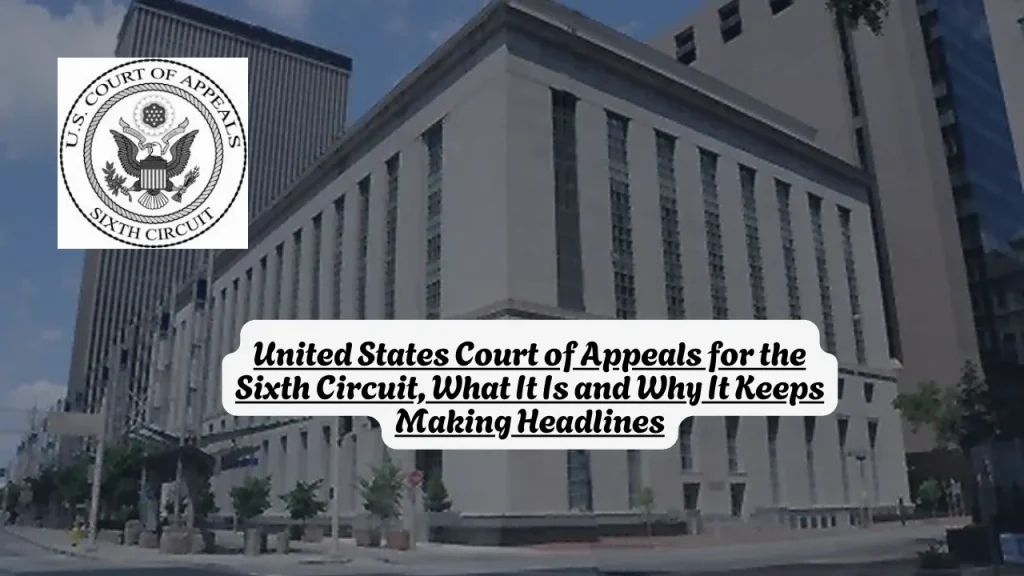
The U.S. Court of Appeals for the Sixth Circuit is one of the most consequential federal appellate courts in the country right now. It covers the federal district courts in Ohio, Michigan, Kentucky, and Tennessee, and sits at the Potter Stewart U.S. Courthouse in Cincinnati, Ohio. From killing net neutrality to rewriting union election rules, the Sixth Circuit has handed down decisions in 2025 and 2026 that affect millions of Americans — and that is exactly why people are searching for it.
What the Sixth Circuit Actually Is and How It Works
Most Americans never think about a federal appeals court until a ruling touches their life. Here is how the Sixth Circuit fits into the legal system.
The court is composed of 16 judges and is one of 13 United States courts of appeals. When someone loses a case in a federal district court in Ohio, Michigan, Kentucky, or Tennessee, their next step is appealing to the Sixth Circuit. The Sixth Circuit then reviews whether the lower court made a legal error — it does not hold new trials or hear new witnesses. It reads the record and decides whether the law was applied correctly.
The chief judge of the court is Jeffrey Sutton, appointed by President George W. Bush. Six of the current judges were appointed by President Donald Trump. After the Sixth Circuit rules, the only place left to appeal is the U.S. Supreme Court — and the Supreme Court accepts very few cases. Justice Brett Kavanaugh is the circuit justice for the Sixth Circuit, meaning he handles emergency applications from this circuit when the full Court is not in session.
The median time from the notice of appeal to a final decision at the Sixth Circuit is about nine months — which is consistent with recent years. If you are in a case that gets appealed there, you are looking at roughly a year-long process from start to finish.
The Sixth Circuit Rulings from 2025–2026 Driving Search Traffic
Several decisions from this court are reshaping federal law right now. Each one directly affects consumers, workers, and businesses across the country.
Net Neutrality Is Dead at the Federal Level — The Sixth Circuit Did It
On January 2, 2025, the U.S. Court of Appeals for the Sixth Circuit set aside the FCC’s 2024 Safeguarding and Securing the Open Internet Order — the net neutrality rules — ruling that the FCC lacks the statutory authority to classify broadband providers as telecommunications carriers under Title II of the Communications Act of 1996.
In plain English: the court ruled that internet service providers are not required to treat all internet traffic equally under federal law. The decision hinged on the Supreme Court’s 2024 Loper Bright ruling, which stripped federal agencies of automatic deference when interpreting their own authority. The FCC lost because it no longer gets the benefit of the doubt from courts when it stretches its regulatory reach.
This ruling directly affects every American who uses the internet at home. Without federal net neutrality, ISPs can theoretically slow down, block, or charge more for certain websites or streaming services — unless Congress passes new legislation. The door now remains open for states like California to implement their own net neutrality rules.
The Sixth Circuit Rewrote Union Election Rules — And Bourbon Is at the Center of It
On March 6, 2026, the Sixth Circuit became the first federal appeals court to reject the NLRB’s Cemex framework — a National Labor Relations Board rule that allowed unions to skip secret ballot elections and demand recognition directly from employers in certain situations.
The case involved workers at the Woodford Reserve bourbon distillery in Kentucky. Employees began organizing in 2022 after expressing dissatisfaction with their compensation. When it appeared the union was gaining ground, the company implemented several changes including a $4-per-hour across-the-board wage increase, modified benefits, and distributed bottles of bourbon. The NLRB had tried to use Cemex to order the company to recognize the union without an election. The Sixth Circuit said no — that the board had created the Cemex rule illegally through adjudication rather than proper rulemaking.
Related article: Yelp Unpaid WagesClass Action Lawsuit, Hourly Workers Claim They Were Never Paid for Boot-Up Time
If you are a worker or employer in Ohio, Michigan, Kentucky, or Tennessee, this ruling matters to you directly. It is also a case with national implications. Because the Sixth Circuit is the first appellate court to address Cemex directly, if other circuits rule differently, the Supreme Court may need to step in and settle the split.
For more on how federal courts handle class-wide employment disputes, see our article on the Toyota Sienna Seat Rail Class Action Lawsuit 2025, which shows how product liability and worker rights claims move through the federal system.
The Sixth Circuit Sanctioned Lawyers for Using Fake AI-Generated Cases
In Whiting v. City of Athens, the Sixth Circuit sanctioned two Tennessee attorneys who cited over 24 fake case citations — hallucinated by artificial intelligence — in their court briefs. The panel awarded sanctions under Rule 38, holding that using fake citations constituted “misconduct in arguing the appeal” and went well beyond “sloppiness in drafting.”
This matters beyond the legal world. It signals that federal courts are paying close attention to how AI is being used by lawyers — and that attorneys who rely on AI tools without verifying their output face real professional and financial consequences. Although the Sixth Circuit has no local rule requiring attorneys to disclose their use of AI, this ruling may encourage district courts in the circuit to order such disclosures going forward.
Which States Fall Under the Sixth Circuit?
If you live, work, or do business in any of these four states, the Sixth Circuit’s rulings apply directly to you:
- Ohio — including Columbus, Cleveland, Cincinnati, and Akron
- Michigan — including Detroit, Grand Rapids, and Lansing
- Kentucky — including Louisville, Lexington, and Frankfurt
- Tennessee — including Nashville, Memphis, and Knoxville
Any federal lawsuit filed in these states — whether it involves employment discrimination, consumer fraud, civil rights, or criminal charges — can eventually land at the Sixth Circuit on appeal.
The Sixth Circuit’s Reversal Rate and What It Means for Litigants
Since 2010, the Supreme Court has decided 88 cases originating from the Sixth Circuit, affirming in 17 cases and reversing in 71 — a reversal rate of 80.7 percent. That is one of the highest reversal rates among federal appellate courts. In practical terms, it means that if you are appealing a Sixth Circuit ruling to the Supreme Court, the odds historically favor the Court overturning that ruling.
For litigants asking how long an appeal at the Sixth Circuit takes, the median time from notice of appeal to final decision is roughly nine months. That number has been consistent for the past several years. Complex cases involving class actions or constitutional questions can take longer.
For a broader look at how consumers pursue legal claims at the federal level, see our guide on the Ford Recall Of 119,000 Vehicles Over Engine Heater Fire Risk — a case where consumer rights claims navigated both the regulatory and judicial systems simultaneously.
Frequently Asked Questions
What is the U.S. Court of Appeals for the Sixth Circuit?
It is a federal appellate court that reviews decisions made by federal district courts in Ohio, Michigan, Kentucky, and Tennessee. It does not hold trials — it reviews whether lower courts applied the law correctly. It sits at the Potter Stewart U.S. Courthouse in Cincinnati, Ohio, and is composed of 16 judges.
Why is the Sixth Circuit trending right now?
Several landmark rulings have put it in the national spotlight. In 2025, it struck down federal net neutrality rules. In March 2026, it became the first appellate court to reject the NLRB’s Cemex union recognition framework. It also made news for sanctioning attorneys who submitted AI-generated fake case citations.
Does the Sixth Circuit affect me if I don’t live in Ohio, Michigan, Kentucky, or Tennessee?
Its rulings directly bind those four states, but they set important legal precedents that influence courts across the country — especially when the Supreme Court has not yet ruled on an issue. The net neutrality and NLRB decisions, for example, affect federal policy nationally.
Can the Sixth Circuit’s rulings be appealed?
Yes. Parties can petition the U.S. Supreme Court for review. However, the Supreme Court takes only a small fraction of cases. Justice Brett Kavanaugh serves as the circuit justice for the Sixth Circuit and handles emergency requests from this circuit between Supreme Court terms.
Is there a class action lawsuit currently before the Sixth Circuit?
Yes, multiple class actions move through the circuit at any given time. If you believe a company violated your rights in Ohio, Michigan, Kentucky, or Tennessee, a consumer rights lawyer can assess whether your situation fits within an existing class action or warrants an individual claim. Most initial consultations are free.
What happens if the Sixth Circuit and another appeals court disagree on the same legal question?
That is called a circuit split. When it happens, the Supreme Court often steps in to resolve the conflict. The Sixth Circuit’s Cemex ruling is a prime example — because it is the first appellate court to address that question, a split could develop if other circuits rule differently, potentially forcing Supreme Court review.
How do I find a Sixth Circuit ruling that affects my case?
You can search for official opinions at ca6.uscourts.gov or search the court docket at CourtListener.com. If you are looking at a ruling that affects your employment, property, or consumer rights, consult an attorney who can explain how the decision applies to your specific situation.
Sources & References
Prepared by the AllAboutLawyer.com Editorial Team and reviewed for factual accuracy against official court records and verified legal news sources on May 12, 2026. Last Updated: May 12, 2026
Disclaimer: This article is for informational purposes only and does not constitute legal advice. Legal claims and outcomes depend on specific facts and applicable law. For advice about your particular situation, consult a qualified attorney.
About the Author
Israr Ahmad is a legal content researcher with 4+ years of experience covering class action settlements and consumer rights cases. He has researched and published coverage of 2,500+ settlements using verified court records, settlement administrator filings, and government sources. Learn more about Israr.