
Toyota Faces Class Action Over Defective 2025 Sienna Seat Rails — Thousands of Families Left Without a Safe Vehicle and No Fix in Sight
Tens of thousands of families who purchased 2025 Toyota Sienna minivans are caught in a dangerous limbo: they own vehicles with defective second-row seat rails that Toyota acknowledges could injure passengers in a crash — yet months after a recall was issued, many owners still have no repair date and have been told simply not to use the seats. Plaintiffs Adam Hamblin and Juliet Kelsten filed a class action complaint against Toyota Motor Sales U.S.A., Toyota Motor North America, and Toyota Motor Manufacturing Indiana on April 1, 2026, in California federal court, alleging violations of state and federal consumer laws. The case, Hamblin, et al. v. Toyota Motor Sales U.S.A. Inc., et al., Case No. 2:26-cv-03458, is pending in the U.S. District Court for the Central District of California.
Quick Case Snapshot
| Plaintiffs | Adam Hamblin and Juliet Kelsten (on behalf of a proposed nationwide class) |
| Defendants | Toyota Motor Sales U.S.A. Inc.; Toyota Motor North America Inc.; Toyota Motor Manufacturing Indiana Inc. |
| Court | U.S. District Court, Central District of California |
| Case Number | 2:26-cv-03458 |
| Filing Date | April 1, 2026 |
| Judge | Not yet publicly confirmed |
| Claims Alleged | Violations of state and federal consumer protection laws; breach of warranty; failure to provide timely repair remedy; selling a vehicle unfit for its intended purpose |
| Vehicles Affected | 2025 Toyota Sienna Hybrid minivans (approx. 54,631 units) produced January 14 – July 24, 2025 |
| Damages Sought | Not yet disclosed; injunctive relief, compensatory and statutory damages sought |
| Current Status | Newly filed; class certification not yet sought |
| NHTSA Recall Numbers | 25V668000 (NHTSA); 25TA12 / 25TB12 (Toyota internal) |
The Core Problem: A Welding Machine Set Wrong, and Seats That Could Kill in a Crash
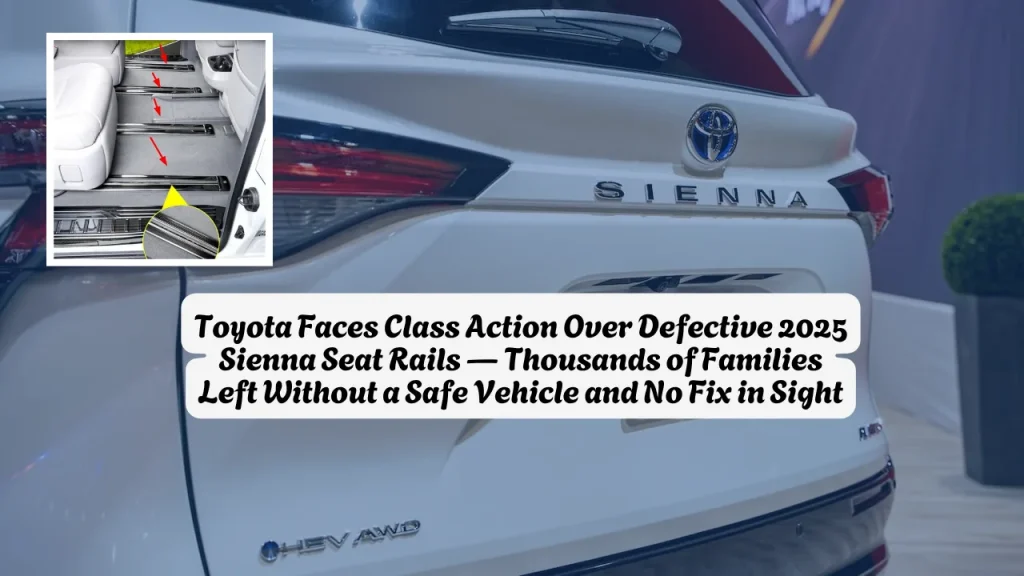
This case begins on the factory floor. In the 2025 Sienna Hybrid minivans produced between January 14 and July 24, 2025, the second-row seat rails may not have been welded properly by the supplier — Toyota Boshoku Kentucky Harrodsburg. According to documents filed with the National Highway Traffic Safety Administration, an incorrect setting of the welding machine is the root cause behind the improper welds.
The consequences are serious. Welds that haven’t fully penetrated the seat rail assembly lead to a loss of structural integrity in certain high-speed collisions, greatly increasing the risk of injury for second-row occupants.
In a minivan marketed specifically to families — and often used to transport children — the second-row seats are not a secondary feature. They are the reason many buyers choose the vehicle. Owners who discovered the defect described it in stark personal terms. One owner recounted that the recall notice explained that Siennas manufactured between January and July 2025 may have defective middle-row seat rails and that in certain high-speed collisions, those seats could lose structural integrity if occupied, increasing the risk of injury. “This was not a minor oversight or a cosmetic issue,” the owner wrote. “It involved seating where children ride.”
An internal Toyota timeline shows that as early as July–August 2025, Toyota found prototype seat systems had failed internal tests due to incomplete weld penetration in the second-row seat rails. According to Toyota’s own filings, the company became aware by September that the seats could dislodge in a crash, a voluntary safety campaign decision was made on October 1, and the National Highway Traffic Safety Administration was notified shortly thereafter.
Related article: 3M Combat Arms Earplug Settlement, Are You Still Eligible to Receive Payment?
What the Lawsuit Alleges: Sold as Family Vehicles, Unusable as Family Vehicles
According to the lawsuit, Toyota marketed its 2025 Sienna minivans as family-friendly vehicles with ample seating, but the second-row seat rails were improperly welded, posing a significant safety risk. Toyota issued a recall acknowledging the defect but has yet to repair any affected Toyota Sienna vehicles, the plaintiffs say. Toyota allegedly advised owners not to use the second-row seats, rendering the minivans unusable for families who purchased them for their seating capacity.
The gap between recalling a vehicle and actually fixing it is the crux of the lawsuit. Toyota acknowledged the problem months ago — but acknowledgment without remedy leaves owners in an impossible position. A vehicle marketed as a seven- or eight-passenger family minivan, where two full rows of seating cannot be safely used, is not the vehicle buyers paid for.
The lawsuit points to numerous complaints from frustrated Sienna owners who have been unable to use their vehicles for months. One complaint to NHTSA states: “The vehicle has been out of service for over 80 days, and Toyota has confirmed that there is still no repair remedy available and no timeline for resolution.”
Toyota’s failure to provide a timely fix has left many owners without suitable transportation, the lawsuit says.
The plaintiffs allege violations of state and federal consumer protection laws — legal claims designed to hold manufacturers accountable when they sell products that don’t perform as advertised or warranted. Under lemon law principles and consumer protection statutes, a manufacturer’s failure to repair a vehicle within a reasonable time and number of attempts can give rise to remedies including replacement, refund, and damages.
The Scale of the Problem: 54,000+ Vehicles, Months Without a Fix
A 2025 Toyota Sienna Hybrid recall involves more than 62,000 minivans equipped with second-row seats mounted on seat rails that may not have been welded correctly, meaning the seat may not remain secured in a crash, especially if the seat is occupied.
Toyota is recalling certain 2025 Sienna Hybrid vehicles. Interim letters notifying owners of the safety risk were expected to be mailed November 21, 2025. Additional letters were to be sent once the final remedy is available, anticipated December 6, 2025.
But those promised December timelines did not materialize for many owners. As of early 2026, the NHTSA recall status page still listed the recall as incomplete with the remedy not yet available, and owners continued to report that both dealerships and Toyota’s Brand Engagement Center had been unable to help them — with one owner stating it had been 2.5 months and there was still no fix.
The reason the repair takes so long has to do with engineering complexity. To fix the defect, Toyota needs to rip out interior seats and remove the gas tank to access the bolts and remove the inner middle seat rails — an extremely complex operation given the design of the vehicle. This is not a simple software patch or part swap. It is a major disassembly of the vehicle’s interior, which requires time, parts supply, and dealer capacity at scale.
Toyota’s Recall Response: A Promise Made, Slowly Kept
Toyota has not denied the defect. When the recall was first announced, Toyota stated that the subject vehicles contain second-row seats mounted on seat rails that may have been improperly welded, and that if the seats are occupied during certain high-speed collisions, the seat may lose structural integrity, increasing the risk of injury. Toyota committed that dealers will replace the second-row seat rails with rails that have proper welding, free of charge.
Toyota said all known owners of the subject vehicles would be notified to return their vehicles to a Toyota dealer, and that for all involved vehicles, Toyota would notify customers by early December 2025.
The company has not issued a public statement responding specifically to the April 2026 class action lawsuit. Toyota’s legal defense is expected to argue that the recall process is ongoing, that free repairs are being provided, and that the plaintiffs have not suffered cognizable legal damages beyond the inconvenience of waiting for a repair that was always promised at no cost.
This Is Not the First Sienna Seat Problem
This is not the first time Toyota has faced class action litigation over the Sienna’s seating. In a prior class action, Simerlein et al. v. Toyota Motor Corporation et al., a court approved a settlement valued at between $30 and $40 million on behalf of an estimated 1.3 million owners of model year 2011 through 2018 Toyota Sienna minivans with sliding doors. Plaintiffs in that case — all parents concerned about the safety of their children — alleged that the Siennas’ doors were inherently defective and that Toyota’s recall was insufficient to render the doors safe.
The parallel is striking: a family-focused Toyota Sienna, a safety recall that owners argued was inadequate, and a class action that ultimately resulted in a significant settlement.
Separately, in February 2025, Toyota also recalled approximately 168,000 model year 2021–2025 Sienna HV vehicles because the bolts connecting the third-row seat backs to the recliner assemblies may not have been tightened to specification, causing those vehicles to not meet certain safety standards with the potential for increased risk of injury. Some 2025 Sienna owners may be subject to both the second-row seat rail recall and this third-row seat back recall simultaneously.
Legal Context: What Laws Apply and What Owners Can Seek
Federal and State Consumer Protection Laws
Prohibit selling products that are materially defective or that fail to conform to advertised specifications. When a manufacturer knows about a defect before sale — or should have known — and fails to disclose it, claims of fraudulent concealment or unfair business practices may follow.
Implied and Express Warranty Claims
Are central to auto defect cases. When Toyota sells a Sienna as a seven-passenger family minivan, it implicitly warrants that the vehicle can safely carry seven passengers. A vehicle where two seats cannot be used does not conform to that warranty.
Lemon Laws
In many states — including California, where this case is filed — provide additional protections. California’s Song-Beverly Consumer Warranty Act is among the strongest lemon laws in the country. If Toyota cannot repair a defect within a reasonable number of attempts or within a reasonable time, California law may entitle owners to a replacement vehicle or full refund, plus civil penalties.
Magnuson-Moss Warranty Act,
A federal law, allows consumers to sue manufacturers for warranty violations and recover attorneys’ fees, making class actions under this statute particularly attractive to plaintiffs’ lawyers.
In prior automotive defect class actions of comparable scale, settlements have ranged from tens of millions to hundreds of millions of dollars, depending on the severity of the defect, the size of the affected class, and whether the manufacturer’s conduct was found to be willful or egregious.
Are You Affected? Check Your VIN and Know Your Rights
Your vehicle is potentially affected if:
- You own a 2025 Toyota Sienna Hybrid
- Your vehicle was manufactured between January 14, 2025 and July 24, 2025
- Your VIN begins with “5” (U.S.-assembled Siennas built in Princeton, Indiana)
Steps to take now:
- Check your VIN at Toyota.com/recall or nhtsa.gov/recalls — enter your 17-character VIN to confirm if your vehicle is subject to NHTSA Recall No. 25V668 / Toyota Recall Nos. 25TA12 and 25TB12
- Do not allow anyone to sit in the second-row seats while driving until the recall repair has been completed
- Contact Toyota customer service at 1-800-331-4331 to ask about repair availability at your local dealer and to request a loaner vehicle if needed
- Document everything — keep records of all dealer visits, communications with Toyota, rental car expenses, and any days your vehicle was out of service
- Consult a consumer protection or lemon law attorney — especially if your vehicle has been out of service for an extended period without a repair remedy
- File a complaint with NHTSA at nhtsa.gov/report-a-safety-problem to add your experience to the federal record
Current Status and What Happens Next
The lawsuit is in its earliest stage. Toyota has not yet filed a response. Upcoming procedural steps will likely include:
Motion to Dismiss: Toyota is expected to argue that because it acknowledged the defect and is providing free repairs, plaintiffs have not suffered compensable harm, or that the lawsuit is premature while the repair process continues.
Class Certification: If the case survives early motions, plaintiffs will seek to certify a nationwide class of all 2025 Sienna owners subject to the recall. Given the discrete production dates and identifiable VIN range, the class is relatively well-defined — which tends to favor certification.
Discovery: Both sides will exchange internal Toyota communications, engineering reports, supplier records from Toyota Boshoku, and data on how long owners have waited for repairs.
Settlement: Given the scale of the recall, the strength of California’s consumer protection laws, and Toyota’s prior settlement history on similar Sienna defect claims, a negotiated resolution before trial remains a realistic possibility.
Frequently Asked Questions
Who can join the Toyota Sienna seat rail class action?
The lawsuit was filed against Toyota Motor Sales U.S.A., Toyota Motor North America, and Toyota Motor Manufacturing Indiana on behalf of owners of affected 2025 Toyota Sienna minivans. The subject minivans were produced exclusively between January 14, 2025 and July 24, 2025. Any owner of a 2025 Sienna Hybrid falling within those production dates may potentially qualify as a class member.
What exactly is wrong with the 2025 Toyota Sienna seat rails?
The second-row seat rails may not have been welded properly by the supplier, Toyota Boshoku Kentucky Harrodsburg. An incorrect setting of the welding machine is the root cause. Welds that haven’t fully penetrated the seat rail assembly lead to a loss of structural integrity in certain high-speed collisions.
Is my Sienna safe to drive?
Toyota’s official guidance is that no one should sit in the second-row seats while driving until the recall repair is completed. The vehicle can be driven, but with second-row occupants, it poses a documented safety risk. Check your VIN at nhtsa.gov/recalls to confirm your recall status.
How long have owners been waiting for a fix?
The lawsuit points to NHTSA complaints from owners reporting their vehicles were out of service for over 80 days with no repair remedy available and no timeline for resolution. The recall was announced in October 2025, meaning some owners have been waiting since then without resolution.
Has Toyota offered any compensation to waiting owners?
Toyota has stated that the seat rail replacement will be free of charge. Some owners report being provided rental vehicles while they wait, though experiences vary. The class action seeks additional compensation beyond the free repair for the months of inconvenience, diminished vehicle value, and safety exposure owners have endured.
What could owners receive if the lawsuit succeeds or settles?
Potential remedies could include compensation for out-of-pocket expenses (rental cars, alternative transportation), damages for diminished vehicle value, civil penalties under California’s Song-Beverly Act (which can double or triple actual damages for willful warranty violations), and injunctive relief requiring Toyota to expedite the repair process. Specific amounts would be determined by the court or negotiated in a settlement.
Last Updated: April 17, 2026
This article is for informational purposes only and does not constitute legal advice. Allegations in a complaint are not findings of fact. All parties are presumed innocent unless and until proven otherwise in court. If you believe your vehicle is affected, consult a qualified consumer protection or lemon law attorney for advice specific to your situation.
About the Author
Israr Ahmad is a legal content researcher with 4+ years of experience covering class action settlements and consumer rights cases. He has researched and published coverage of 2,500+ settlements using verified court records, settlement administrator filings, and government sources. Learn more about Israr.