
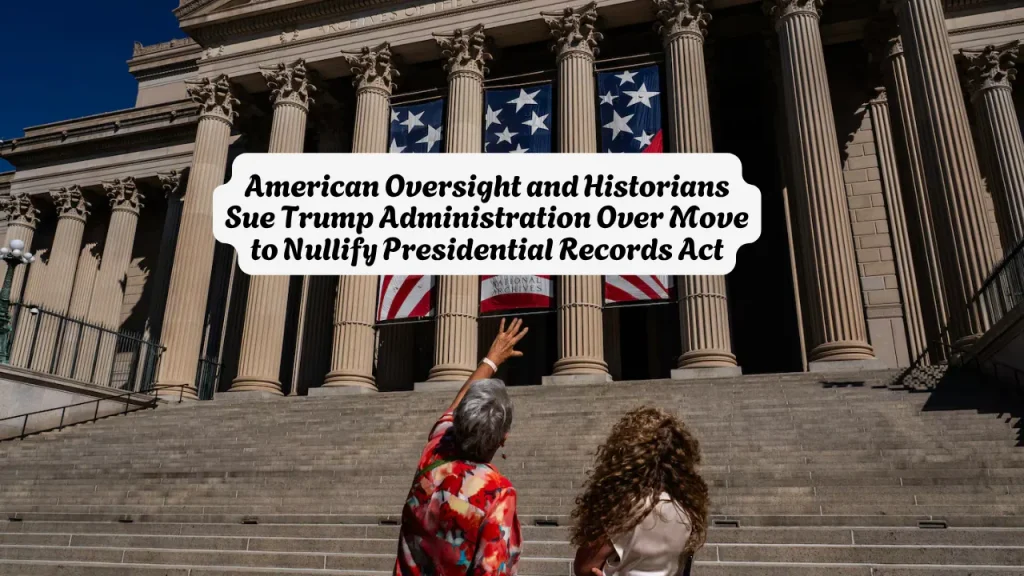
American Oversight and Historians Sue Trump Administration Over Move to Nullify Presidential Records Act
American Oversight and the American Historical Association (AHA) filed a federal lawsuit against President Donald J. Trump and the Department of Justice (DOJ) on April 6, 2026, seeking to halt an executive effort to declare the Presidential Records Act (PRA) unconstitutional. The legal challenge centers on a sweeping memorandum from the DOJ’s Office of Legal Counsel (OLC) which asserts that the President “need not further comply” with federal record-retention laws, potentially allowing for the destruction or concealment of over 700 million White House emails and digital records.
This is not a class action settlement; there is no monetary payout, claim form, or deadline for individual readers to receive cash. Instead, this is a civil transparency lawsuit filed in the U.S. District Court for the District of Columbia (Case No. 1:26-cv-01169). The outcome will determine whether presidential records remain the property of the American public or become the private property of the sitting president. For the general public, the “benefit” of this case is the preservation of historical accountability and the continued legality of Freedom of Information Act (FOIA) access to executive branch records.
Quick Case Snapshot
| Field | Details |
| Plaintiff | American Oversight; American Historical Association (AHA) |
| Defendant | Donald J. Trump (Official Capacity); U.S. Department of Justice (OLC) |
| Court | U.S. District Court for the District of Columbia |
| Case Number | 1:26-cv-01169 |
| Filing Date | April 6, 2026 |
| Judge | TBD (Initial assignment pending) |
| Claims Alleged | Violation of the Presidential Records Act (PRA); Ultra Vires Action; Constitutional Breach |
| Damages Sought | Declaratory and Injunctive Relief (No monetary damages) |
| Current Status | Newly Filed; Awaiting Defendant Response |
What the Lawsuit Alleges: The OLC “Nullification” Memo
The core of the lawsuit involves a March 2026 memorandum issued by the DOJ’s Office of Legal Counsel. This memo reportedly argues that the Presidential Records Act of 1978—a law passed following the Watergate scandal to ensure presidential documents belong to the public—infringes upon the executive branch’s “inherent Article II powers.”
According to court filings, the Trump administration’s new policy would allow the White House to:
- Halt the transfer of records to the National Archives and Records Administration (NARA).
- Use encrypted messaging applications and personal email for official business without archiving the data.
- Destroy electronic communications at the President’s sole discretion, bypassing the mandatory notification process for the Archivist of the United States.
The plaintiffs argue that this memo relies on “virtually no judicial authority” and directly defies the 1977 Supreme Court ruling in Nixon v. Administrator of General Services, which established that Congress has the authority to regulate the preservation of presidential materials.
Defendant’s Response: The “Unitary Executive” Defense
While a formal answer in court has not yet been filed, the DOJ and White House spokespeople have signaled a defense rooted in the Unitary Executive Theory. The administration’s public position is that the PRA creates an “unconstitutional burden” on the President’s ability to conduct confidential diplomatic and domestic policy.
The DOJ’s Office of Legal Counsel maintains that its memos are “binding” on executive agencies. This means that unless a court intervenes, agencies like NARA may be legally forced by the DOJ to stop collecting records, regardless of what the underlying federal statute says. The defense is expected to file a Motion to Dismiss based on the argument that the President has absolute immunity and authority over the internal operations of his office.
Related article: White Abarrio Owners File $10 Million Lawsuit Against Breeders’ Cup and CHRB Over Disputed 2025 Del Mar Scratch
The “Missing Pillars” of the Records Retention Lawsuit
1. Discovery Insights: What Data is at Risk?
The “discovery” phase of this litigation is expected to be contentious. Plaintiffs are seeking a full accounting of all records currently subject to the “non-compliance” policy. Specifically, the suit highlights 700 million White House emails from the current and previous administrations. Discovery will likely focus on whether any records have already been deleted or moved to private servers since the OLC memo was issued in March 2026. If it is proven that records were destroyed after the litigation was “reasonably anticipated,” the administration could face spoliation of evidence sanctions.
2. Bellwether Context: The Future of Executive Transparency
This case serves as a bellwether for the entire concept of government transparency in the 21st century. If the court upholds the OLC’s view that the PRA is unconstitutional, it sets a precedent that would effectively end the “public ownership” of presidential history. Future presidents of any party would no longer be legally bound to turn over records to the National Archives, turning the executive branch into a “black box” of information.
3. Objector Status: The Role of Historians and Archivists
While the public cannot “object” to a settlement here (as no money is involved), the American Historical Association (AHA) acts as the primary “objector” to the administration’s policy. As the largest professional organization in the U.S. devoted to the study of history, the AHA argues that the loss of these records would cause “irreparable harm” to the national record. They are joined by various “friend of the court” (amicus) groups representing journalists who rely on these records for investigative reporting.
4. Tax Implications: Public Funding of Private Litigation
While there is no “taxable payout” to individuals, the tax implications for the American public are significant. The cost of litigating this case is borne by taxpayers, as the DOJ uses public funds to defend the OLC’s memo. Furthermore, if the records are not preserved in a central location (NARA), the future cost of locating, retrieving, and declassifying these documents for FOIA requests could increase by millions of dollars due to the fragmented nature of private storage.
5. Attorney Fee Breakdown
In federal civil rights and transparency cases, the Equal Access to Justice Act (EAJA) allows prevailing plaintiffs to recover attorney fees from the government.
- Plaintiff Fees: American Oversight is a non-profit, but if they win, they may bill the government for thousands of hours of legal work at prevailing market rates.
- Government Costs: The DOJ’s internal costs for defending this suit are not publicly itemized but involve hundreds of hours from senior OLC and Civil Division attorneys, often costing the public upwards of $500,000 to $1.5 million per major constitutional challenge.
Legal Context: The Presidential Records Act (PRA)
The PRA changed the legal ownership of the official records of the President from private to public. It requires that:
- Preservation: All records related to the constitutional, statutory, or ceremonial duties of the President must be preserved.
- Archiving: These records must be transferred to the National Archives as soon as a President leaves office.
- Public Access: Most records become available to the public via FOIA 5 to 12 years after the President leaves office.
By challenging the constitutionality of this law, the Trump administration is attempting to reverse nearly 50 years of legal tradition.
Current Status & What Happens Next
The lawsuit is currently in the Initial Pleading Stage.
- May 2026: Deadline for the DOJ to file a response or a Motion to Dismiss.
- June 2026: Expected hearing on a Preliminary Injunction. Plaintiffs want the court to immediately order the White House to stop destroying records while the lawsuit proceeds.
- Late 2026: A decision from the D.C. District Court is expected, which will almost certainly be appealed to the D.C. Circuit and potentially the U.S. Supreme Court.
Frequently Asked Questions (FAQ)
1. Can I get a payout from the Trump records lawsuit?
No. This is a transparency and constitutional lawsuit, not a class action for money. There is no claim form to fill out and no settlement check coming to individuals.
2. Who is eligible to use these records if the lawsuit succeeds?
If the lawsuit succeeds and the records are preserved, any member of the public—including journalists, historians, and students—can request access to them through the National Archives and FOIA once the mandatory waiting periods (5–12 years) expire.
3. What happens if the court rules against the Presidential Records Act?
If the court agrees with the DOJ that the PRA is unconstitutional, the President would have the power to delete or keep any records they choose. This would likely end the practice of presidential libraries being open to the public for historical research.
4. Is there a deadline for this case?
There is no deadline for public action. However, the legal “deadline” for the government to respond to the complaint is typically 60 days from the date of service (roughly mid-June 2026).
5. How does this affect current FOIA requests?
If the OLC memo stands, agencies may begin denying FOIA requests for White House-adjacent records, claiming they are “personal” to the President rather than “agency records.” This lawsuit seeks to prevent that from happening.
Last Updated: April 15, 2026
This article is for informational purposes only and does not constitute legal advice. Allegations in a complaint are not findings of fact. All parties are presumed innocent of legal violations until proven otherwise in a court of law.
About the Author
Israr Ahmad is a legal content researcher with 4+ years of experience covering class action settlements and consumer rights cases. He has researched and published coverage of 2,500+ settlements using verified court records, settlement administrator filings, and government sources. Learn more about Israr.