
White Abarrio Owners File $10 Million Lawsuit Against Breeders’ Cup and CHRB Over Disputed 2025 Del Mar Scratch
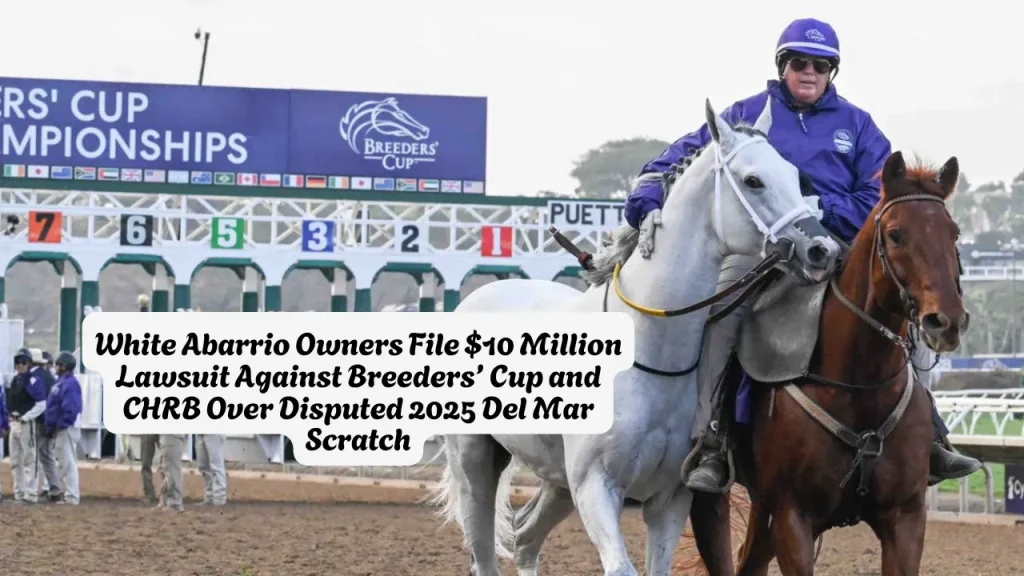
On April 14, 2026, the owners of the elite thoroughbred White Abarrio filed a high-stakes civil lawsuit in California Superior Court against Breeders’ Cup Limited, the California Horse Racing Board (CHRB), and the Del Mar Thoroughbred Club. The complaint alleges that these organizations wrongfully scratched the horse from the 2025 Breeders’ Cup Dirt Mile just minutes before the race, causing over $10 million in economic losses.
This is a single-party civil litigation, not a class action settlement. There is no public claim form or pool of money for bettors; instead, the case seeks to hold racing regulators and event organizers accountable for what the plaintiffs call an “unjustified and unlawful” decision that disregarded established veterinary protocols and scientific data. The lawsuit focuses on a last-minute determination regarding the horse’s gait—a movement style that the owners claim was well-documented, previously cleared, and consistent with the horse’s 2023 Breeders’ Cup Classic victory.
Quick Case Snapshot
| Field | Details |
| Plaintiff | Gary Barber; C2 Racing Stable, LLC |
| Defendant | Breeders’ Cup Limited; California Horse Racing Board; Del Mar Thoroughbred Club |
| Court | California Superior Court, Los Angeles County |
| Case Number | Not yet available (Newly Filed) |
| Filing Date | April 14, 2026 |
| Judge | TBD |
| Claims Alleged | Breach of Contract, Gross Negligence, Intentional Interference with Economic Relations |
| Damages Sought | In excess of $10 million (Compensatory + Punitive) |
| Current Status | Newly Filed; Awaiting formal response from Defendants |
What the Lawsuit Alleges: The “Choppy Gait” Controversy
The lawsuit centers on the events of October 31, 2025, at Del Mar Racetrack. White Abarrio, a champion horse with 10 wins in 24 starts, was slated to compete in the Grade 1 Breeders’ Cup Dirt Mile. However, during the post-parade—mere minutes before the start—on-track veterinarian Dr. Brant Cassady recommended a scratch, citing potential lameness in the horse’s left front leg.
According to the 20-page complaint, this decision was “not a mere exercise of reasonable veterinary judgment” but a breach of professional and regulatory duties. The plaintiffs allege:
- Historical Consistency: White Abarrio has a well-known, “choppy” gait that has been noted in nearly every pre-race inspection of his career.
- Prior Clearance: Dr. Cassady himself reportedly examined the horse before the 2023 Breeders’ Cup Classic, noted the same gait, and cleared the horse as “racing sound.” White Abarrio went on to win that race.
- Scientific Evidence Ignored: Leading up to the 2025 race, the horse underwent a PET scan and multiple daily inspections by the defendants’ own veterinary teams. The PET scan concluded that minor changes in the fetlock region were “within the range of normal for a racehorse in training.”
- Failure of Protocol: The suit claims the veterinary team failed to solicit input from the jockey, Irad Ortiz, Jr., who later stated the horse was warming up “perfectly.”
The owners contend that the sudden scratch deprived them of the opportunity to earn a share of the $1 million purse and significantly depressed White Abarrio’s commercial value as a future stallion.
Related article: Alec Bohm Sues Parents Alleging $3 Million Financial Mismanagement and Fraud
Defendant’s Response and Position
As of April 15, 2026, the defendants have maintained a posture of institutional silence. A spokesperson for Breeders’ Cup Limited stated the organization does not comment on “threatened or pending litigation.” Similarly, Del Mar President Josh Rubinstein noted that the club looks forward to “presenting our defense… at the appropriate time” but declined further details.
The California Horse Racing Board (CHRB) typically relies on the broad discretionary authority granted to official veterinarians to ensure equine safety. The defense is expected to argue that the veterinarian’s duty is to prioritize the horse’s welfare above all else, and that even a subjective assessment of lameness is sufficient grounds for a scratch under the Horseracing Integrity and Safety Authority (HISA) rules.
Legal Context: The “Missing Pillars” of the Dispute
1. Discovery Insights: The Battle Over Veterinary Logs
The discovery phase of this case will be uniquely technical. Attorneys for Gary Barber and C2 Racing Stable will likely subpoena the “Veterinary and Horsemen’s Guides” and the private internal logs of the CHRB’s daily inspections from the week leading up to the event. If those logs show that the horse was cleared by different veterinarians just hours before the scratch, the plaintiffs will have strong evidence of “arbitrary and capricious” decision-making.
2. Bellwether Context: A Test Case for HISA
This lawsuit serves as a bellwether for the thoroughbred industry. Since the federal implementation of HISA, there has been a significant push toward stricter, and sometimes more subjective, scratching protocols to prevent horse injuries. This case will test whether owners have any legal recourse when those protocols are applied inconsistently or if the “veterinarian’s discretion” is truly absolute in a court of law.
3. Objector Status: The Betting Public
While the betting public cannot officially join this suit as plaintiffs, they function as “unseen objectors.” The late scratch of a favorite like White Abarrio causes massive shifts in betting pools and late-money fluctuations. If the court finds the scratch was “negligent,” it could pave the way for future litigation from high-volume bettors or “Computer-Assisted Wagering” (CAW) groups who feel the lack of transparency in the scratching process constitutes unfair competition.
4. Tax Implications and Attorney Fee Breakdown
- Tax Considerations: For the plaintiffs, any recovery for “lost earnings” (the race purse) will be taxed as ordinary income. However, damages sought for the “depressed value” of the horse (stallion value) may be treated as capital losses or recoveries of basis, depending on how the final judgment or settlement is structured.
- Attorney Fees: This case is likely being litigated on a mixed fee or high-hourly basis, given the complexity. In California, if the plaintiffs prevail on the Breach of Contract claim, they may be able to recover attorney fees if the underlying agreement with the Breeders’ Cup contains a fee-shifting provision.
Current Status & What Happens Next
The case is currently in the Initial Pleading Stage. The defendants have approximately 30 days to file a formal answer or a demurrer (a motion to dismiss).
If the case proceeds to trial, it will likely be heard in early to mid-2027. The racing world is watching closely, as a victory for the owners could force a massive overhaul of how veterinarians communicate with trainers and jockeys during the “final minutes” before a world championship race.
FAQs: What Readers Need to Know
1. Is there a settlement I can claim if I bet on White Abarrio?
No. This is a private lawsuit between the owners and the racing organizations. Bettors who lost money or received a refund due to the scratch are not part of this litigation and will not receive any payout from this case.
2. Why was White Abarrio scratched?
The official reason given on the race day was “potential lameness” in the left front leg. The lawsuit, however, argues that this was a misinterpretation of the horse’s natural, long-standing gait.
3. How much money is at stake?
The owners are seeking over $10 million. This includes the potential race winnings and the “significant impairment” of the horse’s value for breeding purposes.
4. Can this lawsuit stop the Breeders’ Cup from scratching horses in the future?
While the lawsuit seeks a permanent injunction against “unfair competition,” it is unlikely to stop veterinarians from scratching horses for legitimate safety concerns. However, it could lead to new rules requiring more transparency and mandatory jockey consultations.
Last Updated: April 15, 2026
Disclaimer: This article is for informational purposes only and does not constitute legal advice. Allegations in a complaint are not findings of fact. All parties are presumed innocent until proven otherwise in a court of law.
About the Author
Israr Ahmad is a legal content researcher with 4+ years of experience covering class action settlements and consumer rights cases. He has researched and published coverage of 2,500+ settlements using verified court records, settlement administrator filings, and government sources. Learn more about Israr.