
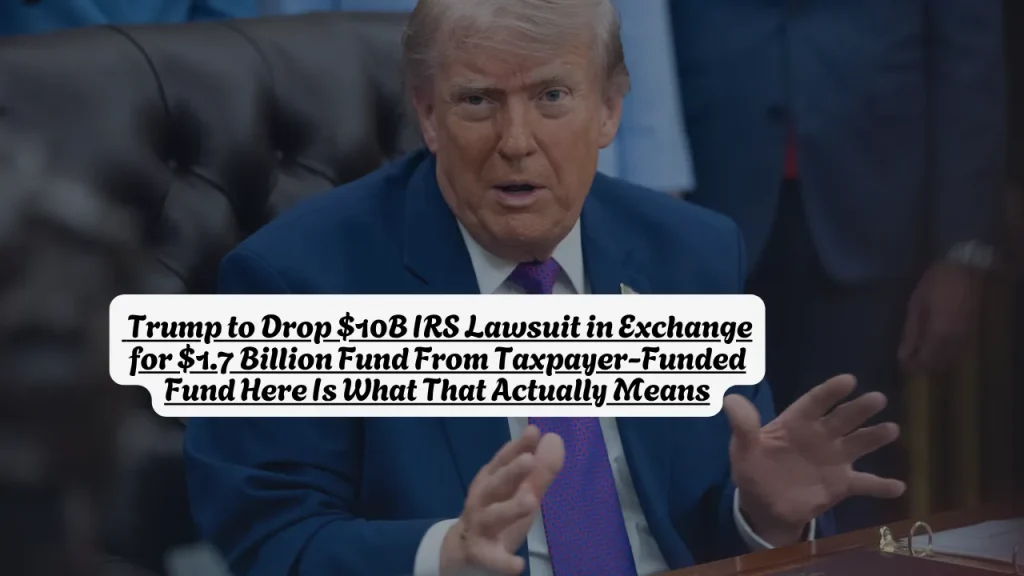
Trump to Drop $10B IRS Lawsuit in Exchange for $1.7 Billion Fund From Taxpayer-Funded Fund Here Is What That Actually Means
Prepared by the AllAboutLawyer.com Editorial Team and reviewed for factual accuracy against reporting from ABC News, CNN, NBC News, and The New York Times on May 15, 2026. Last Updated: May 15, 2026
President Donald Trump is expected to drop his $10 billion lawsuit against the IRS in exchange for the creation of a $1.7 billion taxpayer-funded compensation fund — one that would pay political allies who claim they were targeted by the Biden administration, including the nearly 1,600 people charged in connection with the January 6, 2021 Capitol attack. The arrangement, reported by ABC News on May 14, 2026, has not been officially announced and sources caution final terms have not yet been set. If it goes forward, legal experts describe it as an unprecedented use of public money with little oversight.
Quick Facts — Trump IRS Lawsuit and Proposed Settlement
| Field | Detail |
| Trump’s Lawsuit | $10 billion against the IRS and Treasury Department, filed January 2026 |
| Alleged Harm | Unauthorized leak of Trump’s confidential tax returns by IRS contractor Charles Littlejohn |
| Proposed Deal | Trump drops lawsuit; DOJ creates a $1.7 billion compensation fund for alleged Biden-era “weaponization” victims |
| Who Could Collect | Jan. 6 defendants, other Trump allies claiming wrongful targeting; potentially Trump-linked entities |
| Fund Source | Treasury Department’s Judgment Fund — existing taxpayer money; no new congressional vote required |
| Oversight | Minimal — commission can withhold procedures and recipient identities; Trump can remove members without cause |
| Judge’s Concern | U.S. District Judge Kathleen Williams questioned whether Trump can sue agencies he controls |
| Settlement Deadline Pressure | DOJ must respond to court by May 20, 2026 |
| Status | Expected but not yet officially announced as of May 15, 2026 |
| Last Updated | May 15, 2026 |
What Is Trump’s Lawsuit Against the IRS About?
The lawsuit begins with a real crime. Between 2018 and 2020, Charles Littlejohn — a contractor at Booz Allen Hamilton working inside the IRS — illegally accessed and stole the confidential tax return information of thousands of wealthy Americans, including Trump and his family. He leaked that information to media outlets including The New York Times and ProPublica.
The New York Times published stories in September 2020 revealing that Trump paid only $750 in federal income taxes in both 2016 and 2017, and in some years paid no federal income tax due to losing more money than he made. Littlejohn also stole records belonging to roughly 7,600 of the highest net-worth individuals in the country, including Jeff Bezos and Elon Musk.
In October 2023, Littlejohn pleaded guilty to the unauthorized disclosure of income tax returns and was sentenced in January 2024 to the maximum term of five years in federal prison. He is currently appealing his sentence.
Trump, along with his sons Donald Trump Jr. and Eric Trump, filed suit in January 2026 alleging that the government failed to protect his and the Trump Organization’s confidential tax information. Trump’s legal team alleged that the IRS is legally responsible for Littlejohn’s actions because he had staff-like access to tax returns and exploited longstanding security failures the IRS had been warned about but had not corrected.
Legal experts who reviewed the complaint broadly agreed the underlying facts involved a real wrong — but identified serious obstacles, including the statute of limitations, sovereign immunity, and the near-impossibility of proving $10 billion in actual damages from a newspaper story.
Related article: Mifepristone Supreme Court Ruling Explained, What the Supreme Court Just Decided and What Happens Next
What Is the Proposed Settlement — and What Is the Judgment Fund?
The commission overseeing the proposed compensation fund would have total authority to hand out approximately $1.7 billion in taxpayer funds to settle claims brought by anyone who alleges they were harmed by the Biden administration’s “weaponization” of the legal system, including the nearly 1,600 individuals charged in connection with the January 6 Capitol attack as well as potentially entities associated with President Trump himself.
The money would come not from any new congressional appropriation but from an existing pool of public funds. The Judgment Fund is a permanent, standing appropriation administered by the Treasury that pays court judgments and agency-approved settlements against the United States. It does not require congressional action for individual payouts. That means Congress would have no vote on this specific payout.
In addition to the $1.7 billion fund, the settlement would include a public apology from the IRS. The settlement terms are expected to prohibit Trump from directly receiving payments related to those three legal claims; however, entities associated with Trump are not explicitly barred from filing additional claims.
The settlement would also resolve $230 million in legal claims related to the 2022 search of his Mar-a-Lago estate and the Russia investigation he faced during his first term in office.
The Oversight Problem — Who Controls the Fund?
This is the detail that has drawn the most concern from legal analysts across the political spectrum. Under the terms of the potential settlement agreement, President Trump would have the authority to remove members of the commission running the fund without cause, and the commission would be under no obligation to disclose its procedures or decision-making process for awarding more than a billion dollars.
Trump’s proposed commission is expected to be composed of five members who would issue monetary awards based on a majority vote, and the process for awarding money and the identities of recipients could be kept private. Any funds not distributed before Trump leaves office would be returned to the government, sources said.
The proposed creation of the compensation fund has led some administration officials to raise ethical concerns — stemming not only from Trump suing his own government but also from having control of an entity that can freely hand out $1.7 billion to his allies. Trump himself acknowledged in October 2025 that the arrangement “looks bad,” saying: “It’s awfully strange to make a decision where I’m paying myself.”
Why the Judge Was Already Skeptical of Trump’s IRS Lawsuit
The settlement talks accelerated in part because the lawsuit was in legal trouble in court. U.S. District Judge Kathleen Williams questioned whether Trump and the agencies are “sufficiently adverse to each other” and ordered both sides to provide more information on the relationship. “Although President Trump avers that he is bringing this lawsuit in his personal capacity, he is the sitting president and his named adversaries are entities whose decisions are subject to his direction,” Williams wrote.
The court ordered the parties to respond by May 20, 2026 — the same deadline that appears to have pushed the DOJ toward settlement talks. Legal experts told The New York Times that even if the judge ultimately found the settlement to be collusive or reached in bad faith, she probably would not be able to stop the money or other benefits from changing hands.
How This Fits a Pattern of DOJ Settlements With Trump Allies
This proposed deal is not happening in isolation. The DOJ has already settled several lawsuits brought by other Trump allies.
In March 2026, the DOJ settled a lawsuit with former National Security Adviser Michael Flynn, awarding him over a million dollars following what he described as a wrongful prosecution. Flynn had sued the government for $50 million, alleging the FBI tried to entrap him. In April 2026, the DOJ settled a lawsuit brought by former Trump campaign adviser Carter Page, who sued the DOJ and FBI over surveillance related to Russian contacts in 2016.
The proposed Jan. 6 compensation component also follows Trump’s blanket pardons of defendants charged in connection with the Capitol attack. Since those pardons, hundreds of defendants have begun seeking payouts from the federal government. The Proud Boys separately filed a $100 million lawsuit against the DOJ in June 2025, alleging their prosecutions were politically motivated.
Frequently Asked Questions
Does Congress have to approve this $1.7 billion fund?
No. The proposed fund would draw money from the Treasury Department’s Judgment Fund, a permanent appropriation used to pay government settlements. Congress would not need to separately approve the payment. This is one of the most significant concerns raised by critics of the arrangement.
Can Jan. 6 defendants automatically collect from this fund?
Not automatically. The commission would have total authority to hand out funds to anyone who alleges they were harmed by Biden-era “weaponization.” The procedures for proving a claim, the amounts each person could receive, and even the recipients’ identities could all be kept private under the proposed terms.
Would Trump personally receive money from this deal?
The settlement terms are expected to prohibit Trump from directly receiving payments related to the three legal claims; however, entities associated with Trump are not explicitly barred from filing additional claims. Trump has also said publicly he would donate any proceeds to charity, though he has not named specific charities.
What law governs this type of government settlement?
The Federal Tort Claims Act (FTCA) is the primary federal law that allows individuals to sue the U.S. government for civil wrongs committed by federal employees or agencies. The Judgment Fund, established under 31 U.S.C. § 1304, is the mechanism through which those settlements are paid. Legal scholars note that a settlement of this scale — and with this structure — would have no precedent in FTCA history.
Has the settlement been officially confirmed?
No. As of May 15, 2026, the deal has not been officially announced. Sources familiar with the matter told ABC News it is expected in the coming days, but “the final terms will not be set until they are officially announced.”
Sources & References
- Treasury Department’s Judgment Fund: 31 U.S.C. § 1304
- Federal Tort Claims Act: 28 U.S.C. §§ 1346, 2671–2680
Disclaimer: This article is for general informational and educational purposes only and does not constitute legal advice. Laws vary by state and jurisdiction. For advice about your specific situation, consult a qualified attorney.
About the Author
Israr Ahmad is a legal content researcher with 4+ years of experience covering class action settlements and consumer rights cases. He has researched and published coverage of 2,500+ settlements using verified court records, settlement administrator filings, and government sources. Learn more about Israr.