
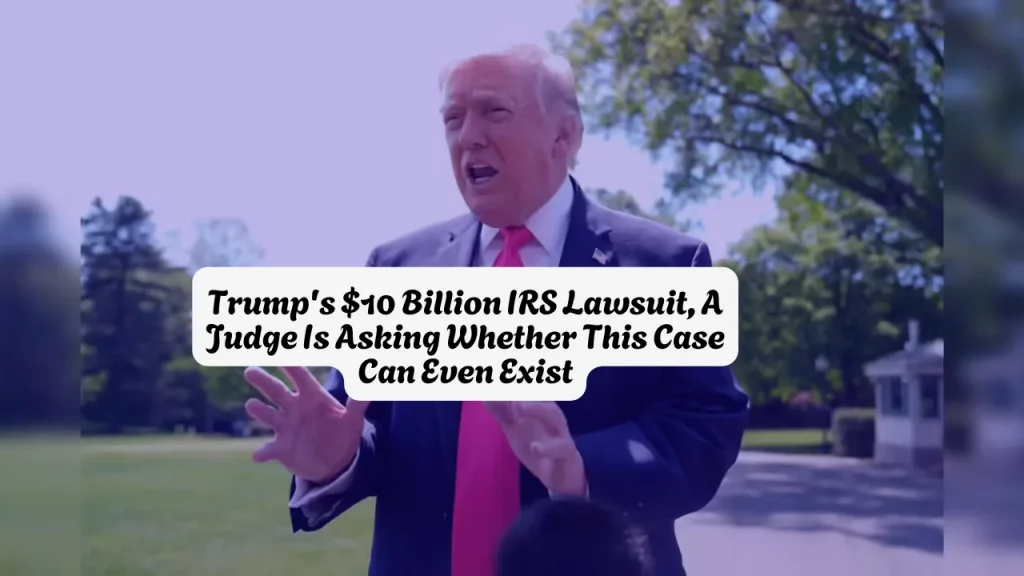
Trump’s $10 Billion IRS Lawsuit, A Judge Is Asking Whether This Case Can Even Exist
Prepared by the AllAboutLawyer.com Editorial Team and reviewed for factual accuracy against CNN Politics, ABC News, NBC News, and IRS.gov on April 25, 2026. Last Updated: April 25, 2026
President Donald Trump filed a $10 billion lawsuit against the IRS and Treasury Department over the leak of his tax returns, and a federal judge is now questioning whether the case can legally proceed — because Trump, as president, effectively controls both agencies he is suing. The lawsuit stems from one of the largest unauthorized disclosures of tax records in U.S. history. Trump’s lawyers are now in active discussions with the IRS and Treasury to settle the case before it ever goes to trial.
Quick Facts: Trump v. IRS and Treasury Department
| Field | Detail |
| Lawsuit Filed | January 29, 2026 |
| Plaintiffs | Donald Trump (personal capacity), Donald Trump Jr., Eric Trump, the Trump Organization |
| Defendants | Internal Revenue Service; U.S. Treasury Department |
| Alleged Violation | Failure to prevent unauthorized disclosure of confidential tax return information under 26 U.S.C. § 7431 |
| Damages Sought | $10,000,000,000 |
| Current Court Stage | Pre-answer; judge questioning whether federal court has jurisdiction |
| Court & Jurisdiction | U.S. District Court for the Southern District of Florida — Judge Kathleen M. Williams |
| Lead Law Firm | Private attorneys for Trump; DOJ represents IRS and Treasury |
| Next Hearing Date | May 27, 2026 (Miami); written filings due May 20, 2026 |
| Official Case Website | TBD — no official case website has been launched |
| Last Updated | April 25, 2026 |
What Is the Trump IRS Lawsuit About?
The story behind this lawsuit starts with a government contractor named Charles Littlejohn. Littlejohn was rehired as an IRS contractor in 2017, and his first target was 15 years of Donald Trump’s tax returns, which he shared with The New York Times between around August and October 2019 — revealing that Trump had paid only $750 in federal income taxes in 2016 and 2017, and in some years paid no federal income tax at all.
Littlejohn then stored tax information belonging to thousands of the country’s wealthiest Americans on a personal device before leaking it to ProPublica, which used the data for a series revealing that many of America’s wealthiest people pay little or no taxes. It was later revealed that he compromised the tax records of 405,000 individuals and businesses. In October 2023, Littlejohn pleaded guilty to the unauthorized disclosures of income tax returns, and was sentenced to five years in prison.
Trump, along with his sons Donald Trump Jr. and Eric Trump, filed suit in January 2026 alleging that the government failed to protect his and the Trump Organization’s confidential tax information. Trump’s legal team argued that the IRS is legally responsible for Littlejohn’s actions because he had exploited longstanding security failures that the IRS had been warned about but had gone uncorrected. The legal theory rests on 26 U.S.C. § 7431, the federal statute that allows taxpayers to sue the government for unauthorized disclosures of their tax returns — a taxpayer rights provision that exists precisely for situations like this one.
Why Is a Judge Questioning the Lawsuit?
This is where things get genuinely unusual — and it is the reason this case is attracting so much attention right now.
Florida District Judge Kathleen M. Williams said it is unclear whether Trump and the agencies are “sufficiently adverse to each other,” and ordered both sides to provide more information on their relationship. “Although President Trump avers that he is bringing this lawsuit in his personal capacity, he is the sitting president and his named adversaries are entities whose decisions are subject to his direction,” Williams wrote.
In plain English: a lawsuit only works if two genuinely opposing sides are fighting over something. The judge is asking whether that actually exists here, given that Trump — as president — oversees the IRS and the Treasury Department that his private lawyers are suing.
Related article: Trump Lawsuits 2026, Every Major Case, What Happened, and Where Things Stand
The judge pointed to an executive order Trump signed barring executive branch employees from advancing legal interpretations that contradict the president’s opinion on a matter of law. She noted that the Attorney General has a statutory obligation to defend the IRS in court, but is also required by executive mandate to follow the president’s legal positions — raising questions about whether the parties are truly fighting each other at all.
A group of former government officials filed an amicus brief with the court last month raising similar concerns, writing that “this case is extraordinary because the President controls both sides of the litigation, which raises the prospect of collusive litigation tactics.”
Judge Williams ordered both parties to explain “whether a case and controversy exists” by May 20, and scheduled a hearing on the matter for May 27 in Miami.
What Are the Plaintiffs Seeking in This Lawsuit?
Trump is not seeking a modest sum. The lawsuit asks for $10 billion in damages from the IRS and Treasury. The complaint alleged “reputational and financial harm” as well as “public embarrassment” from the leak, which led to reporting that Trump had paid only $750 in federal income taxes in 2016 and 2017.
The legal basis is Section 7431 of the Internal Revenue Code, which gives any taxpayer whose returns are unlawfully disclosed the right to sue the federal government for civil damages. That statute exists to protect every American taxpayer — not just presidents. Trump is using the same law that any citizen affected by the Littlejohn leak could theoretically invoke.
Trump’s efforts to resolve his lawsuit come as his Department of Justice recently settled two other high-profile cases — a $1 million settlement for former national security adviser Michael Flynn’s wrongful prosecution case, and a separate settlement with former Trump campaign adviser Carter Page. Those prior settlements are feeding concern among critics about whether the DOJ is being used to direct taxpayer money toward Trump’s political allies.
Democratic lawmakers this week introduced a bill that aims to ban the president, vice president, and their families from collecting lawsuit settlement payments from the government. Trump has said he would donate any received funds to charity, but that money would still come from U.S. taxpayers.
What Should You Do If You Were Also Affected by the Littlejohn Leak?
You may not realize it, but you could be one of the 405,000 taxpayers whose financial records Littlejohn stole. The IRS has sent letters to taxpayers whose information was unlawfully disclosed, confirming that it has notified 405,427 taxpayers whose information was inappropriately disclosed — with 89% of those being business entities.
Here is what to do right now:
- Check your mail. The IRS sent Letter 6613 to affected taxpayers. If you received one, your records were part of the breach.
- Save it. That letter is your documentation of the harm.
- Know your rights. The same statute Trump is using — 26 U.S.C. § 7431 — gives any affected taxpayer the right to pursue a compensation for damages claim against the government for an unauthorized disclosure.
- Consult a tax or privacy attorney. If you received the IRS notification letter and believe you suffered harm from the disclosure of your financial information, a free legal consultation with a tax privacy attorney can help you understand whether you have an individual claim.
- Monitor this case. If the Trump lawsuit settles or a court ruling establishes new precedent under § 7431, it could affect the legal landscape for all affected taxpayers.
No class action has been filed on behalf of the 405,000 affected individuals. This is a space to watch.
Trump IRS Lawsuit Timeline
| Milestone | Date |
| Littlejohn steals Trump tax records, leaks to NYT | 2018–2019 |
| Littlejohn leaks billionaires’ records to ProPublica | 2019–2020 |
| Littlejohn pleads guilty | October 2023 |
| Littlejohn sentenced to 5 years in prison | January 29, 2024 |
| IRS begins notifying 405,427 affected taxpayers | February–May 2024 |
| Trump files $10 billion lawsuit (personal capacity) | January 29, 2026 |
| Trump lawyers disclose settlement talks, request 90-day delay | April 17, 2026 |
| Judge Williams issues order questioning jurisdiction; denies delay | April 24, 2026 |
| Written briefings due from both sides | May 20, 2026 |
| Jurisdiction hearing scheduled in Miami | May 27, 2026 |
| Expected settlement or next major ruling | TBD — depends on May 27 hearing outcome |
Frequently Asked Questions: Trump’s $10 Billion IRS Lawsuit
1. Is there a class action lawsuit against the IRS over the Littlejohn leak?
Not currently. Trump’s lawsuit is an individual civil action filed under 26 U.S.C. § 7431. No certified class action exists on behalf of the 405,000 other affected taxpayers, though any of them could theoretically pursue individual claims under the same statute.
2. Do I need to do anything right now if my records were part of the Littlejohn breach?
If you received IRS Letter 6613, your records were disclosed. No action is required today, but you should save that letter. If you want to explore an individual legal claim, consult a consumer rights lawyer familiar with federal tax privacy law. No claim deadline is currently published for private citizens.
3. Can Trump actually win $10 billion from the IRS?
That is deeply uncertain. The more immediate question — raised by Judge Williams on April 24 — is whether the case can proceed at all. If the judge finds the parties lack genuine adverseness, the case could be dismissed on constitutional grounds before anyone litigates the merits or the damages.
4. Why would a settlement mean taxpayers pay Trump?
If the case resolves with any monetary settlement, it would be Trump’s own administration paying him and his family — because the DOJ, which reports to Trump, would be the entity authorizing any payment. That dynamic is the core ethical concern critics and the amicus brief have raised.
5. How will I know if the Trump IRS case settles?
Trump’s lawyers disclosed the settlement talks in a court filing requesting a 90-day pause, describing discussions designed to “narrow or resolve the issues efficiently.” Any settlement would require court approval and would become public record. Monitor AllAboutLawyer.com and the Southern District of Florida PACER docket for updates.
6. What happened to Charles Littlejohn?
Before sentencing, federal District Judge Ana Reyes called his conduct “an attack on our constitutional democracy,” and sentenced him to the statutory maximum of five years in prison. Littlejohn is currently serving his sentence at the Federal Correctional Institution in Marion, with a release date of October 22, 2027.
7. Is this the first time a president has sued a federal agency they oversee?
Trump himself acknowledged “the unique dynamic of this litigation” in January, telling reporters aboard Air Force One that “it’s very interesting” to be on both sides of a lawsuit. Legal analysts and the judge herself have described this situation as legally unprecedented — no clear prior case law directly governs a sitting president suing an agency under their own executive authority.
Sources & References
- CNN Politics: Judge questions Trump’s $10B IRS lawsuit — April 24, 2026
- DOJ: Former IRS Contractor Sentenced
Disclaimer: This article is for informational purposes only and does not constitute legal advice. Legal claims and outcomes depend on specific facts and applicable law. For advice regarding a particular situation, consult a qualified attorney.
About the Author
Israr Ahmad is a legal content researcher with 4+ years of experience covering class action settlements and consumer rights cases. He has researched and published coverage of 2,500+ settlements using verified court records, settlement administrator filings, and government sources. Learn more about Israr.