
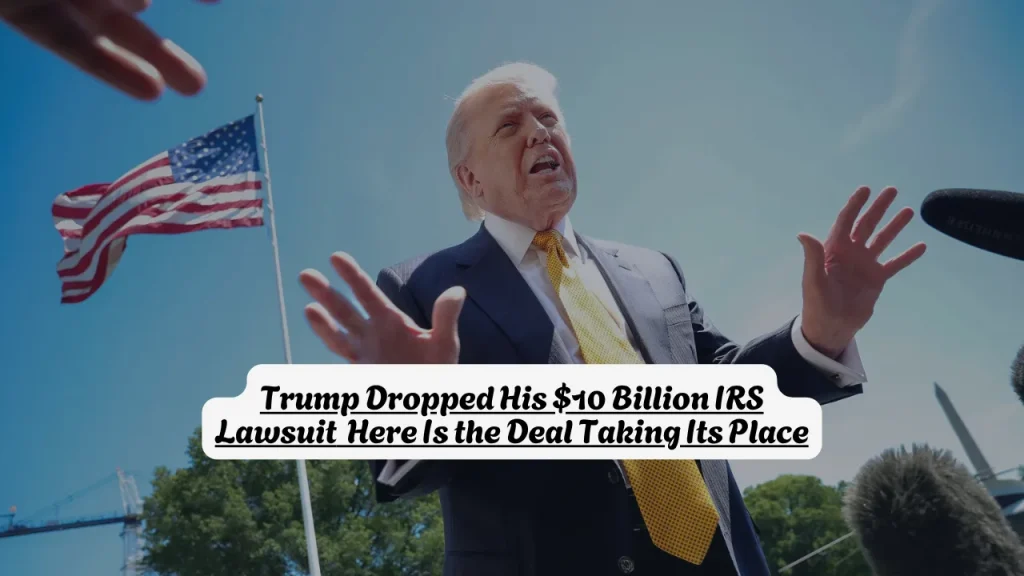
Trump Dropped His $10 Billion IRS Lawsuit Here Is the Deal Taking Its Place
Trump dropped his $10 billion lawsuit against the Internal Revenue Service on May 18, 2026, filing court documents that dismissed the case with prejudice — meaning he cannot bring it again.
The dismissal came as talks advanced on a far larger arrangement: a taxpayer-funded compensation fund for political allies.
Quick Facts
| Field | Detail |
| Lawsuit Filed | January 2026 |
| Plaintiffs | Donald Trump, Donald Trump Jr., Eric Trump |
| Defendants | IRS and Treasury Department |
| Claim Amount | $10 billion |
| Dismissed | May 18, 2026 — with prejudice |
| Proposed Fund | ~$1.8 billion from Treasury’s Judgment Fund |
| Last Updated | May 18, 2026 |
Why Trump Sued the IRS
The lawsuit accused the IRS of an unauthorized leak of Trump’s tax returns from his first presidency. Trump alleged the agency failed to protect confidential tax information belonging to him and the Trump Organization.
Charles Littlejohn, a contractor at Booz Allen Hamilton working inside the IRS, illegally accessed and stole the tax return information of thousands of wealthy Americans, including Trump and his family. He leaked that information to media outlets including The New York Times and ProPublica. Littlejohn was sentenced to five years in prison. All About Lawyer
The legal basis for the claim is 26 U.S.C. § 7431, the federal statute that lets any taxpayer sue the government for an unauthorized disclosure of their tax records.
For a full breakdown of how the original lawsuit was structured, read our earlier coverage: Trump Sued the IRS for $10 Billion — Now His Own Justice Department May Pay Him Using Taxpayer Money.
The Problem the Judge Saw
The case was already in legal trouble before the dismissal.
U.S. District Judge Kathleen Williams questioned whether Trump and the agencies were “sufficiently adverse to each other,” noting that he is the sitting president and his named adversaries are entities whose decisions are subject to his direction. All About Lawyer
Williams ordered the Justice Department to explain in writing by May 20 how she could oversee the case when the Constitution requires legitimate adversarial disputes for courts to function. She had also set a hearing for May 27. All About Lawyer
Trump’s lawyers moved to dismiss before that hearing took place.
Related article: GAF Is Being Sued for Antitrust Violations and Contractor Retaliation Here Is What the Lawsuit Alleges
The $1.8 Billion Fund Being Built in Its Place
Trump is expected to drop his lawsuit in exchange for the creation of a $1.7 billion fund to compensate allies who claim they were wrongfully targeted by the Biden administration. The commission overseeing the fund would have total authority to hand out approximately $1.7 billion in taxpayer funds to settle claims brought by anyone who alleges they were harmed by the Biden administration’s “weaponization” of the legal system, including the nearly 1,600 individuals charged in connection with the January 6 Capitol attack.
Sources caution that the final terms will not be set until they are officially announced
The money would come from the Treasury Department’s Judgment Fund, which pays out court judgments and settlements against the federal government
Who Would Run It — and Who Controls It
The “President Donald J. Trump Truth and Justice Commission” would have five members. Four would be appointed by the attorney general, and Trump would reportedly have the right to remove any of them without cause. The commission would not have to disclose how it decides to allot the money.
In addition to a public apology from the IRS, the compensation fund is believed to be the main condition for Trump to drop a series of legal actions he filed against the federal government, including the $10 billion lawsuit related to the 2019 leak of his tax returns, as well as $230 million in legal claims related to the 2022 search of his Mar-a-Lago estate and the Russia collusion investigation.
Other Trump Allies Already Settled
In March, the DOJ settled a lawsuit with Michael Flynn, who sued the government for $50 million accusing the FBI of trying to entrap him. Flynn was awarded over $1 million. Carter Page, a former Trump campaign adviser, also settled a lawsuit with the Trump administration in April.
For our full earlier breakdown of the proposed fund, see: Trump’s $1.7B IRS Deal Explained — What It Means for Taxpayers.
The Criticism
Democratic leaders called the arrangement “corruption.” Rep. Jamie Raskin stated that Trump was “orchestrating a $1,700,000,000 fraud on the American taxpayer to line the pockets of his MAGA political allies.”
Legal experts have described the arrangement as an unprecedented use of public money with little oversight. Under the terms, Trump can remove commission members without cause, and the commission would not be required to disclose its decision-making on who receives awards.
Trump himself acknowledged in October 2025 that the situation “looks bad,” saying he found it “awfully strange to make a decision where I’m paying myself.”
Frequently Asked Questions
What law did Trump use to sue the IRS?
Trump’s lawsuit relied on 26 U.S.C. § 7431 of the Internal Revenue Code. That statute allows any taxpayer to sue the federal government when their tax returns are unlawfully disclosed by a government officer or employee.
Did Trump receive any money from dropping the lawsuit?
No direct payment has been confirmed. The settlement terms are expected to prohibit Trump from directly receiving payments; however, entities associated with Trump are not explicitly barred from filing additional claims.
Is the $1.8 billion fund approved yet?
The administration is preparing to go forward with the plan, but the fund has not been officially announced or finalized as of May 18, 2026.
Could other taxpayers affected by the Littlejohn leak file their own claims?
Yes. The IRS notified 405,427 taxpayers whose information was inappropriately disclosed by Littlejohn — 89% of those being business entities. The IRS sent Letter 6613 to affected taxpayers. The same statute Trump used — 26 U.S.C. § 7431 — is available to any taxpayer whose returns were unlawfully disclosed. All About Lawyer
What happens to the fund when Trump leaves office?
Any funds not distributed before Trump leaves office would be returned to the government, sources said. All About Lawyer
Sources
- CNN Politics, May 18, 2026
- ABC News, May 14–18, 2026
- TIME, May 16, 2026
- U.S. Internal Revenue Code, 26 U.S.C. § 7431 — Cornell Law LII
- Treasury Department Judgment Fund, 31 U.S.C. § 1304
Prepared by the AllAboutLawyer.com Editorial Team and reviewed for factual accuracy against official legal sources on May 18, 2026. Last Updated: May 18, 2026
Disclaimer: This article is for general informational and educational purposes only and does not constitute legal advice. Laws vary by state and jurisdiction. For advice about your specific situation, consult a qualified attorney.
About the Author
Israr Ahmad is a legal content researcher with 4+ years of experience covering class action settlements and consumer rights cases. He has researched and published coverage of 2,500+ settlements using verified court records, settlement administrator filings, and government sources. Learn more about Israr.