
Amare Global FTC Lawsuit Mental Health Income Claims, Did Its Supplements Really Treat Depression, Anxiety, and ADHD? — FTC v. Amare Global Holdings Inc., C.D. Cal. (2026)
Amare Global Holdings Inc. is facing a federal lawsuit — filed by the FTC on June 2, 2026, in the U.S. District Court for the Central District of California — alleging the company falsely told consumers its dietary supplements could treat depression, anxiety, and ADHD in children and adults, while separately misleading people who signed up to sell its products about how much money they were likely to make. The FTC also sued three of the company’s principals for their roles in the alleged violations. If you bought Amare supplements for yourself or your child based on mental health claims, or if you joined Amare as a “brand partner” based on income promises, this case is directly relevant to you.
Amare Global FTC Lawsuit — Key Facts
| Field | Detail |
| Lawsuit Filed | June 2, 2026 |
| Plaintiff | Federal Trade Commission |
| Defendants | Amare Global Holdings Inc.; Shawn Talbott (former chief science officer); Patrick Hintze (founding brand partner); David Chung (current CEO and majority shareholder) |
| Court | U.S. District Court, Central District of California |
| Alleged Harm | False and unsubstantiated mental health claims; deceptive income claims to brand partner recruits |
| Specific Laws Alleged | Section 5(a) of the FTC Act, 15 U.S.C. § 45(a) — prohibiting unfair or deceptive acts in commerce |
| Products Named | Happy Juice; Kids Mood+; Kids Happy Juice; Happy Juice Product Pack |
| Who Is Affected | Consumers who bought Amare supplements for mental health benefits; current and former “brand partners” who joined based on income representations |
| Prior FTC Orders | Talbott — CortiSlim/CortiStress settlement (2005); Hintze — Green Foot Global/EnviroTabs settlement (2013) |
| Settlement Status | No settlement — active litigation filed June 2, 2026 |
| FTC Commission Vote | 2–0 authorizing the complaint |
| Last Updated | June 3, 2026 |
Who Is Amare Global and Why Is the FTC Suing?
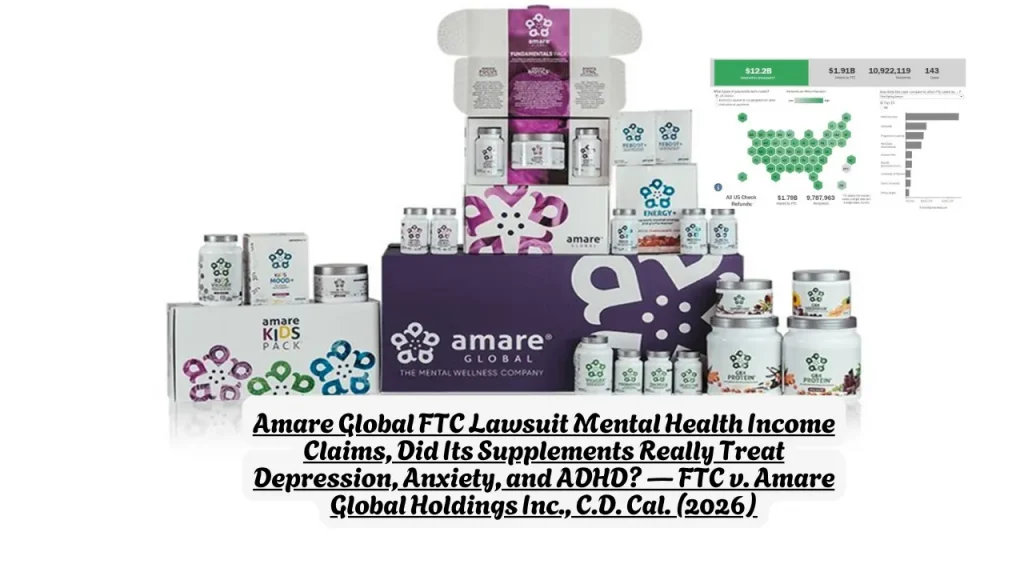
Amare Global Holdings is a multilevel marketing company that sells dietary supplements marketed around the concept of mental wellness. The company sells products for children and adults including Kids Happy Juice, Kids Mood+, and the Happy Juice Product Pack. It operates through a network of independent salespeople the company calls “brand partners” who recruit other sellers and promote products on social media platforms including Instagram, TikTok, YouTube, and Facebook.
This is not a company the FTC is encountering for the first time. Two of the three individual defendants named alongside Amare already have prior FTC orders on their records. Shawn Talbott, the company’s former chief science officer, and Patrick Hintze, its founding brand partner, are both subject to previous orders with the FTC that prohibit them from making false, misleading, and unsubstantiated claims.
Talbott’s prior order dates to 2005. The FTC sued him in 2004 in connection with CortiSlim and CortiStress, two dietary supplements he formulated, alleging unsubstantiated weight-loss and disease-prevention claims. Under a stipulated final order, Talbott was barred from misrepresenting the health benefits of any supplement and required to have competent and reliable scientific evidence to support any claims made about dietary products. Hintze’s prior order stems from a 2013 FTC action against Green Foot Global, an MLM that sold a fuel additive called EnviroTabs with false efficacy claims. He settled with a permanent injunction prohibiting him from making unsubstantiated product claims.
What the FTC Says Amare Global Told Consumers — and Why That Was Wrong
The complaint centers on two distinct categories of allegedly false claims: health representations made to supplement buyers, and income representations made to brand partner recruits.
On the health claims side, the FTC’s position is that Amare marketed its products as treatments for serious mental health conditions — without scientific evidence to back any of it up.
The FTC alleges the defendants’ claims violated the FTC Act by claiming without substantiation that Amare’s products, including Happy Juice, Kids Mood+, and Kids Happy Juice would lower, reduce, or regulate cortisol; raise, increase, or normalize serotonin, dopamine, and GABA; and cure, treat, or mitigate depression, anxiety, and ADHD.
The marketing went further than general wellness language. The company’s brand partners claimed that Amare’s products are “scientifically backed” or clinically proven, and would treat or mitigate depression, including by reducing the risk of suicide in children. Claiming a dietary supplement reduces suicide risk in children — without substantiated evidence — is precisely the kind of marketing the FTC Act prohibits as deceptive.
FTC Bureau of Consumer Protection Director Christopher Mufarrige said: “Amare’s claims were not only deceptive but dangerous since it was aware that some brand partners were taking advantage of parents looking for products to help their children, who suffer from serious conditions like depression and anxiety and need proven treatments.”
On the income claims side, the FTC says Amare misled people considering joining as brand partners about how much they could realistically earn. The FTC alleges Amare claimed that anyone can join the company and earn specific stated amounts of income, such as $500 a month, or supplement or replace their current income, even if they have neither MLM sales experience nor a large social media following.
These two categories together — health claims targeting desperate parents and income claims targeting people seeking extra money — form the core of the FTC’s complaint. For deeper context on how supplement false advertising cases develop through federal court, see AllAboutLawyer.com’s coverage of the Airborne vitamin C false advertising class action lawsuit, which involves similar unsubstantiated label claims. For a look at how courts have handled settlement of similar supplement false-health-benefit litigation, the Balance of Nature federal class action dismissal and California settlement traces how FTC-adjacent supplement cases move from complaint to resolution.
If you bought Amare products — especially Kids Mood+, Kids Happy Juice, or the Happy Juice Product Pack — based on claims about depression, anxiety, or ADHD, or if you joined as a brand partner after seeing income representations, this case is about what you were told and whether it was true.
Are You Affected by the Amare Global FTC Lawsuit?
This is an FTC enforcement action, not a private class action with a claim form. No money is available to consumers yet. But here is who the allegations most directly concern.
You may be affected if:
- You purchased Happy Juice, Kids Mood+, Kids Happy Juice, or the Happy Juice Product Pack based on mental health claims — particularly claims about depression, anxiety, or ADHD treatment for yourself or your child
- You joined Amare as a brand partner based on income representations — such as claims you could earn $500 a month or replace your current income
- You are a current or former brand partner who made health or income claims yourself based on Amare’s marketing training or materials, and may now be wondering about your own exposure
You are NOT directly in scope if:
- You bought Amare supplements for general nutrition purposes without relying on mental health treatment claims
- You are an Amare brand partner who never made unsubstantiated health or income claims in your own marketing
Consumers outside California — are you still covered?
Yes. The FTC filed this as a federal enforcement action in the Central District of California, but the FTC Act covers deceptive practices in commerce nationwide. The complaint’s reach is not limited to California residents. Anyone in the U.S. who purchased the named products or joined Amare based on the challenged representations may be covered by any injunctive or restitutionary relief the court orders.
If you suffered financial harm — either as a consumer who bought products based on false health claims, or as a brand partner who invested money based on misleading income projections — a free consultation with a consumer rights lawyer can help you understand whether individual legal action makes sense alongside the FTC case.
What Are Plaintiffs Asking the Court to Award Against Amare Global?
The FTC is seeking injunctive relief — a court order stopping Amare from continuing the challenged practices — as well as monetary relief for consumers harmed by the deceptive representations. The complaint does not specify a total dollar demand at this stage.
What Could Amare Consumers and Brand Partners Recover?
No money is available yet and no claim form exists. The FTC can seek consumer redress as part of its enforcement action, meaning that if the court finds violations and orders monetary relief, affected consumers could potentially receive refunds. The scale of any individual payment would depend on the court’s findings, how many consumers are identified, and what redress formula the court approves.
For context: when the FTC settled with the CortiSlim defendants in 2005 — a case also involving Shawn Talbott and unsubstantiated dietary supplement claims — the three CortiSlim defendants were required to give up $4.5 million in cash and other assets. That is a different case, and past outcomes do not predict what this new action will produce. Consulting a consumer protection attorney is the most direct way to understand your individual options.
What Should Amare Buyers and Brand Partners Do Right Now?
No immediate action is required to preserve your rights as a potential beneficiary of FTC relief. Here is what makes practical sense:
- Save your purchase records. If you bought any of the six named Amare products — especially Kids Mood+, Kids Happy Juice, or Happy Juice — gather receipts, credit card statements, and any order confirmation emails. If you purchased based on specific mental health claims, note what those claims were and where you saw them.
- Document the marketing you saw. Screenshot any Instagram, TikTok, Facebook, or YouTube posts you relied on when buying the product or joining as a brand partner. Marketing materials shown to you by a brand partner are also relevant.
- Brand partners: preserve your income disclosures. If you joined Amare based on representations about potential earnings, save any earnings claims you were shown — in webinars, social media posts, or recruiter materials — and document what you actually earned.
- Monitor FTC updates. The FTC posts case updates at ftc.gov. Search “Amare Global Holdings” for the complaint and any subsequent court filings.
- Consult an attorney if you suffered significant harm. If you spent substantial money on products based on mental health claims that did not work, or if you invested significant time and money in the brand partner program based on income promises, a data privacy attorney or consumer protection lawyer can assess whether individual legal action is warranted.
Amare Global FTC Lawsuit Timeline
| Milestone | Date |
| Amare Global founded | 2016 |
| Shawn Talbott prior FTC order (CortiSlim) | 2005 |
| Patrick Hintze prior FTC order (Green Foot Global/EnviroTabs) | November 2013 |
| Direct Selling Self-Regulatory Council closes Amare inquiry (administrative closure) | July 2025 |
| FTC complaint filed in C.D. California | June 2, 2026 |
| FTC Commission vote authorizing complaint | 2–0 |
| Amare response to complaint due | TBD — court schedule pending |
| Expected resolution | TBD — active litigation |
Amare Global FTC Lawsuit — Frequently Asked Questions, C.D. Cal. (2026)
Is there a real federal lawsuit against Amare Global right now?
Yes. The Federal Trade Commission sued multilevel marketer Amare Global Holdings Inc. and three of its principals on June 2, 2026, in the U.S. District Court for the Central District of California, alleging false mental health claims and deceptive income representations. The case is active. Amare has not yet filed its response.
Do I need to do anything right now to be included in any potential relief?
No immediate action is required. The FTC pursues this case on behalf of affected consumers. If the court orders consumer redress, there will be a formal process — likely a claims portal or direct notification — announced at that time. Monitor ftc.gov for updates.
What specific products does the FTC say made false claims?
The FTC’s complaint names Amare’s Happy Juice, Kids Mood+, and Kids Happy Juice specifically, along with the Happy Juice Product Pack. The complaint covers claims made through social media advertising by Amare and its brand partners.
What specific laws does Amare allegedly violate?
The FTC brings this case under Section 5(a) of the FTC Act, which prohibits unfair or deceptive acts or practices in commerce. The FTC alleges the defendants’ claims violated the FTC Act by claiming without substantiation that Amare’s products would lower or regulate cortisol; raise or normalize serotonin, dopamine, and GABA; and cure, treat, or mitigate depression, anxiety, and ADHD.
Why are two of the individual defendants significant beyond just this case?
Shawn Talbott and Patrick Hintze are both subject to previous orders with the FTC that prohibit them from making false, misleading, and unsubstantiated claims. That means the FTC isn’t just alleging they broke the law for the first time — it is alleging they violated specific prior court orders that already barred them from this conduct.
When will the Amare Global FTC case settle or conclude?
There is no way to predict. FTC enforcement actions of this type can take one to three years to resolve, and may conclude via settlement, consent order, or court judgment. Amare has not yet publicly responded to the complaint.
Can I file my own lawsuit against Amare Global for false health claims instead of relying on the FTC?
Potentially. Private consumers can bring individual claims or class actions under state consumer protection laws separate from the FTC enforcement action. If you spent substantial money on products based on claims that a supplement would treat your child’s depression or ADHD, a free consultation with a product liability or consumer rights lawyer can help you assess whether an independent claim makes sense.
How much could affected Amare consumers or brand partners receive from a future settlement?
No money exists yet and no amount has been set. Any consumer redress would depend on the scope of the class the FTC identifies, what the court finds, and how relief is distributed. The prior CortiSlim case — also involving Talbott — resulted in $4.5 million in surrendered assets from the defendants. That is historical context only and says nothing about what this case will produce.
Sources Used in This Amare Global FTC Lawsuit Article
- FTC Official Press Release — FTC v. Amare Global Holdings Inc., June 2, 2026: https://www.ftc.gov/news-events/news/press-releases/2026/06/ftc-sues-stop-amare-global-holdings-misrepresenting-health-benefits-its-dietary-supplements-children
- FTC Prior Action — CortiSlim/CortiStress defendants, September 2005: https://www.ftc.gov/news-events/news/press-releases/2005/09/three-cortislim-defendants-give-45-million-cash-other-assets
- FTC Prior Action — Green Foot Global/EnviroTabs (Patrick Hintze), November 2013: https://www.ftc.gov/legal-library/browse/cases-proceedings/122-3103-green-foot-global-llc-dba-green-foot-global-greenfoot-global-gfg-gfg-commercial-gfg-industrial
Prepared by the AllAboutLawyer.com Editorial Team and reviewed for factual accuracy against the official FTC press release and prior FTC case records on June 3, 2026. Last Updated: June 3, 2026.
This article is for informational purposes only and does not constitute legal advice. Laws vary by state and individual circumstances differ. For advice about your specific situation, consult a qualified attorney.
About the Author
Israr Ahmad is a legal content researcher with 4+ years of experience covering class action settlements and consumer rights cases. He has researched and published coverage of 2,500+ settlements using verified court records, settlement administrator filings, and government sources. Learn more about Israr.