
Joyce Beatty Kennedy Center Lawsuit, Trump Name Ruling, Closure Fight and What Happens Next
U.S. Rep. Joyce Beatty, an Ohio Democrat who sits on the Kennedy Center board as an ex officio trustee, sued in December 2025 to stop the board from adding President Donald Trump’s name to the building. She won the name fight and a related ruling on trustee voting rights on May 29, 2026. The case has since moved to a bigger question: whether the board lawfully and independently decided to close the center for roughly two years, and what the president had to do with that decision.
The main building has been closed since September 16, 2026. A hearing on discovery is set for November 3, 2026, a motion to dissolve the closure injunction is pending, and appeals of earlier rulings are in briefing at the D.C. Circuit. There is no class action, settlement or claim form.
Joyce Beatty v. Trump Kennedy Center Lawsuit: Key Facts
| Detail | What the record shows |
| Case | Beatty v. Trump et al., No. 1:25-cv-04480 (CRC), U.S. District Court for the District of Columbia |
| Judge | Christopher R. Cooper |
| Plaintiff | U.S. Rep. Joyce Beatty, ex officio trustee |
| Defendants | President Trump, the Kennedy Center, its Board of Trustees and related officials |
| Filed | December 22, 2025 |
| Board vote adding Trump’s name | December 18, 2025 |
| Two-year closure announced | February 1, 2026 |
| Original closure vote | March 16, 2026 (closure planned from July 5, 2026) |
| Major ruling | May 29, 2026: renaming and removal of ex officio voting rights held unlawful; March 16 closure decision enjoined |
| D.C. Circuit stay denied | July 8, 2026 |
| Second ruling | September 15, 2026: renovation inscription and “President Donald J. Trump Plaza” blocked |
| Center closed | September 16, 2026, after a third board vote on September 15 |
| Latest plaintiff filings | October 30, 2026: opposition to motion to dissolve injunction (Doc. 112); request for live testimony (Doc. 114) |
| Next date in district court | November 3, 2026, 11 a.m., Courtroom 27A: discovery status conference |
| D.C. Circuit briefing | Beatty’s brief due November 30, 2026; defendants’ reply due December 21, 2026 |
| Settlement or claim form | None |
Why Can Joyce Beatty Sue the Kennedy Center Board as a Trustee?
Congress created the Kennedy Center’s governing structure in 20 U.S.C. § 76h. The Board of Trustees has two groups: ex officio trustees, who sit because of a public office or congressional role, and general trustees appointed by the President. Beatty is one of the congressional members. The board’s job under the statute is to maintain and administer the center as the national center for the performing arts and as a living memorial to President John F. Kennedy.
The center began as the National Cultural Center and was renamed for Kennedy by Congress in 1964 (Pub. L. 88-260). That history matters because the judge treated the name as something Congress set, not something a board can edit.
Beatty’s right to sue is not automatic. A member of Congress usually cannot sue over harm to Congress as an institution (Raines v. Byrd, 1997). Her claims were framed around her own role as a trustee: her vote taken away, and her duties on the board. Judge Cooper allowed those claims to proceed and ruled for her on two of them.
How Did the Kennedy Center Dispute Start?
- February 2025: Trump replaced several trustees, named himself a trustee, and was elected chairman. The center’s leadership was also replaced.
- May 2025: The board amended its bylaws to strip ex officio trustees, including members of Congress, of voting rights.
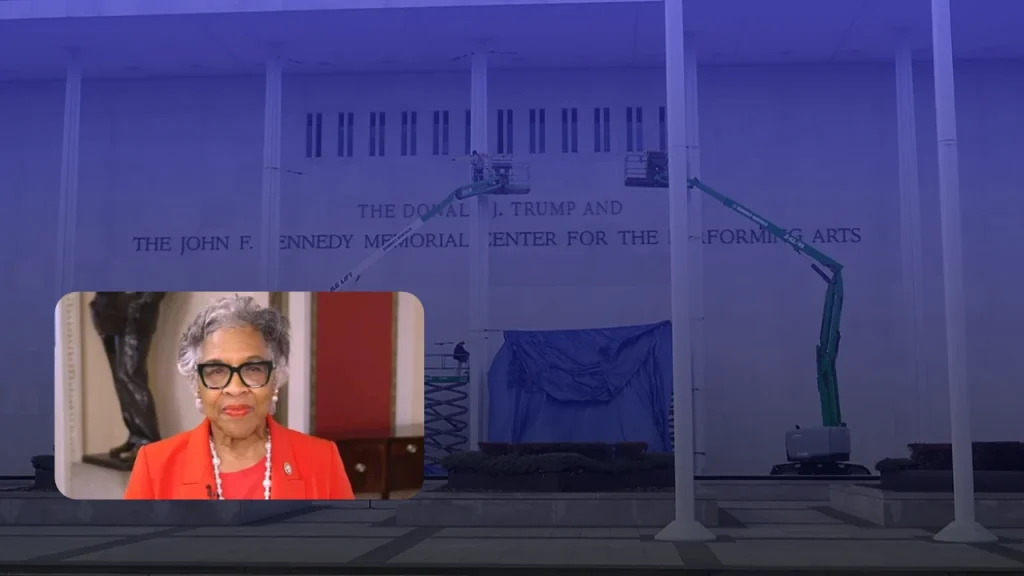
- December 18, 2025: The board voted to rename the institution to include Trump’s name, presented as the Donald J. Trump and John F. Kennedy Memorial Center for the Performing Arts. Signage went up. Beatty says she was muted when she tried to object.
- December 22, 2025: Beatty sued.
- February 1, 2026: Trump announced a two-year closure for construction and renovation.
- March 16, 2026: The board approved closing the building from July 5, 2026.
- May 29, 2026: Judge Cooper ruled for Beatty.
Why Did the Judge Rule That the Kennedy Center Board Could Not Add Trump’s Name?
The legal question was whether a board can change a name Congress put into law. Judge Cooper said it cannot. He relied on the statute that sets the board’s purpose, 20 U.S.C. § 76h, and on 20 U.S.C. § 76j(b)(1), which limits adding memorials or memorial plaques in the public areas of the center. Congress named the institution for Kennedy, and only Congress could change that.
What Did the Judge Order the Kennedy Center Defendants to Do?
The May 29 judgment required the defendants to:
- remove Trump’s name from the building’s title and facade
- remove it from other physical and digital signage
- stop using it in official materials
- withdraw trademark applications that used Trump’s name as part of the institution’s name
The compliance deadline was June 12, 2026. The government appealed and asked for a stay. On July 8, the D.C. Circuit denied the stay, which means the removal order stayed in effect while the appeal went forward.
The ruling was about the statutory name and additional memorials. It did not make every mention of a president or every donor acknowledgment illegal.
Why Did the Judge Restore Voting Rights for Ex Officio Trustees?
The board had no power, the court held, to keep ex officio trustees on the roster while taking away their vote. The statute creates a board that includes both groups, and basic trust-law principles require trustees to take part in the administration of the trust. Those decisions include the closure, which turns on finances, safety, construction options and programming.
Related article: Fairfield Spirit Halloween Shooting, 1 Dead, 6 Injured at Solano Town Center
Why Did the Judge Block the First Two-Year Closure Decision?
The May 29 order did not say the building needs no work. Judge Cooper accepted that substantial repairs are needed. The problem was how the board decided. He found the likely facts to be that the decision was effectively made before trustees got enough balanced information, and that the board did not weigh the effect of a full shutdown on:
- performing arts programs and the National Symphony Orchestra
- fundraising and revenue
- the center’s mission as a living memorial
- alternatives that would keep part of the building operating
That raised a fiduciary-duty problem. A fiduciary has to act with care and loyalty for the benefit of the institution, not just carry out what a powerful person wants. The court found the board likely fell short and granted a preliminary injunction against the March 16 decision under Federal Rule of Civil Procedure 65. To get that relief, a plaintiff must show a likely win on the merits, likely irreparable harm, a balance of equities in her favor, and that the order serves the public interest (Winter v. NRDC, 2008).
The injunction was not a permanent ban on closing. The judge said the board could close the building if it later reached a new decision after prudent, independent review, and he allowed necessary capital repairs and safety work to continue.
What Did the Judge Decide in September 2026 About the Trump Inscription and Plaza?
After the injunction, the board’s August 13, 2026 resolution contemplated three actions:
- Adding “Renovated and Restored by President Donald J. Trump” to the building.
- Adding “Endowed by The Trump Kennedy Center Fund.”
- Renaming the grounds “President Donald J. Trump Plaza.”
On September 15, Judge Cooper granted Beatty’s emergency motion in part. He barred the renovation inscription and the plaza renaming, finding they conflicted with his earlier order and with the law protecting the center’s identity as Kennedy’s memorial. He denied the request on the endowment inscription as premature because it was not imminent. He required notice if $100 million had been raised and at least 60 days’ notice before anything is installed that acknowledges Trump or the fund. That is not a final ruling that the endowment line is lawful.
Why Is the Kennedy Center Closed, and Can It Lawfully Close Again?
The board voted a third time on September 15, 2026, and the center announced the main building would close on September 16. The announcement cited safety and renovation. Beatty’s October 30 filing says a section of plaster fell in the Grand Foyer on September 4 after heavy rain, closing the main building for a day, and that the foyer area stayed closed for a safety assessment. The defense also points to concerns about exterior soffit panels. No reopening date has been announced.
The answer to whether the board can close the building is yes, potentially. The question is whether this vote cured the defects the judge found. Defendants say the August and September votes were new decisions based on updated information. Beatty says the same flaws were repeated.
What Is the Motion to Dissolve the Kennedy Center Injunction?
The defendants asked the court to dissolve or modify the injunction under Federal Rule of Civil Procedure 60(b)(5), which lets a court relieve a party from an order when circumstances have changed so much that continuing it would be inequitable. A party seeking that relief has to show a significant change in facts or law that makes the order unwarranted (Rufo v. Inmates of Suffolk County Jail, 1992; Horne v. Flores, 2009). No ruling had been issued as of November 1, 2026.
What Does Beatty’s October 30 Filing Argue About the Closure Vote?
Beatty’s 51-page opposition (Doc. 112) makes the following arguments. They are her arguments, not findings.
Incomplete renovation analysis. She says trustees got a short presentation from Delta Consulting Group shortly before the August 13 vote and did not get the updated plan from Jones Lang LaSalle (JLL) dated August 20, which she says describes a phased renovation as technically feasible.
The $303 million and $41 million figures. Her filing contrasts a figure of about $303 million tied to the Delta analysis with an additional $41 million that she says JLL’s updated plan estimated for phased work. The defendants filed a notice of errata on October 21 saying the report underlying the $41 million comparison was an alternate version that was not given to the board, and they withdrew that comparison. That correction does not show anyone misled the court, but it is why the different report versions and what trustees actually received are now key discovery issues.
Short review time. She says trustees got the initial information two days before the August 13 meeting and a new packet three days before the September 15 vote. The defendants say the board had updated assessments and further review.
A phased option. She says the board did not get a full analysis of keeping the National Symphony Orchestra in the building during phased work.
The financial warning. She challenges how a warning of possible fiscal collapse within weeks was prepared, citing deposition testimony and financial records. The court has not found that the center’s finances were healthy, or that the warning was unfounded.
A separate October 30 filing (Doc. 114) asks permission to present live testimony from CEO Matthew Floca, because documents were produced after his depositions. The judge has not ruled on that request.
What Is the $257 Million Kennedy Center Appropriation Question?
Congress appropriated about $256.657 million for capital repairs through Section 60025 of Public Law 119-21, available until September 30, 2029. Beatty argues that date marks how long new obligations can be made, not when every dollar must be spent. She cites the federal appropriations accounting statutes: 31 U.S.C. § 1502(a) (limits an appropriation to its period of availability), § 1552 (closes expired accounts after five years) and § 1553 (allows payment of valid obligations during that period).
That five-year period, here to September 30, 2034, is for recording and paying obligations properly made earlier. It does not allow brand-new renovation obligations after 2029. Beatty’s point is that the board may have misread the deadline when it decided a single full closure was needed. The defendants dispute her position, and the court has not ruled.
What Are the 19 Texts and 180 Texts in the Kennedy Center Privilege Dispute?
Beatty asked the court on October 25 to order the government to produce records about the president’s role in the center’s management and the closure decision. According to the Associated Press, the administration’s privilege log lists:
- 19 text messages between CEO Matt Floca and Trump executive assistant Natalie Harp, 11 of them on September 15, the day of the board’s third closure vote
- about 180 text messages between Floca and Commerce Secretary Howard Lutnick
The administration says some records are protected by the presidential communications privilege. That privilege covers confidential communications that help the president make decisions, but it is not absolute. It was recognized in United States v. Nixon (1974), and the D.C. Circuit limits it to communications by the president and close advisers with operational proximity to presidential decision-making (In re Sealed Case, 121 F.3d 729 (D.C. Cir. 1997); Judicial Watch v. Department of Justice, 365 F.3d 1108 (D.C. Cir. 2004)). Even where it applies, a party may overcome it by showing a sufficient need that cannot be met another way.
Two procedural rules frame the dispute: Federal Rule of Civil Procedure 26(b)(5) requires a party withholding material as privileged to describe it well enough to assess the claim, which is the purpose of the privilege log, and Rule 37(a) lets the other side move to compel. The privilege log confirms the messages exist. It does not show what they say or that anyone acted unlawfully. The judge has not ordered disclosure. For the narrower privilege issue, see Trump Executive Privilege Kennedy Center Lawsuit, What Was Asserted, What the Court Must Decide and What It Means.
What Are the Next Court Dates in the Joyce Beatty Kennedy Center Lawsuit?
| Date | Event |
| November 3, 2026, 11 a.m. | In-person status conference, Courtroom 27A, on Beatty’s motion to compel (ECF No. 96). Not a trial or a final hearing on the injunction. |
| Pending | Defendants’ Rule 60(b)(5) motion to dissolve the injunction |
| Pending | Beatty’s request for live testimony from Matthew Floca |
| November 30, 2026 | Beatty’s brief due, D.C. Circuit consolidated appeals |
| December 21, 2026 | Defendants’ reply brief due |
Appeals from preliminary injunctions are permitted under 28 U.S.C. § 1292(a)(1). A party seeking a stay while it appeals has to show a likely win on appeal, irreparable harm, and that the stay does not substantially harm others and serves the public interest (Nken v. Holder, 2009; Fed. R. App. P. 8). The D.C. Circuit’s denial of a stay on July 8 means it found those showings not met at that stage. It is not a ruling on the merits of the appeals.
What Laws Apply to the Joyce Beatty Kennedy Center Lawsuit?
20 U.S.C. § 76h. Creates the board, defines ex officio and general trustees, and sets the board’s duty to maintain the center as a national performing arts institution and living memorial.
20 U.S.C. § 76j(b)(1). Restricts additional memorials and plaques in public areas, the provision central to the renaming ruling.
20 U.S.C. § 76l(b). Gives the board the powers and obligations of a trustee over the funds it administers, which supports the trust-law reasoning on prudence.
Trust and fiduciary principles. Trustees must act prudently, with loyalty, and on adequate information. Courts also look at whether trustees exercised independent judgment instead of simply following another person’s wishes.
Federal Rule of Civil Procedure 56. Governs summary judgment, used for the name and voting-rights rulings.
Federal Rule of Civil Procedure 65 and 28 U.S.C. § 1292(a)(1). Govern preliminary injunctions and their appeal.
Federal Rule of Civil Procedure 60(b)(5). Governs the request to dissolve the injunction.
Declaratory Judgment Act, 28 U.S.C. §§ 2201–2202. Courts commonly use it to declare rights under a statute when a plaintiff challenges official action.
Administrative Procedure Act, 5 U.S.C. §§ 701–706. Beatty also pleaded an APA theory, which Judge Cooper dismissed based on precedent that the Kennedy Center and Smithsonian are not covered agencies for APA purposes in this context. Her trust-based and statutory claims survived.
Trademark law, 15 U.S.C. § 1051 et seq. Relevant because the order required withdrawing trademark applications that used Trump’s name.
Appropriations law, 31 U.S.C. §§ 1502, 1552 and 1553. Govern the renovation funding argument.
Discovery rules, Fed. R. Civ. P. 26(b)(1), 26(b)(5) and 37(a). Govern the scope of discovery, privilege logs and motions to compel.
What Happens If Beatty Wins or Loses the Kennedy Center Closure Fight?
If the court keeps the injunction, the board still cannot carry out the challenged closure decision without meeting the court’s standards, but the order would likely still allow necessary repairs and safety work, with the details left to the court. If the court dissolves or modifies it, the board gets more room to proceed with the closure. Neither result changes the name ruling, which is a separate statutory question, or the September 15 order on the inscription and plaza, which stays in place unless changed by the court or reversed on appeal.
Is There a Kennedy Center Lawsuit Settlement or Claim Form?
No. This is not a consumer case. Beatty sued as a trustee over governance and statutory authority, so ticket holders, subscribers and performers have no claim and no payment is available. Ordinary members of the public cannot join.
Frequently Asked Questions About the Joyce Beatty Kennedy Center Lawsuit
Did Joyce Beatty win her Kennedy Center lawsuit?
She won the name and voting-rights rulings on May 29, 2026, and a preliminary injunction against the original closure decision. The newer closure dispute is undecided.
Can Trump rename the Kennedy Center?
Not through the board alone. The May 29 ruling held that changing the name Congress set requires Congress.
Did the judge order Trump’s name removed?
Yes, with a June 12, 2026 deadline. The D.C. Circuit denied a stay on July 8.
Why is the Kennedy Center closed?
The center announced a closure from September 16, 2026, citing renovation and safety. Beatty disputes whether a full two-year closure was properly justified.
Can the Kennedy Center close for two years?
Potentially, if the board makes a prudent, independent decision that meets its legal duties and any court order. The May injunction did not permanently bar closing.
What did the judge decide on September 15, 2026?
He blocked the “Renovated and Restored by President Donald J. Trump” inscription and the “President Donald J. Trump Plaza” renaming, and left the endowment inscription for later with notice requirements.
What is the dispute over the $257 million?
Congress appropriated about $256.657 million for repairs, available until September 30, 2029. The parties disagree about what that date means for how the work must be planned.
Has the judge ordered the administration to hand over the texts?
No blanket order has been verified. The privilege dispute is pending.
What happens on November 3, 2026?
Judge Cooper holds a status conference on the motion to compel. It is not a trial.
Is the ruling on appeal?
Yes. Appeals are in briefing at the D.C. Circuit, with Beatty’s brief due November 30, 2026.
Can the public join Beatty’s lawsuit?
No. It is an individual case, not a class action.
What to Watch Next in the Beatty Kennedy Center Case
Watch the November 3 conference, any ruling on the motion to compel and the privilege claims, and whether the judge allows live testimony from Floca. Then watch the decision on dissolving the injunction. In the appeals, Beatty’s November 30 brief and the December 21 reply come next. The result will determine how much room a board has to act under the statute that created the center, and what evidence a court will require before a major institutional decision is treated as the board’s own.
Related coverage: Trump Press Access Lawsuit, Judge Restores CNN, MS NOW, Politico explains how federal courts review government action while a case is pending. It is a separate case.
Sources and Court Records
- Beatty v. Trump, No. 1:25-cv-04480, docket
- May 29, 2026 Memorandum Opinion, Doc. 50
- May 29, 2026 orders, Clearinghouse
- September 15, 2026 Memorandum Opinion and Order, Doc. 77
- October 30, 2026 Opposition to Motion to Dissolve, Doc. 112
- October 30, 2026 Request for Live Testimony, Doc. 114
- Associated Press report on the discovery dispute
- 20 U.S.C. § 76h and 20 U.S.C. § 76j
- 31 U.S.C. § 1502 and 31 U.S.C. § 1552
- D.C. Circuit Appeal No. 26-5322 docket
- Raines v. Byrd, 521 U.S. 811 (1997); Winter v. NRDC, 555 U.S. 7 (2008); Nken v. Holder, 556 U.S. 418 (2009); Horne v. Flores, 557 U.S. 433 (2009); Rufo v. Inmates of Suffolk County Jail, 502 U.S. 367 (1992); United States v. Nixon, 418 U.S. 683 (1974); In re Sealed Case, 121 F.3d 729 (D.C. Cir. 1997); Judicial Watch, Inc. v. Department of Justice, 365 F.3d 1108 (D.C. Cir. 2004)
This article is for informational purposes only and does not constitute legal advice. Laws vary and individual circumstances differ. For advice about your specific situation, consult a qualified attorney. Allegations and arguments in filings are not judicial findings.
Researched and written by Israr Ahmad, legal content researcher and founder of AllAboutLawyer.com. All facts verified against the May 29, 2026 and September 15, 2026 opinions in Beatty v. Trump (Docs. 50 and 77), Beatty’s October 30, 2026 filings (Docs. 112 and 114), the D.D.C. and D.C. Circuit dockets, the Associated Press report on the discovery dispute, and the cited statutes and rules, as of November 1, 2026. Last Updated: November 1, 2026.
About the Author
Israr Ahmad is a legal content researcher with 4+ years of experience covering class action settlements and consumer rights cases. He has researched and published coverage of 2,500+ settlements using verified court records, settlement administrator filings, and government sources. Learn more about Israr.