
Six Flags Over Georgia Incident, 1 Dead, Others Injured as Police Investigate Goliath Coaster
On the afternoon of Monday, October 12, 2026, one guest died and several others were injured in an incident involving the Goliath roller coaster at Six Flags Over Georgia in Austell, Cobb County, Georgia. Cobb County Police confirmed the death and injuries, and detectives from the department’s Major Crimes Unit are investigating. As of October 13, 2026, authorities had not publicly explained exactly how the death and injuries occurred.
This article explains what is confirmed, what is still unknown, what Georgia law requires after a fatal ride incident, who could face legal responsibility, and what the deceased guest’s family and injured guests may be able to do. It does not assign fault. No cause has been established.
Quick Facts: Six Flags Over Georgia Incident
| Detail | What is known |
| Date and time | Monday, October 12, 2026, at about 3:58 p.m. local time |
| Location | Six Flags Over Georgia, Austell (Cobb County), Georgia |
| Ride involved | Goliath, a steel hypercoaster (local coverage showed riders being evacuated from the ride) |
| Deaths | One |
| Injuries | Police said several people were injured; WSB-TV reported four |
| Investigating agencies | Cobb County Police Department (Major Crimes Unit); Georgia state amusement-ride safety officials |
| Park response | Six Flags said it was cooperating fully, supporting affected guests and employees, and temporarily closing similar attractions at other parks as a precaution |
| Cause | Not publicly established |
| Criminal charges | None announced |
| Lawsuit over this incident | None verified in the sources reviewed |
| Settlement or claim form | None. This is an investigation, not a class-action settlement |
| Deceased guest’s identity | Not publicly released in the reports reviewed |
Reporting cutoff: October 13, 2026. The investigation is ongoing, and confirmed facts may change.
What Happened at Six Flags Over Georgia?
Cobb County Police said officers assigned to the park and patrol officers responded to a roller coaster incident at about 3:58 p.m., that several people were reported injured, and that one person had died. Detectives from the Major Crimes Unit were sent to investigate the circumstances.
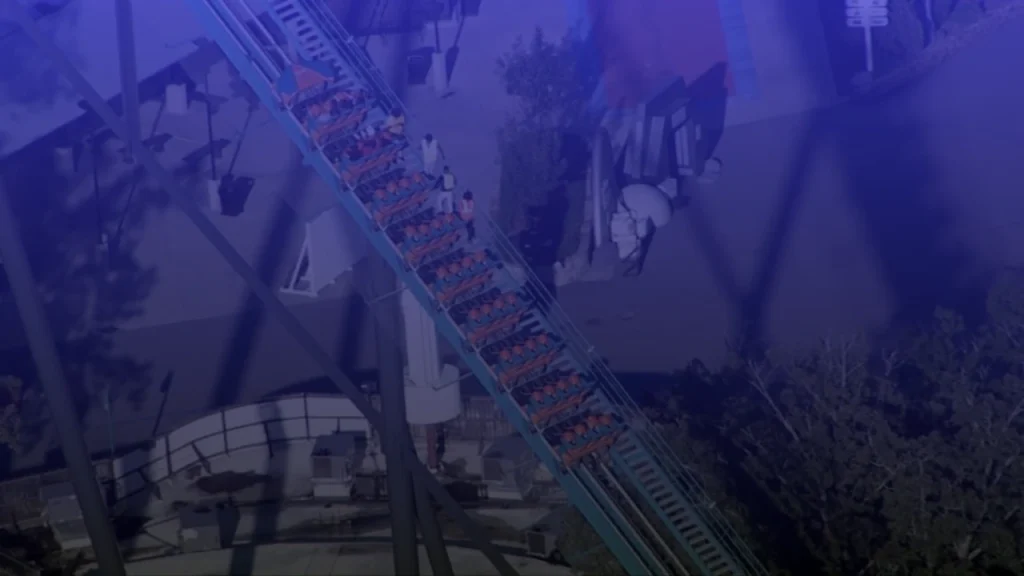
Local television footage showed the Goliath train stopped on an incline near the top of a hill, with park staff and emergency personnel helping remaining riders off the ride using emergency stairs or harness systems. State amusement-ride safety inspectors were reported to have arrived to examine the equipment alongside local authorities.
Some witnesses told local media outlets that a guest appeared to fall or be ejected from the ride. Those accounts are unconfirmed. Police had not said whether someone fell, whether equipment failed, whether a restraint was involved or whether a medical event or another cause was responsible. Reports linking the emergency response to Goliath do not by themselves establish what caused the death or the injuries.
Six Flags said it was deeply saddened, expressed condolences to the guest’s family, friends and loved ones, and said it was supporting affected guests and employees. It said it would not share more details out of respect for the family’s privacy. The company later said similar attractions at other Six Flags parks were temporarily closed out of an abundance of caution, and ABC7 Chicago reported that Raging Bull at Six Flags Great America in Illinois was among the rides closed.
Those closures are a precaution. They do not show that other rides share a defect, and they do not show that Goliath malfunctioned.
What Do We Know About the Goliath Roller Coaster?
Goliath is a steel hypercoaster built by Bolliger & Mabillard that opened in 2006. According to the park, it rises about 200 feet, reaches speeds up to about 70 miles per hour, and includes a 540-degree helix. It has no inversions.
Reporting on the ride’s history notes an earlier incident in July 2006, soon after it opened, in which a rider with a reported heart condition became unresponsive and later died. According to those reports, the ride was inspected and reopened after officials found it operating properly. That earlier event was a different incident and does not show what happened on October 12, 2026.
The ride’s age, height and speed explain why investigators will need to look at its mechanical systems, inspection history and operating procedures. They do not show that the design was unsafe.
What investigators will need to determine
- Where the deceased guest and injured guests were seated and what happened to them.
- Whether the ride was operating normally before the emergency.
- Whether the restraints, seats, trains, track, brakes and control systems worked as intended.
- Whether daily inspection and maintenance records show unresolved problems.
- Whether operators followed required loading, restraint-check and dispatch procedures.
- Whether emergency stops, evacuations and medical response were handled properly.
- Whether a mechanical failure, human error, medical event or something else contributed.
These are lines of inquiry, not findings.
Related article: 2028 Democratic Primary, Is Kamala Harris the Front-Runner?
Why Is the Major Crimes Unit Investigating?
Detectives from the Major Crimes Unit investigate unexplained deaths. That does not mean police suspect a crime, and it does not mean Six Flags is accused of wrongdoing. Detectives typically interview witnesses, collect video, gather records and coordinate with other agencies.
Three types of investigation may run at the same time:
- Police investigation: establishes the circumstances of the death and whether evidence supports criminal charges.
- Regulatory safety investigation: examines the ride, its maintenance and inspections, and compliance with Georgia’s amusement-ride rules.
- Civil investigation: examines whether negligence, a defective product or another legal wrong caused the injuries or death.
A civil claim does not require a criminal conviction, and a police investigation does not establish civil liability. No charges had been announced as of the reporting cutoff.
Georgia Law After a Fatal Amusement-Ride Incident
Georgia regulates amusement rides under the Amusement Ride Safety Act (O.C.G.A. § 34-12-1 et seq.) and the state’s implementing rules in Chapter 120-3-27 of the Georgia Rules and Regulations, administered by the Office of the Commissioner of Insurance and Safety Fire. These rules matter most in the first days after a death or serious injury.
1. The ride must be shut down and secured (Rule 120-3-27-.06)
When a fatality, serious injury or injury requiring overnight hospitalization occurs and the owner or operator knows of it, the rules generally require the ride to be shut down and secured to prevent operation until the state’s safety office completes an investigation. The rule contains specific provisions about when a ride can be repaired and returned to service. This preserves the equipment and conditions relevant to what happened.
2. The incident must be reported to the state (Rule 120-3-27-.06)
Covered serious accidents must be reported to the state safety office immediately by telephone, followed by a detailed written report no later than the close of the next business day. The public record does not show whether every reporting step has been completed, so that should be confirmed with the agency rather than assumed.
3. Rides must be inspected (Rule 120-3-27-.07)
Stationary rides generally must be inspected before first public operation and at least annually, under the applicable permit provisions. An annual inspection does not replace daily checks, maintenance and safe operation.
4. Records and daily checks are required (Rule 120-3-27-.10)
Owners must keep up-to-date records of inspections, violations and corrective action, and breakdowns and repairs of major mechanical parts. Each ride must be inspected and tested on every day it is intended to operate, by a qualified person. These records often become key evidence.
5. The state can investigate and enforce
State safety officials can inspect and investigate rides, require a hazardous ride to stop operating until conditions are corrected, and impose administrative penalties for certain violations. None of this means Six Flags violated a rule. That would require evidence.
6. Insurance and industry standards
The Act and rules also include insurance or financial-responsibility requirements for ride operators, and Georgia’s ride regulations generally rely on recognized industry standards, such as those developed through ASTM International’s amusement-ride committee. The exact requirements that apply to Goliath should be confirmed against the current rule text.
7. Federal oversight is limited for fixed-site rides
Federal consumer product safety law excludes fixed-site amusement rides, so permanent parks like this one are regulated mainly by the states. That is why Georgia’s rules and inspectors play the central role here.
Who Could Be Legally Responsible?
It depends entirely on what investigators find. A fatal incident at a park does not automatically make any party liable.
Six Flags Over Georgia (the park operator)
Under Georgia’s premises-liability statute, O.C.G.A. § 51-3-1, an owner or occupier must use ordinary care to keep the premises and approaches safe for invited guests. For a ride, that includes reasonable inspection, maintenance, operator training and enforcement of safety rules. A negligence claim would require proof of a duty, a breach, causation and damages. The occurrence of a death is not enough on its own.
The ride manufacturer
If evidence showed a design defect, manufacturing defect or inadequate warnings, a product-liability claim could be considered under O.C.G.A. § 51-1-11. Georgia generally applies a 10-year statute of repose to strict-liability claims, measured from the first sale for use or consumption, with exceptions. Because Goliath opened in 2006, that limit may be a major issue for any strict-liability claim against the manufacturer, while negligence-based theories, later replacement parts or failure-to-warn theories may be analyzed differently. This is a question for a lawyer reviewing the actual facts.
Maintenance or inspection contractors
If outside companies serviced or inspected relevant equipment, their work may be examined, including whether a repair was done properly or a dangerous condition was missed.
Operators and other employees
Investigators may review whether employees followed restraint-check, dispatch and emergency procedures. No employee misconduct has been established.
Component suppliers and others
Depending on the evidence, suppliers of parts, restraint systems or control systems could also be examined.
Georgia’s fault-allocation rules
Under O.C.G.A. § 51-12-33, Georgia uses modified comparative negligence with apportionment of fault. A plaintiff’s recovery is reduced by the plaintiff’s percentage of fault and is barred if the plaintiff is 50 percent or more at fault. Fault can also be allocated among several defendants and, in some cases, nonparties. Defendants sometimes argue that a rider ignored warnings or restraint rules. No such claim has been made here, and nothing in the reports suggests the deceased guest was at fault.
Could the Incident Lead to a Wrongful-Death Lawsuit?
Possibly, if evidence establishes that negligence, a defective product or another actionable failure caused the death. A family does not need to wait for a criminal case to end.
Georgia’s wrongful-death statutes, O.C.G.A. § 51-4-1 et seq., including § 51-4-2, allow recovery of the full value of the life of the decedent as shown by the evidence, measured from the decedent’s own perspective, including both economic and intangible components. Who may sue depends on family structure: generally a surviving spouse, then children, then parents, and in some cases the estate’s personal representative. The estate may also pursue separate claims for funeral and medical expenses and for the decedent’s pre-death pain and suffering, where the facts support them.
Georgia generally does not cap compensatory damages in this type of case, but the available recovery depends entirely on the facts and the law. Punitive damages are possible only on clear and convincing evidence of willful misconduct, wantonness or conscious indifference to consequences (O.C.G.A. § 51-12-5.1). Georgia caps most punitive awards at $250,000, with exceptions that include product-liability cases.
No lawsuit tied to this incident was verified as of October 13, 2026. For general background, see Wrongful Death Lawyer, What Families Can Sue For and How the Process Works. It is a general guide, and Georgia rules may differ from examples involving other states.
Can Injured Guests File Personal-Injury Claims?
Possibly. Anyone physically injured may have a claim if evidence shows that another party’s negligence, a defective product or another actionable failure caused the injury. Damages in a personal-injury claim may include:
- Emergency treatment, hospital bills and follow-up care.
- Rehabilitation, therapy and future treatment.
- Lost wages and reduced earning ability.
- Physical pain and suffering.
- Other legally recoverable losses.
Guests who were evacuated but not physically injured are in a different legal position. Georgia limits emotional-distress claims, and distress after a frightening event does not automatically create a right to compensation. The key issue is whether a guest can show a legally recognized injury caused by another party’s actionable conduct.
Could Ticket Terms or Waivers Block a Claim?
Park tickets, season-pass agreements and online terms often include liability waivers or arbitration clauses. Whether any of those terms apply to a particular guest, and whether Georgia courts would enforce them against a claim of this kind, depends on the exact language and circumstances. A guest should not assume that such terms defeat a claim, and should not assume they do not apply. Keep your ticket or pass records and ask a lawyer to review them.
What Evidence Could Decide Whether Negligence Occurred?
Investigators and civil lawyers may seek to preserve and review:
- Ride and maintenance records: inspections, repairs, reported defects, component replacements and earlier mechanical problems.
- Daily inspection checklists: whether required pre-opening checks were performed and what they found.
- Ride-control and technical data: system logs showing operating state, stops, alarms or faults.
- Video: park cameras, on-ride cameras and guest photos or videos.
- Witness accounts: statements from riders, employees and bystanders, weighed against technical evidence.
- Medical and autopsy findings: cause of death and the nature and cause of injuries.
- Training and procedure records: whether employees were trained and followed required procedures.
- Engineering reports: expert examination of the ride, its components and history.
Evidence preservation
Georgia law requires a party to preserve relevant evidence once litigation is reasonably foreseeable, and courts may impose sanctions for destroying evidence (see Phillips v. Harmon, Ga. 2015). Lawyers for families and injured guests commonly send preservation (spoliation) letters to the park and other possible parties asking them to keep ride data, video and maintenance records.
Public records
Records held by state agencies may be requestable under the Georgia Open Records Act (O.C.G.A. § 50-18-70 et seq.), although records tied to an active investigation may be withheld until it ends (see O.C.G.A. § 50-18-72). Expect delays.
Could There Be Criminal Charges?
Criminal charges are possible only if investigators find evidence supporting them, and none have been announced. Georgia law includes offenses such as involuntary manslaughter (O.C.G.A. § 16-5-3) and reckless conduct (O.C.G.A. § 16-5-60). Charges in a ride accident would require proof of the specific mental state and conduct each offense demands. Many ride deaths are found to result from accidents, medical events or equipment problems that do not lead to prosecution. A civil case does not depend on criminal charges, and criminal prosecution does not decide civil liability.
What Should Injured Guests and Witnesses Do Now?
- Get medical care. Some injuries are not obvious right away. Keep all treatment records.
- Write down what you remember while it is fresh: time, ride, seat location, sequence of events and witness names.
- Preserve photos and videos in their original form, and avoid posting medical or identifying information publicly.
- Keep park records: tickets, passes, receipts, any incident report and all correspondence.
- Report injuries through the park’s channels and keep a copy. Georgia’s ride rules include requirements about written reports of certain rider injuries.
- Avoid speculating about the cause, especially online, before evidence is available.
- Be careful with insurers and park representatives. Anything you sign or say may be used later.
- Talk to a qualified Georgia attorney about claims, evidence and deadlines.
Witnesses who were not hurt can still help investigators. They should give truthful accounts and keep original files.
How Long Do Families and Injured Guests Have to Sue?
Georgia’s general statute of limitations for personal-injury and wrongful-death claims is two years (O.C.G.A. § 9-3-33). For an October 12, 2026 incident, that means a general deadline of October 12, 2028, but the correct date can change. Georgia law can toll (pause) the limitation period in some cases, including for certain tort claims connected to a crime while a criminal prosecution is pending (O.C.G.A. § 9-3-99), and different rules apply to minors, estates and other situations. Do not rely on an article to calculate a deadline. A police investigation or a conversation with an insurer should not be assumed to pause the deadline.
Does the X2 Litigation Mean Goliath Was Unsafe?
No. Six Flags faces separate litigation over its X2 coaster at Six Flags Magic Mountain in California, and in September 2026 it announced that X2 would be retired. That ride and Goliath are different rides at different parks, and the X2 claims do not establish that Goliath was unsafe. Evidence about one ride can raise questions about broader safety practices, but it does not prove that another ride has the same defect or cause. The Georgia investigation must first establish what happened on October 12.
For background on that separate matter, see Six Flags Permanently Closes X2 After 100+ Brain Injury Claims.
Could Six Flags Face Regulatory Penalties or Be Forced to Keep Goliath Closed?
Potentially, if the investigation finds violations or an unsafe condition. State officials can require a ride to remain closed until problems are corrected and can impose administrative penalties for specified violations. A regulatory investigation can also produce recommendations or corrective measures even if no civil damages follow. Any enforcement should be reported based on an actual agency decision, not inferred from a ride being closed.
No reopening date for Goliath had been confirmed in the sources reviewed.
What Happens Next?
- Police: may release information about the sequence of events, medical findings and whether any criminal law was violated.
- State safety officials: examine the ride’s components, maintenance, inspection and reporting history.
- Six Flags: provides records and cooperates, and may need to complete inspections or repairs before affected attractions reopen.
- Families and injured guests: weigh legal options. If evidence supports a claim, negotiations or litigation may follow.
- More information: authorities may release identification, autopsy and investigative findings once the family has been notified and the investigation advances. Any lawsuits would create public court records.
Frequently Asked Questions
How many people died at Six Flags Over Georgia?
One person died. Police said several others were injured, and WSB-TV reported four injuries.
What caused the incident on Goliath?
It has not been publicly established. Police and state inspectors are investigating.
Did someone fall from the coaster?
Some witnesses told local media that a guest appeared to fall or be ejected, but police have not confirmed that or any other cause. The cause should not be treated as confirmed until investigators release reliable findings.
Was Goliath defective?
No defect had been established in the reports reviewed.
Had anyone died on Goliath before?
Reporting describes a July 2006 incident in which a rider with a reported heart condition died after becoming unresponsive. That event was reported to be unrelated to any ride malfunction, and the ride reopened after inspection. It is a separate incident.
Why did Six Flags close similar rides at other parks?
The company said it did so out of an abundance of caution. The closures do not show a shared defect.
Does the police investigation mean Six Flags committed a crime?
No. An investigation is a fact-finding process. It does not mean a crime occurred or that any party is responsible.
Can the deceased guest’s family sue?
Potentially, if evidence shows a legally actionable failure caused the death. The proper claimant, available damages and deadline depend on Georgia law and the facts.
Can injured guests sue the park?
Potentially. They would generally need to show a legally recognized injury caused by negligence, a defective product or another actionable failure.
Is there a settlement or claim form?
No settlement or compensation program for this incident was verified.
Which agency regulates amusement rides in Georgia?
The Georgia Office of the Commissioner of Insurance and Safety Fire administers the state’s amusement-ride safety rules. Police separately investigate the death and injuries.
When will Goliath reopen?
No date had been confirmed.
Sources and Legal References
- Associated Press, One Person Is Dead, Several Others Injured in Incident Involving Six Flags Roller Coaster in Georgia (Oct. 12, 2026). https://apnews.com/article/3c643c8984f32370c9cd2123c53a1031
- WSB-TV, 1 Dead, 4 Injured in Goliath Ride Incident at Six Flags Over Georgia (Oct. 12, 2026). https://www.wsbtv.com/news/local/cobb-county/goliath-ride-six-flags-over-georgia-evacuated/5A5TSTE2ZNB3ZBTVUR64JI4JPA/
- ABC News, 1 Dead, Several Injured in Roller Coaster Incident at Six Flags Over Georgia (Oct. 12, 2026). https://abcnews.com/US/1-dead-injured-roller-coaster-incident-flags-georgia/story?id=137208656
- Cobb County Police Department statement on the Oct. 12, 2026 incident, as reported by the media above; Six Flags statement on the guest incident, as reported by the media above.
- Georgia Rules and Regulations for Amusement Ride Safety, Chapter 120-3-27 (including Rules .06, .07 and .10). https://rules.sos.ga.gov/gac/120-3-27
- Georgia Office of the Commissioner of Insurance and Safety Fire, Amusement Rides rules and regulations. https://oci.georgia.gov/inspections-permits-plans/amusements-rides/rules-and-regulations
- Georgia Amusement Ride Safety Act, O.C.G.A. § 34-12-1 et seq.
- Premises liability: O.C.G.A. § 51-3-1.
- Product liability and statute of repose: O.C.G.A. § 51-1-11.
- Wrongful death: O.C.G.A. § 51-4-1 et seq., including § 51-4-2. https://law.justia.com/codes/georgia/title-51/chapter-4/article-1/section-51-4-2/
- Apportionment and comparative fault: O.C.G.A. § 51-12-33. Punitive damages: O.C.G.A. § 51-12-5.1.
- Statute of limitations: O.C.G.A. § 9-3-33. https://law.justia.com/codes/georgia/title-9/chapter-3/article-2/section-9-3-33/ Tolling during criminal prosecution: O.C.G.A. § 9-3-99.
- Criminal statutes: O.C.G.A. §§ 16-5-3 and 16-5-60.
- Georgia Open Records Act: O.C.G.A. § 50-18-70 et seq.
- Phillips v. Harmon, 297 Ga. 386 (2015) (duty to preserve evidence).
- Six Flags Over Georgia, official Goliath ride information. https://www.sixflags.com/overgeorgia/attractions/goliath
- AllAboutLawyer, Wrongful Death Lawyer, What Families Can Sue For and How the Process Works.
- AllAboutLawyer, Six Flags Permanently Closes X2 After 100+ Brain Injury Claims.
Disclaimer: This article provides general legal information, not legal advice. No conclusion about fault or liability should be drawn before the investigation establishes the relevant facts.
About the Author
Israr Ahmad is a legal content researcher with 4+ years of experience covering class action settlements and consumer rights cases. He has researched and published coverage of 2,500+ settlements using verified court records, settlement administrator filings, and government sources. Learn more about Israr.