
Pregnant Workers Fairness Act Ruled Unconstitutional in 2026, Can Your Employer Deny Pregnancy Accommodations?
On November 20, 2026, a federal appeals court ruled that Congress passed the Pregnant Workers Fairness Act in an unconstitutional way. That does not mean employers across the country can now refuse pregnancy accommodations or fire someone for being pregnant. The court’s order is narrow, and several other federal and state laws still protect pregnant workers.
The full U.S. Court of Appeals for the Fifth Circuit decided the case, State of Texas v. Blanche, No. 24-10386, by a 9–8 vote. The court agreed with Texas that the House of Representatives did not have a valid quorum when it passed the 2022 spending bill that contained the Pregnant Workers Fairness Act (PWFA). It then kept in place a court order that stops the federal government from enforcing the PWFA against the State of Texas as an employer.
For a pregnant worker, three points matter most:
- The order itself covers one employer: the State of Texas. It does not name private companies, cities, counties or other states.
- The reasoning reaches further. Because the Fifth Circuit’s reasoning is binding on federal courts in Texas, Louisiana and Mississippi, private employers there can now use it as a defense if a worker sues under the PWFA. How far that defense will go has not been tested yet.
- Your other rights did not change. The Pregnancy Discrimination Act, the Americans with Disabilities Act, the Family and Medical Leave Act, the PUMP Act and state laws are all still in force.
The sections below explain what the court decided, who is affected, what the law normally requires, and what to do if your employer says it no longer has to help you.
Pregnant Workers Fairness Act Ruling: Quick Facts
| Detail | Verified information |
| Case | State of Texas v. Blanche |
| Court | U.S. Court of Appeals for the Fifth Circuit (full court, also called “en banc”) |
| Appeal number | 24-10386 |
| Original trial court case | 5:23-cv-00034, U.S. District Court, Northern District of Texas |
| Decision date | November 20, 2026 |
| Vote | 9–8 |
| Judge who wrote the majority opinion | Judge Cory T. Wilson |
| Judge who led the dissent | Judge James E. Graves Jr. |
| Law challenged | Pregnant Workers Fairness Act, 42 U.S.C. §§ 2000gg to 2000gg-6 |
| Date the PWFA took effect | June 27, 2023 |
| Constitutional issue | Article I, Section 5, the Quorum Clause |
| Who brought the challenge | State of Texas |
| What the order blocks | Federal enforcement of the PWFA against Texas as an employer |
| Are private businesses automatically exempt? | No |
| Was the whole 2022 spending law struck down? | No |
| Is the Pregnancy Discrimination Act affected? | No |
| Are FMLA, ADA and PUMP Act protections gone? | No |
| Deadline to ask the U.S. Supreme Court to review | February 18, 2027, unless a Justice extends it |
| Is there a class action or settlement? | No. This is a constitutional case. No money is being paid to workers. |
How Did the Pregnant Workers Fairness Act Case Get to the Fifth Circuit?
| Date | What happened |
| December 23, 2022 | The House passes the $1.7 trillion Consolidated Appropriations Act, 2023, 225–201. The PWFA is part of it. |
| December 29, 2022 | President Joe Biden signs the bill into law. |
| June 27, 2023 | The PWFA takes effect. |
| 2023 | Texas, led by Attorney General Ken Paxton, sues federal officials in Texas federal court. |
| February 27, 2024 | The Northern District of Texas judge blocks enforcement of the PWFA against Texas as an employer (719 F. Supp. 3d 521). |
| August 15, 2025 | A three-judge Fifth Circuit panel splits 2–1 and sides with the federal government. |
| January 14, 2026 | The full Fifth Circuit cancels the panel decision and agrees to rehear the case. |
| May 12, 2026 | The full court hears arguments. |
| November 20, 2026 | The full court rules 9–8 for Texas. |
What Did the Fifth Circuit Actually Decide About the Pregnant Workers Fairness Act?
The Constitution says a majority of the House must be present for the House to do business. That minimum number is called a quorum.
During the COVID-19 pandemic, the House allowed members who were not in the building to be counted as present if they let a colleague vote for them. This was called proxy voting. It was set out in House Resolution 8 (and earlier, H. Res. 965).
When the House passed the spending bill on December 23, 2022, the court record shows:
- The House had 431 serving members.
- A quorum was 216 members.
- 427 members recorded a vote or their presence.
- 226 of them did it by proxy.
- Fewer than 216 members were physically on the floor.
Representative Chip Roy objected to the lack of a physical quorum, but the presiding officer overruled him under the House’s own rules.
Judge Cory T. Wilson, writing for the nine-judge majority, held that “present” means physically present. Members counted only by proxy do not count toward a quorum. The majority also rejected the government’s argument that courts should not look behind a bill that the presiding officers of both chambers have signed (the “enrolled-bill rule”). It held that courts can check the Congressional Record to see whether the Constitution was followed.
The court then did something narrow. Texas asked for a court order against only one part of the 2022 law, the PWFA. The court kept in place the order that stops the federal government from enforcing the PWFA against Texas as an employer. It did not cancel the rest of the spending law. A separate $20 million immigration pilot program that Texas had also challenged was not part of the final judgment.
Why Did Eight Judges Disagree?
Judge James E. Graves Jr., joined by seven other judges (Judge Catharina Haynes also wrote separately), argued that:
- The Constitution does not say members must be physically present.
- Each chamber has broad power to write its own rules.
- No member successfully challenged the quorum at the time of the vote.
- Texas accepted billions of dollars from the same spending bill while attacking only the pregnant-worker protections.
The dissent also warned that the majority’s reasoning could invite challenges to other laws passed with proxy votes.
For the full story of the House vote itself, see Fifth Circuit Rules 9–8 That House Proxy Voting Violated the Quorum Clause in State of Texas v. Blanche, What It Blocks and What It Doesn’t.
Does the Fifth Circuit Ruling End Pregnancy Accommodations in Texas, Louisiana and Mississippi?
No. But the answer depends on who your employer is.
| Your employer | What the ruling means for you |
| State of Texas and its agencies | The federal government is blocked from enforcing the PWFA against them. |
| Private company in Texas, Louisiana or Mississippi | Not named in the order. But if you sue under the PWFA, the company can point to the Fifth Circuit’s reasoning, and a federal court in these states has to follow it. |
| Texas city or county | Not named in the order. Texas also has a separate state rule for city and county employees (Texas Local Government Code, Chapter 180). |
| Louisiana state government | Not named in the order. Louisiana’s own state law still applies. |
| Mississippi employers | Not named in the order. Federal laws other than the PWFA matter most here. |
| Federal government employer | Not covered by the Texas order. |
| Any employer outside Texas, Louisiana and Mississippi | Not covered. The Fifth Circuit’s decision is not binding in other states. |
Outside the Fifth Circuit, federal courts continue to apply the PWFA unless another appeals court agrees with the Fifth Circuit or the Supreme Court decides the question.
Some advocates say the decision effectively cancels the PWFA in all three Fifth Circuit states. The written order does not say that. What is clear is that an employer in those states now has a serious legal argument it did not have before, and that the question of how far it goes will be decided in future cases.
The practical takeaway: do not stop asking for accommodations because of a headline. Many employers will keep following the law, and your request also creates a written record that can support a claim under another law.
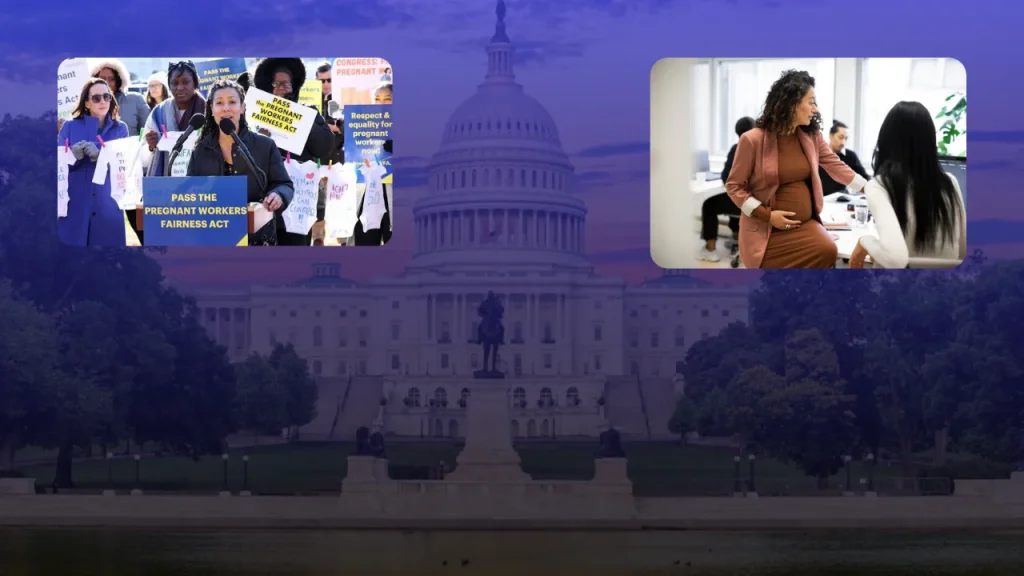
What Does the Pregnant Workers Fairness Act Normally Require?
The PWFA generally covers employers with 15 or more employees, plus most government employers. It requires them to make reasonable changes at work for an employee or job applicant who has a limitation caused by pregnancy, childbirth or a related medical condition. The employer can say no only if the change would cause an undue hardship, which means significant difficulty or expense.
The EEOC’s rule that explains the law is at 29 C.F.R. Part 1636. It took effect June 18, 2024.
Examples of accommodations the PWFA can cover:
- Extra bathroom, water, food or rest breaks
- Permission to sit instead of stand
- Limits on lifting
- Schedule changes for prenatal appointments
- A different uniform or protective equipment
- Temporary light-duty work
- Avoiding unsafe chemicals or very physical tasks
- Working from home when the job allows it
- Time off to recover from childbirth, a miscarriage or a related condition
The employer does not have to grant the exact change you ask for. It can offer another effective option after talking with you.
Can My Employer Force Me to Take Unpaid Leave Instead of Giving Me an Accommodation?
Where the PWFA applies, generally no. An employer cannot make you take leave if a reasonable change would let you keep working. A warehouse worker who needs a stool or a lifting limit should not be sent home just because she is pregnant. The employer can still raise an undue hardship defense.
Can My Employer Demand a Lot of Medical Paperwork?
Under the EEOC’s PWFA rule, an employer should not ask for medical proof when the need is obvious or the request is simple, such as carrying a water bottle, taking more bathroom breaks, sitting down or eating at work. When more information is truly needed, the employer can ask only for what is reasonable.
Which Federal Pregnancy Protections Still Apply After the Fifth Circuit Ruling?
Pregnancy Discrimination Act of 1978 (Title VII)
This law, found at 42 U.S.C. § 2000e(k), bans pregnancy discrimination by employers with 15 or more employees. An employer cannot refuse to hire you, fire you, demote you or treat you worse because you are pregnant, gave birth or have a related condition. It also requires employers to treat pregnant workers the same as other workers who are similarly able or unable to work.
The difference from the PWFA: the PDA mostly asks, “Are you being treated worse than other workers?” The PWFA goes further and requires an employer to provide accommodations, without having to show how other employees were treated.
Americans with Disabilities Act (ADA)
The ADA (42 U.S.C. § 12112) requires reasonable accommodations for workers with a disability. Pregnancy alone is not a disability. But a pregnancy-related condition can qualify, such as severe preeclampsia or gestational diabetes. Employers with 15 or more employees are covered.
Family and Medical Leave Act (FMLA)
The FMLA (29 U.S.C. § 2612) gives eligible workers up to 12 weeks of unpaid, job-protected leave in a 12-month period. To qualify, you generally need to:
- Work for a covered employer (private employers with 50 or more employees, plus public agencies and schools)
- Have worked there at least 12 months
- Have worked at least 1,250 hours in the last 12 months
- Work at a location with 50 or more employees within 75 miles
The FMLA can cover prenatal care, pregnancy-related medical conditions, childbirth and bonding with a newborn. It does not guarantee paid maternity leave.
PUMP Act
The PUMP Act expanded the right to break time and a private space (not a bathroom) to pump breast milk, for up to one year after the child is born, under the Fair Labor Standards Act. It was part of the same 2022 spending bill as the PWFA. The Fifth Circuit did not rule on it, and the November 20 judgment does not cancel it. A future lawsuit could try to use the same quorum argument against it, but that has not happened.
What Pregnancy Laws Do Texas, Louisiana and Mississippi Have?
Texas
Texas Labor Code Chapter 21, including § 21.106, bans employers from discriminating because of pregnancy, childbirth or related conditions. This law covers private employers with 15 or more employees. It is mainly a ban on unequal treatment. It does not give workers the full set of accommodation rights that the PWFA does. City and county employees have a separate accommodation rule in Chapter 180 of the Texas Local Government Code.
Louisiana
Louisiana has its own accommodation law. Under La. R.S. § 23:342, covered employers must give reasonable accommodations for pregnancy-related limits, such as seating, extra breaks, schedule changes, help with lifting and light duty, unless it would cause undue hardship. Under § 23:341, the law applies to employers with more than 25 employees. This law is separate from the PWFA, and the Fifth Circuit ruling does not touch it.
Mississippi
Mississippi has no broad pregnancy accommodation law for private employers. Workers there depend more heavily on the federal laws above, so the PWFA uncertainty hits Mississippi workers hardest.
What About Pregnant Workers in California, New York and Florida?
The ruling does not block the PWFA against employers in these states. Workers there may also have state protections:
- California: The Fair Employment and Housing Act and pregnancy disability leave rules.
- New York: The New York State Human Rights Law, plus New York City rules for city workers and employers.
- Florida: Mainly federal protections, plus the state’s own anti-discrimination law.
About 30 states and Washington, D.C., have their own pregnancy accommodation laws. They differ on employer size, what conditions count, leave, complaint steps and remedies. A ruling about how Congress passed a federal law does not cancel laws passed by state legislatures.
Can Employers Fire Pregnant Workers Because of the Fifth Circuit Ruling?
No. The Pregnancy Discrimination Act is still law. An employer with 15 or more employees cannot lawfully fire you because you are pregnant, gave birth or have a related condition. It also cannot punish you for asking for your rights.
Employers sometimes argue that a firing was really about attendance, performance, misconduct or layoffs. The question a court asks is whether the real reason was unlawful. If you think pregnancy played a part, keep your evidence (see below).
For an example of what pregnancy-related workplace claims can look like in court, read Amazon Pregnancy Discrimination Lawsuit, Were You Affected? — Hatch v. Amazon.com, Inc. That case alleges that pregnant warehouse workers were denied accommodations. Amazon disputes the claims, no final judgment has decided them, and the Texas ruling does not end that separate New York case.
What If My Employer Denies Accommodations During a High-Risk Pregnancy?
A high-risk pregnancy can mean limits on lifting, standing, long hours or exposure to certain chemicals. Tell your employer, in writing if you can, exactly what your limit is and what change you need. Whether the employer must agree depends on the law that applies to you, your job and any hardship defense.
Courts hear these disputes in many forms. In California, a former private chef for Kylie Jenner has sued, alleging that her requests for changes during a high-risk pregnancy were denied and that she later had a miscarriage. The defendants dispute the claims, and no court has found that her work caused the pregnancy loss or that anyone broke the law. The case is covered in Kylie Jenner Chef Lawsuit, Former Private Chef Fights to Stay Anonymous as Jane Doe After Pregnancy Discrimination and Miscarriage Claims. It shows why doctor’s notes, messages with supervisors and the employer’s identity can matter.
How Do I Ask for a Pregnancy Accommodation After the Ruling?
You do not need legal language. A simple process works:
- Say what your pregnancy-related limit is.
- Say what change you are asking for.
- Ask for an answer in writing.
- Be open to other options the employer suggests.
- Keep copies of every message.
- Get a doctor’s note if the employer reasonably needs one.
- If you are refused, note which laws may apply (see the table below).
A sample request:
I am pregnant and have a medical limitation that affects how long I can stand. I am asking to sit while I work and to take extra breaks when I need them. Please let me know how we can set this up.
You do not have to share unrelated medical details.
Which Law Helps Me in My Situation?
| Your situation | Laws to look at first |
| Fired, demoted or not hired because of pregnancy | Pregnancy Discrimination Act (Title VII), state law |
| Need a chair, breaks or a lifting limit | PWFA (where it still applies), ADA if you have a qualifying condition, Louisiana or other state law |
| Need time off for childbirth, recovery or prenatal care | FMLA, state leave laws, employer policy |
| Need time and space to pump | PUMP Act |
| Work for the State of Texas | Pregnancy Discrimination Act, ADA, FMLA, Texas law |
| Treated worse than coworkers with similar limits | Pregnancy Discrimination Act |
What Should I Do If My Employer Says the PWFA Is Unconstitutional?
- Ask which ruling the employer is relying on.
- Check whether your employer is actually the State of Texas. A private company in Houston is not the State of Texas, and the court’s order does not name it.
- Do not assume a manager’s description of the law is accurate.
- Get the refusal in writing if possible.
- Contact the EEOC, your state civil rights agency or an employment lawyer.
Even if the PWFA turns out not to apply to your employer, another law may.
How Long Do I Have to File a Pregnancy Discrimination Complaint?
The deadlines are short.
- Most private-sector workers: 180 calendar days from the unlawful act to file a charge with the EEOC. The deadline becomes 300 days if a state or local agency enforces a law against the same kind of discrimination. Do not assume you get the longer period.
- Federal employees and applicants: contact an agency EEO counselor within 45 days.
- Internal complaints and negotiations generally do not pause these deadlines.
Where to file:
- U.S. Equal Employment Opportunity Commission: https://www.eeoc.gov/how-file-charge-employment-discrimination
- Texas Workforce Commission, Civil Rights Division: https://www.twc.texas.gov/programs/civil-rights/employment-discrimination
- U.S. Department of Labor, Wage and Hour Division (for pumping breaks and FMLA): https://www.dol.gov/agencies/whd
Filing a complaint does not guarantee money.
Can I Sue My Employer After the Fifth Circuit Ruling?
Possibly. You may have a claim if an employer unlawfully refuses an accommodation, discriminates because of pregnancy, retaliates against you or breaks another employment law. In most federal discrimination cases, you must file an EEOC charge first and wait for a “right to sue” notice before going to court.
Depending on the law, remedies can include back pay, reinstatement and compensation for losses. Federal law caps some damages based on employer size.
In the Fifth Circuit states, a PWFA claim against a private employer now faces a serious legal defense. That is a reason to also look at the other laws above. There is no compensation fund created by Texas v. Blanche.
What Happens Next: Will the Supreme Court Review the Pregnant Workers Fairness Act Decision?
It might. The federal government has 90 days from the November 20, 2026 judgment, until February 18, 2027, to ask the U.S. Supreme Court to hear the case (28 U.S.C. § 2101(c)). A Justice can extend that deadline. Texas could also ask the Court to hear a different part of the case.
Asking is not the same as being heard. The Court chooses which cases to take. If it does, it could agree with the Fifth Circuit, side with the dissent, or decide on narrower grounds.
As of November 23, 2026, no Supreme Court order has been issued.
Could the Ruling Affect Other Laws Passed in the December 2022 Spending Bill?
Possibly, if someone brings a new case. The same bill included the PWFA, the PUMP Act, the SECURE 2.0 retirement law, the Electoral Count Reform Act and many funding provisions. Lawyers could cite the Fifth Circuit’s reasoning to challenge them, and the dissent warned about this. The November 20 judgment itself did not cancel any of them. Any new challenge would still need to win in court.
Some commentators also note that the reasoning could reach other laws passed by proxy vote between May 2020 and January 2023.
Frequently Asked Questions About the Pregnant Workers Fairness Act Ruling
Was the Pregnant Workers Fairness Act struck down nationwide?
No. The Fifth Circuit found a constitutional problem with how it was passed, but the court order only blocks federal enforcement against the State of Texas as an employer. The law is still on the books.
Does the Fifth Circuit ruling apply to Louisiana and Mississippi?
The order does not name them. But the court’s reasoning is binding on federal courts in both states, so employers there can use it as a defense in PWFA lawsuits.
Can private Texas employers refuse pregnancy accommodations now?
The order does not exempt them. They now have a legal argument against PWFA claims, and other laws, including the Pregnancy Discrimination Act and the ADA, may still require fair treatment or accommodations.
Can I still ask for extra bathroom breaks while pregnant?
Yes. You can always ask. Whether the employer must say yes depends on the law that covers you.
Can my employer make me take unpaid leave?
Where the PWFA applies, an employer generally cannot force leave if another reasonable accommodation would let you work. Other laws may protect you too.
Does the ruling cancel maternity leave?
No. The FMLA and state leave laws are not affected.
Can my employer fire me for being pregnant after November 20?
No. The Pregnancy Discrimination Act still bans it.
Is the PUMP Act also unconstitutional?
The court did not rule on it. It passed in the same bill, but the November 20 judgment does not cancel it.
Can my employer require medical documentation?
Sometimes. Where the PWFA applies, an employer generally cannot demand unnecessary proof for obvious or simple needs.
Is there a settlement or payment for workers affected by the ruling?
No. This is a constitutional case, not a class action.
Does the ruling apply outside the Fifth Circuit?
No. Courts in the other 47 states and Washington, D.C., are not bound by it.
When will the Supreme Court decide?
Not yet. The deadline to ask the Court to hear the case is February 18, 2027, unless it is extended.
Bottom Line: What Pregnant Workers Should Know After the November 20 Ruling
By a 9–8 vote, the Fifth Circuit held that Congress passed the Pregnant Workers Fairness Act without a valid quorum. The actual court order only blocks enforcement against the State of Texas as an employer. Private employers have not been exempted by order, though in Texas, Louisiana and Mississippi they now have a strong argument to raise in court. Outside those three states, the ruling is not binding at all.
The Pregnancy Discrimination Act, ADA, FMLA, PUMP Act and state laws remain in place.
Keep asking for the accommodations you need, put every request and answer in writing, and check every law that may apply before you accept a “no.” The next major step will likely be a Supreme Court petition by the February 18, 2027 deadline, or a new case testing how far the Fifth Circuit’s reasoning goes.
This article gives general U.S. employment-law information, not legal advice. Your rights depend on your employer, your state and your facts, and the law may change.
Primary Sources and Official References
- Fifth Circuit — State of Texas v. Blanche, No. 24-10386, November 20, 2026 (Official PDF)
- Fifth Circuit — Panel Opinion, No. 24-10386, August 15, 2025 (Official PDF)
- Northern District of Texas — State of Texas v. Garland, 719 F. Supp. 3d 521 (2024)
- EEOC — Pregnant Workers Fairness Act, Statutory Text
- EEOC — What You Should Know About the Pregnant Workers Fairness Act
- EEOC — Pregnancy Discrimination and Pregnancy-Related Disability Discrimination
- EEOC — Time Limits for Filing a Charge
- U.S. Department of Labor — Family and Medical Leave Act
- U.S. Department of Labor — Pumping at Work Protections
- Louisiana Legislature — Revised Statutes § 23:342
- Louisiana Legislature — Revised Statutes § 23:341
- Texas Workforce Commission — Pregnancy Rights in the Workplace
- U.S. Constitution — Article I, Section 5, Quorum Clause
- Congress — Consolidated Appropriations Act, 2023, Public Law 117-328
Researched and written by Israr Ahmad, legal content researcher and founder of AllAboutLawyer.com. All facts verified against the Fifth Circuit’s official opinions in State of Texas v. Blanche (No. 24-10386), the EEOC and U.S. Department of Labor guidance, and the federal and state statutes cited, as of November 23, 2026. Last Updated: November 23, 2026.
About the Author
Israr Ahmad is a legal content researcher with 4+ years of experience covering class action settlements and consumer rights cases. He has researched and published coverage of 2,500+ settlements using verified court records, settlement administrator filings, and government sources. Learn more about Israr.