
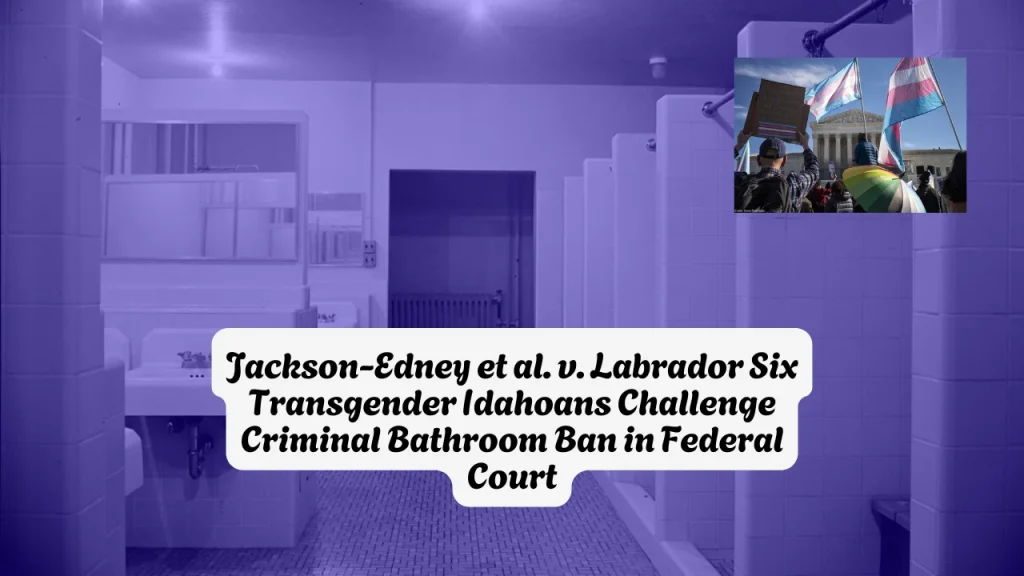
Jackson-Edney et al. v. Labrador— Six Transgender Idahoans Challenge Criminal Bathroom Ban in Federal Court
This article covers a recently filed lawsuit. Information is limited to the complaint as filed and verified public reporting. This page will be updated as the case develops.
Jackson-Edney et al. v. Labrador is a federal civil rights lawsuit filed April 30, 2026, in which six transgender Idaho residents challenge Idaho House Bill 752 — a new state law that criminalizes using public restrooms that match a person’s gender identity — arguing it violates their constitutional rights to equal protection, due process, and privacy.
| Field | Detail |
| Plaintiffs | Emilie Jackson-Edney and five other transgender Idaho residents |
| Defendant | Idaho Attorney General Raúl Labrador and county prosecutors |
| Case Name | Jackson-Edney et al. v. Labrador |
| Case Type | Civil Rights — Equal Protection / Due Process |
| Court | U.S. District Court for the District of Idaho |
| Date Filed | April 30, 2026 |
| Legal Claims | Violations of the 14th Amendment (Equal Protection and Due Process Clauses) and constitutional right to privacy |
| Law Challenged | Idaho House Bill 752 |
| Damages Sought | Injunction to block enforcement of H.B. 752 before it takes effect |
| Current Stage | Recently filed — temporary injunction requested |
| Next Scheduled Date | TBD — preliminary injunction hearing not yet scheduled |
| Attorneys of Record | ACLU, ACLU of Idaho, Lambda Legal, Munger Tolles & Olson LLP, Alturas Law Group PLLC |
| Last Updated | April 30, 2026 |
What Is the Jackson-Edney v. Labrador Lawsuit About? Jackson-Edney et al. v. Labrador, U.S. District Court for the District of Idaho
Six transgender residents of Idaho filed a lawsuit in federal court challenging H.B. 752 — a new state law prohibiting them from using sex-designated public restrooms in government-owned buildings and private businesses that are open to the public consistent with their gender identity. The plaintiffs argue the law violates their constitutional rights to due process, equal protection, and privacy under the 14th Amendment.
H.B. 752 was signed into law by Idaho Gov. Brad Little and makes the first offense a misdemeanor with up to one year in prison. A second offense becomes a felony with up to five years in prison. The law applies to all government-owned buildings and private businesses open to the public — including libraries, rest stops, airports, malls, gas stations, restaurants, entertainment venues, and hospitals.
The plaintiffs also argue the law is so vaguely written that people cannot reasonably determine what conduct is prohibited. According to the complaint, the statute does not clearly define key terms such as “biological sex,” “reasonably available,” or “dire need.”
Related article: Conservation Groups vs. U.S. Fish and Wildlife Service, The 2026 Endangered Species Lawsuit Wave Explained
What Does H.B. 752 Actually Do?
Idaho’s new law creates criminal charges for people who “knowingly and willfully” enter a bathroom or changing room designated for the opposite sex, with some exceptions.
The ACLU says Idaho’s bathroom ban is the only state ban that extends to private businesses — and that of the three states with criminal bathroom bans, Idaho’s carries the steepest penalties in terms of prison sentences.
The law passed the Idaho Legislature with support from only Republicans and was signed by Gov. Brad Little. It takes effect July 1, 2026.
Who Are the Plaintiffs in This Case?
The six plaintiffs are transgender Idaho residents who say the law would immediately and directly harm their ability to live and move freely in public.
One of the plaintiffs, Emilie Jackson-Edney, is a 77-year-old transgender woman who has lived in Idaho her entire life and has used women’s restrooms in public for 20 years without issue. People perceive her as female. If the law takes effect, the lawsuit says she plans to drink less water and eat less to avoid needing to use public restrooms.
Another plaintiff described the law’s impact this way: “I’ve been enjoying life as a man and using the men’s restrooms hasn’t been a big deal. But this law would force me to use the women’s facilities, and doing so would only invite suspicion, questions, and raised eyebrows. The only safe option truly available is to just stay home — or leave the state entirely.”
What Are Plaintiffs Alleging?
According to the complaint filed in the U.S. District Court for the District of Idaho, the plaintiffs allege:
- The law violates the Equal Protection Clause of the 14th Amendment by singling out transgender people for criminal penalties
- The law violates the Due Process Clause by being unconstitutionally vague — residents cannot reasonably know what conduct will result in arrest
- The law violates the constitutional right to privacy
- The law presents transgender Idahoans with “an impossible choice: use a restroom that does not align with their gender identity and risk severe physical and psychological harms, or continue to use restrooms in public in accordance with their gender identity and risk a criminal record and imprisonment”
All allegations above are as stated in the complaint filed by the plaintiffs. They have not been proven in court.
What Happens Next?
The plaintiffs filed for a temporary injunction — a court order that would block the law from taking effect on July 1, 2026, while the case plays out. A federal judge must decide whether to grant that request before the law’s effective date.
The Idaho Attorney General’s Office responded to the filing, with spokesperson Damon Sidur saying: “We look forward to defending the law.”
The Idaho Fraternal Order of Police and the Idaho Chiefs of Police Association had opposed H.B. 752 during the legislative process, noting there is no clear or reasonable way to determine a person’s sex at birth during a field contact without engaging in invasive and inappropriate questioning or searches.
The next key date is whenever the federal court schedules a hearing on the injunction request — TBD as of this publication.
Frequently Asked Questions
Is there a lawsuit against Idaho’s bathroom law?
Yes. Six transgender Idaho residents filed Jackson-Edney et al. v. Labrador in the U.S. District Court for the District of Idaho on April 30, 2026, challenging House Bill 752 on constitutional grounds.
Do transgender Idahoans need to do anything right now?
The law does not take effect until July 1, 2026. The plaintiffs have asked the federal court for an injunction to block the law before that date. No action is required of other transgender residents at this stage — the case is in its earliest phase.
When will a ruling happen in this case?
TBD — the court has not yet scheduled a hearing on the plaintiffs’ request for a temporary injunction. Given the July 1 enforcement date, a ruling is likely to come before then.
What are the criminal penalties under H.B. 752?
A first offense is a misdemeanor carrying up to one year in prison. A second offense is a felony carrying up to five years in prison.
Can I file my own lawsuit against this law?
You cannot join this specific case, but you can consult a civil rights attorney about your individual options. The ACLU and Lambda Legal are representing the current plaintiffs at no cost.
How will I know if the court blocks the law?
Monitor the ACLU’s official case page and Lambda Legal’s newsroom for updates. If a temporary injunction is granted, it will be national news.
What makes Idaho’s law different from other states?
Idaho’s H.B. 752 is the only state bathroom ban that extends to private businesses, and it carries the steepest criminal penalties of any state with a criminal bathroom ban — up to five years in prison for repeat violations.
Sources & References
- Lambda Legal — Jackson-Edney et al. v. Labrador case page: lambdalegal.org
- ACLU press release — April 30, 2026: aclu.org
- Idaho Capital Sun — April 30, 2026: idahocapitalsun.com
- Associated Press / Boise State Public Radio — April 30, 2026
Disclaimer: This article is for informational purposes only and does not constitute legal advice. Information about this ongoing legal case is based on publicly available court records and verified public reporting. Allegations described in this article have not been proven in court. For advice regarding a particular legal situation, consult a qualified attorney.
Prepared by the AllAboutLawyer.com Editorial Team and reviewed for factual accuracy against official ACLU and Lambda Legal press releases and verified news reporting on April 30, 2026. Last Updated: April 30, 2026
About the Author
Israr Ahmad is a legal content researcher with 4+ years of experience covering class action settlements and consumer rights cases. He has researched and published coverage of 2,500+ settlements using verified court records, settlement administrator filings, and government sources. Learn more about Israr.