
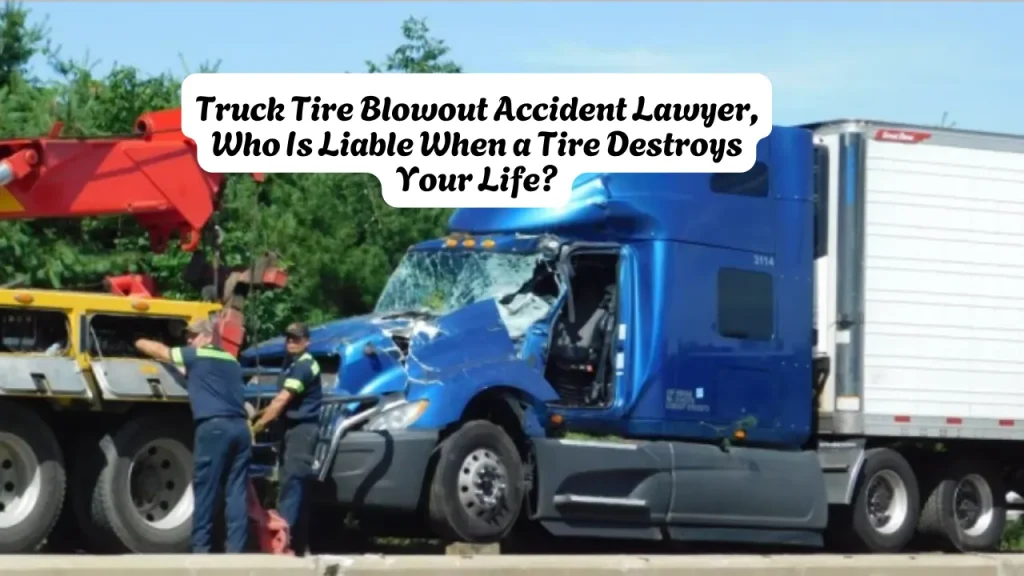
Truck Tire Blowout Accident Lawyer, Who Is Liable When a Tire Destroys Your Life?
A truck tire blowout accident lawyer helps victims injured when a commercial truck tire fails catastrophically. Blowouts cause drivers to lose control, sending 80,000-pound trucks into other lanes, guardrails, or oncoming traffic. Attorneys prove negligence by examining maintenance records, tire inspection logs, and manufacturer defect data to hold carriers, drivers, and tire makers fully accountable.
What does a truck tire blowout accident lawyer do?
A truck tire blowout accident lawyer investigates why a commercial truck tire failed and identifies every party legally responsible for that failure. They examine maintenance logs, tire inspection records, manufacturer defect data, and federal safety violations to prove the blowout was preventable. These attorneys pursue compensation from trucking companies, drivers, and tire manufacturers — on contingency, so you pay nothing unless they win.
A commercial truck tire blowout is not a gradual event. It is violent, instantaneous, and catastrophic. One moment a tractor-trailer is traveling normally at highway speed. The next, a tire explodes with enough force to send 80,000 pounds of steel and freight lurching across multiple lanes, often directly into traffic that has no warning and no escape route.
For the drivers and passengers caught in the path of a truck tire blowout, the results are frequently fatal. For those who survive, the injuries are often life-altering — traumatic brain injuries, spinal cord damage, crush injuries, and permanent disability that follows victims for decades.
What makes truck tire blowouts especially devastating from a legal standpoint is this: they are almost always preventable. Commercial truck tires do not fail without a reason. They fail because they were not maintained, not inspected, not replaced on schedule, overloaded beyond their rated capacity, or defectively manufactured. Every one of those causes points directly to a human decision — and human decisions create legal liability.
If a truck tire blowout injured you or killed someone you love, you deserve to understand exactly what caused that tire to fail and who is responsible for making it right. This guide explains how blowouts happen, who bears legal accountability, what evidence proves the case, and how a truck tire blowout accident lawyer fights to recover the compensation you are owed.
Why Commercial Truck Tire Blowouts Are So Uniquely Dangerous
Every vehicle that experiences a tire blowout faces a crisis. But the crisis a commercial truck creates is fundamentally different in scale from anything a passenger car blowout produces — and understanding why matters for understanding the legal stakes.
The Physics Are Unforgiving
A fully loaded tractor-trailer traveling at 65 mph carries kinetic energy that a passenger vehicle simply cannot match. When a rear tire on a commercial truck blows out, the vehicle does not just pull to one side. The sudden, asymmetric loss of support on an axle carrying 20,000 to 34,000 pounds can cause the entire trailer to swing outward — a motion known as trailer sway that can sweep across two or three lanes within seconds.
When a front steer tire blows, the driver faces an immediate and catastrophic loss of directional control. Steering inputs that would normally correct a drift instead become almost meaningless. At highway speeds, the window between a blowout and a deadly crash is measured in fractions of a second.
Debris Becomes a Weapon
Commercial truck tires weigh between 100 and 150 pounds. When they fail at highway speed, they do not simply deflate. They shred. Chunks of steel-belted rubber — some the size of a suitcase — explode outward at high velocity. These tire debris strikes kill motorcyclists and small vehicle occupants, shatter windshields, destroy radiators, and cause secondary crashes when drivers swerve to avoid them.
Secondary Crashes Multiply the Harm
A single truck tire blowout routinely triggers multi-vehicle pileups. When an 80,000-pound truck suddenly loses control, every vehicle behind it has milliseconds to react. On a congested interstate, that is not enough time. Secondary crashes caused by a truck tire blowout are legally attributable to the original blowout — and the parties responsible for that blowout are liable for all of it.
The Real Reasons Commercial Truck Tires Fail
The trucking industry prefers the public to view tire blowouts as unforeseeable accidents. They are not. Here are the actual causes — each one pointing to a specific responsible party:
- Worn tread beyond legal minimums — federal regulations require minimum tread depth on all commercial truck tires; carriers that allow tires to wear below this threshold before replacement are violating federal law and creating a foreseeable blowout risk
- Under-inflation — chronically under-inflated tires flex excessively with every rotation, generating internal heat that destroys the tire’s structural integrity from the inside; drivers are required to check tire pressure before every trip
- Over-inflation — over-inflated tires have a reduced contact patch and are more vulnerable to road hazard punctures and sudden failure from impact
- Overloading beyond tire load ratings — every commercial truck tire carries a maximum load rating; exceeding that rating generates the same destructive internal heat as under-inflation, leading to inevitable blowout
- Heat damage from brake fade — tires positioned adjacent to brake drums that overheat due to aggressive braking or overloaded cargo absorb destructive heat that compromises the tire’s structure over time
- Road hazard damage left uninspected — cuts, punctures, and sidewall damage from road debris are detectable on pre-trip inspection; a driver who misses visible damage and continues driving is independently negligent
- Defective manufacturing — some blowouts trace back to tires with manufacturing defects — belt separations, bead failures, or compound flaws — that make the tire structurally unsafe even when properly inflated and maintained
- Age-related degradation — tires older than six years develop microscopic cracking in the rubber compound regardless of visible tread depth; carriers that run aged tires without replacement are accepting a known and quantifiable blowout risk
Each of these causes connects to a decision someone made — or failed to make. That decision is the foundation of your legal case.
Related article: Speeding Truck Accident Lawyer, Who Pays When a Truck Driver Was Going Too Fast?
What Federal Law Requires for Commercial Truck Tire Maintenance
The FMCSA does not leave tire safety to the discretion of carriers. Federal regulations under 49 CFR Part 393 set mandatory minimum standards for every commercial truck tire operating in interstate commerce. Violations of these standards are direct evidence of negligence — and in most jurisdictions, they establish negligence per se.
| Federal Tire Requirement | What the Regulation Mandates |
| 49 CFR § 393.75(a) | No truck may operate with a tire that has a tread groove depth less than 2/32 inch on front steering axles or 1/32 inch on other axles |
| 49 CFR § 393.75(b) | No truck may operate with a tire that has any fabric exposed through the tread or sidewall |
| 49 CFR § 393.75(c) | No truck may operate with a tire that has a cut exposing the ply or belt material |
| 49 CFR § 393.75(f) | No truck may operate with a regrooved tire on a front steering axle |
| 49 CFR § 396.3 | Carriers must systematically inspect, repair, and maintain all tires on every vehicle in their fleet |
| 49 CFR § 396.11 | Drivers must complete a written vehicle inspection report after every trip, including tire condition |
| FMCSA Out-of-Service Criteria | Tires with tread below minimum depth or visible structural damage must be immediately removed from service |
When a carrier dispatches a truck with tires that violate any of these standards — or when a driver fails to document tire defects in the required vehicle inspection report — that regulatory violation is powerful evidence of negligence that your attorney can place directly before a jury.
Federal safety regulation violations of this type create the same carrier liability established in landmark truck accident cases — cases where trucking companies prioritized profit and operational speed over federal safety compliance.
Who Is Legally Responsible When a Truck Tire Blows Out?
Truck tire blowout cases routinely involve more than one liable party. A thorough attorney investigates every potential defendant simultaneously. Here is who can be held legally accountable:
The Trucking Company
The carrier owns the truck and controls its maintenance schedule. That ownership creates a non-delegable duty to ensure every tire on every vehicle in the fleet meets federal minimum safety standards before dispatch. When a carrier defers tire replacements to reduce costs, skips required periodic inspections, fails to address tire defects noted in driver inspection reports, or dispatches a truck with tires showing visible wear or damage, that conduct is negligent. The carrier is also vicariously liable for the driver’s own inspection failures under respondeat superior.
The Driver
Federal regulations require commercial truck drivers to inspect tires before every trip and document any defects in a written vehicle inspection report. A driver who skips the pre-trip inspection, notices a worn or damaged tire and says nothing, or continues operating after a tire warning indicator activates is independently negligent — regardless of what pressure the carrier placed on them to keep moving. The driver’s independent obligation to refuse unsafe dispatches is absolute under federal law.
Third-Party Maintenance Contractors
Many carriers outsource tire service, rotation, and replacement to independent maintenance companies. When a maintenance contractor performs a tire inspection negligently — missing visible tread wear, failing to check inflation pressure, or reinstalling a tire with known sidewall damage — that contractor is directly liable for the resulting blowout. Both the carrier and the maintenance company can be pursued simultaneously as independent defendants.
The Tire Manufacturer
When a blowout traces back to a manufacturing defect — a belt separation that should not occur on a properly used tire, a bead failure at normal operating pressure, or a compound flaw that caused premature structural degradation — the tire manufacturer bears liability under product liability law. Product liability claims do not require proof of negligence in the traditional sense. They require proof that the tire was defective when it left the manufacturer’s control, and that the defect caused the blowout that caused your injuries.
As explained in the framework governing product liability cases involving defective goods, manufacturers are held to strict liability when their products cause harm — meaning you do not need to prove they were careless, only that the product was defective and that defect injured you.
The Cargo Loader or Shipper
When overloaded or improperly distributed cargo exceeded the tire’s rated load capacity and caused the blowout, the party responsible for loading — whether the shipper, the carrier’s loading crew, or a third-party freight handler — shares direct liability for the crash. Overloading is one of the most common and most easily provable causes of tire failure, and it is almost always documented in weight tickets and bills of lading that your attorney can subpoena.
How a Lawyer Proves a Truck Tire Blowout Was Caused by Negligence
Building a truck tire blowout case requires moving fast and preserving evidence before it disappears. Here is the investigation sequence an experienced attorney follows:
Step 1: Preserve the failed tire immediately. The most important piece of evidence in a blowout case is the tire itself. A litigation hold letter goes to the carrier the same day you retain an attorney, demanding the tire be preserved in its post-blowout condition. A tire forensics expert can examine the physical failure pattern and determine whether the blowout resulted from wear, under-inflation, overloading, road hazard damage, or manufacturing defect. Once the tire is discarded or replaced, that analysis is impossible.
Step 2: Retain a tire forensics expert. These specialists physically examine failed tires and identify the failure mode from the damage pattern. Belt separations look different from bead failures. Heat-induced blowouts leave different signatures than impact failures. A tire forensics report from a credentialed expert transforms a blowout into a documented negligence finding.
Step 3: Obtain all tire maintenance and inspection records. Carriers must maintain records of tire inspections, replacements, and pressure checks for every vehicle. These records document when the failed tire was last inspected, what its tread depth was, whether any defects were previously noted, and when it should have been replaced. Suspicious gaps or implausibly clean records are themselves evidence of negligent record-keeping.
Step 4: Review driver vehicle inspection reports (DVIRs). Federal regulations require drivers to note tire defects in their post-trip inspection report. A driver who noted a concern with the failed tire — and whose report was ignored by the carrier — proves two forms of negligence in a single document: the driver who documented the problem, and the carrier who dispatched the truck anyway.
Step 5: Analyze Electronic Data Recorder (EDR) and tire pressure monitoring data. Modern commercial trucks are frequently equipped with tire pressure monitoring systems (TPMS). EDR and TPMS data can reveal that the tire was operating under-inflated for hundreds or thousands of miles before the blowout — destroying any defense that the failure was sudden and unforeseeable.
Step 6: Examine cargo weight and loading records. Weight tickets, bills of lading, and axle weight readings from weigh stations establish whether the tire was operating above its rated load capacity. Overloading documentation is often straightforward to obtain and straightforward for a jury to understand.
Step 7: Research the vehicle’s inspection and violation history. The FMCSA maintains publicly accessible records of every commercial carrier’s roadside inspection results, including out-of-service orders related to tire defects. A carrier with a documented pattern of tire violations who was still dispatching trucks is evidence of systemic negligence — not an isolated oversight.
The Injuries Truck Tire Blowout Crashes Cause
Truck tire blowout crashes produce some of the most severe injury patterns in personal injury law. Victims frequently sustain:
- Traumatic brain injuries (TBI) ranging from concussion to permanent severe cognitive impairment
- Spinal cord injuries causing partial or complete paralysis
- Severe fractures — including pelvis, femur, spine, and skull fractures common in high-energy impacts
- Crush injuries requiring surgical amputation of limbs
- Internal organ damage from blunt force trauma
- Deep lacerations and puncture wounds from tire debris at highway speed
- Severe burns from fuel system ruptures that accompany high-energy crashes
- Permanent disfigurement
- Wrongful death
The severity and permanence of these injuries directly shape the value of your legal claim. A personal injury case that accounts for long-term medical care, lost earning capacity, and permanent disability produces a fundamentally larger recovery than one limited to current medical expenses. An attorney who understands blowout injury patterns builds the full damages picture — current costs, future costs, and non-economic losses — from the moment they take your case.
What Compensation Can You Recover?
Victims of truck tire blowout accidents can pursue several categories of financial recovery:
Economic damages cover all measurable financial losses — emergency medical care, surgeries, hospitalizations, physical and occupational therapy, future medical treatment and long-term care, adaptive equipment and home modifications, lost wages, and the full reduction in your earning capacity caused by permanent injury.
Non-economic damages address losses that carry no price tag but are no less real — physical pain and suffering across the full course of your recovery, emotional distress and psychological trauma, loss of enjoyment of life, and loss of companionship when a blowout crash kills a family member.
Punitive damages are available when the carrier’s conduct was especially reckless — for example, when internal maintenance records show the carrier knew the failed tire was below federal minimum tread depth and dispatched the truck anyway to avoid a tire replacement cost. Courts award punitive damages to punish that kind of deliberate, profit-driven disregard for public safety.
Product liability damages can be pursued directly against a tire manufacturer independent of carrier negligence claims when a manufacturing defect caused the blowout. These claims proceed under strict liability and do not require proof that the manufacturer was careless.
Wrongful death damages are available to surviving family members when a blowout crash is fatal, covering funeral and burial costs, lost financial support, and loss of consortium.
Because blowout cases often involve multiple liable defendants — each carrying separate insurance — claims can be pursued across multiple policies simultaneously. An attorney experienced in identifying all responsible parties in commercial truck accident cases ensures no source of recovery is overlooked.
Frequently Asked Questions
How do I know whether the blowout was caused by poor maintenance or a defective tire?
You likely cannot determine this on your own — and you do not need to. A tire forensics expert physically examines the failed tire and identifies the failure mode from the damage pattern. Manufacturing defects produce specific signatures in the rubber and belt structure that are distinct from heat-induced wear failures, impact damage, or under-inflation failures. Your attorney retains this expert as one of the first steps in the investigation, which is why preserving the physical tire immediately after the crash is so critical. Once the tire is discarded, that analysis cannot be performed.
Can I sue the tire manufacturer if the blowout was caused by a defect?
Yes. Product liability law holds manufacturers strictly liable for defective tires that cause injury. You do not need to prove the manufacturer was negligent or careless — only that the tire was defective when it left their control and that the defect caused your blowout and your injuries. This claim proceeds independently of any negligence claim against the carrier, and both can be pursued simultaneously. In cases involving defective tires, the manufacturer is often a named defendant alongside the carrier, the driver, and any maintenance contractor involved.
How long do I have to file a truck tire blowout accident lawsuit?
Most states allow two to three years from the accident date to file a personal injury lawsuit, with deadlines varying by state and by defendant type. Product liability claims against manufacturers may follow different timelines in some states. What matters most immediately is the evidence window — the failed tire can be discarded within days, maintenance records can be altered, and EDR and TPMS data can be overwritten within 30 days. The filing deadline is important, but preserving physical evidence is far more urgent than tracking that deadline.
What if the trucking company claims the tire was inspected recently and showed no problems?
Inspection records can be falsified, and inspections can be performed negligently. Your attorney subpoenas all maintenance records, driver vehicle inspection reports, and third-party service documentation, then has a tire forensics expert evaluate whether the failure pattern is consistent with the claimed maintenance history.
A tire that blew out due to advanced tread wear does not develop that wear overnight. If the carrier claims they inspected the tire two weeks before the blowout and found no issues, a forensics expert can typically establish — from the physical evidence remaining in the failed tire — whether that claimed inspection history is credible.
What if tire debris from the blowout struck my car before the truck itself hit me?
Debris strikes are fully compensable as part of the same blowout accident. The carrier, driver, and tire manufacturer bear the same liability for injuries caused by tire debris as they do for injuries caused by the truck losing control after the blowout.
Debris strikes from commercial truck tire failures have caused fatal injuries to motorcyclists and small vehicle occupants without any direct vehicle-to-vehicle contact. If debris from a truck tire blowout struck your vehicle and caused your injuries, you have a full legal claim against the same parties responsible for the blowout itself.
Legal Terms Used in This Article
Negligence Per Se: A legal doctrine establishing automatic negligence when a defendant violates a safety statute. A carrier operating a truck with tires below federal minimum tread depth under 49 CFR § 393.75 typically satisfies negligence per se in most jurisdictions.
49 CFR Part 393: The federal regulation governing the mechanical condition of commercial motor vehicles, including specific minimum standards for tire tread depth, structural integrity, and load capacity compliance.
Driver Vehicle Inspection Report (DVIR): A written report federal regulations require commercial truck drivers to complete after every trip, documenting any mechanical defects observed — including tire conditions — that must be addressed before the vehicle is dispatched again.
Product Liability: A legal theory holding manufacturers, distributors, or sellers strictly liable for injuries caused by defective products. In tire blowout cases, product liability claims can be filed against tire manufacturers when a manufacturing defect caused the failure.
Strict Liability: A product liability standard under which a manufacturer is liable for defective products that cause harm regardless of whether the manufacturer was careless. Victims need only prove the product was defective and that the defect caused their injury.
Tire Forensics Expert: A specialist who physically examines failed tires and identifies the failure mode from the damage pattern — distinguishing manufacturing defects from wear failures, heat damage, or impact failures. Their testimony is foundational in blowout liability cases.
Respondeat Superior: A legal doctrine making employers automatically liable for their employees’ negligent acts committed within the scope of employment. Trucking companies are vicariously liable for drivers’ failures to conduct required pre-trip tire inspections.
Out-of-Service Order: An FMCSA enforcement action requiring a commercial vehicle to be immediately removed from operation due to safety defects that exceed federal thresholds. Operating a truck under a tire-related out-of-service order is strong evidence of knowing carrier negligence.
The Tire Didn’t Just Fail — Someone Let It Fail
Commercial truck tires do not blow out at random. They blow out because someone — a carrier, a driver, a maintenance contractor, a manufacturer — made a decision that created the conditions for failure. That decision put you in the path of an 80,000-pound truck that suddenly lost control.
The law does not accept tire failure as an excuse. It demands accountability from every party whose negligence contributed to putting a dangerous tire on a highway where it could destroy lives.
If you or a loved one was injured in a truck tire blowout accident, do not wait to act. The failed tire can be discarded within days. Maintenance records can be altered. EDR data is overwritten within 30 days. A truck tire blowout accident lawyer can move immediately to preserve the physical tire, retain forensics experts, and build the case that proves exactly what failed and exactly who is responsible. Contact a truck accident attorney today for a free consultation. You pay nothing unless your attorney wins.
Disclaimer: This article is for general informational purposes only and does not constitute legal advice. Laws vary by state and individual circumstances differ. Always consult a licensed attorney in your jurisdiction for advice specific to your situation.